SECTION 1 - The Strategic Foundation: Your Portfolio Narrative Determines What You Build
Most ML candidates begin their portfolio journey backward.
They ask:
“What project should I build?”
“What dataset should I pick?”
“What GitHub template should I follow?”
But the strongest portfolios, the ones that hiring managers remember months later, start with a completely different question:
“What kind of ML engineer am I trying to become?”
This is your portfolio identity, and it shapes everything that follows:
the types of projects you choose, the level of depth you show, the tools you use, the systems you design, and the storyline you present to recruiters.
Most candidates skip this step.
Experts never do.
Your Portfolio Must Tell a Cohesive Story
A great ML portfolio isn't a random supermarket of projects.
It is a curated narrative.
That narrative could be:
- “I specialize in LLM applications and GenAI tooling.”
- “I’m a strong applied ML engineer focused on experimentation and iteration.”
- “I design scalable ML systems end-to-end.”
- “My strength is classical ML + analytics for business impact.”
- “I build perception systems and vision pipelines.”
- “I combine ML engineering with software craftsmanship.”
Without a narrative, your portfolio looks like a messy academic scrapbook.
With a narrative, it looks like the beginning of a career.
Narrative Creates Memorability - the #1 Hiring Signal
Think about interviewers:
They see hundreds of candidates.
They forget 95% of them within days.
So how do you become someone they remember?
You give them a clear, simple, resonant story.
Example:
“I’m the ML engineer who builds production-ready LLM evaluation tools, here are three projects that show this progression.”
Or:
“I specialize in real-time ML systems, streaming, latency optimization, and online inference.”
This memorability directly influences hiring.
Why?
Because interviewers aren’t just evaluating if you are qualified.
They’re evaluating whether you are positioned for the role.
A strong narrative makes the hiring decision easier, especially when technical skills between candidates are similar.
This is the same principle explained in:
➡️ Career Ladder for ML Engineers: From IC to Tech Lead
…where narrative clarity accelerates perceived seniority.
Your Portfolio Should Show Progression, Not Perfection
Many candidates try to build “perfect” projects.
But what recruiters want is progression, evidence that you are growing in complexity, systems thinking, and capability.
Your portfolio should demonstrate:
- a beginner project (to show fundamentals),
- an intermediate project (to show applied reasoning),
- an advanced system (to show engineering maturity),
- an LLM or GenAI component (because industry demand is exploding).
This progression creates a visual arc:
“I didn’t just build projects, I evolved.”
And evolution is one of the strongest predictors of success in ML engineering.
Signal-to-Noise Ratio: The Secret of Elite Portfolios
Most ML portfolios are noisy.
They include:
- toy datasets,
- half-finished notebooks,
- forks of Kaggle code,
- trivial classifiers,
- unmaintained repos,
- shallow metrics,
- no discussion of tradeoffs.
Research-level portfolios are the opposite, clean, deliberate, focused.
Every project has:
- a clear problem definition,
- a reasoning-first approach,
- reproducible code,
- meaningful evaluation,
- clear system diagrams,
- thoughtful reflections on tradeoffs and failure modes.
The signal is high.
The noise is minimal.
Hiring managers love this.
Your Portfolio Is a Performance Demonstration, Not a Showcase
Think of your portfolio like a portfolio for architecture, filmmaking, or research:
It is a performance artifact.
Interviewers will ask:
- Why did you design it this way?
- What tradeoffs did you evaluate?
- How did you handle data issues?
- How would you scale this?
- What went wrong and how did you fix it?
- What would you do differently with more time?
- How would you productionize this?
If your portfolio cannot sustain a 30–40 minute deep dive, it is not interview-ready.
A strong ML portfolio trains interviewers to see you as someone who:
- reasons well,
- executes clearly,
- communicates like a senior engineer,
- understands system-level implications,
- learns from failures,
- and builds with intention.
This is the difference between “I built some projects”
and
“I think like an ML engineer.”
SECTION 2 - The Anatomy of a High-Signal ML Portfolio: What Recruiters Actually Look For
Most ML candidates assume recruiters and hiring managers care about volume, the number of projects, the size of your GitHub, the stars you’ve collected, the Kaggle rankings you’ve earned. But if you speak to actual ML interviewers, especially at companies like Meta, Spotify, Airbnb, or OpenAI, you’ll hear a very different story. They don’t care about quantity. They care about signal.
Signal means clarity.
Signal means competence.
Signal means the project reveals how you think as an engineer.
Strong ML portfolios don’t overwhelm interviewers with noise. They present a small set of thoughtfully crafted examples that demonstrate reasoning, rigor, and engineering maturity. In other words: a portfolio is not a showcase, it is an argument. An argument for why you are someone who can design, implement, evaluate, and deploy machine learning systems with professional-grade thinking.
Unfortunately, most candidates treat portfolios like resumes: flat collections of tasks completed. Great candidates treat them like case studies: windows into their problem-solving ability.
To understand how to craft a high-signal ML portfolio, you must understand how recruiters actually read it.
Recruiters Look for Projects That Tell a Story, Not Projects That Show Off Libraries
When a recruiter or ML hiring manager opens your GitHub or portfolio site, they are not looking for:
- The fanciest architecture you’ve used
- The biggest dataset you’ve touched
- The most advanced model in your repository
What they are looking for is a narrative thread:
Why did you choose this project?
What real-world pain point does it address?
How did you frame the problem?
What tradeoffs did you wrestle with?
What did you learn that changed your approach?
This is why two candidates with similar technical skills can perform wildly differently in interviews. One throws projects together without reflection. The other uses each project to showcase intentional design.
A high-signal project reads like a story:
“I had a question → I explored it → I made decisions → I justified them → I learned something surprising.”
This mirrors the style interviewers expect in ML case-study discussions, a method explained deeply in:
➡️ How to Present ML Case Studies During Interviews: A Step-by-Step Framework
Great portfolios are case studies, not code dumps.
Hiring Managers Look for End-to-End Thinking, Not Just Modeling
Most candidates stop at the model.
Strong candidates think in systems.
When a hiring manager reviews your project, they’re looking for evidence that you:
- Understand the problem context
- Analyze data quality and feature limitations
- Choose models based on constraints, not popularity
- Evaluate tradeoffs instead of chasing accuracy
- Consider latency, scalability, interpretability, and monitoring
- Think about deployment and real-world failures
- Document your reasoning with clarity
This is why so many ML candidates appear “junior” even when they use complex models, because their thinking is narrow. They don’t demonstrate system-level maturity.
When a project shows:
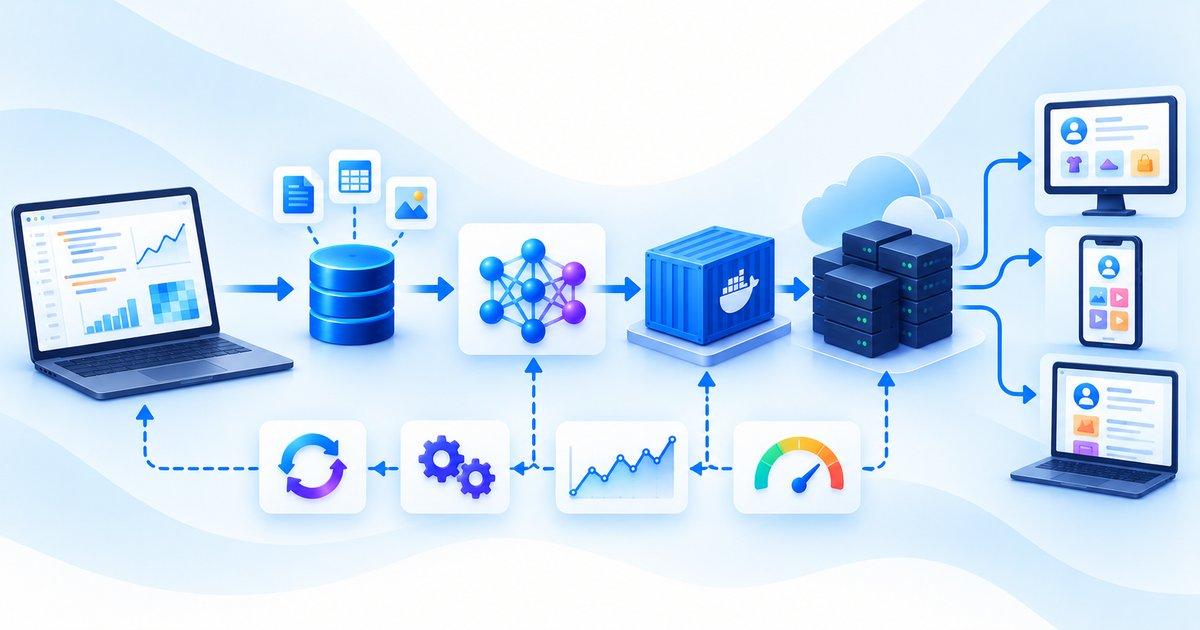
- data → model → evaluation → iteration → deployment → monitoring,
it signals engineering capability, not academic ML skill.
A hiring manager will choose a candidate with three end-to-end projects over someone with twenty Kaggle notebooks every single time.
Recruiters Look for Learning Velocity, Not Perfection
A portfolio isn’t a museum of polished work.
It’s a timeline of your evolution.
Hiring managers pay close attention to:
- How your projects change over time
- Whether your documentation becomes clearer
- Whether your modeling decisions become more principled
- Whether your feature engineering becomes more thoughtful
- Whether your evaluations become more nuanced
- Whether you start addressing real-world constraints
They’re asking:
“Is this person learning fast? Are they reflective? Are they improving meaningfully?”
Velocity matters more than static skill.
A candidate who shows steady progress is far more attractive than someone who tries to “fake seniority” with overly complex projects that offer no insight into decision-making.
Hiring Managers Look for Relevance to the Role, Not Randomness
Many candidates fill their portfolio with unrelated projects:
- one NLP model
- one vision classifier
- one time-series forecast
- one reinforcement learning experiment
- one random Kaggle competition
This makes you look unfocused.
Strong candidates curate.
They choose a theme.
They reveal a coherent professional identity.
If you want to be an LLM engineer:
Show NLP, retrieval, fine-tuning, evaluation projects.
If you want to work in recommendation systems:
Show ranking, embeddings, metric learning, cold-start reasoning.
If you want to work in ML infra:
Show pipelines, orchestration, monitoring, CI/CD, scalable training.
Your portfolio should feel like the early chapters of the career you’re heading toward.
Randomness signals insecurity.
Curation signals intention.
Technical Depth Is Important - But Only If It’s Motivated
Interviewers can tell when you added complexity just to look impressive.
And nothing turns them off faster.
Strong candidates don’t use:
- transformers when a baseline works
- neural nets for tiny datasets
- exotic loss functions without justification
- data augmentation without analysis
- hyperparameter sweeps that add nothing
Depth must have purpose.
Purpose must have explanation.
Explanation must reveal reasoning.
This is how hiring managers distinguish “ML hobbyists” from “ML engineers.”
Your Portfolio Should Reveal How You Think, Not What You Know
At its core, a strong ML portfolio is a psychological artifact.
It tells interviewers:
- how you break down problems
- how you make assumptions
- how you explore and prune ideas
- how you reason through tradeoffs
- how you communicate under complexity
- how you reflect
- how you grow
Knowledge is everywhere.
Reasoning is rare.
Your portfolio should demonstrate the latter.
SECTION 3 - How to Present Your ML Work Like a Senior Engineer: Storytelling, Structure, and Signal
You can build amazing projects, craft elegant notebooks, and push clean commits to GitHub, but if you don’t know how to present your work, the impact evaporates. Recruiters skim. Hiring managers evaluate fast. ML interviewers don’t have time to decipher messy narratives. In a market where thousands of engineers showcase similar projects, your ability to communicate what you built, and why it matters, becomes your differentiator.
And here’s the truth no one tells you:
Portfolios don’t fail because the projects are weak. They fail because the narrative is weak.
ML interviewers don’t remember the model you used.
They remember the story of how you solved the problem.
The strongest ML portfolios are those that demonstrate:
- clear reasoning
- thoughtful architecture
- decision-making under constraints
- problem ownership
- awareness of business or product context
- ability to measure results
- ability to communicate impact
This section goes deep into how top ML candidates’ structure and presents their work so that hiring teams immediately see senior-level thinking. This is not about flashy visuals or fancy GitHub themes, it’s about designing your portfolio for signal, not aesthetics.
You Don’t Present Code - You Present Thought Process
The mistake most engineers make is writing a portfolio like a lab report:
- data
- preprocessing
- modeling
- evaluation
- conclusion
This format hides the most important thing interviewers care about:
👉 your reasoning.
Strong ML candidates present their work the way senior engineers present design docs:
- What problem were you solving?
- Why does it matter?
- What constraints shaped the solution?
- What options did you consider?
- Why did you choose your final approach?
- What tradeoffs did you make?
- What measurable impact did you achieve?
This structure feels senior because it mirrors real production work.
You're not just showing what you built.
You’re showing how you think.
The Problem Framing Should Be Crisp Enough for a Product Manager
Weak candidates frame projects vaguely:
“Predict churn for a telecom company.”
“Classify toxic comments.”
“Recommend movies to users.”
Strong candidates frame with specificity:
“The challenge was to reduce monthly churn among prepaid users by identifying behavior patterns correlated with early attrition. The model aimed to give the retention team a 7-day lead time for interventions.”
Can you feel the difference?
One sounds like a Kaggle submission.
The other sounds like a real internal ML brief at a high-growth startup.
Your portfolio should consistently reflect this level of framing.
It signals you understand business context, not just algorithms.
This is the same framing technique ML interviewers love to see, as explored in:
➡️ Beyond the Model: How to Talk About Business Impact in ML Interviews
When your projects begin with context, interviewers see you as someone who understands product, not just code.
Show Your Decision-Making, Not Just Your Decisions
Most candidates list the model they used without explaining why:
- “I used random forest.”
- “I fine-tuned BERT.”
- “I trained an LSTM.”
This gives interviewers no insight into your thinking.
Senior candidates narrate their decision-making:
“I compared linear models, tree-based ensembles, and shallow neural networks. Tree models won early due to interpretability and strong performance on sparse tabular data, but they failed to capture temporal drift. This led me to engineer sequential features, which unlocked an extra 7% recall.”
This shows:
- exploration
- evaluation
- tradeoff awareness
- iteration
- critical thinking
Even if your model is simple, if your reasoning is mature, interviewers will be impressed.
Visuals Are Not Decoration - They Are Cognitive Amplifiers
Most ML portfolios misuse visuals. Either:
- they include too many charts
- or they include irrelevant ones
- or they use screenshots of notebooks with no explanation
- or they clutter GitHub READMEs with raw plots
Strong ML candidates use visuals as storytelling tools, especially:
- confusion matrices to illustrate errors
- lift charts to show business impact
- drift timelines
- feature importance narratives
- data distribution shifts
- architecture diagrams
- system flowcharts
Every visual should answer one of the following:
- What changed?
- Why does it matter?
- What decision did it lead to?
A good visual is not a picture.
A good visual is an argument.
Every Great Project Has a Measurable Impact Statement
ML interviewers don’t remember your ROC–AUC score.
They remember what changed because of your work.
Weak statement:
“My model achieved 89% accuracy.”
Strong statement:
“My model improved early fraud detection recall by 14%, reducing false negatives by almost 30%, which could save ~$1M annually if applied to a mid-size fintech company.”
Impact > metrics.
Metrics don’t make portfolios memorable.
Impact does.
Even if the project is hypothetical, quantify the outcome relative to a realistic environment.
Your GitHub Should Read Like a Professional Engineering Space
A messy GitHub is a silent rejection.
A polished GitHub signals engineering maturity.
Strong ML GitHubs have:
- clear folder structure
- modular code
- reproducible pipelines
- environment files
- high-quality READMEs
- separate notebooks for EDA, modeling, tuning, deployment
- diagrams and flowcharts
- links to demos or dashboards
Most importantly, each project’s README should feel like a mini design doc, not a notebook dump.
Interviewers should understand your entire solution in 2–3 minutes.
If they can’t, your portfolio isn’t working hard enough.
Tie It All Together With a Signature Style
Just like artists or writers, top ML candidates develop a recognizable portfolio style:
- a consistent storytelling voice
- a structured README format
- a signature visualization approach
- a standardized explanation pattern
- well-organized repositories
- consistent naming and versioning
- thoughtful project selection
This level of intentionality signals craftsmanship.
It tells interviewers you care about clarity, engineering culture, and communication.
That matters more than any single model you used.
Why Strong Presentation Multiplies the Value of Every Project
Think of your portfolio like an ML product:
- The code is the backend.
- The notebooks are the pipeline.
- The README is the API.
- Your reasoning is the UX.
A great product with poor UX loses users.
A great project with poor presentation loses interviews.
Your portfolio is not simply a showcase, it is a communication artifact designed to reveal your thinking.
If you craft it like a senior engineer, interviewers will treat you like one.
SECTION 4 - The Meta-Layer: How to Tell the Story of Your Portfolio So Recruiters Actually Remember You
Building a strong ML portfolio isn’t just about the projects you complete. It’s about how you communicate them. An ML portfolio is not a museum; it is a narrative tool, a carefully curated story about your evolution as an engineer, the problems you choose to solve, the skills you prioritize, and the way your thinking matures over time.
Most candidates misunderstand this.
They treat their portfolio like a storage warehouse:
every experiment, every notebook, every dataset, every half-finished idea gets dumped into GitHub or Kaggle.
But interviewers and recruiters aren’t browsing your repositories the way a data scientist browses papers. They are scanning for:
- coherence
- growth
- decision-making maturity
- evidence of real-world thinking
- clarity of purpose
- repeatable reasoning patterns
The story your portfolio tells matters just as much as the work inside it.
This is where the top 1% of ML candidates separates themselves. They don’t have more projects; they have better storytelling architecture. They make sure each project acts as a chapter in a narrative arc that reveals their evolution from beginner → practitioner → engineer → problem-solver.
Let’s break down how to construct a story that stays in the mind of interviewers long after they’ve looked at your profile.
1. Your Portfolio Should Begin With a “Why” - Not a List of Repositories
When someone lands on your GitHub README or portfolio homepage, they should immediately understand:
- what problems excite you
- what domains you care about
- what direction your ML career is moving
- how you think about impact
Most candidates begin with:
“Hi, I’m ____ and here are my projects.”
Top candidates begin with:
“I build ML systems that solve problems in personalization, natural language understanding, and real-time decisioning.”
This instantly elevates your profile because it frames your work with intentionality.
You stop looking like a hobbyist and start looking like an engineer.
Your “why” also acts as a thematic filter for your portfolio, it tells the reviewer how to interpret every project that follows.
2. Convert Every Project Into a Mini Case Study
A repository with code is not a project.
A dataset with a notebook is not a project.
A model with metrics is not a project.
A recruiter or hiring manager cares about story, not scripts.
Every project should follow a case-study structure:
- Problem: The real-world issue you were addressing
- Why It Matters: The domain significance
- Approach: Your reasoning, not just the algorithm
- Design Decisions: The constraints you handled
- Evaluation: Why you chose specific metrics
- Tradeoffs: What you accepted, what you sacrificed
- What You Learned: The maturity signal
This is what transforms your work from “I built this” into “I understood this deeply.”
Candidates who write project case studies position themselves as thoughtful ML engineers, not model operators.
This case-study thinking is the same principle used in interview storytelling, explored in:
➡️ How to Present ML Case Studies During Interviews: A Step-by-Step Framework
3. Show the Evolution of Your Thinking Across Projects
One of the biggest mistakes candidates make is treating projects as isolated events.
Interviewers don’t want to see isolated events.
They want to see progression, the intellectual evolution of your engineering judgment.
For example:
- In your early projects, you may emphasize exploration and model comparison.
- In mid-stage projects, you emphasize feature engineering, baselines, and improvement curves.
- In later projects, you emphasize tradeoffs, deployment constraints, monitoring, or scaling.
This progression shows that you are not just learning ML, you are growing into an ML engineer who thinks about systems, not just models.
Narrative progression is compelling because it gives recruiters a sense of trajectory.
People hire trajectories, not static snapshots.
4. Connect Your Projects to Real-World Contexts
Your portfolio becomes significantly stronger when each project feels grounded in real-world constraints.
Instead of presenting a sentiment classifier, present:
“A real-time sentiment classifier optimized for 30ms inference latency.”
Instead of presenting a recommender system, present:
“A cold-start-aware recommendation algorithm designed for content diversity.”
Instead of presenting a fraud-detection model, present:
“A high-recall fraud detector with precision constraints for financial automation teams.”
This reframing demonstrates a critical signal interviewers value above all:
practical mental models of ML deployment.
Real-world framing shows that you understand ML in production, not just in notebooks.
5. Use Visuals to Communicate Complexity Without Overwhelming Reviewers
GitHub READMEs with only paragraphs create fatigue.
Kaggle notebooks with only code create confusion.
Top portfolios blend:
- conceptual diagrams
- workflow maps
- architecture sketches
- metric dashboards
- example outputs
- dataset visuals
Visuals help interviewers grasp your reasoning at a glance.
They also help non-technical recruiters understand your impact.
The visuals don’t need to be artistic, they need to be spatially informative.
A diagram of your pipeline is often more impactful than five paragraphs of description.
6. Add a “How This Project Changed Me as an Engineer” Section
This is where your portfolio becomes unforgettable.
Most candidates list:
- “I learned XGBoost.”
- “I implemented PCA.”
- “I tuned hyperparameters.”
Forgettable.
Top candidates write:
- “This project taught me how to handle ambiguous labeling.”
- “This taught me the cost of ignoring evaluation drift.”
- “This forced me to simplify my architecture rather than overfit complexity.”
- “This made me appreciate tradeoff decisions early in the pipeline.”
This is how you show maturity, a recruiter’s favorite signal.
Interviewers don’t remember your model.
They remember your transformation.
7. End Your Portfolio With a Vision Statement
A strong portfolio ends with direction:
- “Here’s where I want to push my ML skills next.”
- “Here are the domains I want to explore.”
- “Here’s how I want to grow as an engineer.”
It’s memorable because it’s forward-looking.
It tells recruiters you are not static, you are evolving, ambitious, intentional.
People hire potential.
They hire momentum.
They hire vision.
Your portfolio should radiate all three.
Conclusion - Your ML Portfolio Is Not a Showcase. It’s a Signal.
Most ML candidates think a portfolio is a gallery, a place to display models, notebooks, or side projects that demonstrate effort. But hiring managers, especially in competitive US ML/AI markets, don’t evaluate your portfolio as a scrapbook. They evaluate it as a signal system:
- Does this engineer understand real-world ML?
- Can they identify business value?
- Can they frame problems rigorously?
- Do they know how to design systems and pipelines?
- Can they think beyond the model?
- Do they understand deployment, monitoring, reliability, impact?
Your portfolio is not a list.
It’s a story of how your mind works.
Strong ML portfolios are not built by accident, they’re engineered. They combine depth (2–3 excellent, end-to-end projects) with breadth (some supporting experiments or applied work). They demonstrate your ability to move from raw problem → structured framing → data → modeling → tradeoffs → evaluation → deployment → iteration → real-world constraints.
What differentiates a top-tier portfolio from a mediocre one has nothing to do with model complexity. Recruiters don’t care if you used XGBoost or a transformer. They care whether you understand why you used it, what constraints shaped your decision, what tradeoffs you considered, and how you reasoned when the problem became messy.
The best ML portfolios feel alive. They show evolution, curiosity, and engineering. They show that you’re not just copying tutorials, you’re designing systems. They show that you’re not just running notebooks, you’re building products. They show that you’re not just practicing ML, you’re learning to think like an ML engineer.
And here's the secret:
Your portfolio becomes your most powerful interview tool.
Instead of relying solely on hypothetical questions, you can speak from experience. You can walk interviewers through your decisions, constraints, failures, and improvements. You can showcase judgment, not just knowledge. You can demonstrate ownership, not just participation.
In a world where thousands of engineers list the same skills and the same courses, your portfolio is where differentiation finally happens. It is your leverage. It is your artifacts of proof. It is your intellectual fingerprint.
If you build a portfolio that reflects not just what you learned but how you think, you don’t just impress interviewers, you become unforgettable.
FAQs
1. How many projects should a strong ML portfolio have?
Quality beats quantity.
A portfolio with 2–3 excellent end-to-end projects outperforms one with 10 shallow ones. The goal is to show depth of reasoning, not volume of output.
2. Should projects be unique, or can I adapt existing datasets/tutorials?
You can start with public datasets, but the differentiation must come from your framing:
new constraints, new evaluation strategies, new architectures, business impact estimation, or deployment.
If you simply reproduce a Kaggle notebook, your portfolio blends into the crowd.
3. How important is end-to-end coverage vs. modeling depth?
End-to-end execution wins every time.
Recruiters want engineers who understand:
- data collection
- preprocessing
- modeling
- evaluation
- deployment
- monitoring
Not people who jump straight to training a model.
4. Do recruiters care about the UI or frontend around ML projects?
Not usually.
A simple Streamlit, Gradio, or FastAPI interface is enough.
What they do care about is whether the system architecture is clear and the ML logic is sound.
5. How valuable is Kaggle for ML portfolios?
Kaggle is excellent for:
- demonstrating experimentation
- working with real datasets
- showcasing competitive modeling
- learning reproducibility
- practicing feature engineering
But top companies know Kaggle ≠ real-world ML.
You still need end-to-end projects that simulate production.
6. Should I include projects that failed?
Yes, if you frame them well.
A failed project shows:
- experimentation
- iteration
- learning
- humility
- scientific thinking
Failure that leads to insight is extremely attractive to interviewers.
7. What makes a GitHub repository “stand out”?
Great repos have:
- a clean, narrative-style README
- system diagrams
- clear folder structure
- environment + reproducibility instructions
- evaluation details
- tradeoff analysis
- deployment steps
Think:
“Can a stranger understand and run this in 15 minutes?”
8. Do hiring managers read your code?
Some do, some don’t.
But all of them scan:
- README
- folder structure
- commit quality
- experiment logs
- diagrams
- design decisions
Code readability matters more than model cleverness.
9. Should I use cutting-edge models or stick to fundamentals?
Both have value.
Cutting-edge (LLMs, diffusion models, transformers):
→ Signals curiosity and ability to work with modern tooling.
Fundamentals (tree models, regression, classical ML):
→ Signals strong reasoning and practical engineering.
The most impressive portfolios show understanding of both worlds.
10. Should I include notebooks or convert everything to scripts?
Include both:
- Notebooks → for exploration and EDA
- Scripts → for training, evaluation, reproducibility, deployment
This combination mirrors real ML workflows.
11. How important is cloud deployment?
Increasingly essential.
Even a simple deployment on:
- AWS Lambda
- Google Cloud Run
- Azure ML
- Hugging Face Spaces
- Render
- Railway
…shows you understand how ML systems operate beyond a notebook.
12. Should I include business impact calculations?
Absolutely.
Showing expected business value (even approximate) demonstrates maturity:
“Increasing recall by 3% in this churn model could save $X per quarter.”
Interviewers love candidates who think beyond metrics.
13. How do I make my portfolio memorable?
By telling a story:
- Why you built the project
- What problem motivated you
- What tradeoffs you navigated
- What challenges you overcame
- What insights you discovered
People remember stories, not models.
14. How often should I update my ML portfolio?
Every 3–6 months.
A stale portfolio sends a signal that you’ve stopped learning or iterating.
Active portfolios → active minds.
15. What’s the biggest mistake candidates make in ML portfolios?
They build projects for the algorithm, not the problem.
Strong portfolios show thinking, not just implementation:
- Why this model?
- Why this metric?
- Why this framing?
- Why this deployment path?
If you can answer “why” consistently, interviewers will trust your judgment.