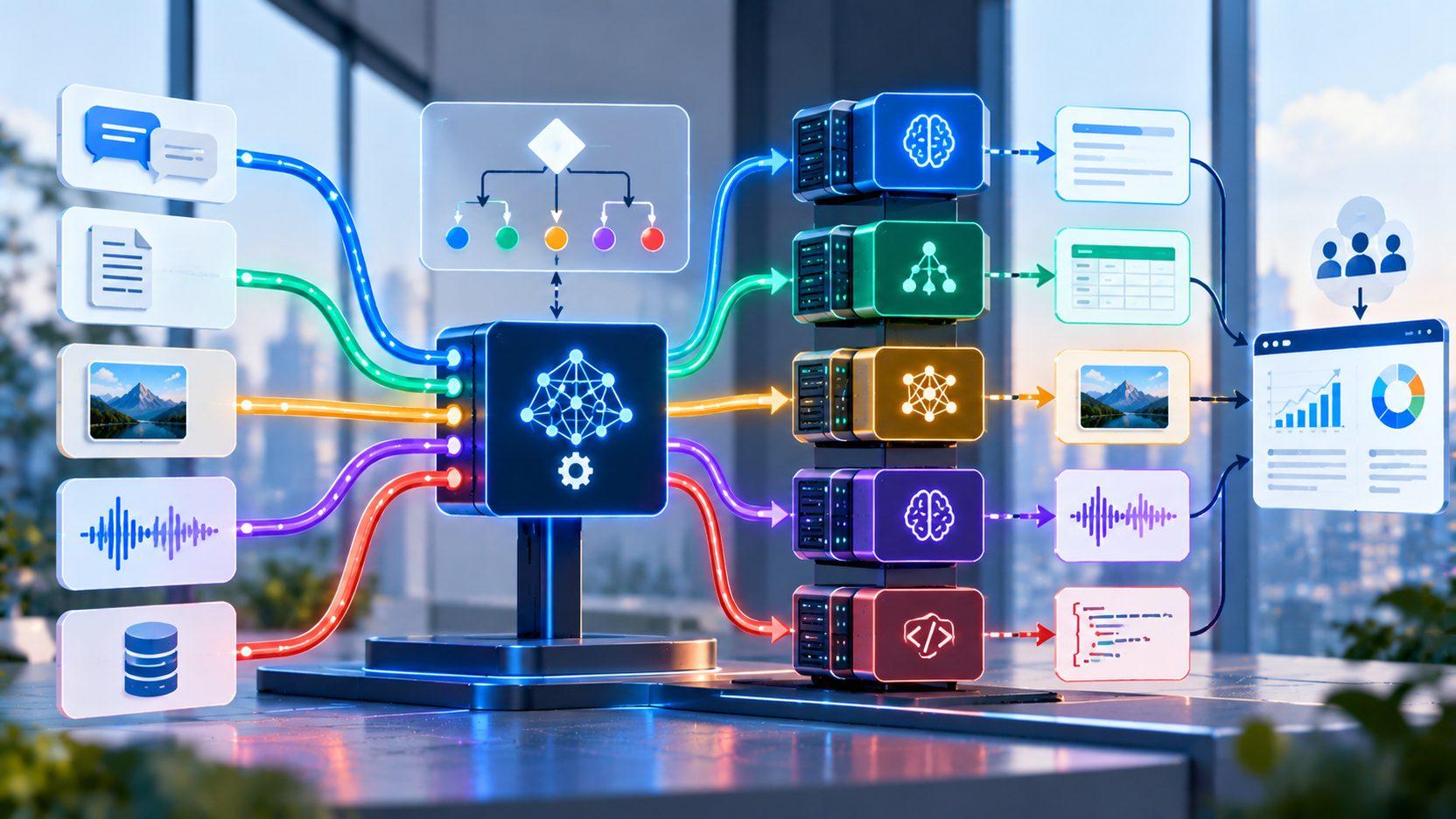

Section 1: Hiring Managers Want Engineers Who Can Build Production AI Systems
AI Engineering Has Expanded Beyond Model Development
One of the biggest changes in AI hiring is the evolution of the AI engineer's role itself.
Several years ago, many AI interviews focused heavily on supervised learning algorithms, model evaluation metrics, feature engineering, and statistical reasoning. Candidates were often assessed on how well they could train predictive models and improve their accuracy.
Today's enterprise AI environments are much more complex.
Organizations deploy AI assistants, intelligent search systems, autonomous agents, recommendation engines, enterprise copilots, and workflow automation platforms that interact with thousands of users every day.
Building these applications requires much more than machine learning expertise.
AI engineers now design retrieval systems, manage vector databases, integrate APIs, orchestrate multiple AI services, optimize cloud infrastructure, implement monitoring, secure enterprise data, and continuously improve production performance.
Hiring managers therefore evaluate candidates based on their ability to engineer complete AI systems rather than simply develop machine learning models.
System Design Has Become a Core Interview Skill
Modern AI interviews increasingly include architecture and system design discussions.
Rather than asking only how a model works, interviewers often ask candidates how they would build an enterprise AI application from end to end.
Candidates may be asked to design an AI-powered customer support assistant, an enterprise search platform, an intelligent document analysis system, or an autonomous AI agent.
These discussions reveal far more than technical knowledge.
Hiring managers evaluate how candidates organize information, identify system components, make architectural trade-offs, consider scalability, plan for security, and address operational reliability.
Strong candidates explain not only what they would build but also why specific architectural decisions support business objectives.
System design has therefore become one of the strongest indicators of production engineering readiness.
Business Thinking Matters as Much as Technical Knowledge
Another significant shift in hiring is the increasing importance of business impact.
Organizations invest in AI because they expect measurable improvements.
Reducing operational costs.
Improving customer satisfaction.
Increasing employee productivity.
Accelerating software development.
Enhancing decision-making.
Generating new business opportunities.
Hiring managers therefore seek engineers who understand how technical decisions influence these outcomes.
During interviews, candidates who explain how their AI systems improved operational efficiency, reduced latency, increased automation, or simplified employee workflows often distinguish themselves from candidates who discuss technical implementation alone.
The ability to connect engineering work with measurable business value demonstrates maturity and practical experience.
The growing importance of discussing business outcomes during AI interviews is explored in "Beyond the Model: How to Talk About Business Impact in ML Interviews," which explains how hiring managers increasingly evaluate candidates based on the real-world value their engineering work creates rather than technical implementation alone.
This mindset aligns closely with how enterprise organizations evaluate AI investments.
Practical Experience Is Becoming More Valuable Than Certifications
Hiring managers increasingly recognize that AI engineering is learned through building systems rather than memorizing concepts.
While certifications and online courses demonstrate initiative, they rarely substitute for hands-on experience.
Candidates who have built production-style AI applications often stand out because they can discuss real engineering challenges.
They explain deployment decisions.
Describe infrastructure trade-offs.
Discuss monitoring strategies.
Reflect on failures and improvements.
Demonstrate lessons learned from practical implementation.
A portfolio containing enterprise-style projects, such as AI assistants using Retrieval-Augmented Generation, intelligent search systems, AI agents, cloud deployments, or production monitoring, provides concrete evidence that a candidate understands modern AI engineering beyond theory.
As AI hiring continues evolving, practical engineering experience is becoming one of the strongest predictors of interview success.
Key Takeaway
Hiring managers in 2026 are looking for engineers who can design, deploy, and operate complete AI systems rather than simply train machine learning models. Production engineering, system design, business understanding, and hands-on project experience have become essential differentiators in the hiring process. Candidates who demonstrate practical expertise alongside strong technical fundamentals are best positioned to succeed in the modern AI job market.
Section 2: The Technical Skills Hiring Managers Prioritize in 2026
Production AI Engineering Has Become the Most Important Technical Skill
One of the biggest changes in AI hiring is the growing emphasis on production engineering.
Only a few years ago, many interviews focused primarily on algorithms, model architecture, optimization techniques, and mathematical concepts. While these topics remain relevant, hiring managers now place much greater importance on an engineer's ability to deploy and maintain AI systems in production.
Organizations are no longer investing in AI prototypes alone.
They are deploying enterprise assistants that support thousands of employees, AI-powered customer service platforms that process millions of conversations, intelligent document analysis systems, autonomous agents, recommendation engines, and workflow automation platforms that operate continuously.
These applications introduce engineering challenges that extend well beyond machine learning.
Candidates are expected to understand deployment pipelines, inference optimization, API integration, cloud infrastructure, security, monitoring, scaling, fault tolerance, and operational reliability.
For example, an interviewer may ask how an AI application should recover from infrastructure failures, how to reduce inference latency, how to monitor response quality after deployment, or how to manage increasing traffic without significantly increasing operational costs.
These questions evaluate practical engineering ability rather than theoretical knowledge.
Hiring managers increasingly believe that organizations gain greater value from engineers who can build reliable production systems than from candidates who only understand model development.
As enterprise AI adoption accelerates, production engineering has become one of the strongest indicators of long-term success.
System Design Interviews Are Becoming Increasingly Sophisticated
AI system design has evolved considerably over the past few years.
Earlier interviews often focused on building recommendation engines or designing traditional machine learning pipelines.
In 2026, hiring managers expect candidates to think much more broadly.
Interview questions increasingly involve designing complete AI ecosystems.
Candidates may be asked to architect enterprise knowledge assistants, AI-powered coding copilots, autonomous customer support platforms, intelligent document processing systems, or AI agents capable of coordinating multiple business workflows.
These discussions extend far beyond selecting a language model.
Interviewers evaluate how candidates structure retrieval pipelines, integrate enterprise APIs, manage long-term memory, orchestrate multiple AI services, implement observability, secure sensitive information, optimize infrastructure costs, and ensure system scalability.
Strong candidates demonstrate structured thinking throughout the discussion.
They identify functional requirements.
Clarify assumptions.
Evaluate architectural trade-offs.
Explain why certain technologies are appropriate.
Consider operational challenges before they become production problems.
System design interviews increasingly reflect the complexity of real enterprise AI environments rather than isolated technical exercises.
Employers Expect Strong Knowledge of Modern AI Infrastructure
The rapid growth of generative AI has significantly expanded the technologies AI engineers are expected to understand.
Knowledge of language models alone is no longer enough.
Hiring managers increasingly evaluate whether candidates understand the infrastructure surrounding those models.
This includes Retrieval-Augmented Generation, semantic search, vector databases, embedding models, inference servers, cloud-native deployment, containerization, orchestration platforms, model serving, observability frameworks, AI security, and enterprise integration.
Candidates are not necessarily expected to be experts in every technology.
However, they should understand how these components interact to create reliable production systems.
For example, an interviewer may ask how an enterprise AI assistant retrieves current organizational knowledge, why vector databases improve semantic retrieval, how inference services scale under heavy workloads, or how monitoring platforms identify declining response quality.
These discussions demonstrate whether candidates understand complete AI architectures rather than isolated technologies.
The growing importance of mastering production AI infrastructure is explored in "Context Engineering: The Skill Every AI Engineer Needs in 2026," which explains how retrieval systems, memory architectures, orchestration frameworks, enterprise knowledge integration, and intelligent context assembly have become essential components of modern AI engineering.
As enterprise AI systems become increasingly sophisticated, infrastructure knowledge is becoming one of the most valuable technical differentiators during interviews.
Hiring Managers Look for Engineers Who Can Learn New Technologies Quickly
Perhaps the most important technical quality hiring managers evaluate is adaptability.
Artificial intelligence evolves faster than almost any other area of software engineering.
New foundation models appear regularly.
Inference frameworks improve continuously.
Deployment platforms evolve.
AI agent architectures mature rapidly.
Entire categories of development tools emerge within months.
Organizations recognize that no candidate can know every technology.
Instead, they look for engineers who demonstrate an ability to learn efficiently.
Candidates who explain how they explored unfamiliar frameworks, built personal projects, solved practical engineering problems, or adapted to changing technologies often leave a stronger impression than candidates who simply list numerous technical skills.
This learning mindset is particularly valuable because enterprise AI environments continue evolving after engineers join an organization.
Successful AI professionals regularly evaluate new tools, improve deployment practices, optimize architectures, and refine production systems as technology advances.
Hiring managers therefore seek engineers who are not only technically capable today but also likely to remain effective as the AI industry continues evolving throughout the coming years.
Key Takeaway
Hiring managers in 2026 prioritize engineers who can build production-ready AI systems, design scalable enterprise architectures, understand modern AI infrastructure, and adapt quickly to emerging technologies. While machine learning fundamentals remain important, employers increasingly differentiate candidates based on their ability to deploy reliable AI applications, solve real-world engineering challenges, and continuously evolve alongside one of the fastest-changing fields in technology.
Section 3: The Professional Qualities That Separate Top AI Engineering Candidates
Communication Skills Have Become a Major Hiring Factor
One of the biggest misconceptions among aspiring AI engineers is that technical expertise alone determines hiring decisions.
While strong engineering skills remain essential, hiring managers increasingly evaluate how effectively candidates communicate their ideas.
Modern AI projects involve collaboration across multiple teams.
AI engineers work with product managers, software engineers, data engineers, cloud architects, cybersecurity teams, legal departments, UX designers, and business stakeholders. They are expected to explain technical concepts to people with different levels of technical knowledge and justify engineering decisions in terms of business objectives.
Interviewers pay close attention to how candidates organize their thoughts during technical discussions.
They look for structured explanations rather than fragmented answers.
Candidates who clearly explain assumptions, evaluate alternative solutions, discuss architectural trade-offs, and communicate their reasoning often perform better than candidates who simply provide technically correct answers.
Communication also becomes particularly important during AI system design interviews.
Hiring managers want to understand how candidates think.
Rather than rushing toward a solution, strong candidates ask clarifying questions, define system requirements, identify constraints, explain design decisions, and discuss how the system might evolve as business requirements change.
This collaborative approach closely resembles real engineering work.
Organizations are not hiring engineers to solve problems in isolation.
They are hiring professionals who can collaborate effectively across the business while helping teams build reliable AI products.
Hiring Managers Want Evidence of Real-World Problem Solving
The most impressive candidates rarely rely on theoretical knowledge alone.
Instead, they demonstrate how they have applied engineering principles to solve practical problems.
During interviews, hiring managers frequently ask candidates to describe previous projects, technical challenges, system failures, or situations where they improved an existing solution.
These discussions help interviewers evaluate engineering maturity.
For example, a candidate who explains how they reduced inference latency by redesigning a retrieval pipeline demonstrates much deeper practical understanding than someone who only describes how Retrieval-Augmented Generation works conceptually.
Similarly, discussing infrastructure bottlenecks, monitoring strategies, deployment challenges, or scaling decisions provides insight into real production experience.
Interviewers are also interested in how candidates approach uncertainty.
Production engineering rarely involves perfect information.
Requirements evolve.
Business priorities change.
Unexpected failures occur.
Successful engineers adapt while maintaining system reliability.
Candidates who can describe how they investigated problems, evaluated multiple approaches, collaborated with teammates, and iterated toward better solutions demonstrate qualities that organizations value highly.
The ability to solve unfamiliar engineering challenges often matters more than recalling textbook definitions.
Ownership and Accountability Are Increasingly Important
As AI systems become integrated into mission-critical business operations, organizations expect engineers to take ownership of their work.
Ownership extends far beyond writing code.
It includes understanding how systems behave after deployment, monitoring performance, responding to incidents, improving reliability, documenting architectural decisions, and continuously optimizing production environments.
Hiring managers therefore look for candidates who think beyond implementation.
Strong candidates discuss how they measured success, monitored applications after release, gathered user feedback, addressed operational issues, and improved systems over time.
This demonstrates a production mindset.
Rather than considering deployment the end of a project, they view it as the beginning of continuous improvement.
The growing importance of ownership in AI engineering is explored in "The Hidden Metrics: How Interviewers Evaluate ML Thinking, Not Just Code," which explains how interviewers increasingly assess structured problem-solving, engineering judgment, ownership, collaboration, and long-term thinking in addition to technical ability.
Organizations increasingly recognize that engineers who take ownership build more reliable products, collaborate more effectively, and contribute more significantly to long-term business success.
Adaptability and Curiosity Define Long-Term Success
Artificial intelligence is changing so rapidly that even experienced engineers cannot rely solely on existing knowledge.
Hiring managers understand this reality.
Rather than expecting candidates to know every framework or model, they look for evidence of curiosity and continuous learning.
Candidates who discuss experimenting with new AI tools, building side projects, contributing to open-source initiatives, reading technical research, or exploring emerging architectures demonstrate that they can adapt as the industry evolves.
This adaptability provides confidence that they will continue growing after joining the organization.
Hiring managers also appreciate intellectual humility.
Strong candidates openly acknowledge trade-offs, discuss lessons learned from failed projects, explain how they improved over time, and demonstrate a willingness to learn from teammates.
These qualities often distinguish future technical leaders from candidates focused solely on demonstrating expertise.
As AI technologies continue evolving throughout the coming decade, organizations increasingly prioritize engineers who can evolve alongside them rather than those who simply possess today's technical knowledge.
Key Takeaway
In 2026, hiring managers evaluate far more than technical expertise. Communication, structured problem-solving, ownership, collaboration, adaptability, and continuous learning have become essential qualities for AI engineers. Candidates who combine strong engineering skills with business awareness, practical experience, and a growth mindset consistently stand out because they demonstrate the ability to succeed not only during interviews but also in real-world enterprise AI environments.
Section 4: How to Prepare for AI Engineering Interviews in 2026
Build Projects That Reflect Real Enterprise AI Systems
One of the most effective ways to prepare for AI engineering interviews in 2026 is to build projects that resemble the systems companies are deploying today.
Hiring managers have become increasingly familiar with tutorial-based projects. Simple sentiment analysis models, image classifiers trained on standard datasets, or basic chatbot demonstrations no longer provide strong evidence of production engineering skills.
Instead, employers want to see engineers who understand how modern AI applications operate in real business environments.
A strong portfolio should demonstrate more than model development.
Candidates should build applications that retrieve enterprise knowledge, integrate external APIs, manage user authentication, deploy to cloud infrastructure, monitor production performance, and handle real-world engineering challenges such as latency, scalability, reliability, and security.
For example, an AI-powered customer support assistant can demonstrate Retrieval-Augmented Generation, semantic search, long-term memory, vector databases, cloud deployment, and observability within a single project.
Similarly, an enterprise document analysis platform can showcase intelligent retrieval, workflow automation, API integration, and secure data access.
Projects like these allow candidates to discuss architecture, design decisions, deployment strategies, operational trade-offs, and business impact during interviews.
Hiring managers consistently value candidates who can explain why they made specific engineering decisions rather than simply demonstrating that an application works.
A production-style portfolio provides tangible evidence that a candidate is prepared for modern AI engineering roles.
Practice Explaining Engineering Decisions, Not Just Writing Code
Strong interview performance depends on much more than solving technical problems.
Hiring managers want to understand how candidates think.
This means engineers should practice explaining their reasoning as they solve problems.
When discussing system design, candidates should clarify assumptions before proposing solutions.
They should explain why one architecture is preferable to another.
They should identify trade-offs between scalability, latency, infrastructure cost, security, maintainability, and development complexity.
Similarly, when discussing previous projects, candidates should focus on engineering decisions rather than implementation details alone.
For example, instead of saying that a vector database was used, candidates should explain why semantic retrieval was necessary, how documents were indexed, how retrieval quality was evaluated, and what improvements resulted from the chosen architecture.
These conversations demonstrate engineering maturity.
Interviewers often remember structured explanations more clearly than isolated technical facts.
The ability to communicate technical reasoning effectively has become one of the strongest differentiators among experienced AI engineers.
Demonstrate Business Thinking Alongside Technical Expertise
Modern AI engineers are expected to contribute to business success as well as technical execution.
As a result, hiring managers increasingly evaluate whether candidates understand the relationship between engineering decisions and organizational outcomes.
Candidates should therefore prepare examples that demonstrate measurable impact.
Rather than describing projects solely in technical terms, they should explain how their work improved productivity, reduced operational costs, enhanced customer experiences, increased system reliability, or accelerated software delivery.
For example, a candidate might describe how optimizing an inference pipeline reduced latency by a significant margin, allowing customer support agents to resolve requests more efficiently.
Another candidate might explain how implementing Retrieval-Augmented Generation improved answer accuracy while reducing reliance on manual documentation searches.
These examples illustrate business value rather than technical implementation alone.
The importance of demonstrating measurable engineering impact during interviews is explored in "Quantifying Impact: How to Talk About Results in ML Interviews Like a Pro," which explains how successful candidates use metrics, business outcomes, and structured storytelling to communicate the value of their technical contributions.
Hiring managers consistently favor engineers who understand not only how systems work but also why those systems matter to the organization.
Prepare for a Career, Not Just an Interview
Perhaps the most important expectation hiring managers have in 2026 is finding engineers who will continue growing after they are hired.
Artificial intelligence is evolving rapidly.
New foundation models continue emerging.
Enterprise architectures are becoming more sophisticated.
AI agents are transforming software development.
Infrastructure platforms continue improving.
No candidate is expected to know everything.
Instead, organizations increasingly hire engineers who demonstrate curiosity, adaptability, and a commitment to continuous learning.
Candidates who regularly build new projects, experiment with emerging technologies, contribute to technical communities, and refine their engineering skills often leave a stronger long-term impression than candidates who focus exclusively on interview preparation.
Ultimately, companies are hiring future colleagues rather than temporary interview performers.
They want professionals capable of adapting as AI evolves over the coming years.
Preparing with this long-term mindset benefits candidates far beyond a single interview process.
It creates the habits that support sustained career growth in one of the fastest-changing fields in technology.
Key Takeaway
Preparing for AI engineering interviews in 2026 requires far more than mastering technical questions. Candidates should build production-style AI projects, practice explaining engineering decisions, demonstrate measurable business impact, and develop a mindset of continuous learning. Hiring managers are increasingly looking for professionals who can design scalable AI systems, communicate effectively, and grow alongside rapidly evolving technologies. Engineers who prepare for long-term success rather than short-term interviews will be best positioned to build rewarding careers in artificial intelligence.
Conclusion
The expectations for AI engineers are changing faster than ever before.
As artificial intelligence becomes deeply integrated into enterprise software, business operations, and customer experiences, organizations are no longer looking for engineers who can simply train machine learning models. They are hiring professionals who can design, build, deploy, monitor, and continuously improve production AI systems that create measurable business value.
This shift reflects the growing maturity of the AI industry.
A few years ago, demonstrating knowledge of machine learning algorithms and deep learning frameworks was often enough to secure interviews. In 2026, hiring managers expect considerably more. Candidates are evaluated on their understanding of AI system architecture, Retrieval-Augmented Generation (RAG), AI agents, vector databases, cloud-native infrastructure, model deployment, observability, enterprise integration, security, and production reliability.
Equally important is the ability to think like an engineer rather than simply an AI practitioner.
Hiring managers increasingly look for candidates who understand system design, evaluate technical trade-offs, optimize infrastructure, solve complex engineering problems, and communicate their reasoning clearly. These qualities demonstrate that an engineer can contribute effectively to real production environments where technical decisions have direct business consequences.
Business understanding has also become a defining characteristic of successful AI engineers.
Organizations invest in AI to improve productivity, reduce operational costs, enhance customer experiences, accelerate innovation, and create competitive advantages. Engineers who understand these objectives, and can explain how their technical work supports them, consistently stand out during interviews and throughout their careers.
Another major trend shaping AI hiring is the growing importance of continuous learning.
Artificial intelligence evolves too quickly for any engineer to rely solely on existing knowledge. New models, frameworks, deployment platforms, orchestration systems, and enterprise architectures continue emerging at an unprecedented pace. Hiring managers therefore value curiosity, adaptability, and the willingness to learn almost as much as current technical expertise.
The strongest candidates demonstrate this mindset through production-style projects, open-source contributions, technical writing, practical experimentation, and a clear record of professional growth.
Looking ahead, AI interviews will continue evolving alongside the technology itself.
System design discussions will become more sophisticated.
Production engineering scenarios will become increasingly common.
Behavioral interviews will focus more heavily on collaboration, ownership, communication, and business impact.
Candidates who prepare only for coding interviews may find themselves unprepared for the broader expectations of modern AI engineering roles.
Ultimately, success in AI hiring is no longer determined by technical knowledge alone.
It is determined by an engineer's ability to combine software engineering, machine learning, cloud infrastructure, systems thinking, communication, and business understanding into complete, production-ready solutions.
The engineers who develop this combination of skills will not only perform well in interviews but will also remain highly valuable as artificial intelligence continues reshaping the technology industry throughout the coming decade.
Frequently Asked Questions
1. What are hiring managers looking for in AI engineers in 2026?
Hiring managers are looking for engineers who can build production-ready AI systems. This includes expertise in machine learning, Large Language Models (LLMs), Retrieval-Augmented Generation (RAG), AI agents, cloud infrastructure, system design, deployment, monitoring, security, and business problem-solving.
2. Are machine learning fundamentals still important?
Yes. Concepts such as supervised learning, model evaluation, optimization, probability, and statistics remain essential. However, employers now expect candidates to combine these fundamentals with software engineering and production deployment skills.
3. How important is system design in AI interviews?
System design has become one of the most important interview components. Candidates are increasingly asked to design enterprise AI assistants, intelligent search systems, AI agents, recommendation platforms, and scalable AI architectures rather than discussing models alone.
4. What production AI skills should candidates learn?
Candidates should understand model serving, cloud deployment, APIs, vector databases, Retrieval-Augmented Generation (RAG), AI observability, inference optimization, Kubernetes, Docker, authentication, monitoring, and enterprise integrations.
5. Do hiring managers expect experience with Large Language Models?
Yes. Many AI engineering roles now expect familiarity with LLM applications, prompt design, context management, Retrieval-Augmented Generation, embeddings, evaluation techniques, and AI agents, especially for enterprise AI positions.
6. How important are personal AI projects?
Personal projects are extremely valuable because they demonstrate practical engineering skills. Hiring managers prefer production-style applications that solve real problems over simple tutorial-based implementations.
7. What soft skills matter most for AI engineers?
Communication, structured problem-solving, collaboration, ownership, adaptability, curiosity, leadership potential, and the ability to explain technical concepts clearly are among the most important professional qualities employers evaluate.
8. Should candidates focus only on coding interviews?
No. While coding remains important, candidates should also prepare for AI system design, architecture discussions, behavioral interviews, business case studies, production troubleshooting, and technical communication exercises.
9. How important is cloud computing for AI engineers?
Cloud computing is essential because most enterprise AI systems run on cloud-native infrastructure. Familiarity with AWS, Azure, Google Cloud, containers, Kubernetes, CI/CD, and distributed systems is highly valuable.
10. What role does business understanding play during interviews?
Hiring managers increasingly evaluate whether candidates understand how AI creates business value. Engineers should be able to explain how their work improves productivity, reduces costs, enhances customer experiences, or supports organizational goals.
11. How can candidates stand out in competitive AI interviews?
Candidates stand out by building production-quality AI projects, explaining architectural decisions clearly, demonstrating measurable business impact, showcasing continuous learning, and communicating confidently throughout technical discussions.
12. How important is adaptability in AI careers?
Adaptability is one of the most important qualities employers seek because AI technologies evolve rapidly. Engineers who continuously learn new tools, frameworks, and architectural patterns remain valuable even as the industry changes.
13. What interview mistakes do hiring managers commonly notice?
Common mistakes include focusing only on model accuracy, neglecting production considerations, failing to explain technical decisions, ignoring scalability and security, lacking business context, and giving unstructured answers during system design discussions.
14. Will AI engineering interviews continue changing after 2026?
Yes. As enterprise AI becomes more sophisticated, interviews are expected to place even greater emphasis on production engineering, AI agents, enterprise architecture, reliability, governance, observability, and cross-functional collaboration.
15. What is the biggest expectation hiring managers have for AI engineers in 2026?
The biggest expectation is that candidates can think beyond individual models and engineer complete AI solutions. Hiring managers want professionals who combine machine learning expertise, software engineering, cloud infrastructure, systems design, communication, and business understanding to build reliable, scalable, and production-ready AI applications that solve real organizational problems.