
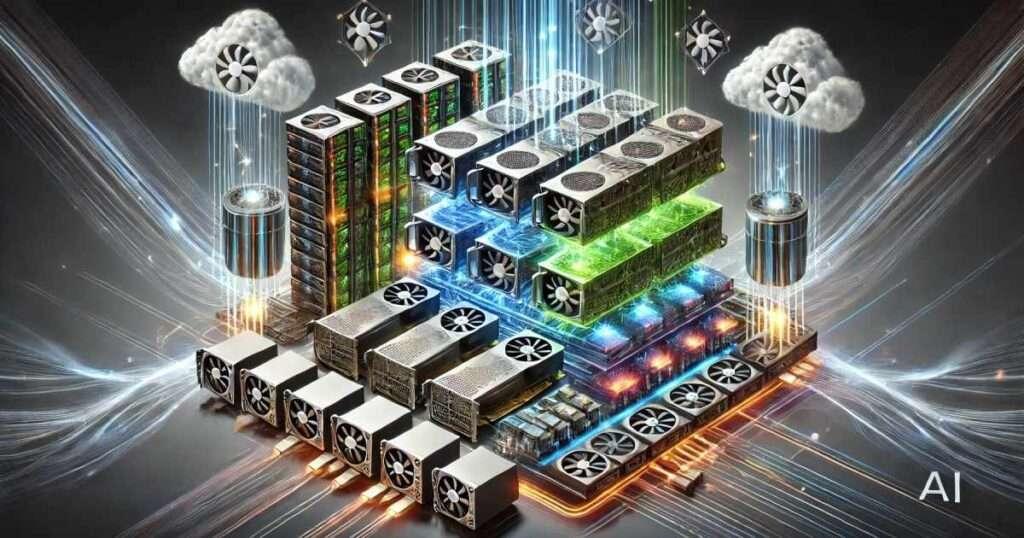
Section 1: Why AI Infrastructure Has Become the Foundation of Modern Computing
AI Is Reshaping Global Infrastructure Demands
The rise of artificial intelligence has transformed the technology industry more rapidly than almost any previous computing revolution. Earlier waves of software innovation focused primarily on cloud applications, mobile platforms, APIs, and distributed internet services. In 2026, the center of technological competition is increasingly shifting toward AI infrastructure, the massive computational systems that power training, inference, orchestration, and deployment for modern intelligent applications.
Large language models, multimodal systems, autonomous agents, recommendation engines, and enterprise AI platforms require enormous amounts of computational power. Training modern foundation models involves processing trillions of parameters across distributed clusters containing thousands of specialized accelerators operating simultaneously. Even inference workloads for production AI systems consume significantly more resources than traditional software applications.
This explosive demand for compute is reshaping global infrastructure priorities. Cloud providers, semiconductor companies, hyperscalers, and enterprise technology firms are investing billions of dollars into AI-native infrastructure ecosystems optimized specifically for machine learning workloads.
One of the biggest reasons for this transition is that traditional CPU-based infrastructure is no longer sufficient for modern AI operations. Earlier software systems primarily relied on sequential processing and general-purpose compute architectures. AI systems require massively parallel computation capable of handling matrix multiplications, tensor operations, and large-scale distributed training workloads efficiently.
As a result, GPUs, TPUs, high-bandwidth networking systems, distributed storage architectures, and AI-specific accelerators are becoming foundational components of modern computing environments. AI infrastructure is no longer treated as a niche research domain. It is becoming the backbone of the next generation of global software systems.
This transition is also changing how companies compete technologically. Organizations capable of building efficient AI infrastructure ecosystems often gain significant advantages in model performance, inference scalability, latency optimization, and operational cost efficiency.
The future of AI increasingly depends not only on model innovation, but also on the infrastructure capable of training and operating intelligent systems at global scale.
Why GPUs Became the Core Engine of the AI Revolution
Graphics Processing Units, commonly known as GPUs, became central to modern AI infrastructure because they are highly optimized for parallel computation. Originally designed for rendering graphics in gaming and visual applications, GPUs proved exceptionally effective for machine learning workloads involving large-scale matrix operations.
Unlike CPUs, which are optimized for sequential task execution, GPUs contain thousands of smaller processing cores capable of handling many operations simultaneously. This architecture makes GPUs extremely efficient for neural network training and deep learning workloads.
Modern AI models require enormous computational throughput during training. Large language models process massive datasets involving billions or trillions of tokens while updating neural network weights continuously through backpropagation. GPUs dramatically accelerate these operations compared to traditional processors.
The rise of transformer architectures accelerated GPU demand even further. Transformer models rely heavily on tensor operations and attention mechanisms that scale extremely well across parallel compute environments. As model sizes increased, organizations began building distributed GPU clusters containing thousands of accelerators connected through ultra-high-speed networking systems.
Another major reason GPUs dominate AI infrastructure involves ecosystem maturity. Software frameworks such as CUDA, PyTorch, TensorFlow, and distributed orchestration systems were optimized extensively around GPU acceleration. This created a powerful infrastructure ecosystem where hardware, software tooling, and AI frameworks evolved together.
GPU infrastructure is now used far beyond training workloads. Inference systems for conversational AI, enterprise copilots, recommendation platforms, image generation systems, and multimodal applications increasingly depend on GPU acceleration during runtime as well.
The massive global demand for GPUs has therefore transformed semiconductor economics and cloud infrastructure strategy across the technology industry.
TPUs and Specialized AI Accelerators Are Expanding Rapidly
While GPUs dominate much of the AI ecosystem, Tensor Processing Units (TPUs) and other specialized AI accelerators are becoming increasingly important in modern infrastructure environments. TPUs were designed specifically for machine learning workloads and are optimized heavily for tensor computation and deep learning operations.
One of the biggest differences between GPUs and TPUs involves architectural specialization. GPUs remain relatively general-purpose accelerators capable of handling a broad range of computational tasks. TPUs are more narrowly optimized for machine learning operations, particularly large-scale neural network training and inference.
This specialization often allows TPUs to achieve extremely high performance efficiency for specific AI workloads. Large organizations operating massive training clusters increasingly use TPUs to optimize energy efficiency, throughput, and distributed scalability.
Another major trend involves the rise of custom AI accelerators developed by hyperscalers and semiconductor companies. Organizations increasingly build hardware specifically optimized for inference workloads, low-latency reasoning systems, edge AI deployment, and large-scale distributed orchestration.
This expansion of specialized infrastructure reflects a broader industry realization: general-purpose computing architectures alone are insufficient for the future scale of AI systems. Hardware optimization is becoming deeply integrated into AI strategy itself.
The competition between GPUs, TPUs, and emerging AI accelerators is also reshaping cloud computing markets. Infrastructure providers increasingly compete based on access to advanced AI compute clusters, networking efficiency, distributed training capabilities, and inference optimization systems.
This infrastructure race closely aligns with broader industry shifts explored in AI Infrastructure Engineering: The Most Important Career Shift in Software Engineering, where operational intelligence infrastructure is becoming one of the most valuable technical domains in modern computing.
The future of AI development will likely depend heavily on how efficiently organizations can scale specialized compute infrastructure globally.
Key Takeaways
AI infrastructure is becoming the foundation of modern computing because intelligent systems require enormous computational resources.
GPUs dominate AI workloads because they are highly optimized for parallel tensor computation and neural network training.
TPUs and specialized accelerators are expanding rapidly as organizations optimize hardware specifically for machine learning workloads.
Distributed training systems allow organizations to train massive AI models across thousands of accelerators simultaneously.
The future of AI will depend heavily on scalable infrastructure ecosystems capable of supporting intelligent systems at global scale.
Section 2: GPUs vs TPUs: Understanding the Core of Modern AI Compute
Why GPUs Continue to Dominate AI Infrastructure
In 2026, GPUs remain the dominant hardware foundation powering most large-scale artificial intelligence systems across the technology industry. From training frontier-scale language models to running inference for enterprise AI assistants, GPUs continue to serve as the primary compute engine behind modern intelligent applications.
One of the biggest reasons GPUs remain dominant is flexibility. Unlike specialized accelerators optimized only for narrow workloads, GPUs can support a wide range of machine learning tasks across training, inference, simulation, multimodal processing, and scientific computing. This versatility makes them highly attractive for companies building diverse AI ecosystems.
Modern GPUs are designed specifically for massively parallel processing. Large language models rely heavily on matrix multiplications, tensor operations, and transformer attention mechanisms that scale efficiently across thousands of GPU cores simultaneously. The architecture of GPUs allows organizations to process huge volumes of data in parallel while accelerating neural network training dramatically compared to traditional CPUs.
Another major reason GPUs continue leading the market is the maturity of the software ecosystem surrounding them. CUDA, PyTorch, TensorFlow, NCCL, Triton, DeepSpeed, and distributed training frameworks have all evolved extensively around GPU acceleration. Engineers across the industry already understand how to optimize training pipelines, orchestration workflows, and runtime systems using GPU-based infrastructure.
This ecosystem maturity creates a powerful network effect. Companies adopting GPUs benefit not only from hardware performance but also from broad tooling compatibility, optimized libraries, distributed training support, and strong developer familiarity. This reduces operational complexity significantly when scaling AI infrastructure globally.
Inference scalability is another critical advantage. GPUs are increasingly optimized not only for training but also for serving production AI workloads at massive scale. Modern conversational systems, enterprise copilots, recommendation platforms, and multimodal applications often require low-latency inference across millions of users simultaneously. GPU infrastructure supports these workloads effectively through batching optimization, parallel execution, and runtime orchestration systems.
However, GPU dominance also introduces major challenges. Power consumption, hardware cost, supply chain limitations, cooling requirements, and infrastructure scaling complexity remain significant concerns across the industry. Organizations operating large GPU clusters must manage enormous operational expenses while optimizing utilization efficiency aggressively.
The result is an industry where GPUs remain central to AI infrastructure, but pressure continues growing for more specialized and efficient alternatives.
TPUs Are Optimized for Large-Scale AI Workloads
Tensor Processing Units, commonly known as TPUs, represent one of the most important alternatives to GPU-based AI infrastructure. Unlike GPUs, which evolved originally from graphics processing technology, TPUs were designed specifically for machine learning computation from the ground up.
This specialization gives TPUs several important advantages for certain AI workloads. TPUs are highly optimized for tensor operations, matrix multiplication, and neural network execution efficiency. Their architecture is specifically designed to accelerate deep learning workloads at extremely large scale while reducing computational overhead and improving throughput.
One of the biggest advantages of TPUs involves training efficiency. Large transformer-based models require enormous computational coordination across distributed infrastructure environments. TPUs often provide strong performance efficiency for these workloads because they are optimized specifically for the types of tensor operations used heavily in modern neural networks.
Energy efficiency is another important factor. Training frontier-scale AI models consumes enormous amounts of electricity, making infrastructure sustainability a growing industry concern. TPUs are often designed to maximize performance-per-watt efficiency for machine learning workloads, allowing organizations to reduce operational energy consumption during large-scale training runs.
Another major advantage involves distributed scalability. TPU pods are designed specifically for coordinated large-scale machine learning training environments. High-speed interconnect systems allow accelerators to communicate efficiently across distributed clusters, reducing synchronization bottlenecks during model training.
This becomes increasingly important as AI models continue growing larger. Training trillion-parameter models often requires sophisticated distributed orchestration involving thousands of accelerators operating simultaneously. Efficient communication between devices directly affects training performance and infrastructure scalability.
However, TPUs also introduce tradeoffs. Unlike GPUs, TPU ecosystems are more specialized and less flexible for general-purpose computing tasks. Engineers often require more specialized tooling knowledge, and software ecosystem maturity can vary depending on deployment environments and workload types.
Despite these tradeoffs, TPUs continue expanding rapidly because organizations increasingly prioritize AI-specific optimization over generalized compute flexibility.
The growing importance of AI-optimized infrastructure closely connects with trends explored in Inference-Time Scaling: Why Runtime Intelligence Matters in 2026, where infrastructure efficiency and runtime optimization increasingly define AI scalability and operational performance.
Distributed Compute Is Becoming More Important Than Individual Hardware
One of the most important trends shaping AI infrastructure in 2026 is the realization that distributed coordination often matters more than individual accelerator performance alone. Earlier AI development cycles focused heavily on building faster GPUs or more powerful accelerators. Today, organizations increasingly recognize that large-scale AI capability depends heavily on how efficiently compute clusters operate together.
Modern AI training environments involve thousands of accelerators communicating continuously across distributed networking systems. Data parallelism, tensor parallelism, pipeline parallelism, and sharded optimization techniques are used simultaneously to coordinate massive workloads efficiently.
This means networking infrastructure has become just as important as compute hardware itself. High-speed interconnect technologies such as NVLink, InfiniBand, and custom networking fabrics are essential for reducing communication overhead during distributed training.
Without efficient networking coordination, distributed training performance degrades rapidly. Synchronization delays, bandwidth limitations, and communication bottlenecks can dramatically reduce training efficiency even when powerful accelerators are available.
Storage architecture is also becoming critical. Modern AI systems process enormous datasets continuously during training and inference workflows. Distributed storage systems must deliver extremely high throughput while minimizing latency across geographically distributed infrastructure environments.
Another major challenge involves fault tolerance. Training large AI models can take weeks or months across thousands of accelerators. Infrastructure systems must therefore handle hardware failures, checkpoint recovery, synchronization consistency, and workload redistribution dynamically without interrupting training progress significantly.
Inference infrastructure is becoming increasingly distributed as well. Modern AI products often operate globally across multiple cloud regions, edge systems, and distributed inference clusters simultaneously. Runtime orchestration frameworks dynamically route requests across infrastructure environments while balancing latency, throughput, and operational cost continuously.
This shift demonstrates that AI infrastructure engineering is becoming one of the most sophisticated distributed systems challenges in modern computing.
Key Takeaways
GPUs remain dominant because of their flexibility, mature software ecosystem, and strong parallel compute performance.
TPUs are highly optimized for machine learning workloads and provide strong efficiency for large-scale distributed AI training.
Distributed coordination, networking infrastructure, and storage systems are becoming as important as accelerator hardware itself.
AI infrastructure increasingly depends on sophisticated distributed systems engineering rather than standalone compute devices alone.
The future of computing is being shaped heavily by competition around scalable intelligent infrastructure ecosystems.
Section 3: Distributed Training and the Engineering Challenges Behind Large AI Models
Why Distributed Training Became Necessary for Modern AI
One of the biggest reasons AI infrastructure became so complex is the enormous size of modern machine learning models. Earlier generations of neural networks could often be trained on a single GPU or a small compute cluster. In 2026, frontier AI systems contain hundreds of billions or even trillions of parameters, making single-device training practically impossible.
Large language models require massive computational throughput during training because they process huge datasets repeatedly while continuously updating model weights through gradient optimization. A single accelerator simply cannot provide enough memory capacity or compute power to train these systems efficiently within reasonable timeframes.
This limitation led to the rise of distributed training architectures where workloads are spread across thousands of GPUs or TPUs operating simultaneously. Distributed training allows organizations to scale compute resources horizontally, dramatically accelerating model development.
One of the most common techniques used is data parallelism. In this approach, training data is divided across multiple accelerators while each device maintains a replica of the model. After processing batches independently, gradients are synchronized across the cluster to ensure consistent model updates.
Another important strategy is model parallelism, where different portions of a large neural network are distributed across multiple accelerators because the entire model cannot fit into the memory of a single device. This becomes especially important for trillion-parameter architectures that exceed individual hardware memory limitations.
Pipeline parallelism is also widely used. Instead of processing all neural network layers simultaneously on every accelerator, workloads are divided sequentially across devices. Different stages of the model process different data batches concurrently, improving hardware utilization and training throughput.
These distributed approaches allow organizations to train increasingly sophisticated AI systems, but they also introduce enormous engineering complexity involving synchronization, networking, memory optimization, checkpointing, and fault tolerance.
The rise of distributed AI infrastructure has therefore transformed machine learning from a relatively isolated computational problem into one of the most advanced distributed systems engineering challenges in the technology industry.
Networking Infrastructure Is the Hidden Backbone of AI Scaling
One of the most overlooked realities of modern AI infrastructure is that networking systems often determine distributed training performance just as much as accelerator hardware itself. Many people focus heavily on GPUs and TPUs, but large-scale AI training would be impossible without extremely high-speed communication between devices.
Distributed training requires accelerators to exchange gradients, synchronize parameters, share memory states, and coordinate optimization steps continuously. As model sizes grow larger, the amount of data transferred across clusters becomes enormous. Communication overhead can quickly become a major bottleneck if networking infrastructure is inefficient.
This is why technologies such as NVLink, InfiniBand, and custom AI networking fabrics have become essential for modern AI infrastructure. These systems provide ultra-high-bandwidth, low-latency communication between accelerators, allowing distributed clusters to coordinate efficiently during training workloads.
One major challenge involves synchronization delays. During distributed training, all accelerators must frequently align model updates to maintain consistency. If communication latency becomes too high, GPUs or TPUs spend significant time idle while waiting for synchronization, dramatically reducing training efficiency.
Another important issue is bandwidth scaling. Training trillion-parameter models requires moving massive amounts of tensor data continuously across distributed clusters. Infrastructure engineers must therefore optimize communication protocols carefully to minimize bottlenecks and maintain compute utilization.
Storage infrastructure also plays a critical role. Modern AI training systems process enormous datasets involving text, images, video, audio, and multimodal information. Distributed storage architectures must deliver extremely high throughput while supporting continuous access across geographically distributed compute environments.
This complexity explains why hyperscalers and AI-native companies increasingly invest heavily in vertically integrated infrastructure ecosystems combining compute hardware, networking systems, distributed storage, and orchestration software into unified platforms optimized specifically for AI workloads.
The growing importance of distributed coordination closely aligns with broader infrastructure trends explored in AI Infrastructure Engineering: The Most Important Career Shift in Software Engineering, where intelligent systems infrastructure is becoming one of the most strategic technical domains in modern computing.
Fault Tolerance and Reliability Are Massive Engineering Challenges
One of the biggest engineering challenges in distributed AI systems is maintaining reliability across extremely large infrastructure environments. Modern training runs often involve thousands of accelerators operating continuously for weeks or even months. In systems this large, hardware failures become statistically inevitable.
A single GPU failure inside a distributed cluster can disrupt synchronization workflows and potentially interrupt entire training jobs if fault tolerance systems are not designed carefully. AI infrastructure engineers therefore build sophisticated resilience mechanisms specifically for large-scale training environments.
Checkpointing is one of the most important techniques used for reliability. During training, models periodically save their current state to distributed storage systems. If failures occur, training can resume from recent checkpoints instead of restarting from the beginning entirely.
Another major concern involves memory optimization. Large models consume enormous amounts of memory across distributed hardware environments. Engineers use advanced sharding techniques, gradient checkpointing, mixed-precision training, and memory offloading strategies to reduce infrastructure overhead while maintaining training performance.
Power and cooling infrastructure are equally critical. AI training clusters consume extraordinary amounts of electricity and generate substantial thermal output. Data centers supporting large-scale AI systems increasingly require advanced cooling systems, energy optimization frameworks, and specialized hardware configurations.
Operational observability has become another essential discipline. Engineers continuously monitor accelerator utilization, communication latency, memory consumption, throughput efficiency, synchronization health, and infrastructure failures across distributed clusters. Even small inefficiencies can create massive performance losses at scale.
These operational realities explain why AI infrastructure engineering is becoming one of the most sophisticated specialties in software and systems engineering.
Key Takeaways
Distributed training became essential because modern AI models exceed the compute and memory capacity of single accelerators.
Networking systems such as NVLink and InfiniBand are critical for efficient distributed AI coordination.
Fault tolerance, checkpointing, observability, and memory optimization are major engineering challenges in large-scale AI infrastructure.
Distributed inference is becoming increasingly important as AI systems serve millions of users globally.
Modern AI infrastructure represents one of the most advanced distributed systems engineering challenges in the technology industry.
Section 4: The Future of AI Infrastructure and What Engineers Should Learn Next
Inference Infrastructure Is Becoming More Important Than Training Infrastructure
For years, the AI industry focused heavily on training infrastructure because building larger and more capable models required enormous computational power. In 2026, however, the focus is gradually shifting toward inference infrastructure, the systems responsible for running AI models efficiently in real-world production environments.
One major reason for this shift is that inference workloads now operate at massive scale. Millions of users interact daily with conversational assistants, recommendation engines, enterprise copilots, autonomous workflows, and multimodal AI systems. Serving these workloads continuously often consumes far more infrastructure resources over time than the original training process itself.
This means companies increasingly prioritize runtime optimization, latency reduction, semantic caching, adaptive routing, and inference orchestration. AI infrastructure teams now spend significant effort optimizing how models behave during production workloads rather than focusing only on training performance.
Inference systems also introduce stricter operational requirements. Users expect near real-time responses during conversational interactions, making latency engineering a critical discipline. Organizations increasingly deploy distributed inference clusters globally to reduce response times and improve reliability across regions.
Another major trend involves model optimization techniques such as quantization, distillation, and adaptive inference routing. These approaches reduce computational overhead while maintaining strong reasoning performance, allowing companies to scale AI products more efficiently.
The growing importance of runtime infrastructure demonstrates that AI engineering is evolving from a research-heavy discipline into a large-scale operational systems field centered around intelligent runtime coordination.
Edge AI and Decentralized Infrastructure Are Expanding Rapidly
Another major transformation shaping AI infrastructure in 2026 is the rise of edge AI systems. Earlier AI workloads operated primarily inside centralized cloud environments where large compute clusters handled both training and inference. Increasingly, intelligent systems are moving closer to users through distributed edge infrastructure.
Edge AI allows inference workloads to run locally on devices, regional compute nodes, mobile systems, autonomous machines, and IoT environments. This reduces latency significantly while improving responsiveness for applications requiring real-time interaction.
Autonomous vehicles, robotics platforms, industrial automation systems, wearable AI devices, and augmented reality applications all depend heavily on edge inference infrastructure. These systems cannot rely entirely on distant cloud servers because communication delays may create unacceptable operational risks.
Another major advantage of edge AI involves bandwidth optimization. Instead of continuously transmitting massive volumes of raw data to centralized cloud systems, edge infrastructure processes information locally and sends only essential outputs across networks. This improves scalability and reduces infrastructure overhead.
However, decentralized AI infrastructure introduces new engineering challenges. Engineers must manage distributed deployment coordination, synchronization consistency, hardware optimization, security enforcement, and runtime reliability across highly fragmented environments.
Specialized AI accelerators designed for edge workloads are therefore becoming increasingly important. Low-power inference chips optimized for real-time reasoning are rapidly expanding across consumer devices and industrial systems.
The expansion of edge AI reflects a broader industry transition toward distributed intelligent infrastructure operating across both centralized cloud environments and decentralized runtime ecosystems simultaneously.
The evolution of distributed AI operations closely aligns with ideas explored in The New Software Engineer: How AI, LLMs, and System Design Are Reshaping Engineering Careers, where infrastructure awareness and runtime systems thinking are becoming foundational engineering capabilities.
AI Infrastructure Engineering Will Become One of the Most Valuable Technical Fields
As AI systems continue expanding globally, infrastructure expertise is likely to become one of the most strategically important career paths in technology. Organizations increasingly understand that scalable AI depends not only on model innovation but also on operational efficiency, distributed orchestration, runtime observability, and intelligent infrastructure coordination.
This creates enormous demand for engineers capable of designing scalable AI ecosystems across training clusters, inference environments, networking systems, storage architectures, and edge infrastructure platforms.
Another major trend is the growing convergence between infrastructure engineering and AI systems design. Engineers increasingly work across distributed systems, cloud platforms, runtime orchestration, observability tooling, inference optimization, and intelligent application architecture simultaneously.
The future of computing will therefore likely be shaped heavily by infrastructure professionals who understand how to operationalize intelligence at global scale.
Key Takeaways
Inference infrastructure is becoming increasingly important as AI systems serve millions of users continuously in production environments.
Edge AI is expanding rapidly because many intelligent applications require low-latency localized inference.
Distributed runtime coordination introduces new engineering challenges involving synchronization, deployment, observability, and reliability.
AI infrastructure engineering is becoming one of the most valuable technical career paths in modern computing.
The future of artificial intelligence will depend heavily on scalable intelligent infrastructure operating across cloud and edge environments simultaneously.
Conclusion
AI infrastructure has become one of the most important foundations of the modern technology industry in 2026. The rapid rise of large language models, multimodal AI systems, autonomous agents, recommendation engines, and intelligent enterprise platforms has created computational demands unlike anything previous generations of software infrastructure had to support.
Earlier eras of computing focused primarily on cloud applications, backend systems, and distributed internet services powered largely by general-purpose CPUs. Today’s AI-native world depends heavily on GPUs, TPUs, distributed networking fabrics, large-scale storage architectures, inference orchestration systems, and specialized accelerators optimized specifically for machine learning workloads.
One of the biggest reasons this shift matters is because modern AI systems require extraordinary amounts of computation. Training large models involves coordinating thousands of accelerators across distributed environments while processing massive datasets continuously over long periods of time. Even inference workloads for production AI systems now consume enormous resources because conversational applications and intelligent assistants serve millions of users globally every day.
GPUs became the backbone of the AI revolution because of their ability to perform massively parallel tensor operations efficiently. Their mature ecosystem, flexibility, and strong integration with machine learning frameworks made them the dominant infrastructure choice across the industry. At the same time, TPUs and specialized AI accelerators are expanding rapidly because organizations increasingly need hardware optimized specifically for large-scale machine learning efficiency.
Distributed training emerged as a necessity because modern models can no longer fit within the memory or computational limits of single accelerators. Data parallelism, model parallelism, pipeline orchestration, and high-speed networking systems now form the operational backbone of frontier AI development. Infrastructure engineering has therefore become deeply intertwined with distributed systems engineering itself.
Another major trend is the growing importance of inference infrastructure. Earlier AI discussions focused heavily on training larger models, but companies increasingly recognize that serving AI applications at production scale is equally challenging. Runtime optimization, low-latency inference, semantic caching, adaptive routing, and distributed orchestration are becoming central priorities for organizations operating AI-native products globally.
Edge AI is also reshaping infrastructure design. Intelligent systems are moving closer to users through localized inference environments optimized for real-time interaction. Autonomous vehicles, robotics, IoT systems, and augmented reality platforms increasingly depend on decentralized AI infrastructure capable of operating with minimal latency.
These changes are transforming engineering careers as well. AI infrastructure engineering is becoming one of the fastest-growing technical disciplines because organizations urgently need professionals capable of managing distributed compute environments, GPU orchestration, observability systems, runtime optimization, and intelligent infrastructure scalability.
Perhaps the most important takeaway is that the future of AI will not be defined only by better models. It will also be defined by the infrastructure capable of training, serving, scaling, and coordinating intelligent systems efficiently across global environments.
AI infrastructure is therefore no longer just a support layer for machine learning. It is rapidly becoming the computational foundation of the next generation of software systems.
Frequently Asked Questions
1. What is AI infrastructure?
AI infrastructure refers to the hardware and software systems used to train, deploy, scale, and operate artificial intelligence applications.
2. Why are GPUs important for AI?
GPUs are optimized for massively parallel computation, making them highly efficient for tensor operations, neural network training, and large-scale inference workloads.
3. What is the difference between GPUs and TPUs?
GPUs are flexible accelerators designed for parallel computing across many workloads, while TPUs are specialized processors optimized specifically for machine learning operations.
4. Why is distributed training necessary?
Modern AI models are too large to train efficiently on a single device, so workloads are distributed across many accelerators operating simultaneously.
5. What is data parallelism?
Data parallelism divides training datasets across multiple accelerators while each device maintains a copy of the model during distributed training.
6. What is model parallelism?
Model parallelism splits a neural network across multiple accelerators because the entire model cannot fit into the memory of a single device.
7. Why is networking infrastructure important in AI systems?
Distributed AI systems require extremely fast communication between accelerators to synchronize training workloads and maintain high computational efficiency.
8. What technologies support high-speed AI networking?
Technologies such as NVLink, InfiniBand, and custom networking fabrics help reduce communication bottlenecks during distributed training and inference.
9. What is inference infrastructure?
Inference infrastructure refers to the systems responsible for running trained AI models efficiently in production environments for real-world applications.
10. Why is inference optimization important?
Inference optimization reduces latency, improves throughput, lowers infrastructure cost, and helps AI systems scale efficiently across millions of users.
11. What is edge AI?
Edge AI involves running inference workloads locally on devices or nearby compute nodes instead of relying entirely on centralized cloud infrastructure.
12. Why are specialized AI accelerators growing rapidly?
Specialized accelerators improve efficiency for machine learning workloads by optimizing hardware specifically for tensor operations and inference tasks.
13. What engineering skills are valuable in AI infrastructure?
Distributed systems knowledge, cloud infrastructure, GPU optimization, networking, observability engineering, runtime orchestration, and scalability design are highly valuable.
14. Why is AI infrastructure engineering becoming important?
AI systems require sophisticated operational environments involving distributed compute, inference scaling, runtime coordination, and infrastructure optimization.
15. What does the future of AI infrastructure look like?
The future points toward highly distributed intelligent infrastructure operating across cloud systems, edge environments, specialized accelerators, and globally coordinated inference ecosystems.