Section 1: Understanding AI Workflow Engineering and Why It Is Transforming Enterprise AI
Artificial Intelligence Has Evolved Beyond Individual Models
For many years, artificial intelligence projects focused primarily on building highly accurate machine learning models. Organizations invested heavily in developing systems capable of classifying images, detecting fraud, forecasting demand, recommending products, predicting equipment failures, and automating repetitive analytical tasks. These applications generated enormous business value because they enabled companies to make faster and more informed decisions using data-driven insights.
Despite their success, these systems generally solved one specific problem at a time.
A recommendation model suggested products.
A fraud detection model evaluated financial transactions.
A forecasting model estimated future sales.
A computer vision model identified defects in manufactured products.
Each model operated independently and produced a prediction that was typically passed to another application or a human employee responsible for determining the next course of action.
This approach worked well during the early stages of enterprise AI adoption because organizations were primarily interested in augmenting human decision-making rather than automating complete business operations.
Today, enterprise expectations have changed dramatically.
Organizations no longer ask how artificial intelligence can improve one task. Instead, they ask how AI can automate entire business processes from beginning to end.
Consider a customer requesting a refund through an online support portal.
Instead of simply classifying the request, a modern AI application retrieves customer information, reviews previous interactions, analyzes purchase history, verifies company policies, evaluates eligibility, generates a personalized response, updates backend systems, notifies relevant departments, schedules follow-up activities, and records the entire interaction for future analysis.
The intelligence is no longer limited to generating a prediction.
It exists throughout the complete business workflow.
This transformation represents one of the most significant shifts occurring in enterprise artificial intelligence. Businesses increasingly recognize that real value comes from intelligent workflows capable of coordinating multiple decisions automatically rather than isolated models producing independent outputs.
As organizations continue investing in automation, workflow engineering has become the discipline responsible for connecting individual AI capabilities into complete production-ready systems.
AI Workflow Engineering Is Becoming One of the Most Valuable Enterprise Skills
The growing importance of workflow engineering reflects broader changes occurring throughout the technology industry.
Organizations have largely moved beyond experimental AI projects.
Today, executive leadership expects artificial intelligence to improve productivity, automate operations, reduce costs, accelerate decision-making, and enhance customer experiences across every department.
Meeting these expectations requires engineers capable of designing production-ready workflows rather than isolated machine learning models.
Consequently, hiring priorities are changing.
Companies increasingly recruit professionals who understand software engineering, cloud infrastructure, workflow orchestration, distributed systems, APIs, Large Language Models, Retrieval-Augmented Generation, AI agents, observability, enterprise security, and production deployment alongside traditional machine learning concepts.
The demand is driven by business needs rather than technological trends.
Organizations need professionals capable of transforming artificial intelligence into measurable operational value.
The importance of designing production-scale AI systems that automate complete business processes is explored in "How AI Engineers Are Designing Systems for Billions of Inferences Per Day," which explains how distributed inference architecture, workflow orchestration, cloud-native infrastructure, enterprise integrations, and observability enable organizations to deploy reliable AI applications at global scale.
As enterprise AI adoption continues accelerating, AI Workflow Engineering is emerging as one of the most valuable technical disciplines because it bridges the gap between intelligent models and real-world business execution. Engineers capable of designing complete AI workflows will play a central role in helping organizations transition from isolated AI experiments to intelligent enterprises where automation, reasoning, and decision-making operate seamlessly across every business function.
Key Takeaway
AI Workflow Engineering represents the next stage in enterprise artificial intelligence by shifting the focus from building individual machine learning models to designing complete intelligent workflows that automate end-to-end business processes. By integrating Large Language Models, Retrieval-Augmented Generation, AI agents, enterprise software, cloud infrastructure, APIs, observability, and security into unified production systems, workflow engineers enable organizations to transform isolated AI capabilities into scalable, reliable, and business-driven intelligent applications.
Section 2: The Core Components of an AI Workflow and How They Work Together
Every Intelligent Workflow Begins with Understanding the User's Intent
Every AI workflow starts with a request. That request may come from a customer asking a question, an employee searching for internal documentation, a healthcare professional reviewing patient information, a financial analyst generating a report, or an automated system triggering a business process. Regardless of where the request originates, the first responsibility of an AI workflow is to understand what the user actually wants to accomplish.
Unlike traditional software applications that rely on predefined menus and structured inputs, modern AI systems frequently receive information in natural language. Users rarely communicate using precise technical terminology. Instead, they describe problems conversationally, ask follow-up questions, provide incomplete information, or change their objectives as conversations evolve. This creates a significant engineering challenge because the workflow must correctly interpret intent before any meaningful action can begin.
Large Language Models (LLMs) have become the primary technology responsible for solving this challenge. Rather than simply identifying keywords, these models analyze context, relationships between concepts, conversational history, and user objectives to determine the actual meaning behind a request. This enables AI workflows to support far more natural interactions than traditional rule-based systems.
Consider an employee asking, "Can you prepare the latest quarterly sales summary and send it to my manager?"
A traditional application might require the employee to manually locate sales reports, download spreadsheets, summarize the data, compose an email, and upload supporting documents. An AI workflow interprets the request as a sequence of related business tasks rather than a single question. The workflow identifies the reporting period, retrieves the latest sales information, generates an executive summary, identifies the employee's manager from organizational systems, prepares a professional email, attaches the appropriate reports, and requests approval before sending the message.
This ability to transform conversational requests into structured business operations is one of the defining characteristics of AI Workflow Engineering.
Modern workflows therefore begin not with computation but with understanding. Accurate intent recognition establishes the foundation upon which every subsequent decision depends. If the workflow misunderstands the user's objective, every downstream action becomes increasingly unreliable regardless of how sophisticated the remaining components may be.
Observability and Monitoring Keep AI Workflows Reliable in Production
Designing an intelligent workflow is only part of the engineering challenge. Once deployed into production, workflows must continue operating reliably despite changing workloads, evolving business requirements, infrastructure failures, and continuously growing enterprise knowledge.
This is where observability becomes indispensable.
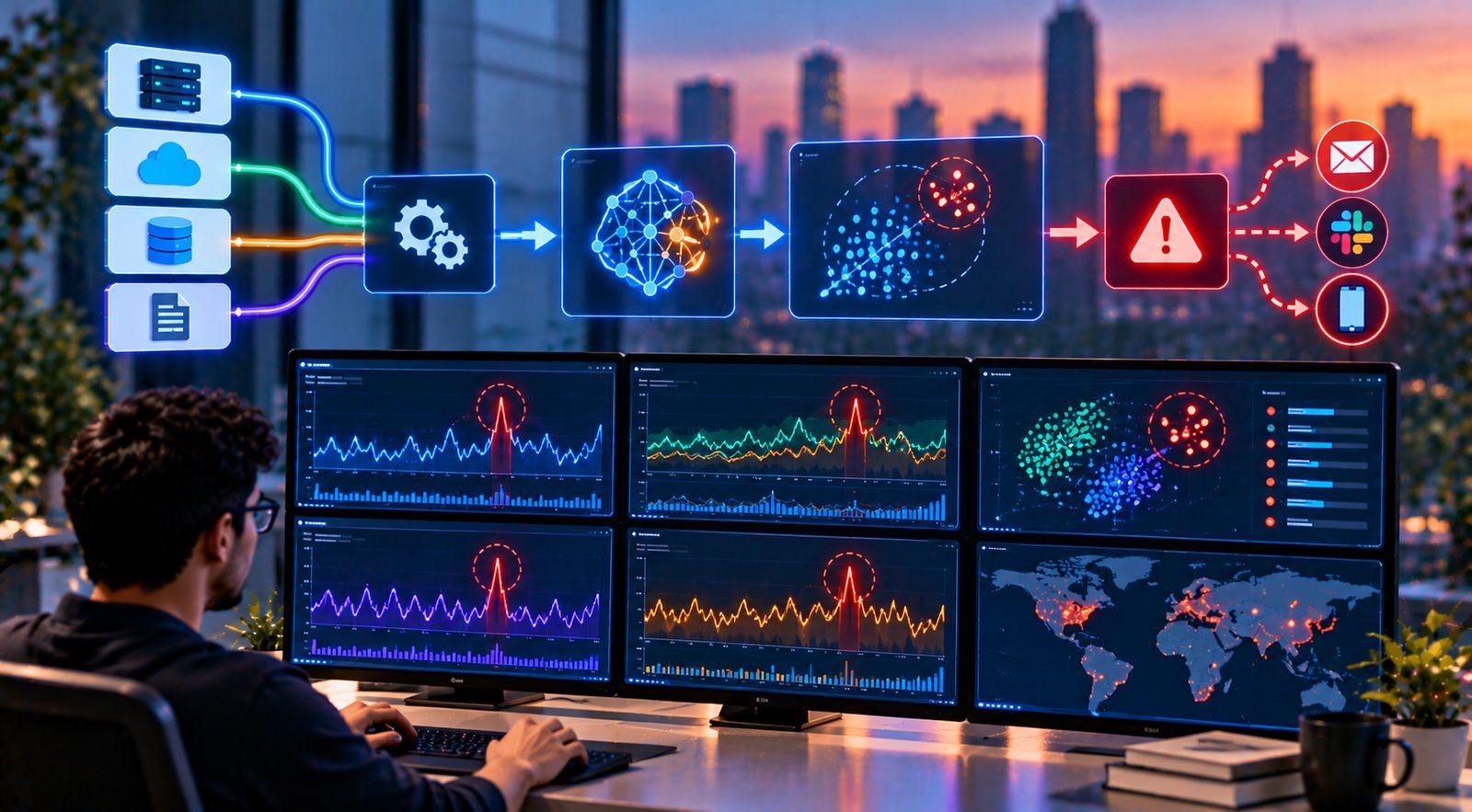
Unlike traditional application monitoring, AI workflow observability provides visibility into every stage of workflow execution. Engineering teams monitor request latency, retrieval quality, model inference performance, workflow completion rates, infrastructure utilization, API response times, security events, business outcomes, and operational failures simultaneously.
For example, if a workflow begins responding more slowly than expected, observability platforms help engineers determine whether the delay originates from the language model, vector database retrieval, cloud infrastructure, authentication systems, external APIs, or workflow orchestration itself.
Similarly, if users begin reporting lower-quality responses, engineers can investigate whether enterprise documents have become outdated, embeddings require regeneration, retrieval accuracy has declined, or infrastructure bottlenecks are affecting inference quality.
Continuous monitoring also supports business governance.
Organizations increasingly analyze workflow success rates, user satisfaction, operational efficiency, infrastructure costs, and business impact to identify opportunities for optimization. Rather than simply measuring model accuracy, engineering teams evaluate the effectiveness of the complete workflow from initial request to final business outcome.
The importance of maintaining reliable AI workflows is explored in "The Rise of AI Reliability Engineering: Keeping Models Running at Scale," which explains how observability, continuous monitoring, infrastructure automation, workflow evaluation, and production engineering enable enterprise AI systems to remain reliable while supporting large-scale business operations.
As AI workflows become increasingly central to enterprise operations, observability ensures that intelligent applications remain scalable, transparent, efficient, and dependable throughout their production lifecycle.
Key Takeaway
Modern AI workflows depend on multiple engineering components working together seamlessly. Large Language Models interpret user intent, Retrieval-Augmented Generation provides current enterprise knowledge, orchestration platforms coordinate complex business processes, and observability ensures workflows remain reliable after deployment. Together, these technologies enable organizations to build intelligent applications that go far beyond answering questions by automating complete business operations with speed, accuracy, and enterprise-grade reliability.
Section 3: Engineering Best Practices for Building Reliable End-to-End AI Workflows
Designing Modular Workflows Improves Scalability and Long-Term Maintainability
One of the most important principles of AI Workflow Engineering is that intelligent applications should never be designed as a single monolithic system. While it may be tempting to place every capability inside one large workflow, this approach quickly becomes difficult to maintain as applications grow in complexity. Enterprise AI systems constantly evolve as organizations introduce new business requirements, integrate additional software platforms, expand knowledge bases, and adopt new foundation models. A workflow that functions well today may require significant modifications only a few months later.
To support this continuous evolution, experienced AI engineers design workflows using modular architectures.
Instead of building one large process responsible for every operation, they divide workflows into smaller, independent components that each perform a clearly defined responsibility. One module may authenticate users, another retrieves enterprise knowledge, another evaluates business rules, another generates responses using a Large Language Model, while additional modules update databases, communicate with APIs, or trigger notifications.
This modular approach offers several important advantages.
Individual workflow components can be updated without disrupting the entire application. If a better embedding model becomes available, engineers only replace the retrieval module rather than redesigning the complete workflow. If business policies change, rule-processing components can be modified independently while leaving language models, infrastructure, and enterprise integrations untouched.
Modular design also simplifies testing.
Rather than validating an entire workflow containing dozens of interconnected services, engineering teams can verify each component independently before confirming that the complete workflow functions correctly. This significantly reduces debugging time while improving overall system reliability.
Scalability also improves because different workflow components often experience different workloads.
For example, retrieval services may process substantially more requests than document summarization services. By separating these functions into independent modules, organizations allocate computing resources more efficiently and scale only the components experiencing increased demand rather than expanding the entire infrastructure unnecessarily.
As enterprise AI systems continue growing, modular workflow design has become one of the defining architectural principles that enables organizations to maintain flexibility while supporting increasingly sophisticated intelligent applications.
Continuous Optimization Transforms Good Workflows into Exceptional AI Systems
Building an AI workflow is not the final stage of engineering. In reality, deployment marks the beginning of an ongoing optimization process.
Business environments evolve continuously.
Customer expectations change.
Enterprise knowledge expands.
Foundation models improve.
Infrastructure requirements increase.
New APIs become available.
Regulatory requirements evolve.
An intelligent workflow that performs exceptionally well today will eventually require refinement to maintain the same level of performance.
Successful AI Workflow Engineering therefore emphasizes continuous optimization rather than static deployment.
Engineering teams regularly analyze workflow execution metrics to identify opportunities for improvement. They examine response latency, retrieval quality, model accuracy, workflow completion rates, infrastructure utilization, user feedback, operational costs, and business outcomes. These insights help determine where workflow improvements will generate the greatest value.
Sometimes optimization involves replacing foundation models with newer versions that provide stronger reasoning capabilities. In other cases, engineers redesign Retrieval-Augmented Generation pipelines to improve enterprise knowledge retrieval. Infrastructure teams may optimize cloud resource allocation to reduce operational costs while maintaining performance. Workflow designers may simplify business processes by eliminating unnecessary approval steps or automating repetitive manual activities.
Continuous experimentation also plays an important role.
Organizations increasingly conduct controlled evaluations comparing different prompts, retrieval strategies, orchestration logic, workflow structures, and AI models before deploying improvements into production. This evidence-based approach allows workflows to evolve gradually while minimizing operational risk.
The importance of continuously improving enterprise AI systems is explored in "Context Engineering: The Skill Every AI Engineer Needs in 2026," which explains how prompt optimization, Retrieval-Augmented Generation, orchestration strategies, context management, and workflow design significantly influence the quality, reliability, and scalability of modern AI applications.
Organizations that embrace continuous optimization recognize that intelligent workflows are living systems rather than completed software projects. Their ability to adapt continuously ultimately determines how much long-term business value artificial intelligence can deliver.
Key Takeaway
Building reliable AI workflows requires much more than connecting multiple AI services together. Modular architecture enables scalability and maintainability, Human-in-the-Loop design ensures responsible decision-making, embedded security and governance protect enterprise operations, and continuous optimization allows workflows to improve as business needs evolve. Together, these engineering practices transform individual AI capabilities into resilient, production-ready intelligent applications capable of automating complex business processes at enterprise scale.
Section 4: The Future of AI Workflow Engineering and Why It Will Define the Next Generation of Enterprise AI
AI Workflows Are Evolving into Autonomous Business Systems
The first generation of enterprise AI focused primarily on assisting human decision-making. Machine learning models generated predictions, recommendation systems suggested products, and intelligent search engines retrieved relevant information. Although these applications significantly improved productivity, they still relied heavily on humans to coordinate the overall business process.
The next generation of enterprise AI is fundamentally different.
Organizations are increasingly building intelligent workflows capable of executing complete business operations with minimal human intervention. Instead of producing a recommendation and waiting for someone to decide what happens next, modern AI workflows continue executing multiple tasks automatically until an entire business objective has been completed.
This evolution is transforming artificial intelligence from an analytical tool into an operational platform.
Consider how enterprise procurement traditionally operates.
Employees submit purchasing requests, managers review approvals, procurement teams verify suppliers, finance departments validate budgets, contracts are generated, purchase orders are created, vendors receive notifications, and inventory systems are updated. Historically, each step required separate software applications and considerable manual coordination.
An intelligent AI workflow brings these activities together.
The workflow receives the purchasing request, validates organizational policies, retrieves supplier information, compares vendor pricing, verifies budget availability, generates supporting documentation, routes approvals to appropriate managers, creates purchase orders, updates enterprise resource planning systems, schedules deliveries, and continuously tracks order progress.
Rather than supporting one isolated activity, the workflow manages the complete operational process.
This ability to coordinate multiple business functions is becoming one of the defining characteristics of enterprise AI. Organizations increasingly recognize that the greatest business value is created when artificial intelligence automates entire workflows rather than individual tasks.
As foundation models continue improving and enterprise software becomes increasingly interconnected, autonomous workflows will become the standard architecture for intelligent business applications.
AI Agents Will Become the Building Blocks of Intelligent Workflows
One of the most significant developments shaping AI Workflow Engineering is the rapid emergence of AI agents.
While Large Language Models excel at understanding language and generating responses, AI agents extend these capabilities by enabling artificial intelligence to perform actions rather than simply producing text.
An AI agent can retrieve information, invoke APIs, execute software functions, communicate with enterprise applications, evaluate results, adapt its behavior, and continue working toward predefined objectives without requiring constant human instruction.
Modern enterprise workflows increasingly combine multiple specialized agents working collaboratively.
One agent retrieves enterprise documentation.
Another analyzes financial information.
Another communicates with customer relationship management platforms.
Another schedules meetings.
Another generates reports.
Another monitors workflow execution for failures or exceptions.
Rather than relying on one extremely large model to perform every task, organizations design collections of specialized agents that coordinate their expertise throughout workflow execution.
This modular architecture improves scalability, reliability, and maintainability because individual agents can be updated independently as business requirements evolve.
For example, a healthcare workflow may involve separate agents responsible for reviewing patient histories, retrieving clinical guidelines, scheduling appointments, generating discharge summaries, verifying insurance coverage, and notifying healthcare professionals when urgent intervention is required.
Similarly, a software engineering workflow may use specialized agents for code generation, security analysis, automated testing, infrastructure deployment, documentation updates, and production monitoring.
Workflow orchestration platforms coordinate communication between these agents while ensuring information flows correctly throughout the application.
As enterprise AI matures, organizations will increasingly treat AI agents as reusable business services that can be combined to automate complex operational processes across multiple departments.
AI Workflow Engineers Will Become Central to Enterprise Digital Transformation
Perhaps the most important consequence of AI Workflow Engineering is the changing role of AI professionals themselves.
Organizations no longer need engineers who simply build isolated machine learning models.
They increasingly require professionals capable of designing complete intelligent ecosystems that integrate artificial intelligence into everyday business operations.
Modern AI Workflow Engineers combine expertise across multiple technical disciplines.
They understand machine learning fundamentals.
They design Large Language Model applications.
They build Retrieval-Augmented Generation architectures.
They integrate enterprise APIs.
They develop cloud-native infrastructure.
They implement workflow orchestration.
They optimize distributed systems.
They secure enterprise knowledge.
They monitor production environments.
They continuously improve workflow performance using operational data.
This combination of skills allows workflow engineers to bridge the gap between artificial intelligence research and practical business execution.
Rather than delivering isolated technical components, they build intelligent systems that automate complete organizational processes while remaining scalable, secure, reliable, and maintainable.
The growing importance of this multidisciplinary approach is explored in "How Modern AI Applications Handle Millions of Users Simultaneously," which explains how distributed infrastructure, workflow orchestration, cloud-native architecture, observability, inference optimization, and enterprise-scale engineering enable organizations to deploy reliable AI applications serving global user populations.
As enterprises continue investing in digital transformation, AI Workflow Engineering is expected to become one of the most influential disciplines within software engineering. Organizations that successfully combine artificial intelligence with workflow automation will achieve significant improvements in operational efficiency, decision-making, customer experience, and business scalability.
For engineers, this represents an extraordinary opportunity.
The future of artificial intelligence will not be defined solely by larger models or more advanced algorithms. It will be defined by intelligent workflows capable of connecting people, software, data, and AI into seamless operational ecosystems that transform how modern organizations function.
Key Takeaway
The future of AI Workflow Engineering lies in building autonomous, intelligent business systems that coordinate multiple AI agents, enterprise applications, cloud infrastructure, and business processes into unified operational platforms. As workflows become increasingly adaptive through continuous learning and production feedback, AI Workflow Engineers will play a central role in helping organizations automate complex operations at enterprise scale. Their ability to combine machine learning, software engineering, workflow orchestration, cloud architecture, and AI systems design will make workflow engineering one of the most valuable technical disciplines throughout 2026 and beyond.
Conclusion
Artificial intelligence is rapidly moving beyond isolated machine learning models and entering an era where complete business workflows are becoming intelligent. Organizations are no longer satisfied with AI systems that simply classify images, predict customer behavior, or generate text. They increasingly expect artificial intelligence to execute end-to-end business processes by retrieving information, making decisions, interacting with enterprise applications, coordinating multiple AI services, and continuously adapting to changing operational requirements.
This evolution has given rise to AI Workflow Engineering, one of the fastest-growing disciplines within enterprise AI.
Unlike traditional machine learning development, which focuses primarily on building accurate predictive models, AI Workflow Engineering emphasizes designing complete intelligent systems capable of solving real business problems from beginning to end. These workflows combine Large Language Models (LLMs), Retrieval-Augmented Generation (RAG), vector databases, AI agents, enterprise APIs, cloud-native infrastructure, workflow orchestration, observability platforms, and security frameworks into unified production environments.
The result is a new generation of enterprise applications that extend far beyond conversational AI.
Modern workflows can automate customer support operations, streamline financial approvals, coordinate software development activities, optimize supply chain management, process insurance claims, assist healthcare professionals, accelerate legal document review, and transform countless other business functions. Rather than requiring employees to manually coordinate multiple systems, intelligent workflows execute these operations seamlessly while maintaining business context throughout the entire process.
This shift represents one of the most significant changes in enterprise software architecture.
Organizations are no longer evaluating artificial intelligence solely by measuring model accuracy or benchmark performance. They are increasingly measuring success by examining how effectively AI workflows improve productivity, reduce operational costs, accelerate decision-making, strengthen customer experiences, and automate complex business operations.
Building these systems requires a fundamentally different engineering mindset.
Success depends on understanding how multiple technologies work together rather than mastering one individual framework.
Large Language Models provide reasoning capabilities.
Retrieval-Augmented Generation supplies current enterprise knowledge.
Vector databases enable semantic search.
AI agents perform specialized business tasks.
Workflow orchestration coordinates execution across multiple services.
Cloud-native infrastructure provides scalability.
Observability platforms ensure operational reliability.
Security frameworks protect sensitive enterprise information.
Every component contributes to the overall effectiveness of the workflow, and the quality of the final application depends on how successfully these technologies operate together.
The role of the AI engineer is evolving alongside these technological advances.
Today's engineers are expected to design intelligent ecosystems rather than isolated AI models. They collaborate with software engineers, cloud architects, cybersecurity specialists, product managers, and business leaders to build production-ready workflows capable of supporting thousands or even millions of users while maintaining reliability, transparency, security, and operational efficiency.
This multidisciplinary approach is reshaping hiring across the technology industry.
Organizations increasingly seek professionals who understand not only machine learning but also workflow orchestration, distributed systems, cloud infrastructure, enterprise integrations, observability, API development, and production operations. Engineers capable of connecting these disciplines are becoming some of the most valuable contributors to enterprise digital transformation initiatives.
Looking ahead, AI Workflow Engineering will continue becoming more sophisticated.
Future workflows will coordinate multiple autonomous AI agents, learn continuously from operational feedback, optimize themselves automatically, integrate seamlessly across enterprise ecosystems, and manage increasingly complex business processes with minimal human intervention.
These intelligent workflows will become the operational backbone of modern enterprises.
Healthcare systems will automate patient coordination.
Financial institutions will streamline lending and compliance.
Manufacturers will optimize production workflows in real time.
Retail organizations will personalize every customer interaction.
Software companies will accelerate product development through intelligent engineering workflows.
Government agencies will automate administrative services while maintaining transparency and accountability.
Despite these diverse applications, they all share the same engineering foundation: intelligent workflows that connect data, software, artificial intelligence, and business operations into a unified system capable of delivering measurable value.
Ultimately, the future of enterprise AI will not be determined solely by larger foundation models or more powerful algorithms.
It will be defined by the workflows that transform those technologies into intelligent, scalable, secure, and production-ready business applications.
For aspiring AI professionals, mastering AI Workflow Engineering represents one of the strongest investments they can make for the future. As organizations continue adopting AI across every department, engineers capable of designing complete intelligent workflows will play a central role in shaping how businesses operate throughout 2026 and beyond.
Frequently Asked Questions
1. What is AI Workflow Engineering?
AI Workflow Engineering is the discipline of designing, building, deploying, and maintaining end-to-end intelligent applications that combine Large Language Models, Retrieval-Augmented Generation (RAG), AI agents, enterprise APIs, cloud infrastructure, workflow orchestration, and business systems to automate complete operational processes.
2. How is AI Workflow Engineering different from Machine Learning Engineering?
Machine Learning Engineering focuses primarily on building, training, and deploying predictive models. AI Workflow Engineering focuses on integrating multiple AI technologies and enterprise systems into complete workflows that automate business processes from beginning to end.
3. Why is AI Workflow Engineering becoming important?
Organizations increasingly want AI systems that do more than generate predictions or responses. They need intelligent workflows that can retrieve information, interact with software systems, automate repetitive tasks, coordinate multiple services, and execute complex business operations efficiently.
4. What technologies are commonly used in AI Workflow Engineering?
AI Workflow Engineering typically combines Large Language Models (LLMs), Retrieval-Augmented Generation (RAG), vector databases, embeddings, AI agents, workflow orchestration frameworks, APIs, cloud platforms, Kubernetes, Docker, distributed systems, monitoring tools, and security frameworks.
5. What is the role of Retrieval-Augmented Generation (RAG) in AI workflows?
RAG enables AI workflows to retrieve current enterprise knowledge before generating responses. This improves accuracy because workflows use the latest business documents, policies, and technical information instead of relying only on a model's pretrained knowledge.
6. Why are AI agents important in workflow engineering?
AI agents perform specialized tasks within larger workflows. They can retrieve information, execute APIs, update business applications, analyze documents, generate reports, and coordinate multiple operations while working together to accomplish larger business objectives.
7. What is workflow orchestration?
Workflow orchestration coordinates how different AI services, business applications, APIs, databases, and infrastructure components interact throughout the execution of an intelligent workflow. It ensures tasks execute in the correct order while maintaining reliability and business context.
8. How do intelligent workflows improve business productivity?
Intelligent workflows automate repetitive processes, reduce manual coordination, accelerate decision-making, improve operational consistency, minimize human error, and allow employees to focus on higher-value activities rather than routine administrative work.
9. What industries benefit most from AI Workflow Engineering?
Healthcare, finance, insurance, manufacturing, retail, logistics, telecommunications, legal services, cybersecurity, education, enterprise software, and government organizations all benefit from intelligent workflow automation because they manage complex business processes involving multiple systems and stakeholders.
10. What skills should an AI Workflow Engineer develop?
AI Workflow Engineers should understand Python, software engineering, cloud computing, APIs, distributed systems, Large Language Models, Retrieval-Augmented Generation (RAG), vector databases, AI agents, workflow orchestration, Kubernetes, observability, security, and enterprise architecture.
11. Why is observability important in AI workflows?
Observability allows engineering teams to monitor workflow execution, inference latency, retrieval quality, API performance, infrastructure utilization, workflow success rates, and operational health. This helps identify and resolve issues before they affect users or business operations.
12. Can AI workflows operate without human involvement?
Many routine workflows can execute autonomously, but organizations often implement Human-in-the-Loop (HITL) architectures for high-risk activities such as medical diagnosis, financial approvals, legal reviews, or regulatory decisions where human oversight remains essential.
13. How do AI workflows remain secure?
AI workflows use authentication, authorization, encrypted communication, secure API integrations, role-based access control, audit logging, governance policies, and continuous security monitoring to protect enterprise information and ensure workflows operate safely.
14. How will AI Workflow Engineering evolve in the future?
Future AI workflows will become increasingly autonomous through the use of specialized AI agents, continuous learning, intelligent orchestration, adaptive decision-making, automated optimization, and deeper integration with enterprise software ecosystems, enabling organizations to automate increasingly complex business operations.
15. Why is AI Workflow Engineering considered one of the most valuable AI skills for 2026?
AI Workflow Engineering combines machine learning, software engineering, cloud infrastructure, enterprise architecture, workflow orchestration, and business automation into a single discipline. As organizations move from experimenting with AI to deploying enterprise-scale intelligent applications, professionals capable of designing complete AI workflows will be among the most sought-after engineers in the technology industry because they can transform AI capabilities into measurable business outcomes.