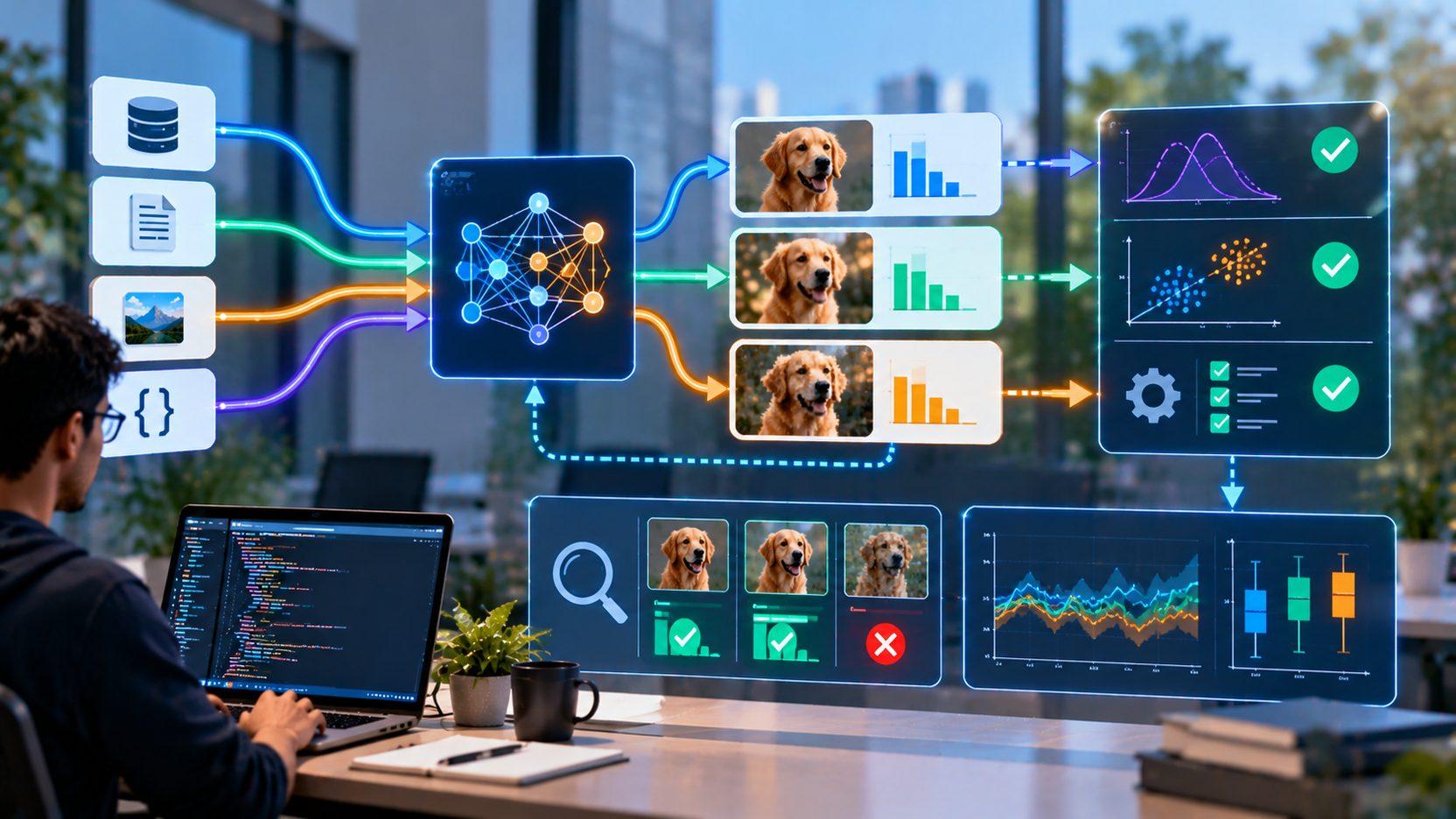
Section 1: From Model APIs to Production AI Systems
The first phase of modern AI deployment was defined by accessibility. Instead of requiring every organization to train and operate its own machine learning infrastructure, model providers exposed sophisticated AI capabilities through APIs. Developers could integrate a model into an application with relatively little infrastructure investment, dramatically lowering the barrier to experimentation. This approach accelerated AI adoption across industries and enabled software teams to build intelligent features without becoming experts in model training or distributed inference.
However, the simplicity of an API becomes less sufficient as AI moves into production. A production AI system must satisfy requirements that extend far beyond sending requests and receiving responses. Organizations need to control model access, manage latency, handle failures, monitor quality, protect sensitive information, track costs, and ensure that AI behavior remains consistent with business requirements. As the number of AI applications increases, these responsibilities become increasingly difficult to manage independently within individual applications.
The Rise of AI APIs
The emergence of AI APIs fundamentally changed how developers accessed artificial intelligence. Instead of building machine learning models from scratch, engineering teams could connect applications directly to hosted models and immediately incorporate capabilities such as text generation, summarization, classification, embeddings, image understanding, and conversational assistance.
This accessibility accelerated AI adoption because organizations could experiment rapidly without first building expensive machine learning infrastructure. A product team could prototype an AI assistant, customer support application, recommendation feature, or document-processing workflow using an external model service and evaluate its value before making significant infrastructure investments.
AI APIs also created a new form of developer accessibility. Software engineers who did not specialize in machine learning could integrate intelligent capabilities using familiar software development patterns. AI became another programmable service within the application stack, similar to payment services, authentication systems, messaging APIs, and cloud storage.
The result was an unprecedented period of rapid experimentation. Organizations could launch proofs of concept quickly, compare different models, test AI-powered user experiences, and identify valuable use cases without committing to complex infrastructure. This API-driven model played an important role in bringing AI from specialized research environments into mainstream software development.
The Emergence of AI Infrastructure
The increasing complexity of production AI has created a dedicated layer of AI infrastructure between applications and individual models. This layer provides standardized services that simplify deployment while giving organizations greater control over how AI is consumed.
One important component is the model gateway, which provides a standardized interface between applications and multiple AI models. Instead of embedding individual model APIs throughout application code, teams can interact with a common gateway responsible for authentication, routing, usage tracking, and policy enforcement.
AI infrastructure also includes specialized inference infrastructure designed to efficiently execute machine learning models at scale. Organizations running their own models must manage compute resources, accelerators, model serving, scaling, batching, and workload scheduling. These responsibilities become increasingly complex as model sizes and request volumes increase.
Behind these services are sophisticated data pipelines that prepare information for AI applications. Retrieval systems, embedding pipelines, document processing, vector databases, and enterprise knowledge repositories all become critical components of modern AI architecture.
Together, these capabilities establish the foundation for an AI deployment architecture that is significantly more sophisticated than direct API consumption. The organization begins moving from individual AI integrations toward reusable infrastructure that can support many applications consistently.
The transition is important because it changes the fundamental unit of AI deployment. Instead of asking, "How do we connect this application to an AI model?" organizations increasingly ask, "How do we provide reliable, governed, observable AI capabilities to every application that needs them?" That question marks the beginning of the platform era.
Readers interested in how software engineering teams are adapting to this transition should also explore "Why Every Software Team Will Have an AI Engineer by 2030," which examines the growing role of AI expertise within modern engineering organizations.
Key Takeaway
AI APIs made artificial intelligence accessible to mainstream software developers, but production-scale AI requires far more than model access. Reliability, monitoring, security, cost management, scaling, inference infrastructure, data pipelines, and model gateways have become essential components of enterprise AI deployment. As these requirements grow, organizations are moving from isolated API integrations toward reusable AI infrastructure capable of supporting production workloads consistently and efficiently.
Section 2: Building Intelligent AI Deployment Platforms
The transition from AI APIs to production infrastructure represents only the first stage of enterprise AI maturity. Once organizations operate multiple AI applications, they quickly discover that simply providing access to models is not enough. Different teams may use different foundation models, retrieval systems, embedding services, vector databases, prompts, and AI agents, creating a fragmented ecosystem that becomes increasingly difficult to manage. The challenge is no longer just deploying an individual model; it is coordinating an entire network of intelligent components while maintaining performance, security, governance, and cost efficiency.
This is where intelligent AI deployment platforms become increasingly important. These platforms provide a centralized operational layer between AI applications and the underlying models, data, infrastructure, and tools. They allow organizations to standardize how AI capabilities are deployed and consumed while giving engineering teams flexibility to experiment with different models and architectures. Instead of every application implementing its own model routing, retrieval infrastructure, authentication, monitoring, and orchestration, shared platform services provide these capabilities consistently across the enterprise.
The development of intelligent deployment platforms also marks the emergence of AI Platform Engineering as a specialized discipline. Platform teams increasingly build internal systems that allow developers to deploy models, configure AI agents, connect enterprise knowledge, manage prompts, monitor applications, and scale workloads through standardized interfaces. The result is an architecture where AI becomes a reusable organizational capability rather than a collection of disconnected application-level integrations.
Multi-Model AI Deployment
One of the defining characteristics of modern AI infrastructure is multi-model AI deployment. Organizations increasingly rely on multiple foundation models because different workloads have different requirements. A sophisticated reasoning model may be appropriate for complex analytical tasks, while a smaller model may be sufficient for classification, summarization, or routine customer interactions. Specialized models may also provide advantages for coding, multimodal processing, multilingual applications, or domain-specific workloads.
This creates a need for intelligent model routing. Instead of hard-coding one model into an application, an AI deployment platform can determine which model should process a request according to factors such as task complexity, latency requirements, security policies, availability, and cost. A simple request can be directed toward a smaller and less expensive model, while complex reasoning tasks can be routed toward a more capable model.
Effective routing depends upon intelligent model selection. The platform evaluates the characteristics of incoming requests and matches them against the capabilities of available models. This allows organizations to take advantage of multiple models without forcing application developers to understand the operational details of each provider or deployment environment.
Multi-model environments also require inference optimization. Engineering teams must optimize how models consume computational resources, particularly when operating large models at high request volumes. Techniques such as batching, caching, workload distribution, and dynamic resource allocation can improve throughput while reducing latency and infrastructure costs.
This creates an important cost-performance tradeoff. The most capable model is not necessarily the optimal choice for every request. Intelligent deployment platforms can continuously balance response quality, latency, availability, and cost, selecting the most appropriate model for each workload rather than treating model selection as a fixed application configuration.
AI Platform Engineering
The growth of these capabilities has created a new discipline known as AI Platform Engineering. Instead of asking every application team to build its own AI infrastructure, organizations create centralized platforms that provide common services to development teams.
These platforms often provide internal AI platforms that expose standardized access to models, retrieval systems, AI agents, observability, security controls, and deployment pipelines. Developers can build applications using these shared services without repeatedly implementing infrastructure from scratch.
A major benefit is shared infrastructure. Multiple applications can use common model gateways, vector databases, prompt repositories, evaluation systems, monitoring platforms, and governance services. This reduces infrastructure duplication while ensuring AI capabilities remain consistent across the organization.
AI Platform Engineering also enables developer self-service. Instead of submitting infrastructure requests to specialized machine learning teams, developers can increasingly provision AI capabilities through standardized interfaces. They can select approved models, create deployment environments, configure retrieval sources, register tools, deploy agents, and access monitoring capabilities without manually managing underlying infrastructure.
Self-service must be balanced with platform standardization. Enterprises cannot allow every development team to build AI systems using completely different security controls, model configurations, deployment processes, and monitoring approaches. Standardized platform capabilities establish common patterns while preserving sufficient flexibility for teams to innovate.
This balance between flexibility and standardization is one of the defining challenges of enterprise AI platform engineering. Developers need freedom to experiment with new models and architectures, while organizations need centralized governance and operational consistency. Intelligent deployment platforms provide the layer that makes both objectives possible.
The evolution toward intelligent deployment platforms therefore represents a fundamental change in enterprise AI architecture. Organizations are moving from a model-centric approach, where applications simply consume AI APIs, toward a platform-centric approach where models, data, agents, tools, infrastructure, and governance operate as interconnected components of a larger intelligent system. This architecture provides the foundation necessary for scaling AI across hundreds or thousands of applications without allowing operational complexity to grow at the same rate as AI adoption.
As organizations mature, the deployment platform increasingly becomes the central interface through which engineering teams interact with enterprise AI. Models become interchangeable services, retrieval becomes a shared capability, agents become orchestrated workloads, and infrastructure becomes an underlying resource managed by the platform. This transition creates a scalable foundation for the next stage of enterprise AI adoption.
Readers interested in how AI orchestration enables increasingly autonomous enterprise workflows should also explore "The Engineering Behind Autonomous AI Workflows," which examines how models, tools, data, and intelligent agents work together within production AI architectures.
Key Takeaway
Intelligent AI deployment platforms transform AI from a collection of individual model integrations into a coordinated enterprise capability. Multi-model deployment, intelligent routing, inference optimization, LLM orchestration, tool calling, AI agents, RAG, vector databases, enterprise search, context engineering, shared infrastructure, and developer self-service enable organizations to deploy sophisticated AI systems at scale. The result is a platform-centric architecture that gives engineering teams greater flexibility while maintaining the standardization, governance, and operational consistency required for enterprise AI.
Section 3: Operating AI at Enterprise Scale
Moving artificial intelligence from controlled experimentation into enterprise-wide production creates an entirely different category of engineering challenge. A prototype can succeed when a model generates an impressive response during a demonstration, but production AI must deliver acceptable quality across thousands or millions of interactions while remaining available, secure, observable, compliant, and economically sustainable. As organizations deploy Large Language Models (LLMs), Retrieval-Augmented Generation (RAG) pipelines, AI agents, multimodal systems, and intelligent workflows across multiple applications, the operational surface area expands dramatically. Every model, prompt, retrieval source, tool integration, and autonomous workflow introduces another component whose behavior must be understood and controlled.
Traditional production engineering practices remain essential, but they cannot address every characteristic of AI systems. Conventional monitoring can determine whether an API is available or whether infrastructure utilization has increased, yet it cannot automatically explain whether retrieved context was relevant, whether a model produced an unsupported answer, or whether an agent selected an inappropriate tool. Similarly, conventional CI/CD pipelines were designed primarily around deterministic software artifacts, while AI applications contain probabilistic models, prompts, retrieval configurations, evaluation datasets, and orchestration logic that can change application behavior without conventional code modifications.
Enterprise AI therefore requires a broader operational discipline combining AI observability, governance, continuous deployment, reliability engineering, and cost management. These capabilities transform AI deployment from a one-time engineering activity into a continuously managed production lifecycle. Intelligent AI platforms increasingly centralize these responsibilities so organizations can operate large portfolios of AI applications without forcing individual product teams to independently build monitoring, security, deployment, and reliability infrastructure.
AI Observability and Monitoring
Operating AI reliably begins with understanding how intelligent systems behave after deployment. Traditional application monitoring focuses heavily on infrastructure signals such as CPU utilization, memory consumption, request latency, error rates, and service availability. These metrics remain valuable, but production AI introduces additional dimensions of performance that require dedicated AI observability.
One important area is model performance. Engineering teams need visibility into whether AI-generated responses remain accurate, relevant, consistent, and aligned with application requirements. Unlike deterministic software, where identical inputs generally produce predictable outputs, generative AI can produce different responses depending on model configuration, context, prompts, and sampling behavior. Production evaluation must therefore examine the quality of model behavior continuously rather than assuming successful infrastructure execution means successful application performance.
Latency becomes equally important as AI applications move into interactive workflows. A customer-facing assistant that requires several seconds for every response may create a poor experience even when its answers are accurate. Agentic workflows can introduce additional latency because a single user request may trigger retrieval operations, multiple model calls, external tools, validation stages, and additional reasoning. Observability platforms help engineering teams identify which component contributes most significantly to end-to-end response time.
Another critical requirement is hallucination detection. Generative models can produce plausible information that is unsupported by available evidence. Enterprise applications therefore require evaluation mechanisms that examine grounding, citation quality, retrieval relevance, and factual consistency. In RAG architectures, engineering teams must distinguish between failures caused by the model and failures caused by retrieval. An incorrect answer may originate because the correct document was never retrieved rather than because the language model failed to reason correctly.
Comprehensive usage analytics adds another layer of operational intelligence. Organizations monitor which applications, models, prompts, agents, and features generate the highest demand while evaluating user engagement and workflow outcomes. These insights allow platform teams to understand how AI infrastructure is actually being consumed and identify where optimization efforts will create the greatest value.
Managing AI Costs and Reliability
Enterprise AI deployment must ultimately remain economically and operationally sustainable. Powerful models can deliver exceptional capabilities, but indiscriminately using the most expensive model for every request can make large-scale applications financially impractical. This has made inference economics an important architectural consideration.
Organizations increasingly analyze the cost of individual AI workflows rather than considering infrastructure expenditure only at the platform level. A single user interaction may involve embeddings, retrieval, multiple model calls, reranking, tool execution, and validation. Understanding the complete cost of that workflow allows engineering teams to identify where optimization will have the greatest impact.
Effective resource optimization can involve caching repeated responses, reducing unnecessary context, selecting smaller models for simpler tasks, batching inference workloads, optimizing retrieval, and dynamically routing requests according to complexity. Intelligent platforms can apply these strategies centrally, allowing optimization improvements to benefit multiple applications simultaneously.
Cost efficiency cannot come at the expense of availability. AI applications supporting customer service, engineering operations, enterprise search, or critical business processes require fallback strategies when individual models or infrastructure components become unavailable. Multi-model architectures can provide resilience by routing requests toward alternative models when primary services fail.
Production platforms must also support effective failure recovery. Model timeouts, retrieval outages, tool failures, malformed responses, and agent execution errors should not automatically result in complete workflow failure. Retry strategies, graceful degradation, circuit breakers, alternative models, and human escalation mechanisms allow applications to continue operating when individual AI components encounter problems.
The result is a broader definition of reliability than traditional infrastructure availability. A reliable AI platform must remain technically available while also delivering acceptable response quality, predictable latency, controlled costs, appropriate security, and recoverable workflow execution.
Operating AI at enterprise scale therefore requires organizations to think beyond model deployment. The production lifecycle extends across observability, evaluation, governance, security, continuous delivery, cost optimization, and reliability engineering. These capabilities are increasingly consolidated within intelligent AI platforms, creating a shared operational foundation that allows organizations to expand AI adoption without multiplying operational complexity across every application team.
Readers interested in the relationship between technical AI decisions and organizational outcomes should also explore “The Business of AI: What Every ML Engineer Should Know Beyond Coding,” which examines why modern AI engineers increasingly need to understand infrastructure economics, product value, governance, and business strategy alongside model development.
Key Takeaway
Operating AI at enterprise scale requires far more than keeping models online. Organizations must continuously monitor model behavior, latency, hallucinations, retrieval quality, and usage while enforcing identity controls, data protection, compliance, and Responsible AI policies. CI/CD for AI, model and prompt versioning, automated rollback, inference economics, resource optimization, resilient architectures, and failure recovery collectively turn experimental AI applications into dependable production systems. Intelligent deployment platforms centralize these capabilities, enabling enterprises to scale AI while maintaining the reliability, governance, security, and economic discipline required for mission-critical software.
Section 4: The Future of Intelligent AI Deployment
The evolution of AI deployment is moving toward a fundamental architectural shift. The first generation of AI applications treated models as external services accessed through APIs. The next generation introduced dedicated infrastructure for inference, retrieval, monitoring, security, and orchestration. The emerging generation is moving further toward intelligent AI platforms capable of dynamically managing models, agents, data, infrastructure, and business workflows according to changing requirements.
This evolution is important because enterprise AI environments are becoming increasingly complex. Organizations may operate dozens of foundation models, hundreds of AI applications, thousands of autonomous agents, and enormous volumes of enterprise data simultaneously. Static deployment configurations cannot efficiently manage this level of complexity. Enterprises increasingly need platforms that can understand workloads, select appropriate models, allocate resources, detect failures, optimize costs, and continuously improve AI performance with minimal manual intervention.
The future therefore lies in deployment platforms that are not merely infrastructure management systems but intelligent operational layers. These platforms will increasingly make decisions about how AI should be deployed and operated while remaining subject to organizational policies and human oversight. They will connect models, data, applications, agents, infrastructure, and governance into a unified environment capable of adapting continuously to changing business conditions.
Self-Optimizing AI Platforms
Future AI deployment platforms will increasingly perform self-optimization, continuously analyzing production workloads and adjusting infrastructure and model configurations according to real-world requirements. Rather than requiring engineers to manually determine which model should process every category of request, the platform will evaluate performance data and dynamically optimize deployment decisions.
One important capability will be automated model selection. AI platforms will evaluate factors such as task complexity, accuracy requirements, latency constraints, security policies, model availability, and cost before selecting an appropriate model. A lightweight model may process routine requests while more computationally expensive models handle complex reasoning tasks. The platform can continuously refine these decisions based on observed production performance.
This capability naturally leads to adaptive routing. Instead of routing requests according to static rules, intelligent platforms will dynamically redirect workloads based on current infrastructure conditions. If one model experiences elevated latency or capacity constraints, requests can automatically move toward alternative models or deployment environments. Routing decisions can therefore respond to real-time operational conditions rather than relying entirely on predefined configurations.
AI platforms will also perform increasingly sophisticated infrastructure optimization. They can analyze accelerator utilization, inference throughput, memory consumption, request patterns, and workload demand before adjusting computational resources. Capacity can increase during periods of high demand and contract during lower utilization, improving both performance and infrastructure economics.
Underlying these capabilities is continuous learning. Deployment platforms will increasingly learn from production behavior, evaluating which models, routing strategies, retrieval configurations, and infrastructure allocations produce the best combination of quality, latency, reliability, and cost. The platform itself becomes an adaptive system that improves its operational decisions over time.
Preparing for the Next Generation of AI Deployment
The transition toward intelligent AI deployment will require organizations to develop new future engineering skills. Engineers will increasingly need expertise across distributed systems, cloud infrastructure, machine learning, Large Language Models, AI agents, RAG architectures, AI observability, security, governance, and platform engineering. Understanding how individual models work will remain important, but engineers will also need to understand how complete AI ecosystems behave under production conditions.
Organizations will also need to rethink platform architecture. Instead of designing infrastructure around individual model integrations, enterprises will increasingly build abstraction layers that allow applications to consume multiple models, retrieval systems, agents, and AI services through standardized interfaces. This architecture reduces model lock-in while allowing organizations to adopt new AI capabilities as they emerge.
A mature AI strategy will therefore focus on infrastructure as much as application development. Organizations must determine which AI capabilities should be centralized, which should remain application-specific, how governance should be enforced, and how AI infrastructure should scale across business units. These decisions will influence both the speed and sustainability of enterprise AI adoption.
Ultimately, intelligent deployment platforms will contribute directly to competitive advantage. As foundation models become increasingly accessible, simply having access to advanced AI will no longer provide meaningful differentiation. Organizations will compete based on how effectively they deploy, govern, orchestrate, optimize, and integrate intelligence into their products and operations.
The evolution from APIs to intelligent platforms therefore represents much more than an infrastructure upgrade. It represents a fundamental change in how organizations conceptualize AI itself. Models are becoming components within broader intelligent systems, while deployment platforms are becoming the mechanisms that coordinate those components. The most advanced enterprises will build platforms capable of adapting automatically to workloads, optimizing infrastructure continuously, coordinating AI agents, enforcing governance, and improving operational performance over time.
The future of AI deployment will ultimately be defined by platforms that understand not only where AI should run, but which intelligence should be used, how it should be orchestrated, when it should adapt, and what constraints should govern its behavior. Organizations capable of building this intelligent operational layer will be able to scale AI faster and more reliably while controlling costs, maintaining security, and continuously improving business outcomes.
Readers interested in how emerging AI technologies become production-ready engineering systems should also explore "Research to Real-World ML Engineering: Bridging the Gap," which examines the engineering practices required to transform AI innovations into scalable real-world systems.
Key Takeaway
The future of AI deployment is moving from infrastructure that simply hosts models toward intelligent platforms that continuously manage and optimize entire AI ecosystems. Self-optimizing platforms, automated model selection, adaptive routing, infrastructure optimization, AI-managed operations, self-healing systems, predictive operations, enterprise intelligence, and AI-native architectures will redefine how organizations deploy artificial intelligence. The companies that build these intelligent deployment platforms will be positioned to scale AI more efficiently, securely, and reliably while turning AI infrastructure itself into a source of long-term competitive advantage.
Conclusion
The evolution of AI deployment reflects a much broader transformation in how organizations build and operate software. The first phase of AI adoption was centered on APIs that gave developers convenient access to powerful machine learning and foundation models. This approach dramatically accelerated experimentation because teams could integrate intelligence without building complex infrastructure themselves. However, as AI applications moved into production, organizations discovered that model access was only one component of a much larger engineering challenge. Reliability, security, observability, cost management, data integration, model selection, orchestration, and governance all became essential requirements for operating AI successfully at scale.
The transition from APIs to dedicated AI infrastructure represented the next stage of this evolution. Organizations began introducing model gateways, inference infrastructure, retrieval pipelines, vector databases, monitoring systems, and standardized deployment architectures. These components created a layer between applications and models, allowing engineering teams to manage AI more consistently. Instead of every application independently integrating and operating its own AI services, shared infrastructure provided reusable capabilities that could support multiple products and business functions.
The emergence of intelligent AI deployment platforms represents the next major step. These platforms do more than provide infrastructure; they coordinate models, data, AI agents, tools, workflows, security policies, and operational processes as interconnected components of a unified ecosystem. Multi-model deployment enables organizations to select different models according to workload requirements, while intelligent routing balances quality, latency, availability, and cost. AI orchestration coordinates model calls, retrieval operations, external tools, and autonomous agents to execute increasingly sophisticated workflows. RAG, vector databases, enterprise search, and context engineering allow AI systems to reason over current organizational knowledge rather than relying solely on model training data.
Operating these systems at enterprise scale requires an equally sophisticated operational foundation. AI observability provides visibility into model performance, latency, hallucinations, retrieval quality, usage patterns, and business outcomes. Security and governance protect enterprise information while ensuring that AI systems comply with organizational and regulatory requirements. AI Operations extends DevOps and MLOps practices to address model updates, prompt versioning, evaluation, deployment, rollback, and continuous optimization. Cost management and reliability engineering ensure that increasing AI adoption does not result in uncontrolled infrastructure expenses or unacceptable operational risk.
Frequently Asked Questions (FAQs)
1. What is AI deployment?
AI deployment is the process of integrating artificial intelligence models and supporting components into production applications so they can reliably serve real-world users and business workflows.
2. How did AI deployment evolve from APIs to platforms?
AI deployment initially relied on simple model APIs that allowed applications to access external AI capabilities. As organizations moved into production, they introduced infrastructure for inference, monitoring, security, retrieval, and orchestration. These capabilities have increasingly evolved into unified intelligent AI deployment platforms.
3. Why are AI APIs no longer sufficient for enterprise AI?
AI APIs provide model access but do not by themselves solve the broader challenges of enterprise deployment, including multi-model routing, security, governance, observability, cost optimization, retrieval, agent orchestration, reliability, and continuous deployment.
4. What is an intelligent AI deployment platform?
An intelligent AI deployment platform is a centralized infrastructure layer that manages models, AI agents, data, retrieval systems, tools, orchestration, security, governance, monitoring, and deployment processes across multiple AI applications.
5. How does multi-model AI deployment work?
Multi-model AI deployment allows organizations to use multiple AI models simultaneously. Intelligent routing determines which model should process a request based on factors such as task complexity, performance requirements, latency, availability, security, and cost.
6. What is AI orchestration?
AI orchestration coordinates models, retrieval systems, tools, APIs, workflows, and AI agents so they can work together to complete complex tasks rather than operating as isolated services.
7. How does RAG affect AI deployment?
Retrieval-Augmented Generation (RAG) connects AI models to external knowledge sources. It allows applications to retrieve relevant enterprise information before generating responses, improving contextual accuracy and reducing reliance on static model knowledge.
8. What is AI Platform Engineering?
AI Platform Engineering involves building reusable infrastructure and services that allow development teams to deploy, manage, monitor, secure, and scale AI applications through standardized enterprise platforms.
9. What is AI observability?
AI observability is the practice of monitoring AI systems across dimensions such as model performance, response quality, latency, hallucinations, retrieval accuracy, infrastructure health, usage, and operational cost.
10. How do enterprises secure AI deployments?
Enterprises secure AI deployments through identity and access management, authorization, encryption, data protection, audit logging, secure APIs, governance policies, privacy controls, and Responsible AI practices.
11. How do organizations manage AI deployment costs?
Organizations manage AI costs through intelligent model selection, adaptive routing, inference optimization, caching, resource allocation, workload distribution, infrastructure monitoring, and selecting less expensive models for appropriate workloads.
12. What is continuous deployment for AI systems?
Continuous deployment for AI involves automatically testing and releasing changes to models, prompts, retrieval configurations, workflows, and supporting infrastructure while using evaluation and monitoring systems to identify regressions and enable rapid rollback.
13. How do AI platforms manage multiple AI agents?
AI platforms manage multiple agents through orchestration frameworks that coordinate agent execution, tool usage, data retrieval, permissions, communication, workflow state, monitoring, and failure recovery.
14. What is the future of AI deployment?
The future of AI deployment involves self-optimizing and increasingly autonomous platforms capable of adaptive model routing, automated infrastructure optimization, predictive operations, self-healing, intelligent agent management, and continuous improvement.
15. Why are intelligent AI platforms important for enterprise AI?
Intelligent AI platforms allow organizations to scale AI without multiplying operational complexity. They provide centralized model management, orchestration, security, governance, observability, cost optimization, and infrastructure management, creating the foundation required for reliable and scalable enterprise AI.