
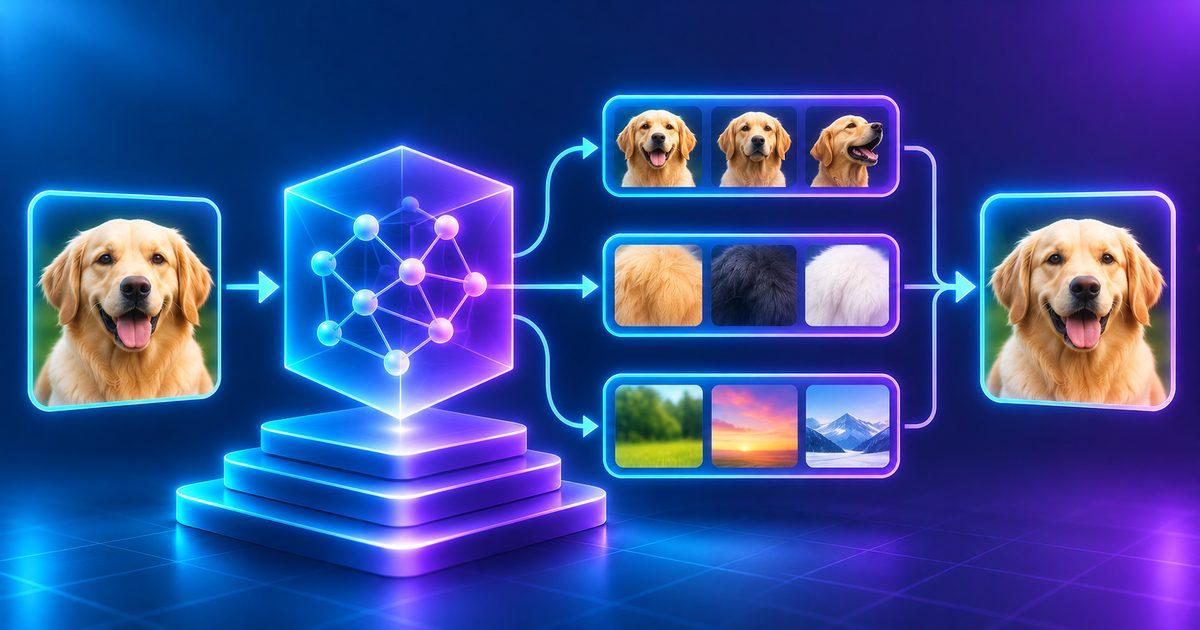
Section 1: Understanding Hidden Factors and Disentangled Latent Representations
What Is Disentangled Representation Learning?
Representation learning allows machine learning models to transform raw inputs into internal features that capture useful information.
For example, an image encoder may convert a high-resolution photograph into a compact numerical vector. The vector contains information that can support image classification, retrieval, reconstruction, or generation.
A conventional representation may distribute information about several underlying properties across many dimensions. The model can use the representation effectively without assigning any single dimension a clear semantic meaning.
Disentangled representation learning attempts to organize this information more systematically.
Suppose an observed image (x) is generated by several underlying factors:
[
s = [s_1,s_2,\ldots,s_k]
]
These factors might represent object identity, rotation, color, scale, lighting, and background.
The observed data can be described conceptually as:
[
x = g(s_1,s_2,\ldots,s_k,\epsilon)
]
Here, (g) is the data-generating process and (\epsilon) represents noise or unmodeled variation.
A representation encoder learns a mapping:
[
z = f_{\theta}(x)
]
The goal is to construct a latent representation (z) whose components correspond, as closely as the task permits, to distinct factors of variation.
For example:
[
z = [z_{\text{shape}},z_{\text{color}},z_{\text{pose}},z_{\text{lighting}}]
]
In an idealized system, changing (z_{\text{color}}) would alter the object's color while leaving its shape, pose, and lighting largely unchanged.
This property is sometimes described as modularity: different factors are represented in different components of the latent space.
However, disentanglement does not necessarily require a strict one-factor-per-coordinate representation. Some factors, particularly geometric quantities such as orientation, may naturally require multiple dimensions or structured subspaces.
For example, representing arbitrary three-dimensional rotation using a single scalar is generally inappropriate. A structured representation may need several coordinates or a mathematical object describing orientation.
The important objective is to separate meaningful factors so that their effects can be analyzed or controlled without unnecessary interference.
This distinction helps explain why disentangled representations are valuable for generative modeling, interpretability, and transfer learning.
A model that separates task-relevant factors can potentially support controlled generation, selective feature reuse, and more targeted analysis of learned behavior.
Entangled Versus Disentangled Representations
The difference between entangled and disentangled representations becomes clearer through a practical example.
Consider a dataset of three-dimensional objects. Each object has a shape, color, size, orientation, and position.
A conventional encoder may produce a latent vector:
[
z = [z_1,z_2,z_3,z_4,z_5]
]
However, the dimensions may contain mixed information.
For example, (z_1) may influence both color and orientation, while (z_2) may affect shape and size. Changing a single coordinate could modify several visible properties simultaneously.
This is an entangled representation.
An idealized disentangled representation would organize the information so that separate latent components control different factors.
For example, changing the orientation component would rotate the object without changing its color or shape.
The distinction can be understood through latent traversal.
A latent traversal begins with an encoded example and modifies one latent component while holding the others fixed. The decoder then reconstructs or generates outputs from these modified representations.
If changing one component consistently affects a single interpretable factor, the representation may exhibit useful disentanglement.
If the same change simultaneously affects several unrelated properties, the representation is more entangled.
However, visual inspection alone is insufficient to establish disentanglement. A model may produce convincing latent traversals while failing to recover the actual factors responsible for the data.
Similarly, a representation may be useful for downstream prediction without matching a human-defined decomposition of the input.
This is why disentanglement should be evaluated against explicit objectives.
If the application requires independently controlling object color and orientation, those factors should be tested directly. If the application requires separating speaker identity from linguistic content, the evaluation should measure whether the representation preserves words while changing speaker characteristics.
The engineering value of disentanglement comes from whether the separation supports a real task, not merely whether the latent space appears organized.
Why Disentangled Representations Matter for Generalization and Interpretability
Disentangled representations are attractive because they may allow machine learning systems to reason about individual factors instead of treating every input as an inseparable combination of characteristics.
Consider a computer vision system that identifies manufactured components. The appearance of a component depends on its identity, orientation, lighting, and camera settings.
If the model can separate object identity from environmental conditions, it may become easier to reuse the identity-related representation across different factories or imaging setups.
This does not guarantee robustness, but it creates an opportunity to analyze and control which factors influence the prediction.
Disentanglement can also support model interpretability.
A developer may be able to investigate how changing a particular latent factor affects a generated image or predicted outcome. This can help identify whether the model relies on meaningful properties or undesirable shortcuts.
For example, if a medical imaging model changes its diagnosis when only scanner-specific appearance is modified, the behavior may indicate that the model has learned an unstable correlation.
A structured latent representation can make such investigations easier.
Another benefit is controllable generation. In a generative application, users may want to modify one attribute while preserving others. A disentangled representation can provide a mechanism for selective editing when the learned factors align with the desired controls.
Disentanglement is also closely related to invariant representation learning. An invariant representation attempts to ignore selected transformations, while a disentangled representation attempts to separate the factors responsible for variation.
A system can combine both approaches by retaining task-relevant factors while isolating nuisance variables that should not influence the final prediction.
For a broader understanding of how machine learning models respond to changing environments, explore InterviewNode's “Adaptive ML Systems: How Models Respond When the Environment Changes”. Separating stable task information from environmental variation is an important consideration when designing adaptive ML systems.
Key Takeaway
Disentangled representation learning aims to organize latent information so that meaningful factors can be analyzed or controlled with limited interference. The approach is useful for interpretability, controllable generation, and selective feature reuse, but statistical independence does not automatically produce semantic meaning. Engineers must define the desired factors and verify that the learned representation supports the intended task.
Section 2: Algorithms and Architectures for Disentangled Representation Learning
Variational Autoencoders and the Foundations of Latent Representation Learning
Variational autoencoders, commonly called VAEs, provide an important foundation for disentangled representation learning.
A VAE is a probabilistic generative model that learns to encode observed data into a latent distribution and reconstruct or generate data from that distribution.
The architecture contains two main components.
The encoder approximates a posterior distribution over latent variables:
[
q_{\phi}(z\mid x)
]
The decoder models the conditional distribution of the observed data given the latent representation:
[
p_{\theta}(x\mid z)
]
The model is typically trained by maximizing the evidence lower bound, or ELBO:
D_{KL}(q_{\phi}(z\mid x)|p(z))
]
The first term encourages accurate reconstruction. The second term regularizes the approximate posterior toward the prior distribution.
In many implementations, the prior is a standard multivariate Gaussian:
[
p(z)=\mathcal{N}(0,I)
]
The encoder often predicts the mean and variance parameters of a Gaussian distribution. A latent sample is then generated using the reparameterization trick:
[
z=\mu_{\phi}(x)+\sigma_{\phi}(x)\odot\epsilon
]
where:
[
\epsilon\sim\mathcal{N}(0,I)
]
This formulation allows gradients to propagate through the stochastic sampling process.
VAEs are useful for disentanglement research because they provide a structured latent space and a training objective that can be modified to encourage particular representation properties.
However, a conventional VAE does not guarantee disentanglement. The model may distribute information about a single factor across several latent dimensions or encode multiple factors together.
Additional constraints, supervision, or architectural assumptions are often needed.
β-VAE: Encouraging Factor Separation Through Regularization
β-VAE is one of the foundational approaches to disentangled representation learning.
It modifies the conventional VAE objective by introducing a coefficient that controls the strength of the KL-divergence regularization term.
A common minimization form is:
\mathcal{L}{reconstruction}
+
\beta D{KL}(q_{\phi}(z\mid x)|p(z))
]
Here, (\beta) controls the relative importance of latent regularization.
When (\beta=1), the objective corresponds to the standard VAE weighting under the same reconstruction formulation.
When (\beta) is increased, the model is encouraged to place stronger constraints on the information encoded in the latent representation.
This can encourage a more factorized representation, although it does not guarantee that the resulting factors will correspond to meaningful concepts.
Consider a dataset of objects varying in shape, color, scale, and rotation. A β-VAE may learn latent dimensions associated with some of these properties.
A developer can inspect the representation by changing one latent dimension and reconstructing the resulting image.
If a single dimension controls object scale while other properties remain stable, the model exhibits useful disentanglement for that factor.
However, stronger regularization introduces a tradeoff.
A high value of (\beta) may reduce the information retained in the latent representation, potentially degrading reconstruction quality.
This is particularly important when the input contains fine details that the downstream task requires.
Research on understanding β-VAE investigated this tradeoff and proposed controlling the information capacity of the latent bottleneck during training. The approach can help balance reconstruction quality with the emergence of structured representations.
In practical implementations, engineers should tune β using validation data and downstream objectives rather than assume that larger values always produce better disentanglement.
Contrastive, Weakly Supervised, and Structured Disentanglement
VAE-based methods are not the only approaches to disentangled representation learning.
Contrastive learning can help separate factors when training examples contain information about which properties are shared and which properties differ.
For example, suppose a dataset contains multiple images of the same object under different lighting conditions.
A contrastive objective can encourage the model to learn an identity-related representation that remains similar across those images while allowing lighting information to vary.
A different objective may encourage the model to preserve lighting characteristics in a separate representation.
This requires carefully constructed positive and negative relationships.
Weakly supervised approaches introduce limited information about the factors that differ between examples.
For example, a training dataset may contain pairs of images known to share object identity but differ in pose. The model does not need complete labels for every factor, but the pairwise relationship provides useful structure.
This can help resolve some ambiguities that arise in fully unsupervised learning.
Structured disentanglement approaches may also use separate latent subspaces for different factors:
[
z=[z_{\text{content}},z_{\text{style}},z_{\text{context}}]
]
The training objective can encourage the content representation to remain stable across selected transformations while the style or context representations capture the corresponding variation.
Such methods can be useful for image editing, speech processing, and multimodal learning.
However, the structure of the latent space must be justified by the task.
A model should not assume that all real-world factors are independent or that every meaningful factor can be represented by a single coordinate.
A practical implementation may combine reconstruction losses, contrastive objectives, limited factor labels, and architecture-specific constraints.
The choice should depend on what information is available and what the model must control.
For teams interested in how representation learning objectives connect to practical ML model development, InterviewNode's “ML Testing for Software Engineers: How to Test Systems That Don't Always Produce the Same Output” provides relevant context on validating probabilistic models and ensuring that their behavior remains reliable across different inputs and conditions.
Key Takeaway
VAEs provide a probabilistic foundation for learning latent representations, while β-VAE and FactorVAE introduce regularization mechanisms intended to encourage factor separation. Contrastive and weakly supervised approaches provide additional structure through relationships between examples. No single objective guarantees meaningful disentanglement, so the choice of method should be guided by the available data, intended factors, and downstream evaluation requirements.
Section 3: Training, Evaluating, and Deploying Disentangled Representation Models
Designing Datasets That Expose Meaningful Factors of Variation
Disentangled representation learning depends heavily on the structure of the training data.
A model cannot reliably separate meaningful factors if the available examples do not provide enough information to distinguish them.
Consider a dataset containing images of colored objects. If every red object is a cube and every blue object is a sphere, the model may have difficulty separating color from shape because the two factors are perfectly correlated in the observed data.
To learn a useful separation, the dataset should ideally contain examples in which color and shape vary independently or in sufficiently informative combinations.
This does not mean that every real-world factor must be statistically independent. It means that the dataset must provide enough variation to support the desired distinction.
Synthetic datasets are often useful during research because the underlying factors can be controlled.
For example, a synthetic dataset may contain objects with known variations in shape, size, rotation, color, and position.
Researchers can generate multiple combinations and evaluate whether the model recovers those factors.
Real-world datasets are more challenging.
In facial imagery, identity, expression, pose, and lighting may be correlated. In speech, speaker identity and accent may be related. In medical data, biological characteristics and acquisition conditions may interact.
A practical dataset design should document the intended factors, known correlations, missing combinations, and possible confounding variables.
It should also distinguish between observed labels and assumed latent factors.
For example, a dataset may include camera identifiers and object categories, but it may not contain reliable labels for illumination or object orientation.
Engineers should avoid treating inferred factors as ground truth without validation.
Training and evaluation splits also require care.
If multiple views of the same underlying object appear across training and test sets, the evaluation may overestimate generalization to unseen objects.
The appropriate split depends on the intended use case. A model designed to generalize across object identities should be evaluated on unseen identities. A model designed to generalize across acquisition environments should be tested on held-out environments.
Training Objectives, Latent Capacity, and Reconstruction Tradeoffs
Training a disentangled representation model involves balancing several objectives.
The model must preserve enough information to reconstruct or predict the data while encouraging the desired separation among latent factors.
For a generative model, the reconstruction objective measures how accurately the decoder reproduces the observed input.
A regularization objective controls the structure of the latent representation.
Additional losses may encourage independence, factor consistency, or separation between specific latent subspaces.
A general training objective can be expressed as:
\mathcal{L}{task}
+
\lambda_1\mathcal{L}{reconstruction}
+
\lambda_2\mathcal{L}{disentanglement}
+
\lambda_3\mathcal{L}{regularization}
]
The weights determine the relative importance of each objective.
A common failure mode occurs when the model is encouraged to compress the latent representation too aggressively.
If the encoder cannot retain sufficient information, the decoder may produce blurry or incomplete reconstructions. In extreme cases, the latent representation may become uninformative.
This is related to posterior collapse in variational autoencoders, where the decoder effectively ignores some or all of the latent variables.
Another failure mode occurs when the representation captures the input accurately but remains entangled.
A model may achieve low reconstruction error while distributing meaningful factors across multiple latent dimensions.
Therefore, reconstruction quality alone is not a sufficient measure of disentanglement.
Engineers should evaluate the model across several dimensions: reconstruction fidelity, factor separation, downstream predictive performance, and stability across training runs.
Hyperparameter selection should also be performed carefully.
Increasing the strength of a disentanglement penalty may improve one metric while degrading another. A model that performs well on a synthetic benchmark may not provide the same benefit on a real-world dataset.
The goal is to find a representation that supports the intended engineering task rather than optimize an abstract disentanglement score in isolation.
Production Architecture and Continuous Validation of Latent Representations
A disentangled representation model becomes operationally useful when its latent factors can be integrated into downstream applications.
A typical production architecture includes an input processing layer, a representation encoder, one or more task-specific heads, and a monitoring system.
The encoder converts raw input into a structured latent representation.
Different downstream components may use different portions of that representation.
For example, a visual inspection application may use shape-related features for classification while using lighting-related features to analyze acquisition conditions.
A generative application may expose selected latent controls to allow users to modify particular attributes.
However, production systems must not assume that latent dimensions retain the same semantic meaning across model versions.
Retraining can change the organization of the latent space. A dimension that appeared associated with rotation in one model version may represent a different combination of factors in another.
This creates a compatibility problem.
If downstream services depend on specific latent coordinates, the representation schema must be versioned and validated.
A practical deployment process should include tests for factor alignment, embedding stability, reconstruction quality, and downstream prediction performance.
Monitoring should also track changes in latent distributions.
For example, an encoder deployed in a manufacturing system may begin receiving images from a new camera. The distribution of lighting-related features may shift even if the underlying objects remain unchanged.
Such changes can provide useful operational information, but they should not automatically be interpreted as model failure.
The monitoring system should compare representation changes with actual task outcomes and known environmental conditions.
For a deeper discussion of the engineering requirements involved in deploying learned representations, explore InterviewNode's “From Notebook to Low-Latency Service: The Engineering Journey of a Production ML Model”. Representation versioning, inference consistency, and monitoring are particularly important when a latent encoder becomes a shared dependency across multiple applications.
Key Takeaway
Training disentangled representations requires datasets with informative factor variation, carefully balanced objectives, and evaluation methods that measure more than reconstruction accuracy. Metrics such as MIG, DCI, and SAP provide useful perspectives but should be combined with controlled interventions and downstream testing. Production systems must also account for latent-space compatibility, model versioning, and changing input distributions.
Section 4: Real-World Applications, Limitations, and the Future of Disentangled Representation Learning
Controllable Image Generation and Generative AI
One of the most intuitive applications of disentangled representation learning is controllable image generation.
Generative models learn latent representations that can be used to create new images. However, conventional latent spaces may combine several visual properties in ways that are difficult to manipulate independently.
Disentangled representations aim to provide more structured controls.
For example, an image generation system may allow a user to modify object color while preserving shape and position. Another control may change the camera angle without changing the object's identity.
This can support applications in product visualization, digital design, image editing, animation, and synthetic data generation.
Consider an e-commerce platform that needs to generate product images in multiple colors and orientations.
A model with useful disentangled controls could generate variations while preserving the underlying product geometry.
However, the generated outputs must be validated. Changing a latent variable may introduce unintended modifications, especially when the model has not learned a clean separation between factors.
Modern generative systems often use high-dimensional representations that do not correspond to a simple set of independent semantic controls.
Disentanglement can still be useful, but practical control may require additional supervision, editing directions, conditioning mechanisms, or structured representations.
The objective is not necessarily to assign one human-readable concept to every latent coordinate. It is to make the factors relevant to the application controllable and reliable.
Speech Processing, Robotics, and Multimodal Learning
Disentangled representation learning also has important applications in speech and audio processing.
A speech recording contains linguistic content, speaker identity, accent, emotional expression, background noise, and recording characteristics.
A speech recognition system primarily needs linguistic content. A voice conversion system may need to preserve the words while modifying speaker characteristics.
A disentangled representation can help separate these factors.
For example, a model may encode linguistic content in one representation and speaker-related information in another. The decoder can then combine the content representation with a selected speaker representation.
However, speech factors are not completely independent. Emotion, accent, speaking rate, and pitch can interact with linguistic content.
The representation must therefore preserve meaningful relationships rather than force every property into an artificially independent variable.
Robotics presents a different application.
A robot may need to distinguish object identity from object pose, environmental context, and task-specific state.
A structured representation can help the robot reuse information about an object across different orientations and positions.
For example, a manipulation system may learn one representation describing the object and another describing its spatial configuration.
This can support transfer across different scenes, although successful transfer depends on the quality of the learned factors and the coverage of the training data.
Multimodal learning introduces further opportunities.
A model combining images, text, audio, and sensor data may benefit from separating shared semantic content from modality-specific characteristics.
For example, an image and a text description may share information about object identity while differing in how that information is represented.
A disentangled multimodal system could preserve shared content while retaining modality-specific features needed for generation or prediction.
These applications illustrate why disentanglement is better understood as structured information separation rather than a requirement that every latent dimension be statistically independent.
The Future: Causal Representation Learning and Structured Foundation Models
The future of disentangled representation learning is increasingly connected to causal representation learning.
Causal representation learning attempts to identify variables and mechanisms that explain how observed data is generated and how it changes under interventions.
This differs from simply encouraging statistical independence.
Two factors may be correlated because one influences the other. A causal representation aims to preserve the relationship while identifying the underlying mechanisms.
For example, changing lighting affects the appearance of shadows. A model that understands the relationship between light direction and shadow geometry may support more reliable scene manipulation than a model that treats lighting and shadows as unrelated factors.
Structured generative models can represent these dependencies explicitly.
Another important direction is the use of partial supervision.
Rather than attempting to discover every factor from completely unlabeled observations, models can incorporate limited information about known attributes, paired observations, or interventions.
For example, a dataset may identify which images share object identity while differing in pose. This information can help the model separate identity from orientation.
Foundation models create additional opportunities.
Large pretrained encoders learn rich representations from diverse data. These representations may contain information about many semantic factors, but they are not necessarily disentangled.
Task-specific training can attempt to organize selected factors into controllable subspaces.
For example, a pretrained vision model may be adapted to separate object identity from camera viewpoint for a robotics application.
However, this process requires careful evaluation. A high-dimensional representation may contain useful information distributed across many coordinates, and forcing a simple decomposition may reduce performance.
Another emerging direction is the use of concept-based models.
Instead of learning arbitrary latent dimensions, these systems may represent intermediate concepts that are meaningful for a particular task.
For example, a medical decision system might use clinically defined intermediate features, while an industrial inspection system might represent specific defect characteristics.
Such approaches can support more targeted explanations, although the concepts must be validated and their relationship to the final prediction carefully assessed.
The long-term opportunity is to develop representations that are not only useful for prediction but also structured enough to support intervention, control, transfer, and reliable interpretation.
For engineering teams responsible for maintaining these systems, InterviewNode's “MLOps for Software Engineers: Building, Deploying, and Monitoring Machine Learning Models in Production” provides relevant context on model lifecycle management, monitoring, and the operational practices required to maintain reliable ML systems as their representations evolve.
Key Takeaway
Disentangled representation learning can support controllable generation, speech processing, robotics, and multimodal systems, but its limitations are fundamental. Unsupervised learning does not guarantee recovery of meaningful factors, and statistical independence should not be confused with causal structure. Future approaches will likely combine structured representations, partial supervision, causal assumptions, and pretrained models to improve controllability and interpretability.
Conclusion: From Hidden Features to Structured Machine Learning Representations
Machine learning models can learn powerful representations without understanding how the underlying factors of variation relate to one another.
A neural network may recognize an object, generate an image, or predict an outcome while encoding several different properties in an entangled latent space.
Disentangled representation learning attempts to make these representations more structured.
By separating factors such as shape, color, pose, identity, style, and environmental context, these models can support more targeted control, analysis, and reuse of learned information.
Variational autoencoders provide a probabilistic foundation for latent representation learning. β-VAE introduces stronger regularization intended to encourage factor separation, while FactorVAE targets statistical dependence through total correlation. Contrastive and weakly supervised methods provide additional ways to introduce structure into the learning process.
However, disentanglement is not guaranteed by architecture or regularization alone.
The fundamental challenge is determining whether the learned factors correspond to meaningful properties of the data-generating process.
Without sufficient assumptions, supervision, or interventions, multiple latent representations may explain the same observations.
For engineers, this means that disentanglement should be treated as a measurable design objective rather than an automatic property of a model.
The most useful implementations begin with a clear definition of the factors that matter to the application. They use datasets that expose relevant variation, training objectives that encourage the desired structure, and evaluations that test whether the representation supports real downstream tasks.
As machine learning systems become more complex, the ability to organize internal representations will become increasingly valuable.
The goal is not simply to create models with cleaner latent spaces. It is to build models whose internal structure supports reliable prediction, meaningful control, and a better understanding of how information is represented.
Frequently Asked Questions
1. What is disentangled representation learning?
Disentangled representation learning is a machine learning approach that aims to separate meaningful factors of variation into distinct components of a latent representation. It can make models easier to control, analyze, and reuse for different tasks.
2. What are latent factors in machine learning?
Latent factors are underlying variables that influence observed data but are not necessarily measured directly. Examples include object identity, shape, color, pose, lighting, speaker identity, and environmental conditions.
3. What is the difference between entangled and disentangled representations?
An entangled representation mixes information about several factors across latent components. A disentangled representation attempts to separate those factors so that changing one component has limited effects on unrelated properties.
4. Why is disentangled representation learning important?
It can support controllable generation, model interpretability, selective feature reuse, and transfer across tasks. However, these benefits must be demonstrated through evaluation rather than assumed from the structure of the latent space.
5. What is a variational autoencoder?
A variational autoencoder is a probabilistic generative model that learns to encode data into a latent distribution and reconstruct or generate observations from that distribution. VAEs provide a foundation for many disentangled representation learning methods.
6. What is β-VAE?
β-VAE is a variant of the variational autoencoder that introduces a coefficient controlling the strength of KL-divergence regularization. This can encourage more structured latent representations but may reduce reconstruction quality if the regularization is too strong.
7. What is FactorVAE?
FactorVAE is a generative model that encourages statistical independence among latent dimensions by penalizing total correlation. It was developed to improve the tradeoff between disentanglement and reconstruction quality.
8. What is total correlation in disentangled learning?
Total correlation measures statistical dependence among components of a multivariate distribution. A total correlation of zero indicates that the components are statistically independent under the measured distribution.
9. Can disentangled representations be learned without labels?
Models can learn structured representations from unlabeled data, but meaningful disentanglement cannot generally be guaranteed without additional assumptions or inductive biases. Limited supervision or known transformation relationships can help resolve ambiguities.
10. What is the difference between disentanglement and invariance?
Disentanglement attempts to separate different factors of variation, while invariance attempts to make a representation insensitive to selected transformations. A model can combine both by separating nuisance factors from task-relevant information.
11. How is disentanglement measured?
Common metrics include Mutual Information Gap (MIG), Disentanglement, Completeness, and Informativeness (DCI), and Separated Attribute Predictability (SAP). Engineers should combine these metrics with controlled factor tests and downstream performance evaluation.
12. Can disentangled representation learning improve generative AI?
It can help generative models provide more selective control over attributes such as shape, color, orientation, and style. However, modern generative models may require additional conditioning or supervision to achieve reliable attribute control.
13. Is disentangled representation learning the same as causal representation learning?
No. Disentanglement focuses on separating factors in a representation, while causal representation learning attempts to identify variables and mechanisms that explain how data changes under interventions. A disentangled representation is not automatically causal.
14. What are the main challenges of disentangled representation learning?
Major challenges include identifiability, correlated factors, reconstruction tradeoffs, unreliable evaluation metrics, latent-space instability, and limited generalization across datasets. Meaningful factor separation often requires domain knowledge or additional supervision.
15. What is the future of disentangled representation learning?
Future work is likely to combine disentangled representations with causal modeling, foundation models, weak supervision, structured generative architectures, and concept-based learning. The objective is to create representations that support more reliable control, transfer, and interpretation.