Section 1: Why Traditional Software Testing Is Not Enough for ML Systems
Exact Output Assertions Do Not Capture Model Correctness
Traditional software testing often relies on deterministic assertions in which engineers provide a known input and verify that the resulting output matches an expected value. This approach works particularly well for functions, APIs, parsers, and business rules where the relationship between input and output is explicitly defined. Machine-learning systems require a broader testing strategy because a prediction is generated from learned statistical relationships, meaning that multiple outputs can be reasonable even when the same general input pattern is presented.
A classification model, for example, may assign probabilities across several classes rather than producing a guaranteed answer, while a recommendation model can return different rankings that remain equally useful according to the application's objectives. A forecasting model can also change its prediction as additional information becomes available without indicating that the implementation is incorrect. Requiring every prediction to match a single hard-coded value can therefore create tests that reject legitimate model behavior or encourage engineers to overfit validation criteria to historical examples.
This does not make assertions irrelevant because deterministic testing remains essential for the software surrounding the model. Engineers can still verify that preprocessing functions return the expected schema, feature transformations apply the correct formulas, APIs reject invalid inputs, and inference services handle failures appropriately. The difference is that model outputs often need to be evaluated against acceptable ranges, statistical properties, performance thresholds, or behavioral constraints rather than exact equality.
The definition of correctness consequently becomes more nuanced because engineers must establish what constitutes an acceptable prediction for the task. A classification system may require a minimum precision or recall level, a ranking system may need to maintain a specified quality metric, and a forecasting model may need its errors to remain below an agreed threshold. Testing must validate these boundaries rather than assuming that one exact output represents universal correctness.
ML Systems Can Fail Through Data Without Breaking the Code
One of the most important differences between conventional software testing and ML testing is that the system's behavior depends directly on data. A software function can remain stable when its implementation does not change, but a machine-learning model can behave differently when the distribution, quality, or meaning of its inputs changes. This means that testing the application code alone cannot establish that the overall ML system remains reliable.
Training data can contain missing values, incorrect labels, duplicated records, leakage, outliers, or biased samples that affect model behavior long before the trained artifact reaches production. Production data can introduce another set of problems through schema changes, unexpected value ranges, altered category frequencies, stale features, or changes in user behavior. In many cases, these issues do not generate exceptions because the model can technically process the data even when its predictions become less reliable.
Data validation therefore becomes a testing layer in its own right. Engineers can verify schemas, data types, allowable ranges, null rates, category distributions, feature relationships, and other properties that should remain within expected boundaries. These checks help catch problems before they propagate into training or inference and provide an early warning when assumptions about the data are no longer valid.
The importance of this layer is closely related to “Data-Centric AI: Why Improving Your Dataset Can Beat Changing Your Model,” because model performance depends heavily on the quality and consistency of the data used to create predictions. Testing the data pipeline is therefore not secondary to testing the model; it is part of validating the system that produces the model's inputs.
Model Changes Can Create Regression Without Code Failures
Traditional regression testing often assumes that a code change should preserve previously expected outputs unless the specification has intentionally changed. ML systems complicate this assumption because retraining can alter model parameters even when the application code remains unchanged. A new training dataset, feature definition, optimization configuration, or random seed can produce a different model artifact and consequently different predictions.
The appropriate regression question therefore becomes whether the new model remains within acceptable behavioral boundaries rather than whether every previous prediction is identical. Engineers can compare candidate and production models using representative evaluation datasets, task-specific quality metrics, subgroup performance, calibration, latency, memory consumption, and other operational measures. A new model may be acceptable even when its individual predictions differ substantially from the previous version if it demonstrates better overall performance without violating critical constraints.
Regression testing should also consider rare and high-impact cases because aggregate metrics can conceal meaningful degradation. A model can improve overall accuracy while becoming significantly worse on a minority class, an important customer segment, or a specific category of production input. Effective ML regression suites therefore need representative datasets that capture the cases where failure has meaningful technical or business consequences.
Key Takeaway
Traditional software tests remain essential for ML applications, but exact-output assertions alone cannot establish that a predictive system is correct because model behavior depends on data, statistical relationships, training processes, and changing production conditions. Effective ML testing therefore combines deterministic software validation with data quality checks, model-level performance thresholds, regression analysis, reproducibility controls, and production monitoring so that engineers can detect failures across the complete system rather than only in the code surrounding the model.
Section 2: How Software Engineers Test Models and Data
Unit Testing Data Transformations and Feature Logic
Software engineers can apply familiar unit-testing practices to the parts of an ML system that perform deterministic transformations, even though the final model prediction may not be deterministic. Feature extraction, normalization, encoding, parsing, missing-value handling, aggregation, and input validation can all have explicit expected behaviors, making them suitable for conventional assertions that verify both correctness and consistency. Testing these components independently is important because a defect in preprocessing can change model predictions substantially while leaving the model implementation untouched.
Feature tests should verify not only the expected output for ordinary inputs but also behavior at boundaries and under unusual conditions. Engineers can test empty collections, missing values, unexpected categories, extreme numerical values, duplicate records, malformed timestamps, and changes in input ordering when those conditions are relevant to the production pipeline. These tests help establish stable contracts between upstream application logic and the model while reducing the risk that an apparently valid production request produces incorrectly constructed features.
Schema validation provides another deterministic testing layer because models generally expect a specific collection of fields, data types, dimensions, and value representations. Engineers can verify that required features exist, categorical values are encoded consistently, numerical ranges remain plausible, and feature ordering matches the model's expectations. These checks are especially valuable when multiple services contribute inputs because an upstream change can otherwise alter model behavior without generating an obvious software failure.
The testing principles described in “The Rise of Data Contracts: Bringing Software Engineering Discipline to ML Data” are particularly relevant because explicit contracts allow engineers to detect incompatible data changes before those changes silently affect predictions. Data and feature tests therefore provide a bridge between conventional software testing and statistical model validation.
Testing Models With Statistical Performance Boundaries
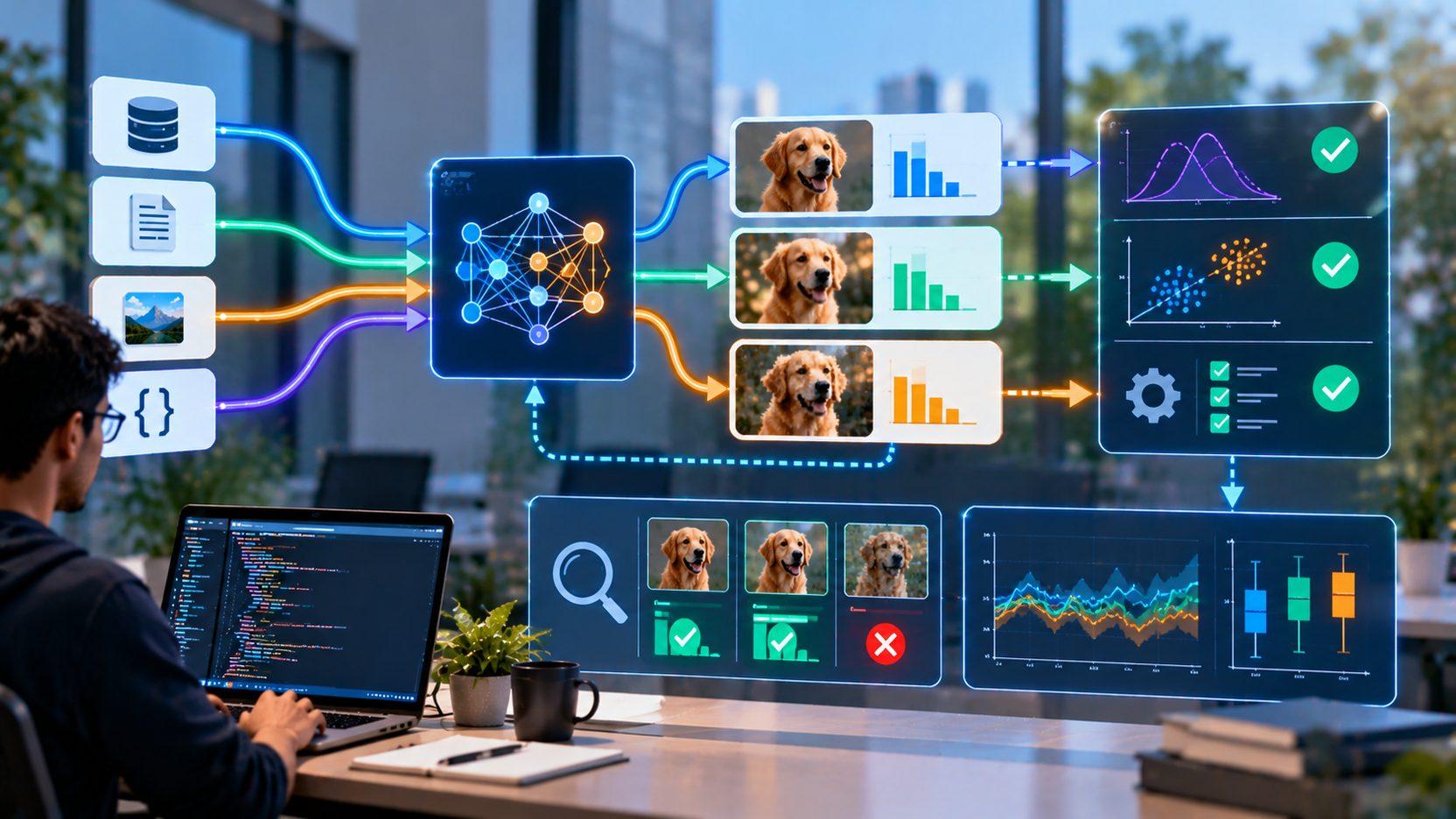
A trained model cannot usually be tested with a single expected output for every input, so engineers instead define acceptable statistical behavior using task-specific metrics and thresholds. Classification systems may be evaluated through precision, recall, F1 score, calibration, or class-specific performance, while regression systems may use measures such as mean absolute error or root mean squared error. The appropriate metric depends on what constitutes useful behavior for the application rather than which metric is easiest to calculate.
Testing should compare model performance against explicit quality thresholds established before deployment. A candidate model might be required to achieve a minimum recall while keeping false positives below a defined limit, or a forecasting model might need to maintain error below a specified range across important time periods. These criteria turn model validation into an automated testable contract, allowing CI/CD systems to reject candidates that fail predefined quality requirements.
Aggregate metrics should not be the only checks because a model can improve overall performance while becoming significantly worse for a smaller but important group of inputs. Engineers can therefore evaluate performance by class, segment, geography, device type, input difficulty, or other dimensions relevant to the application's risk profile. This provides better protection against regressions that disappear when all predictions are combined into a single score.
Threshold-based model tests should also account for expected variation between training runs. Small metric differences may result from sampling, randomness, or changes in optimization without representing meaningful quality degradation. Testing therefore needs reasonable tolerances and statistical context rather than treating every numerical difference as a failure.
Evaluating Robustness, Edge Cases, and Distribution Changes
ML models should be tested against inputs that are unusual, incomplete, noisy, or close to operational boundaries because production data rarely resembles a perfectly curated evaluation dataset. Engineers can construct targeted test sets containing missing features, extreme values, rare categories, malformed inputs, unusual combinations of valid features, or examples from less common regions of the input space. These tests help identify situations where model predictions become unstable or where preprocessing assumptions break.
Robustness testing can also compare how predictions change when inputs are modified slightly in ways that should not materially alter the outcome. For applications where small perturbations should produce similar predictions, engineers can test sensitivity to changes in formatting, ordering, rounding, or irrelevant attributes. The goal is not to require identical output in every circumstance but to identify changes that are disproportionate to the modification introduced.
Distribution-aware testing provides another layer because models may perform differently when evaluation data no longer resembles historical training data. Engineers can compare feature distributions, class frequencies, missing-value rates, and other statistical properties across datasets before accepting a new model or deploying a major data pipeline change. These checks can identify potential distribution shifts before performance degradation becomes visible through delayed business metrics.
Key Takeaway
Effective ML testing combines conventional software tests for deterministic components with statistical validation for model behavior, robustness checks for difficult inputs, distribution-aware testing, and explicit verification of training-serving consistency. Software engineers can create reliable quality gates by defining measurable performance boundaries, testing important edge cases and data assumptions, and validating feature transformations across environments, allowing ML systems to evolve without silently introducing changes that compromise predictive behavior.
Section 3: Testing ML Systems in Production
Production Testing Must Continue After Deployment
Traditional software teams often treat successful deployment as the point at which most functional testing has been completed, but machine-learning systems require testing to continue because model behavior depends on production data and changing environmental conditions. A model can pass every offline validation check and still produce degraded predictions after deployment when user behavior changes, upstream data shifts, or production inputs differ from the evaluation dataset. This means production monitoring becomes an extension of testing rather than a completely separate operational activity.
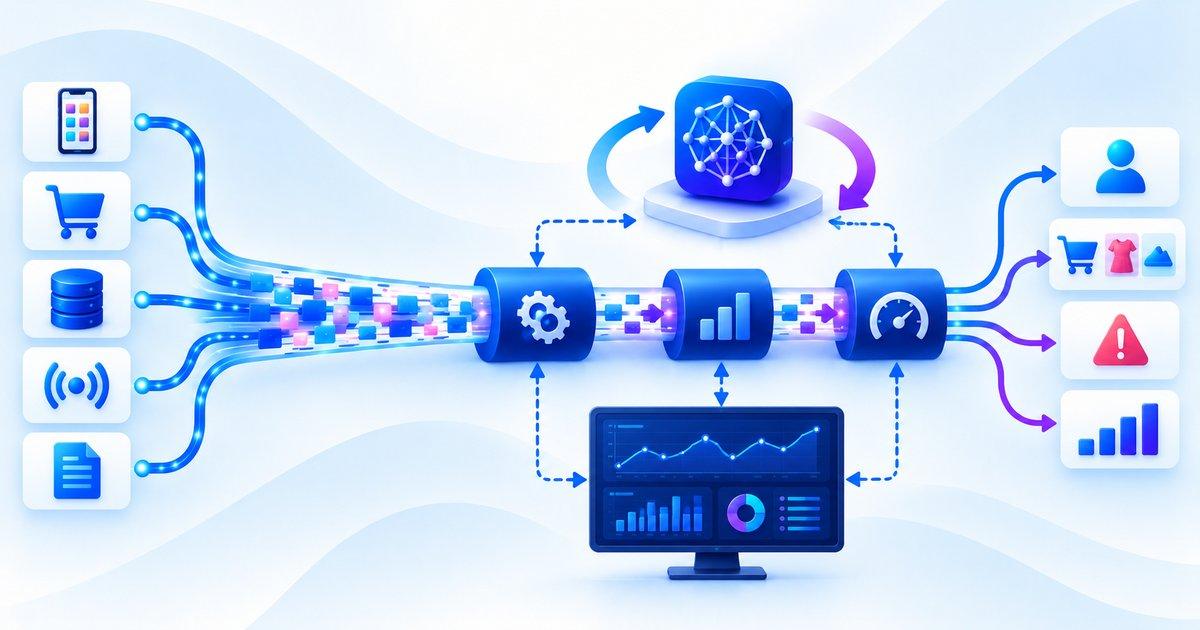
Engineers can establish production quality checks that compare live behavior against expected ranges for prediction distributions, feature values, confidence scores, error rates, and business outcomes. These checks do not necessarily require immediate ground-truth labels because some useful signals can be monitored before the final outcomes become available. A sudden change in the proportion of positive predictions, for example, can indicate a data or model issue even when the actual labels needed for formal accuracy measurement arrive much later.
Production testing should also distinguish between expected variation and meaningful regression. User behavior naturally changes throughout the day, week, or season, so rigid thresholds can generate excessive alerts when normal fluctuations occur. Engineers need baselines that account for historical variation and define conditions under which deviations become statistically or operationally significant. This makes monitoring more useful because teams can focus attention on changes that have a meaningful probability of affecting model behavior.
Shadow Testing and Canary Releases Reduce Deployment Risk
Replacing a production model immediately with a newly trained version creates unnecessary risk because offline evaluation cannot capture every behavior that will occur under live traffic. Shadow testing provides a safer alternative by sending production requests to the candidate model without allowing its predictions to influence user-facing decisions. Engineers can compare its predictions, latency, resource usage, and error characteristics against the existing production model while keeping the current version responsible for the actual application behavior.
Shadow evaluation is particularly valuable when the candidate model has been trained on new data or uses a substantially different architecture. Differences in prediction distributions can reveal unexpected behavior before deployment, while performance measurements can expose inference costs that were not visible in offline benchmarks. The candidate model can therefore be assessed under realistic traffic patterns without immediately exposing users to its decisions.
Canary deployment provides another layer of protection by routing a controlled portion of real traffic to the new model and gradually increasing exposure when its behavior remains within predefined limits. Engineers can compare quality, latency, failure rates, resource utilization, and business metrics between the candidate and production populations before expanding the rollout. This approach makes deployment itself part of the testing strategy rather than treating release as a binary transition.
Rollback procedures should be part of the same design because a model can exhibit problems only after reaching sufficient production volume. Automated rollback thresholds can be based on latency, error rates, prediction anomalies, or available quality metrics, allowing the system to return to a known-good version before a localized issue becomes a broad production incident.
Testing Must Cover Reliability, Performance, and Feedback Loops
Production ML testing also needs to evaluate operational behavior because a statistically strong model can still create application failures when inference latency, memory consumption, or dependency availability falls outside acceptable limits. Engineers should test realistic concurrency, request sizes, feature retrieval times, model initialization behavior, and traffic bursts so that inference infrastructure is validated under conditions similar to actual production workloads.
Feedback loops require another form of testing because the predictions produced by an ML system can influence the data collected for future training. Recommendation models affect which products users see, ranking systems influence which results receive attention, and automated decisions can change the population that generates subsequent labels. A model may therefore appear stable while gradually changing the environment from which future models learn.
Engineers can monitor exposure patterns, prediction distributions, downstream actions, and outcome rates to identify unexpected feedback effects. Comparing production cohorts and tracking how model decisions influence future observations can help reveal situations in which the system increasingly reinforces its own previous decisions. These tests are particularly important when automated predictions directly affect user behavior or business operations.
The broader concerns described in “The Challenge of Feedback Loops in Production Machine Learning” show why production testing must extend beyond isolated model accuracy. A reliable ML system needs continuous validation of its data, model behavior, infrastructure, and downstream effects because changes in one layer can influence every other layer over time.
Key Takeaway
Production ML testing is a continuous discipline that combines monitoring, shadow evaluation, canary releases, drift detection, performance testing, and feedback-loop analysis to verify that a model remains reliable after deployment. Software engineers can reduce operational risk by treating production behavior as testable evidence, comparing candidate models under realistic traffic, detecting changes in data and outcomes, and defining automated safeguards that prevent degraded predictive behavior from silently becoming a broader application failure.
Section 4: Building a Practical ML Testing Strategy
Build Testing Layers Across Code, Data, Models, and Infrastructure
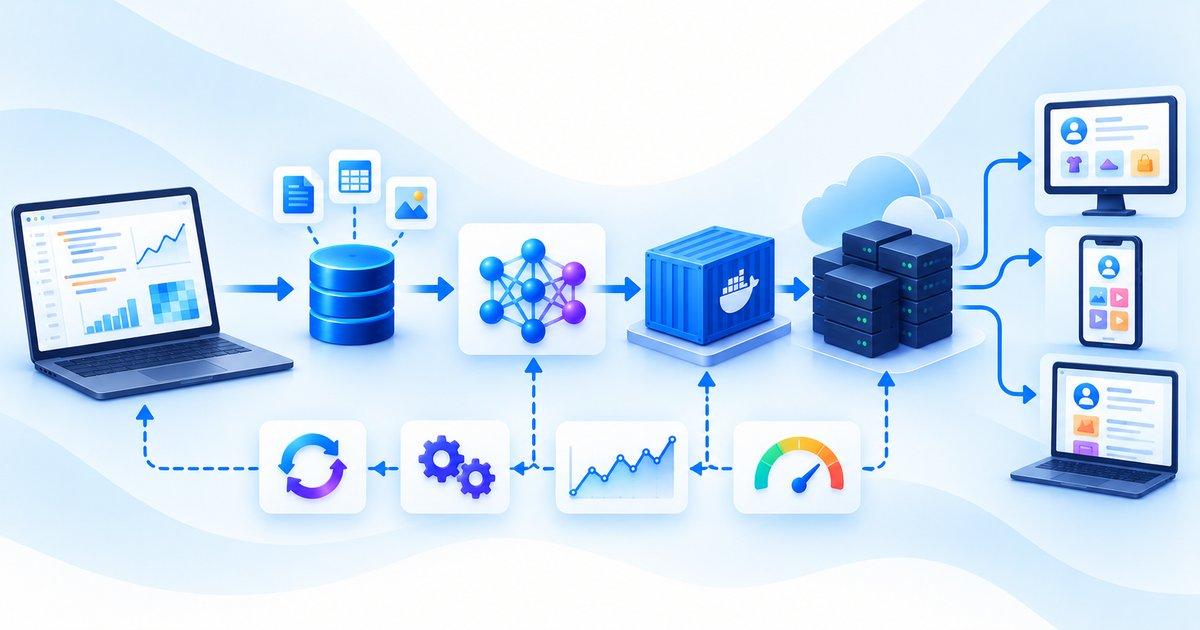
A practical ML testing strategy begins by recognizing that no single test type can validate the behavior of the complete system because failures can originate in application code, data pipelines, feature transformations, trained models, inference infrastructure, or production conditions. Software engineers should therefore organize tests into layers, with each layer responsible for validating a specific class of assumptions. Unit tests can verify deterministic preprocessing and business logic, integration tests can validate service interactions, data tests can check schemas and statistical properties, and model tests can evaluate predictive behavior against defined quality thresholds.
Layered testing also makes debugging more efficient because failures can be localized to the component whose contract has been violated. A schema test that detects an unexpected feature type points toward an upstream data change, while a model-quality regression suggests a problem with training data, model configuration, or feature behavior. Similarly, an inference latency regression may indicate an infrastructure or serving change rather than a model-quality issue. Separating these concerns allows teams to investigate failures systematically instead of treating every prediction problem as a modeling problem.
The most important tests should execute early in the development lifecycle because inexpensive failures are easier to correct than production failures. Data schema validation, preprocessing unit tests, and basic model-quality checks can run during continuous integration, while heavier evaluation and performance benchmarks can run as part of model validation and release pipelines. This creates progressive quality gates in which increasingly expensive tests are applied only after lower-level assumptions have been satisfied.
The layered approach also supports clearer ownership because different teams can maintain the tests closest to their responsibilities without losing sight of system-level behavior. Data engineers can validate upstream contracts, software engineers can maintain service and transformation tests, ML engineers can manage model-quality tests, and platform teams can maintain serving and infrastructure checks, while shared production metrics provide evidence that these layers continue to work correctly together.
Automate Quality Gates in CI/CD and Model Release Pipelines
Automation is essential because ML systems can change frequently through code releases, retraining, feature updates, dataset refreshes, and infrastructure changes. Manual validation cannot reliably keep pace with these changes, making automated quality gates an important component of an ML delivery pipeline. A candidate model should be evaluated against predefined requirements before it becomes eligible for deployment, with failed checks preventing promotion until the underlying issue has been understood.
Quality gates can include data validation, schema compatibility, feature consistency, minimum predictive performance, subgroup performance, inference latency, memory consumption, and comparison against the current production model. A candidate might need to exceed a minimum recall threshold while remaining within a defined latency budget, or it might need to demonstrate that no critical segment experiences unacceptable degradation. These conditions convert broad expectations into measurable deployment criteria.
Regression testing becomes particularly valuable when models are retrained frequently because a new model can change behavior even when application code remains unchanged. Engineers can compare candidate and production models on fixed benchmark datasets, recent representative samples, and carefully selected edge cases to identify meaningful differences. A model should not be rejected simply because every prediction is different, but significant changes in task-specific quality, critical cohorts, calibration, or operational behavior should trigger review.
Automation should also preserve evidence about what was tested and which artifacts produced the result. Dataset versions, feature definitions, model artifacts, configuration parameters, evaluation metrics, and test outcomes should remain traceable so engineers can reproduce decisions when a future regression appears. This is particularly important for ML because debugging often requires reconstructing not only the code environment but also the exact data and model state involved in a previous release.
Prioritize Tests According to Risk and Business Impact
Not every ML system requires the same testing depth because the consequences of incorrect predictions vary significantly across applications. A recommendation service may tolerate moderate prediction variation, while a system involved in financial decisions, security, or critical operations may require much stricter controls around false positives, false negatives, uncertainty, and explainability. Engineers should therefore prioritize testing based on the potential impact of model failure rather than applying identical test suites to every workload.
Risk-based testing can begin by identifying the decisions influenced by the model and the consequences associated with incorrect outputs. High-impact predictions can receive stronger validation through targeted edge cases, subgroup analysis, conservative thresholds, shadow deployment, human review, or additional fallback mechanisms. Lower-risk workloads can use lighter validation where the cost of extensive testing would exceed the consequences of occasional prediction variation.
Business objectives should also determine which metrics become deployment gates because optimizing the wrong metric can create technically impressive but operationally ineffective models. A classifier with higher accuracy may still be unsuitable when recall for an important class deteriorates, while a recommendation model with improved offline ranking may provide little business benefit if latency increases enough to reduce engagement. Testing criteria should therefore connect model metrics to the actual outcomes the system is intended to improve.
This risk-oriented approach reflects the broader principle discussed in “When Machine Learning Should Not Be Used: A Guide to Better Technical Decisions,” because engineering quality depends not only on whether a model can be built and tested but also on whether predictive automation is appropriate for the decision being made. Testing strategy should consequently reflect both technical behavior and the consequences of deploying that behavior.
Key Takeaway
A practical ML testing strategy combines layered validation, automated quality gates, risk-based prioritization, and continuous production feedback so that engineers can test both deterministic system behavior and probabilistic model behavior. The objective is not to force machine-learning systems to produce identical outputs for every execution, but to establish measurable boundaries for data quality, predictive performance, robustness, latency, reliability, and business impact, creating a disciplined framework in which models can evolve without sacrificing system trustworthiness.
Conclusion
Machine-learning testing requires software engineers to expand the definition of correctness beyond exact output matching. Traditional unit, integration, and API tests remain essential for validating deterministic application behavior, but they cannot fully establish whether a predictive system is reliable because model outputs depend on learned relationships, data distributions, training configurations, and changing production conditions. An ML system can pass every conventional software test while producing degraded predictions, making testing across data, models, infrastructure, and production behavior essential.
The strongest testing strategy begins with deterministic components because preprocessing, feature transformations, schema validation, input handling, and service contracts can still be verified through conventional assertions. These tests provide a stable foundation for the predictive layers above them and help identify data or implementation defects before they influence model evaluation. Once deterministic behavior is established, model testing can evaluate statistical performance against explicit quality thresholds rather than requiring every prediction to match a single expected value.
Model validation also needs to consider robustness and distribution changes because production inputs rarely remain identical to historical training data. Edge-case datasets, subgroup evaluation, feature-distribution checks, training-serving consistency tests, and performance thresholds can identify weaknesses that aggregate metrics might conceal. These techniques allow engineers to test whether model behavior remains acceptable across the conditions that matter to the application rather than relying solely on a single offline benchmark.
Testing cannot end at deployment because production environments continuously generate new data and expose models to conditions that may not have been represented during development. Shadow deployments, canary releases, drift monitoring, prediction-distribution analysis, latency testing, and business-outcome monitoring provide additional safeguards that help teams detect degradation before it becomes a widespread application problem. Production incidents should also feed back into the test suite so that newly discovered failure modes become permanent regression cases.
The most mature ML testing practices therefore combine deterministic software testing with statistical validation, data quality controls, model regression testing, robustness analysis, infrastructure testing, and continuous production monitoring. The goal is not to force an ML system to behave identically on every execution, but to establish well-defined boundaries within which its predictions, data dependencies, latency, reliability, and business outcomes remain acceptable.
For software engineers, this represents less of a replacement for conventional testing than an extension of it. The same engineering discipline around contracts, automation, reproducibility, version control, observability, and risk management remains valuable, but it must now account for systems whose behavior is learned rather than completely specified. Effective ML testing ultimately provides the evidence needed to evolve models confidently while preserving the reliability and trustworthiness of the applications that depend on them.
Frequently Asked Questions
1. Why is testing machine-learning systems different from testing traditional software?
Traditional software testing often verifies that a known input produces an expected output, while ML systems produce predictions based on learned statistical relationships. Because several outputs may be acceptable and model behavior can change with data and retraining, ML testing requires statistical, data-centric, and behavioral validation in addition to conventional software tests.
2. Can unit testing be used for machine-learning systems?
Yes, unit testing remains highly useful for deterministic components such as preprocessing, feature transformations, schema validation, input handling, and business logic. The model itself generally requires additional testing methods because its output should be evaluated through statistical performance and behavioral criteria rather than exact-value assertions alone.
3. How do engineers test a model when its output is not deterministic?
Engineers can define acceptable performance boundaries using metrics such as precision, recall, error rates, calibration, ranking quality, or other task-specific measures. Candidate models can then be tested against representative datasets, edge cases, important subgroups, and production-oriented quality thresholds.
4. What is model regression testing?
Model regression testing compares a new model against a previous or established reference version to determine whether important behavior has improved, remained acceptable, or degraded. The comparison can include predictive quality, subgroup performance, calibration, latency, resource consumption, and selected critical examples rather than requiring identical individual predictions.
5. What is data validation in ML testing?
Data validation checks whether the information provided to training or inference satisfies expected structural and statistical properties. Engineers can test schemas, data types, missing-value rates, numerical ranges, category distributions, feature relationships, and other assumptions that are important to reliable model behavior.
6. What is training-serving skew?
Training-serving skew occurs when the transformations or feature calculations used during training differ from those applied when the model receives production inputs. This can cause a model to behave differently in production even though the deployed model artifact itself has not changed.
7. How can engineers test for training-serving skew?
Engineers can pass representative raw inputs through both training and serving pipelines and compare the generated features before inference. Where exact equality is not appropriate because of numerical precision, predefined tolerances can be used to identify meaningful differences in transformations.
8. How should ML engineers test edge cases?
Edge-case testing should focus on inputs that are rare, incomplete, extreme, unusual, noisy, or close to important operational boundaries. Engineers can construct targeted datasets containing missing values, unusual categories, extreme numerical values, malformed inputs, and uncommon feature combinations to evaluate model and pipeline robustness.
9. What is drift testing?
Drift testing checks whether production data or model behavior has changed significantly relative to a reference distribution or historical baseline. Feature distributions, category frequencies, missing-value rates, prediction distributions, and delayed model-quality measurements can all provide evidence that production conditions are evolving.
10. Why are canary releases useful for ML models?
Canary releases allow a new model to receive a controlled portion of production traffic before full deployment. Engineers can compare the candidate against the existing model using latency, quality, error rates, prediction behavior, resource utilization, and relevant business metrics, reducing the risk associated with an immediate full rollout.
11. What is shadow testing in machine learning?
Shadow testing sends production requests to a candidate model while keeping its predictions separate from the user-facing decision path. This allows teams to evaluate the model using realistic traffic without exposing users or business processes to an unvalidated model.
12. Should ML testing be included in CI/CD?
Yes, automated ML quality gates can prevent models or code changes from reaching production when they violate predefined requirements. These gates can include data validation, schema compatibility, model-quality thresholds, subgroup performance, inference latency, resource requirements, and comparisons against the current production version.
13. How can software engineers test model performance without overfitting their tests?
Engineers should use representative evaluation datasets, diverse edge cases, important subgroups, and statistically meaningful thresholds rather than creating assertions around a small collection of expected predictions. Separating training, validation, and testing data also helps prevent the evaluation process from becoming too closely aligned with the data used to develop the model.
14. Why is reproducibility important in ML testing?
Reproducibility allows engineers to determine why a model or evaluation result changed across runs or environments. Tracking model artifacts, datasets, feature definitions, configuration, dependencies, and test results makes it possible to investigate regressions and distinguish genuine changes in model behavior from differences caused by the surrounding environment.
15. What is the best overall strategy for testing ML systems?
The strongest strategy combines conventional software tests with data validation, model-quality testing, robustness and edge-case evaluation, training-serving consistency checks, performance testing, controlled deployment, and continuous production monitoring. This layered approach recognizes that ML failures can originate anywhere across the code, data, model, infrastructure, or evolving production environment, allowing engineers to detect and manage those failures systematically.