Section 1: Understanding the Foundations of Neuromorphic Computing
What Is Neuromorphic Computing?
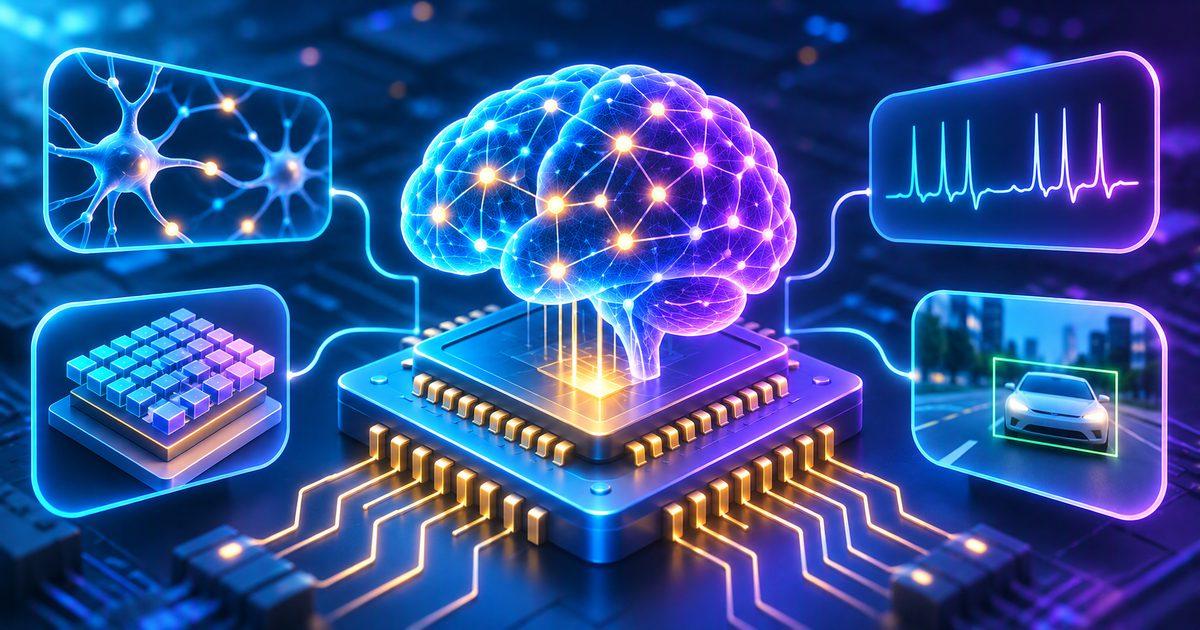
Neuromorphic computing is a computing paradigm that uses principles inspired by biological neural systems to design hardware, software, and learning algorithms.
The term combines two ideas: neuro, referring to nervous systems, and morphic, referring to structure or form. The objective is to build computing systems whose organization and operation reflect selected properties of biological neural networks.
Traditional computing architectures generally separate processing and memory. A processor retrieves data from memory, performs calculations, and writes results back. This arrangement is highly effective for general-purpose computing, but data-intensive machine learning workloads can require repeated movement of large quantities of information.
Neuromorphic architectures attempt to reduce some of this overhead through distributed processing and localized memory. Instead of requiring every operation to access a central memory system, certain neuromorphic designs place computational state close to the artificial neurons or processing elements that use it.
A neuromorphic system may include artificial neurons, synapse-like connections, communication networks, and specialized memory structures. These components work together to process information through patterns of activity rather than exclusively through conventional sequences of arithmetic instructions.
An important distinction is that neuromorphic computing does not require every component to reproduce biological behavior exactly. Some systems use simplified mathematical neuron models implemented digitally. Others use analog circuits or emerging memory technologies to reproduce selected properties of biological neurons and synapses.
The field therefore includes multiple architectural approaches rather than one standardized processor design.
The central engineering objective is to use brain-inspired principles to improve particular computing characteristics, such as energy efficiency, parallelism, real-time responsiveness, and adaptation.
The Von Neumann Bottleneck and the Memory-Movement Problem
To understand why neuromorphic computing is attracting interest, it is useful to examine the limitations of conventional computing architectures.
In a typical von Neumann system, the processor and main memory are separate. When a program performs a computation, the processor retrieves instructions and data, processes them, and stores the results.
This model works extremely well for general-purpose applications. However, machine learning workloads frequently perform large numbers of operations on high-dimensional tensors. The same model parameters may be accessed repeatedly during inference, while intermediate activations must be transferred between different processing stages.
As model sizes increase, moving data can become a major contributor to energy consumption and latency.
This is often discussed as the von Neumann bottleneck: the limitations associated with transferring information between memory and processing units.
Neuromorphic architectures explore ways to reduce this cost by distributing memory and computation more closely.
IBM's NorthPole processor is a useful example of this design philosophy. Its architecture uses local memory within a parallel, distributed core array connected through on-chip networks. IBM describes the design as eliminating off-chip memory access during its targeted neural inference computations. The research paper reports substantial efficiency advantages over a comparable GPU implementation on its evaluated ResNet-50 workload. These results apply to the specific hardware, precision, and benchmark conditions studied, rather than establishing a universal advantage over GPUs.
The architectural lesson is that reducing data movement can be as important as improving arithmetic throughput.
For machine learning engineers, this matters because a model's computational cost is not determined only by the number of multiply-accumulate operations. Memory bandwidth, cache behavior, data layout, communication overhead, and the location of model parameters can all influence performance.
Neuromorphic computing explores a different balance between these components.
Event-Driven Computation and Sparse Neural Activity
A major motivation for neuromorphic computing is event-driven processing.
In conventional digital neural networks, layers often perform computations across complete tensors even when many values contribute little to the final output. Hardware acceleration and sparsity optimization can reduce some of this work, but the underlying execution model may still involve regular batches of operations.
In an event-driven system, computation and communication can be triggered by changes in neural state or incoming events.
For example, consider a sensor monitoring a machine. If the machine operates normally and sensor values remain relatively stable, an event-driven system may generate relatively little activity. When an unusual vibration pattern appears, the system can trigger additional processing.
This can reduce unnecessary computation when input activity is sparse.
However, event-driven processing is not automatically energy-efficient. The communication network, event encoding, synchronization, memory access, and background activity all contribute to total energy consumption. If the input generates continuous high-rate events, the expected sparsity advantage may diminish.
Engineers must therefore evaluate the actual event distribution of the target workload.
The principles of sparse processing also connect to broader machine learning optimization strategies. “Efficient ML: How to Build High-Performance Models With Less Compute” explores how reducing unnecessary computation and improving resource utilization can improve machine learning performance. Neuromorphic computing takes this principle further by making event-driven activity part of the hardware architecture itself.
Key Takeaway
Neuromorphic computing draws inspiration from biological neural systems to rethink how information is represented, stored, and processed. Its main architectural ideas include distributed computation, localized memory, artificial neurons, synaptic connections, and event-driven communication. Spiking neural networks provide one important computational model, but the broader field includes several hardware approaches that aim to reduce data movement and unnecessary processing.
Section 2: How Neuromorphic Hardware and Spiking Neural Networks Work
The Architecture of a Neuromorphic Processor
A neuromorphic processor is designed to execute brain-inspired computational models using specialized processing elements and communication structures.
Unlike a conventional CPU, which executes general-purpose instructions through a relatively centralized processing architecture, a neuromorphic processor may contain many small processing units representing artificial neurons or groups of neurons.
These units maintain internal states and communicate through event-based messages.
A typical digital neuromorphic architecture may include:
- Processing elements that implement neuron dynamics.
- Synaptic memory that stores connection weights.
- Routing networks that deliver spike events.
- Local state storage for membrane potentials and related variables.
- Control mechanisms for managing communication and execution.
- Interfaces that connect sensors, host processors, and other devices.
The architecture can be designed so that neuron updates occur only when relevant events arrive or internal dynamics require an update.
A conceptual processing flow looks like this:
for event in incoming_events:
target_neurons = route_event(event)
for neuron in target_neurons:
neuron.state += (
event.weight * neuron.synaptic_response
)
if neuron.state >= neuron.threshold:
emit_spike(neuron)
reset_state(neuron)
This pseudocode illustrates the event-driven idea rather than the implementation of a particular neuromorphic processor. Real systems use specialized event formats, routing fabrics, neuron models, memory structures, and hardware scheduling.
The important architectural difference is that communication and computation can be driven by neural events rather than by repeatedly processing every element of a dense tensor.
Some neuromorphic processors are fully digital, while others use analog or mixed-signal circuits. Digital designs can offer more predictable numerical behavior and programmability. Analog designs can reproduce certain continuous-time dynamics efficiently but may face challenges involving device variability, calibration, and precision.
There is no single design that dominates every application.
How Spiking Neural Networks Represent Information
Spiking neural networks represent information through discrete events rather than only through continuous-valued activations.
There are several ways to encode information in spikes.
In rate coding, information is represented by the frequency of spikes within a time interval. A neuron that fires more frequently may represent a stronger input or higher activation.
In temporal coding, information is represented by the timing of individual spikes. The precise timing and relative order of events can carry information.
Population coding uses the activity of multiple neurons to represent a signal. Different neurons may respond to different input ranges or patterns, allowing the network to encode more complex information.
For example, an event-based camera may report changes in pixel intensity as asynchronous events. A spiking neural network can process these events directly, potentially preserving useful temporal information without first converting the entire event stream into conventional video frames.
The choice of encoding strategy influences model accuracy, event volume, latency, and hardware utilization.
Rate coding can be relatively straightforward to integrate with conventional neural network concepts, but it may require observing spikes over a time window. Temporal coding can provide low-latency information, but precise timing may increase sensitivity to noise and hardware timing characteristics.
The best encoding method depends on the application and the properties of the sensor.
Hardware-Software Co-Design: Why Algorithms Must Match the Chip
Neuromorphic computing requires close coordination between hardware architecture and machine learning algorithms.
A conventional neural network may be trained using standard GPU frameworks and deployed on a GPU or CPU with relatively mature software support. A neuromorphic system often requires the network's structure, neuron dynamics, communication patterns, and learning method to align with the hardware's capabilities.
For example, a network with dense connectivity may create excessive communication overhead on a processor optimized for sparse spike events. A model with complex neuron dynamics may require hardware resources that are not available on the target chip.
Similarly, a training method that performs well in simulation may not map efficiently to a physical processor.
Intel's Lava framework was introduced to support the development of neuro-inspired applications across supported software and hardware environments. It provides a programming approach for developing applications that can target neuromorphic systems and other computational backends.
This is important because developers need more than specialized hardware. They need software libraries, model-development tools, debugging facilities, simulators, and deployment workflows.
Hardware-software co-design helps ensure that a model's computational requirements match the processor's execution model.
This is also where engineering teams must consider the complete data path. Sensors, event encoders, preprocessing services, model execution, and downstream applications all influence latency and energy consumption.
The concepts covered in “ML Data Pipelines for Software Engineers: From Event Streams to Model-Ready Data” are relevant when designing systems that transform continuous sensor activity into reliable machine learning inputs. In neuromorphic deployments, event representation and data delivery can directly influence the efficiency of the hardware.
Key Takeaway
Neuromorphic processors use specialized processing elements, local memory, and event-routing mechanisms to execute brain-inspired models. Spiking neural networks encode information through spike frequency and timing, but training them requires techniques such as surrogate gradients, STDP, or ANN-to-SNN conversion. Successful deployment depends on hardware-software co-design rather than treating the chip and neural network as independent components.
Section 3: Neuromorphic Hardware Platforms and Real-World Applications
Intel Loihi 2 and Hala Point
Intel's Loihi 2 is one of the best-known neuromorphic research processors.
It is designed to support event-driven spiking neural networks and programmable neuron models. Compared with its predecessor, Loihi 2 provides improvements in processing speed, neuron capacity, and programmability.
Intel describes Loihi 2 as supporting up to one million neurons per chip, with improved communication and support for more flexible neural models. It is accompanied by Lava, an open-source software framework intended to support neuro-inspired application development. These specifications are vendor-reported capabilities and should be distinguished from application-level performance guarantees.
In April 2024, Intel announced Hala Point, a large-scale neuromorphic research system built using Loihi 2 processors. Intel reported that the system contains 1.15 billion artificial neurons and 128 billion synapses across 1,152 Loihi 2 processors. The system was initially deployed at Sandia National Laboratories for research into scalable and energy-efficient AI.
The significance of Hala Point is not simply its neuron count. It demonstrates how neuromorphic systems can be organized at a much larger scale than individual experimental chips.
Researchers can investigate how event-driven networks behave when distributed across multiple processors, how communication overhead changes with scale, and how different workloads map onto the architecture.
Potential research applications include adaptive control, robotics, sensing, optimization, and real-time information processing.
However, a system containing more than a billion artificial neurons should not be interpreted as equivalent to a biological brain or as evidence that it can run arbitrary large language models more efficiently than GPUs. Its architecture and software are designed around particular classes of neuromorphic computation.
IBM NorthPole and Memory-Centric Neuromorphic Design
IBM's NorthPole processor illustrates a different but related brain-inspired hardware direction.
Rather than focusing exclusively on spiking neural networks, NorthPole emphasizes a memory-centric architecture in which processing and memory are distributed across a parallel array of cores.
Traditional systems frequently move model parameters and intermediate data between external memory and processing units. NorthPole integrates local memory within its computational cores to reduce this movement during inference.
The research processor was fabricated using a 12-nanometer process and contains 256 cores with 192 MB of distributed on-chip SRAM. IBM's published architecture describes performance across multiple low-precision operating modes.
In its reported ResNet-50 evaluation, the research team measured advantages in energy efficiency, processing density, and latency compared with a GPU built using a comparable process technology. The comparison reflects the specific inference benchmark and implementation rather than all possible machine learning workloads.
NorthPole highlights an important distinction in neuromorphic computing: brain-inspired hardware does not always require spike-based communication.
Some architectures focus on distributed processing and memory locality. Others focus on asynchronous event-driven neural dynamics. Both approaches draw inspiration from aspects of biological computation, but they solve different hardware problems.
For software engineers, this distinction is important when evaluating neuromorphic technologies. A processor's marketing category does not reveal whether it supports spiking networks, conventional neural inference, on-chip learning, or some combination of these capabilities.
Edge AI, Industrial Monitoring, and Energy-Constrained Devices
Edge AI refers to running machine learning models close to where data is generated rather than sending every observation to a remote cloud service.
This approach can reduce communication latency, limit network bandwidth requirements, and improve privacy. However, edge devices often have limited processing power, memory, and battery capacity.
Neuromorphic hardware is attractive for selected edge applications because event-driven processing may reduce unnecessary computation.
Consider an industrial sensor monitoring a motor. A conventional system might periodically transmit vibration and temperature readings to a central service for analysis. A neuromorphic edge device could potentially process incoming sensor events locally and activate more intensive analysis only when it detects an unusual pattern.
Similar applications include:
- Wearable devices that monitor physiological signals.
- Smart sensors that detect motion or unusual environmental changes.
- Autonomous robots that respond to real-time sensor input.
- Industrial equipment that identifies abnormal vibration patterns.
- Low-power devices that recognize audio or gesture events.
- Distributed monitoring systems that operate with limited connectivity.
These are promising application areas, not proof that neuromorphic hardware is already the most efficient option for each workload.
A conventional microcontroller, low-power CPU, or edge GPU may still be more practical depending on model size, software availability, data characteristics, and required accuracy.
The strongest use cases are likely to involve sparse, continuous, and time-sensitive inputs where the cost of running conventional inference repeatedly is significant.
The connection between neuromorphic edge systems and streaming applications is explored in “Streaming Machine Learning: Building Models That Learn From Data in Real Time”. Both approaches emphasize processing continuously arriving information, but neuromorphic systems add specialized event-driven hardware to the execution path.
Key Takeaway
Neuromorphic hardware is advancing through several distinct architectural approaches. Intel's Loihi 2 and Hala Point demonstrate scalable event-driven spiking systems, while IBM's NorthPole illustrates memory-centric parallel neural inference. Robotics, event-based vision, industrial sensing, and edge AI are promising applications because they often require low-latency processing under energy constraints. The suitability of each platform depends on the workload and software ecosystem.
Section 4: Challenges, Limitations, and the Future of Neuromorphic Machine Learning
Training Difficulty and the Accuracy Tradeoff
One of the biggest challenges in neuromorphic machine learning is training high-performing spiking neural networks.
Conventional deep learning has benefited from mature optimization methods, large datasets, established frameworks, and highly optimized GPU hardware. Neuromorphic systems have a more specialized training ecosystem.
The non-differentiable nature of spike generation complicates gradient-based optimization. Surrogate gradients provide a practical solution, but they introduce approximations into the backward pass.
Another challenge is temporal credit assignment. A network's output may depend on spikes that occurred much earlier in the input sequence. Training algorithms must determine how earlier neural activity contributed to the final result.
Backpropagation through time can address this problem, but it may require substantial memory and computation when sequences are long.
ANN-to-SNN conversion offers another route, but converting a conventional network into a spiking representation can introduce accuracy losses or require additional simulation time.
There is also a practical tradeoff between event sparsity and predictive accuracy. A network that uses very few spikes may be energy-efficient but might not retain enough information to solve a complex task.
Engineers must evaluate accuracy, latency, event count, and energy together rather than optimizing one metric in isolation.
Hardware Scalability, Communication, and Memory Constraints
Neuromorphic systems are designed to support distributed computation, but scaling them introduces difficult engineering problems.
As the number of artificial neurons increases, the network must route more events between processing elements. Communication can become a bottleneck even when individual neuron updates are inexpensive.
The topology of the network matters. A highly connected model may generate a large volume of events, creating congestion in the communication fabric. A sparse network may reduce communication but struggle to represent complex relationships.
Memory capacity is another concern. Neuromorphic systems must store synaptic weights, neuron states, routing information, and other parameters. Large neural networks may exceed the resources available on a single chip.
Distributed systems can address this limitation, but connecting multiple processors introduces communication overhead, synchronization requirements, and software complexity.
The hardware must also support the numerical precision and neuron dynamics required by the model.
Digital neuromorphic processors provide predictable state updates but still require efficient memory and routing. Analog and mixed-signal designs can potentially reproduce certain neural dynamics efficiently, but they face challenges involving noise, calibration, device variability, and reproducibility.
A scalable neuromorphic system must therefore solve more than the problem of increasing neuron count. It must maintain efficient communication, predictable execution, and manageable software complexity as the network grows.
Will Neuromorphic Computing Replace GPUs and CPUs?
Neuromorphic computing is unlikely to replace conventional processors across the entire machine learning ecosystem in the near future.
GPUs remain highly effective for dense matrix operations, large-scale neural network training, and many inference workloads. CPUs continue to provide flexible general-purpose processing. Specialized AI accelerators offer optimized execution for particular neural network operations.
Neuromorphic processors are designed around a different set of computational assumptions. Their strengths are most likely to appear in applications that benefit from sparse event processing, low-latency responses, continuous sensing, and energy-constrained operation.
The future may therefore involve heterogeneous computing systems in which different processors handle different tasks.
For example, a robotic platform could use a neuromorphic processor for rapid event-based perception, a conventional CPU for control and application logic, and a GPU for larger perception or planning workloads.
Similarly, an industrial monitoring system could use neuromorphic hardware for continuous local event detection while sending selected events to a cloud-based model for deeper analysis.
This approach avoids forcing every workload onto the same processor architecture.
Neuromorphic computing is also likely to benefit from improvements in software tooling, compiler support, model conversion, hardware interoperability, and standardized evaluation. A 2025 review of large-scale neuromorphic systems identifies the need for a stronger ecosystem spanning hardware, algorithms, software platforms, and scalable deployment.
For production teams, the most important question is not whether a processor is inspired by the brain. It is whether it provides a measurable advantage for the actual application.
The deployment principles discussed in “MLOps for Software Engineers: Building, Deploying, and Monitoring Machine Learning Models in Production” remain relevant when integrating specialized machine learning hardware. Model versioning, deployment validation, monitoring, and reproducible evaluation are essential regardless of the processor architecture.
Key Takeaway
Neuromorphic computing faces significant challenges in training, hardware scalability, communication, software maturity, and benchmarking. Spiking neural networks must balance energy efficiency with accuracy, while hardware platforms need better interoperability and deployment tools. Rather than replacing GPUs and CPUs, neuromorphic processors are more likely to become specialized components in heterogeneous systems designed around particular workloads.
Conclusion: Brain-Inspired Hardware Could Change How AI Processes Information
Neuromorphic computing represents a different way to approach machine learning hardware. Instead of relying exclusively on conventional processors that move data between separate memory and computation units, it explores distributed processing, localized memory, event-driven communication, and artificial neural dynamics.
Spiking neural networks demonstrate how information can be represented through discrete events and temporal patterns. Specialized hardware such as Intel's Loihi 2 provides a platform for executing these networks, while Hala Point demonstrates how neuromorphic processors can be combined into larger research systems. IBM's NorthPole provides another example of brain-inspired design through memory-centric parallel neural inference.
These developments suggest that biological principles can offer useful ideas for designing more efficient computing systems.
However, neuromorphic computing is not a universal replacement for conventional machine learning hardware. Training spiking networks remains challenging, performance comparisons are not always straightforward, and software ecosystems are less mature than those surrounding mainstream GPUs and CPUs.
The strongest near-term opportunities are likely to emerge in event-driven sensing, robotics, industrial monitoring, adaptive edge intelligence, and other workloads where continuous processing and energy constraints are important.
For software and machine learning engineers, understanding neuromorphic computing means looking beyond model architecture and considering the complete interaction between algorithms, hardware, sensors, memory, and communication.
The long-term opportunity is not necessarily to build computers that behave exactly like biological brains. It is to identify which properties of biological computation can solve practical engineering problems more efficiently.
Neuromorphic computing may not replace the hardware powering today's largest AI models, but it could expand the range of machines capable of running intelligent systems efficiently and continuously.
Frequently Asked Questions (FAQs)
1. What is neuromorphic computing?
Neuromorphic computing is a computing approach inspired by biological neural systems. It uses concepts such as artificial neurons, synaptic connections, distributed processing, and event-driven communication to develop specialized hardware and machine learning systems.
2. How is neuromorphic computing different from traditional computing?
Traditional computing generally separates memory and processing, while many neuromorphic architectures integrate memory and computation more closely. Neuromorphic systems may also use event-driven processing, where computation is triggered by incoming signals rather than continuously processing dense data.
3. What are spiking neural networks?
Spiking neural networks are artificial neural networks that communicate through discrete events called spikes. Their internal neuron states evolve over time, and information can be represented through spike frequency, timing, and patterns of activity.
4. Why is neuromorphic computing considered energy-efficient?
Neuromorphic systems can reduce unnecessary computation through sparse, event-driven processing and localized memory. However, actual energy efficiency depends on the model, input activity, hardware implementation, communication overhead, and measurement conditions.
5. What is Intel Loihi 2?
Loihi 2 is Intel's second-generation neuromorphic research processor. It supports programmable neuron models and event-driven spiking neural networks and is designed for research into low-power, adaptive computing applications.
6. What is Intel Hala Point?
Hala Point is a large-scale neuromorphic research system built using Intel Loihi 2 processors. Intel announced the system in April 2024, reporting a capacity of 1.15 billion artificial neurons and 128 billion synapses across 1,152 processors.
7. What is IBM NorthPole?
IBM NorthPole is a brain-inspired neural inference architecture that distributes processing and local memory across a parallel core array. Its design aims to reduce data movement between external memory and processing units during inference.
8. What is the difference between an ANN and an SNN?
A conventional artificial neural network typically communicates through numerical activations, while a spiking neural network communicates through discrete events. SNNs also model temporal dynamics explicitly, making spike timing an important part of information processing.
9. How are spiking neural networks trained?
SNNs can be trained using surrogate gradients, spike-timing-dependent plasticity, reinforcement learning, or ANN-to-SNN conversion. Each approach has different tradeoffs involving accuracy, computational cost, biological plausibility, and hardware compatibility.
10. What is spike-timing-dependent plasticity?
Spike-timing-dependent plasticity is a learning mechanism in which synaptic weights change based on the relative timing of pre-synaptic and post-synaptic spikes. It is inspired by biological synaptic plasticity and can support local learning in spiking neural networks.
11. Can neuromorphic computing be used in robotics?
Yes. Neuromorphic systems can support event-based vision, motion detection, sensor processing, tactile sensing, and low-latency control. These capabilities are particularly relevant to robots that operate under strict power and response-time constraints.
12. Is neuromorphic computing useful for edge AI?
It can be useful for selected edge applications involving sparse sensor events, continuous monitoring, and low-power inference. However, conventional microcontrollers, CPUs, and edge GPUs may remain more practical for many workloads.
13. What are the biggest challenges in neuromorphic computing?
Major challenges include training spiking neural networks, scaling communication, managing synaptic memory, improving software tools, standardizing benchmarks, and integrating specialized hardware into production systems.
14. Will neuromorphic chips replace GPUs?
Neuromorphic chips are unlikely to replace GPUs for all machine learning workloads. They are better viewed as specialized processors that may complement GPUs and CPUs in event-driven, low-latency, and energy-constrained applications.
15. What should engineers learn to work with neuromorphic computing?
Engineers should understand spiking neural networks, neuron dynamics, event-based data processing, surrogate-gradient training, hardware-software co-design, and neuromorphic software frameworks such as Intel's Lava. Familiarity with edge AI and embedded systems is also useful.