Section 1: Why a Working ML Notebook Is Not a Production-Ready Model
Understanding the Gap Between Experimental Code and Production Software
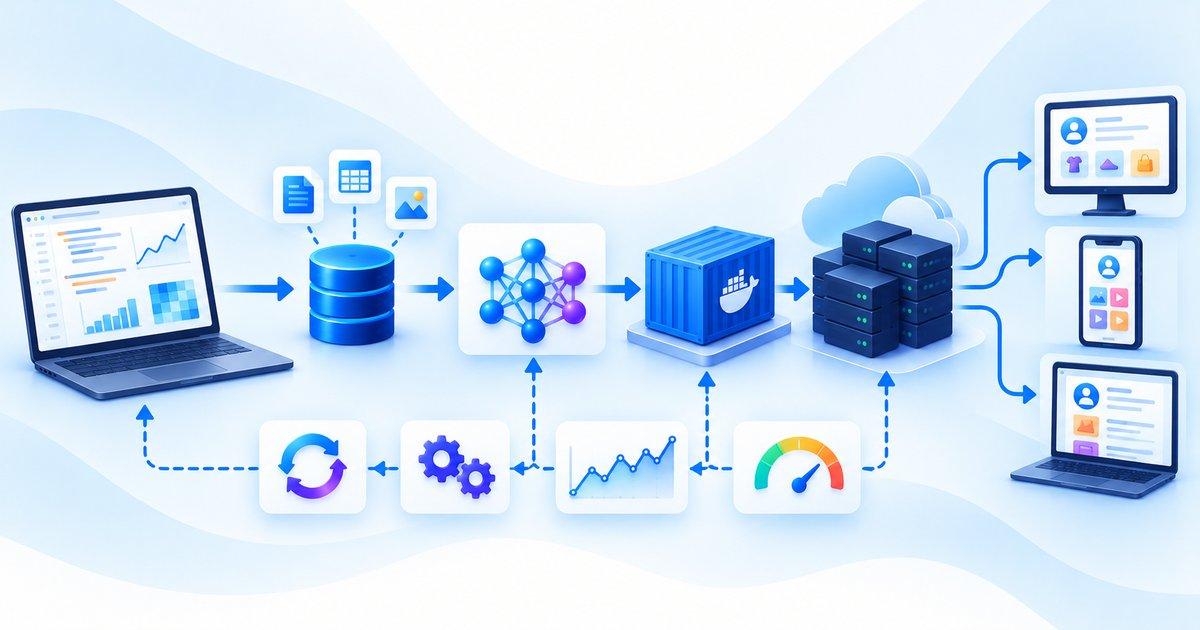
A machine learning notebook provides an effective environment for exploring datasets, testing hypotheses, engineering features, and evaluating candidate models because developers can execute code incrementally and inspect intermediate results as they work. However, the same flexibility that makes notebooks useful for experimentation can create challenges when the resulting solution must operate as a reliable production service, since notebook cells may depend on execution order, previously defined variables, locally installed libraries, or data files that are unavailable outside the original environment. A model that produces accurate predictions during experimentation therefore represents only one part of the production solution, with the remaining engineering work involving reproducibility, interface design, deployment, performance, and operational reliability.
Consider a data scientist who develops a classification model that predicts whether a customer is likely to cancel a subscription, achieving strong validation results using a carefully prepared dataset and a sequence of notebook cells. When the model is integrated into a backend application, the inference service must accept incoming customer information, validate the request, apply the same transformations used during training, load the correct model artifact, generate a prediction, and return a response within the application's latency requirements. If any of these steps relies on undocumented notebook state or assumptions about how the input data was prepared, the deployed service may behave differently from the original experiment even when the trained model itself has not changed.
Production readiness consequently requires engineers to treat the notebook as the starting point for a deployable software component rather than as the final application. The transition involves converting exploratory code into a repeatable inference workflow, establishing clear boundaries between preprocessing and prediction, managing dependencies, and defining the expected behavior when input data is invalid or a downstream dependency becomes unavailable. The engineering decisions discussed in “From Experiment to Production: The Decisions That Shape an ML System” are relevant because successful productionization depends on how the entire system is designed and operated, not merely on how well a model performs during offline evaluation.
Separating Data Preparation, Feature Engineering, Training, and Inference
Notebook-based development often places data loading, cleaning, feature engineering, model training, and evaluation within a single interactive workflow, which is convenient during experimentation but can make production execution difficult to maintain. A production architecture should separate these responsibilities according to their operational purpose, allowing training code to generate and evaluate model artifacts while inference code loads an approved artifact and applies the transformations required to produce predictions. This separation makes it possible to deploy a model without rerunning expensive training operations whenever an application receives a new request, while also giving engineering teams greater control over how data moves through the production system.
Preprocessing deserves particular attention because a model's predictions depend on the representation of its inputs, including how missing values are handled, categorical variables are encoded, numerical values are normalized, and derived features are calculated. If these transformations are reimplemented independently in the training notebook and the production service, small differences can create training-serving skew, causing the deployed model to receive inputs that differ from those used during training. Packaging compatible preprocessing logic with the model artifact, or maintaining shared transformation code that is versioned and tested consistently, helps reduce these discrepancies while making the inference workflow easier to reproduce across environments.
Separating these responsibilities also improves testability and reuse, since data validation, feature generation, model loading, and prediction can each be evaluated independently before being integrated into the complete service. For example, engineers can test whether a preprocessing component produces the expected feature vector, verify that the inference function returns predictions in the expected format, and confirm that invalid inputs trigger defined errors rather than unpredictable behavior. By turning exploratory notebook operations into modular, repeatable components, teams can maintain the flexibility of experimentation while establishing the predictable interfaces and execution paths required by production software.
Preserving Dependencies, Model Artifacts, and Training-Serving Consistency
A trained model depends on more than its serialized parameters because the environment in which it executes may also require specific versions of machine learning libraries, preprocessing components, custom functions, and supporting configuration. A model developed with one version of a library may load or behave differently under another version, while custom transformations that exist only in the notebook can prevent the inference service from reproducing the original feature-processing workflow. Engineers should therefore package the model with its required dependencies, record relevant runtime and configuration information, and validate that the artifact loads and generates expected outputs in an environment representative of production.
Artifact management becomes equally important when teams develop multiple candidate models or deploy updates on different schedules, because production services must know which model version is approved and which supporting preprocessing logic corresponds to it. A reliable release process should identify the model artifact, associated code revision, dependency versions, feature schema, and evaluation results, allowing teams to reproduce a deployment or investigate unexpected prediction changes. Without this traceability, developers may struggle to determine whether a production issue originated in the model, its dependencies, a change to feature processing, or the application code that invokes inference.
Training-serving consistency must also be validated through representative inputs rather than assumed simply because the same model file is used in both environments. If the training pipeline calculates customer spending over a defined time window while the production service uses a different boundary or handles missing records differently, the model may receive systematically different values after deployment. Automated tests comparing expected preprocessing outputs, schema validation, artifact compatibility checks, and reproducibility records help identify these issues before they affect real users, creating a stronger foundation for reliable model serving.
Key Takeaway
A working machine learning notebook is only the beginning of production deployment because a reliable service must reproduce preprocessing, manage dependencies, load the correct model artifact, validate requests, and operate within defined performance and reliability requirements. Separating exploratory code into modular training and inference components, preserving training-serving consistency, and defining operational constraints before selecting an architecture help prevent common production failures. By treating the model as one component of a complete software system, engineering teams can establish the foundation for a deployable prediction service that is reproducible, maintainable, and ready for low-latency inference.
Section 2: Turning a Trained Model Into a Deployable Prediction Service
Packaging Model Artifacts, Dependencies, and Preprocessing Logic
Turning a trained machine learning model into a deployable service begins with packaging the artifacts and dependencies required to reproduce its prediction behavior outside the original development notebook. A trained model may contain learned parameters and a prediction interface, but the complete inference workflow can also depend on preprocessing transformations, feature definitions, encoders, configuration files, and specific versions of machine learning libraries. Engineering teams must identify these dependencies and organize them into a versioned deployment artifact or a coordinated set of artifacts that can be loaded consistently across development, testing, and production environments.
For example, a customer churn model may rely on a categorical encoder fitted during training, a numerical scaler, and a particular ordering of input features before the prediction function can generate a meaningful output. Saving only the model parameters would leave the production service responsible for reconstructing these transformations, creating opportunities for discrepancies if developers implement the preprocessing logic differently from the original training pipeline. Packaging compatible preprocessing components alongside the model, or referencing version-controlled transformation code and its dependencies, helps preserve the intended feature representation while making the inference workflow easier to test and reproduce.
Dependency management becomes particularly important when notebook experiments use library versions that differ from those installed in the production environment, since changes in serialization formats, function behavior, or runtime requirements can prevent an artifact from loading or producing expected results. Engineers should record the runtime version, dependency specifications, model identifier, feature schema, and relevant training metadata, while validating that the complete artifact can be loaded and executed in a clean environment rather than relying on the developer's existing workspace. This approach creates a reproducible foundation for deployment and supports later investigation when a model's production behavior differs from its offline evaluation results.
Designing Prediction APIs With Explicit Input and Output Contracts
Once the inference workflow can run outside the notebook, the next step is to expose it through a well-defined interface that allows backend applications and other services to request predictions without depending on the model's internal implementation. A prediction API typically accepts a structured request, validates its contents, prepares the required features, executes inference, and returns a response that downstream applications can interpret consistently. Designing this interface requires explicit decisions about required fields, data types, optional values, response formats, error conditions, and latency expectations, ensuring that model integration behaves like a dependable software contract rather than an informal function call.
Consider a fraud detection service that receives transaction information from a payment application and returns a risk score used by the transaction workflow. The API contract should specify the required transaction attributes, the supported value formats, and the structure of the response, including how the risk score is represented and whether additional metadata accompanies the result. The consuming service must also understand how invalid inputs, unavailable models, and internal processing failures are reported, allowing it to distinguish a legitimate prediction from a request that could not be evaluated reliably.
API versioning and backward compatibility matter because the model, its input features, and the applications consuming its predictions may evolve on different release schedules. If a new model requires an additional feature or changes the semantics of an existing score, silently modifying the existing endpoint can break downstream consumers even when the new model performs well in testing. Versioned schemas, explicit compatibility checks, authentication, bounded request sizes, and well-defined error responses help teams evolve the inference service without introducing unexpected application failures. The architectural practices described in “Building ML-Driven APIs: Design Patterns for Prediction Services” provide a useful foundation for treating prediction endpoints as production interfaces with predictable behavior, testable contracts, and clear integration boundaries.
Containerizing the Inference Application and Managing Configuration
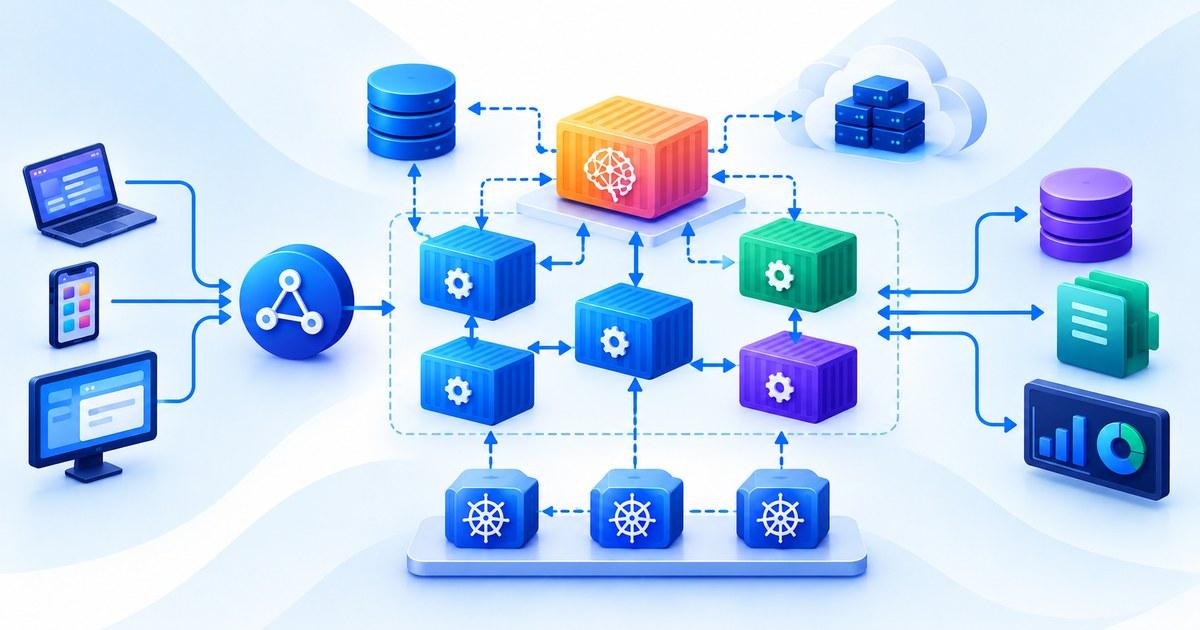
Containerization packages the inference application, its runtime dependencies, and the software required to execute predictions into a consistent deployment unit, reducing the differences between local development, automated testing, and production environments. A container image can include the API implementation, model-loading logic, compatible libraries, and supporting application code, while the model artifact may be embedded within the image or retrieved through a controlled artifact-loading mechanism during initialization. The appropriate approach depends on artifact size, release frequency, startup requirements, and deployment infrastructure, since embedding large models can increase image size while retrieving them separately introduces additional storage and availability dependencies.
Configuration should remain separate from application code wherever practical, allowing the same inference image to operate across environments with different resource limits, endpoint settings, logging levels, and deployment parameters. Engineers can use environment-specific configuration and managed secrets to supply operational values, while keeping credentials and sensitive information out of container images and source repositories. This separation supports more predictable releases because developers can promote the same tested application artifact through different environments without rebuilding it for every deployment target, reducing the risk that environment-specific changes introduce unexpected behavior.
Container resource requirements must also reflect the model's runtime characteristics because inference workloads can differ substantially in memory consumption, CPU demand, accelerator requirements, and initialization time. A model that loads a large artifact into memory may require a higher memory limit than the surrounding API application, while concurrency settings must account for whether the model runtime safely supports simultaneous requests. By testing container startup, resource utilization, request handling, and shutdown behavior under realistic workloads, engineering teams can establish a consistent deployment unit that is ready for orchestration, scaling, and production monitoring without assuming that successful execution on a developer's machine guarantees reliable operation elsewhere.
Key Takeaway
Turning a trained model into a deployable prediction service requires more than saving model parameters, because reliable inference depends on compatible preprocessing, managed dependencies, stable API contracts, reproducible packaging, and predictable initialization. Containerization and configuration management help establish consistent execution environments, while input validation and readiness checks protect the service from malformed requests and incomplete startup conditions. By treating the inference application as production software with explicit interfaces and operational safeguards, engineering teams can establish a dependable foundation for low-latency serving, automated deployment, and continuous monitoring.
Section 3: Engineering Low-Latency Inference Under Real Production Workloads
Profiling the Complete Prediction Request Path
Achieving low-latency inference requires engineers to measure the complete prediction request path rather than focusing exclusively on the time taken by the machine learning model to generate an output. A production request may involve network communication, input validation, feature retrieval, preprocessing, model execution, response serialization, and downstream application logic, with each stage contributing to the time experienced by the caller. Even when the model performs inference efficiently, an application can remain slow if it retrieves features through multiple sequential service calls, repeatedly transforms the same data, or spends excessive time preparing requests before the model can execute.
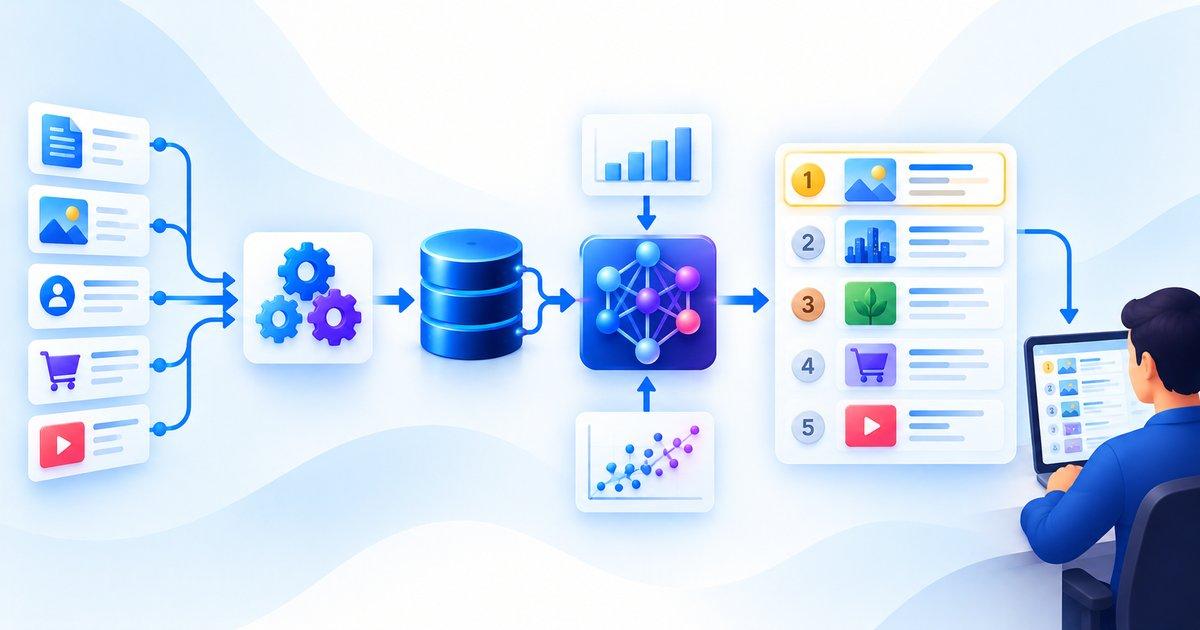
Consider a recommendation API that retrieves customer context from a feature store, loads product attributes from a database, prepares the feature vector, executes a trained model, and returns an ordered list of recommendations. If feature retrieval consumes most of the request time, replacing the existing model with a faster algorithm may produce only a marginal improvement in overall latency, making end-to-end profiling essential for identifying the most consequential bottleneck. Distributed tracing, structured timing logs, and component-level performance measurements help engineers determine whether delays originate in application code, network communication, preprocessing, inference, or downstream dependencies, allowing optimization efforts to target the operations that materially affect response time.
Latency analysis should also distinguish average execution time from tail latency because occasional slow requests can undermine the user experience even when most predictions return quickly. Metrics such as p50, p95, and p99 latency help reveal performance variations caused by resource contention, large input payloads, model initialization, or intermittent delays in feature services, while throughput and error-rate measurements show whether faster responses are being achieved without sacrificing system stability. By profiling representative workloads under realistic traffic conditions, engineering teams can establish a trustworthy baseline against which subsequent inference optimizations can be measured.
Optimizing Model Loading, Preprocessing, and Inference Execution
Model-serving performance depends partly on how the inference application manages its model artifacts and preprocessing operations, because repeatedly loading large artifacts or reconstructing expensive transformations can add avoidable overhead to every prediction request. In many applications, loading the model once during service initialization and reusing it for subsequent requests reduces repeated setup costs, although the appropriate strategy depends on memory availability, model size, runtime behavior, and the serving platform's lifecycle. Engineers should distinguish initialization time from steady-state inference latency so that model startup costs are not confused with the time required to process an individual prediction after the service becomes ready.
Preprocessing can also contribute significantly to end-to-end latency when the production service repeats expensive transformations, performs unnecessary conversions, or retrieves data that could have been prepared earlier. For example, a classification service may need to normalize numerical features and encode categorical values before inference, while a recommendation model may depend on feature lookups or embedding computations that consume more time than the model itself. Reusing compatible transformation logic, reducing redundant data copying, validating inputs efficiently, and precomputing stable features can lower this overhead, provided that the production pipeline continues to generate inputs consistent with those used during model training.
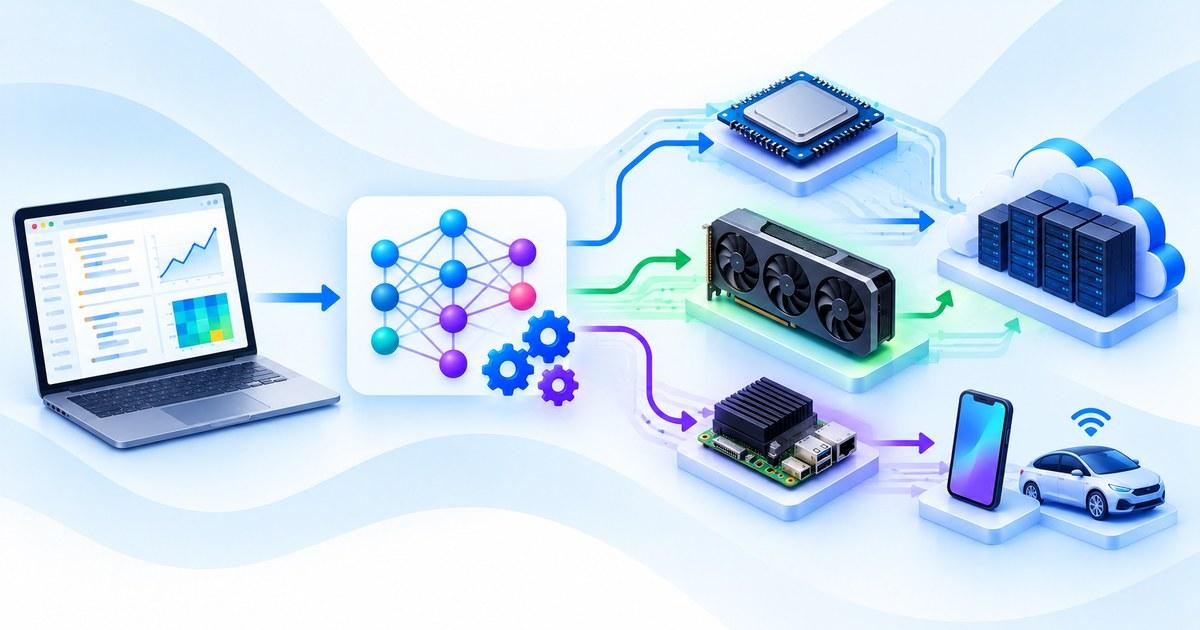
Inference execution can be improved through model-runtime optimization, suitable computational libraries, hardware selection, and careful configuration of thread usage or parallel execution. Depending on the workload, smaller model architectures, quantization, compiled execution, or hardware acceleration may reduce latency and improve throughput, but each technique should be evaluated against prediction quality, memory requirements, and deployment complexity rather than adopted solely for a faster benchmark. The practices covered in “Inference Optimization for ML Engineers: Reducing Latency Without Sacrificing Model Quality” are relevant because useful performance improvements must preserve the accuracy and consistency required by the application while reducing the cost of producing predictions.
Using Batching, Caching, and Resource Allocation to Improve Throughput
Batching can improve inference efficiency when a service must score multiple inputs because processing several examples together may reduce repeated execution overhead and improve hardware utilization. A recommendation system that evaluates hundreds of candidate products, for instance, may score those candidates in a batch rather than invoking the model separately for every product, allowing the service to reuse shared execution resources and reduce per-item overhead. However, larger batches can increase memory consumption and delay individual requests while the system gathers enough inputs to process together, making batch size an important trade-off between throughput and latency, particularly for interactive services with strict response-time requirements.
Caching provides another optimization opportunity when inputs, features, or intermediate results can be reused safely across requests without compromising freshness or correctness. A service might cache stable product metadata, precomputed item embeddings, or frequently accessed reference data, reducing repeated processing and expensive calls to upstream systems, while complete prediction results may be cacheable only when the relevant inputs and contextual conditions are sufficiently equivalent. Engineers must therefore define cache keys, expiration rules, invalidation behavior, and eligibility conditions carefully, since returning a stale result for a user whose context has changed can undermine the purpose of personalization or produce incorrect application decisions.
Resource allocation also influences inference performance because each model has specific requirements for memory, CPU, accelerator capacity, concurrency, and runtime configuration. Assigning insufficient resources can cause queueing, memory pressure, or unstable latency, whereas allocating excessive capacity can increase infrastructure costs without delivering meaningful benefits during typical workloads. Engineering teams should evaluate throughput and latency together under representative concurrency levels, adjust resource requests and execution settings based on measured behavior, and isolate latency-sensitive inference from large background workloads where necessary so that shared resource contention does not undermine production performance.
Key Takeaway
Building a low-latency ML service requires optimizing the complete request path, including model initialization, preprocessing, feature retrieval, inference execution, and response handling. Profiling, batching, caching, resource-aware configuration, concurrency controls, and realistic load testing help engineers identify performance bottlenecks and improve throughput without assuming that a faster model alone guarantees a faster application. By validating every optimization against end-to-end latency, prediction quality, workload behavior, and operating cost, engineering teams can deliver responsive inference services that remain reliable under real production conditions.
Conclusion: Engineering the Complete Journey From Experiment to Production
Turning a machine learning notebook into a reliable, low-latency service requires a combination of model development, software engineering, deployment automation, and production operations, because a model that performs well during experimentation is not necessarily ready to handle real application traffic. Notebooks provide an effective environment for exploring data, engineering features, and evaluating algorithms, but production applications require reproducible preprocessing, managed dependencies, stable interfaces, and predictable execution behavior. The transition therefore involves transforming exploratory code into maintainable software components that can generate consistent predictions while satisfying the performance and reliability requirements of the application.
The first step toward production readiness is establishing a reproducible inference workflow that preserves the relationship between the trained model, its preprocessing logic, and the dependencies required to execute it. Packaging compatible artifacts, separating training from inference, validating incoming requests, and defining explicit API contracts help prevent discrepancies between the experimental environment and the deployed service. Containerization and configuration management further improve consistency across development, testing, and production, while versioned artifacts and metadata make it easier to reproduce deployments and investigate unexpected prediction changes.
Achieving low-latency inference requires engineers to optimize the complete prediction request path rather than focusing exclusively on the model's execution time. Feature retrieval, preprocessing, network communication, model loading, inference, and response serialization can all contribute to latency, making profiling essential for identifying the operations that have the greatest impact on performance. Techniques such as batching, caching, precomputation, model-runtime optimization, and appropriate resource allocation can improve throughput and responsiveness, but every optimization should be evaluated against prediction quality, data freshness, infrastructure cost, and the application's latency objectives.
Reliable deployment also depends on automated testing, controlled releases, and comprehensive monitoring that covers both conventional software behavior and model-specific characteristics. Unit tests, integration tests, regression tests, and load tests help establish whether the inference service behaves correctly under realistic workloads, while CI/CD pipelines make releases more repeatable and easier to audit. Shadow deployments, canary releases, model-version tracking, and rollback procedures further reduce the risks associated with introducing new artifacts, particularly when changes to feature processing or dependencies could affect the behavior of downstream applications.
Once the service is running in production, continuous observation becomes essential for maintaining performance as workloads, data distributions, and application requirements evolve. Engineers should monitor latency percentiles, request failures, resource consumption, feature freshness, prediction behavior, and relevant outcome metrics, using these signals to distinguish infrastructure bottlenecks from data-quality problems or deteriorating model performance. By connecting these measurements with reproducible artifacts and release records, teams can investigate issues efficiently and determine whether improvements should focus on model optimization, preprocessing, serving architecture, or the surrounding data pipelines.
Ultimately, successful productionization means building a complete software system around a trained model rather than simply exposing a prediction function through an API. By combining reproducibility, stable interfaces, efficient inference, automated validation, controlled deployment, and continuous monitoring, engineering teams can transform notebook experiments into services that remain responsive, maintainable, and dependable under real-world workloads. The most effective approach begins with measurable latency and reliability requirements, introduces only the infrastructure needed to satisfy those requirements, and validates each engineering decision against observable improvements in prediction performance and operational outcomes.
Frequently Asked Questions
1. What Is the Difference Between a Machine Learning Notebook and a Production ML Service?
A machine learning notebook is primarily an interactive environment for exploring data, experimenting with algorithms, and evaluating candidate models, whereas a production ML service exposes trained model functionality through a reliable application interface. A production service must also manage dependencies, validate requests, reproduce preprocessing, control resource consumption, handle failures, and provide monitoring so that predictions remain consistent and useful when the application receives real-world traffic.
2. What Does It Mean to Productionize a Machine Learning Model?
Productionizing a machine learning model means converting an experimental solution into a deployable, testable, and maintainable software component that can generate predictions under real operating conditions. This process typically includes packaging the model and its dependencies, extracting reusable preprocessing logic, building an inference API, testing correctness and performance, deploying the service through a controlled workflow, and establishing monitoring and recovery procedures.
3. How Should Engineers Move a Model From a Notebook Into Production?
Engineers should begin by identifying the model artifact, preprocessing transformations, feature requirements, dependency versions, and configuration needed to reproduce the notebook's predictions outside the original environment. They can then separate training and inference code, implement a stable prediction interface, package the application, and validate its behavior using representative inputs before introducing automated deployment and production monitoring.
4. Why Should Training and Inference Code Be Separated?
Training and inference serve different operational purposes because training builds or updates a model using historical data, while inference applies an approved model to incoming requests. Separating these workflows allows the prediction service to generate outputs without repeating expensive training operations, simplifies deployment and testing, and makes it possible to update model artifacts independently from the application code that consumes their predictions.
5. How Can Engineers Prevent Training-Serving Skew?
Training-serving skew can be reduced by ensuring that the preprocessing and feature transformations used during production inference remain compatible with those used during model training. Packaging fitted transformers with the model, maintaining version-controlled transformation logic, validating feature schemas, and testing expected outputs across environments help prevent subtle differences in normalization, categorical encoding, missing-value handling, or feature ordering from changing prediction behavior after deployment.
6. What Should Be Included in a Production ML Model Artifact?
A production ML artifact should include the trained model and the information or compatible components required to execute it correctly, such as preprocessing objects, feature metadata, dependency specifications, and relevant configuration. Depending on the deployment design, some components may be distributed separately, but the release process should preserve their versions and compatibility requirements so that engineers can reproduce inference behavior and investigate production issues.
7. Why Are Prediction APIs Important for Production ML Systems?
Prediction APIs provide a stable interface through which backend applications and other services can request model outputs without depending on the model's internal implementation. Well-designed APIs define input schemas, output formats, validation rules, timeouts, and error responses, allowing the model-serving component to evolve independently while maintaining predictable behavior for its consumers.
8. How Does Containerization Help Deploy Machine Learning Models?
Containerization packages the inference application and its runtime dependencies into a consistent execution environment, reducing differences between development, testing, and production systems. Containers also simplify deployment and orchestration, although engineers must still manage model artifacts, external configuration, secrets, resource requirements, and startup behavior to ensure that the packaged service can operate reliably under its intended workload.
9. What Causes High Latency in Production ML Inference?
Inference latency can originate from several stages of the request path, including network communication, feature retrieval, input validation, preprocessing, model execution, and response serialization. Large model artifacts, inefficient transformations, resource contention, repeated service calls, and high request concurrency can further increase response times, making end-to-end profiling necessary to identify the actual bottleneck before selecting an optimization strategy.
10. How Can Engineers Reduce Inference Latency Without Reducing Model Quality?
Engineers can reduce inference latency by optimizing the serving runtime, eliminating redundant preprocessing, retrieving independent features concurrently, and allocating suitable CPU or accelerator resources to the workload. Batching, caching, and precomputation can also improve efficiency when their behavior is compatible with application requirements, while any changes that affect the model or its numerical execution should be validated against appropriate prediction-quality criteria.
11. What Is the Difference Between Latency and Throughput in an ML Service?
Latency measures the time required to complete a prediction request, whereas throughput measures how many requests the service can process within a given period. Batching and parallel execution may improve throughput by increasing resource utilization, but they can also increase individual request latency under some conditions, making it important to evaluate both metrics when configuring a production inference service.
12. How Should a Production ML Service Be Tested Before Deployment?
Production ML testing should combine conventional software tests with model-specific validation, including API contract tests, preprocessing checks, prediction regression tests, integration tests, and realistic load tests. Engineers should also evaluate invalid inputs, unavailable dependencies, startup failures, timeouts, and resource pressure, ensuring that the service produces controlled responses and maintains appropriate behavior when operating conditions differ from the ideal experimental environment.
13. How Can CI/CD Be Used for Machine Learning Model Deployment?
A CI/CD pipeline can automate dependency validation, artifact packaging, software tests, model evaluation, container image creation, and deployment to suitable environments. Model-aware release checks should compare candidate performance with an approved baseline and verify compatibility with feature definitions and downstream APIs, while shadow deployments, canary releases, and rollback mechanisms allow teams to introduce updates gradually and recover from unexpected regressions.
14. What Metrics Should Engineers Monitor After Deploying an ML Service?
Production monitoring should include request latency percentiles, throughput, error rates, timeouts, CPU and memory utilization, and other indicators of infrastructure performance, alongside model-related signals such as missing-feature rates, input distributions, prediction patterns, and outcome-based quality measurements when reliable labels become available. Connecting these metrics with request traces and model-version metadata helps engineers distinguish serving problems from data-quality issues or deteriorating prediction effectiveness.
15. What Makes an ML Inference Service Production-Ready?
A production-ready ML inference service combines reproducible model artifacts, consistent preprocessing, stable API contracts, tested failure handling, appropriate latency and capacity characteristics, and dependable deployment procedures. It should also provide observability, version tracking, security controls, and tested rollback mechanisms, ensuring that engineers can understand its behavior, investigate incidents, and introduce improvements without compromising the reliability or maintainability of the wider application.