
Section 1: Decisions Before the Model Reaches Production
The transition from an ML experiment to a production system begins long before deployment. The most consequential decisions are often made while the model is still in development: defining the business problem, choosing reliable data, selecting an appropriate model, and understanding the conditions the production system must satisfy.
A model can perform exceptionally well in a notebook and still fail after launch if the team solved the wrong problem, relied on unavailable features, trained on misleading data, or selected a model that cannot meet production constraints.
This is why production thinking should begin before model selection.
Defining the Real Problem
The first decision is determining what the ML system is actually expected to accomplish.
A business request such as "predict customer churn" is not yet a complete ML problem. The team needs to understand what decision the prediction will support and what outcome the organization wants to improve.
The business may want to identify customers who are likely to leave, prioritize customers for retention outreach, determine which customers are most valuable to retain, or identify which intervention is likely to work.
These are different problems even though they all involve churn.
This distinction between prediction and decision is important because the model objective should reflect the action the business intends to take.
The team should also define success criteria before building the model. These criteria need to connect technical performance with business outcomes. Accuracy, precision, recall, or forecasting error may be useful, but they may not be the final measure of success.
A fraud model, for example, may be evaluated using precision and recall, while the business ultimately cares about financial losses prevented while keeping investigation volume manageable.
A recommendation system may optimize ranking quality while the product team cares about conversion, retention, or long-term engagement.
Product constraints also need to be identified early. The model may need to generate predictions in milliseconds, operate at very large scale, provide explanations, or work with incomplete information.
These requirements can influence the technical architecture from the beginning.
Choosing and Validating Data
After defining the problem, teams need to determine whether the available data can support the intended prediction.
The existence of a large dataset does not guarantee that it contains the right information.
Teams need to understand where the data comes from, how it was generated, which observations are reliable, and whether the labels accurately represent the target outcome.
Data quality problems can include missing fields, duplicates, inconsistent definitions, incorrect timestamps, unexpected categories, and corrupted records.
Label quality can be equally important. If the target labels are inconsistent or reflect an outdated business definition, the model can learn the wrong behavior.
The team must also investigate data leakage.
A feature that contains information generated after the prediction point can produce misleadingly strong offline performance. For example, a customer-retention model cannot legitimately use information created after the customer has already cancelled.
Time is therefore part of data validation. Engineers need to determine which information would actually have been available at the moment a production decision was made.
The dataset should also be representative of the expected production environment. A model trained on one customer population may behave differently when deployed to a new population.
This makes data validation a product and engineering responsibility rather than simply a preprocessing step.
Selecting the Right Model
Only after the problem and data are understood should the team determine which model complexity is appropriate.
A strong engineering approach starts with a baseline.
The baseline can be a simple statistical model, a rules-based system, an existing production model, or another straightforward approach that provides a credible reference point.
The purpose is to understand how much performance can be achieved without introducing unnecessary complexity.
More advanced models should then be evaluated based on their incremental value.
If a complex model provides a substantial improvement in an important business metric, additional complexity may be justified. If it produces only a small improvement while requiring significantly more compute, infrastructure, or maintenance, the simpler model may be the better production choice.
Model selection therefore needs to consider more than predictive performance.
Teams should evaluate:
Performance
Latency
Inference cost
Reliability
Interpretability
Scalability
Maintenance
The final choice should reflect the complete production environment rather than the best score on a benchmark.
Determining Production Requirements Early
One of the most common mistakes in ML projects is postponing production requirements until after the model has been built.
Production constraints can fundamentally change the model architecture.
Latency determines how quickly predictions need to be generated. A model appropriate for batch processing may be unsuitable for a real-time customer-facing application.
Scale determines how many predictions the infrastructure must support. A model serving a few thousand predictions per day has very different requirements from one serving millions per second.
Availability determines how the system should behave when the model or one of its dependencies becomes unavailable.
The organization may need fallback rules, cached predictions, a previous model version, or a simpler alternative.
Explainability may also be critical. A model supporting high-impact decisions may require a different design from an internal prediction system where explanations are less important.
These requirements should influence architecture before deployment rather than becoming emergency constraints after the model is complete.
This is why successful ML projects often use a production-oriented progression:
Business problem → Data → Baseline → Model → Production requirements → System design
Rather than:
Build model → Discover production constraints → Redesign everything
The broader role of product managers and domain experts is important at this stage because they help define the actual business decisions, constraints, and real-world behavior the ML system must support. "Why Machine Learning Projects Need Product Managers and Domain Experts" provides relevant context on why technical teams cannot define the entire ML problem in isolation.
Key Takeaway
The decisions that shape a production ML system begin before the model is trained. Teams must define the real business problem, validate the data and labels, prevent leakage, establish a strong baseline, select the appropriate level of model complexity, and identify production requirements early. These decisions determine whether the eventual model can become a reliable production capability rather than remaining an impressive experiment that cannot survive real-world conditions.
Section 2: Decisions That Turn a Model Into a System
Once a model has demonstrated promising performance, the project enters a fundamentally different phase. The team now has to answer a much harder question:
How will this model operate reliably inside a real product?
A trained model is only a software artifact. To become a production capability, it needs data at inference time, a serving mechanism, integration with applications, predictable performance, failure handling, and an architecture capable of supporting the expected workload.
These decisions determine whether the model remains a successful experiment or becomes a dependable production ML system.
Choosing Batch Versus Real-Time Inference
One of the first architectural decisions is determining when predictions need to be generated.
In batch inference, predictions are generated periodically for a large collection of records. A company might score customers overnight, generate demand forecasts every morning, or calculate risk scores for a large portfolio on a scheduled basis.
Batch inference can be operationally simpler because predictions do not need to be produced during an individual user interaction. The system can process large volumes efficiently and often use less expensive infrastructure.
Real-time inference is different. The model generates a prediction when a request arrives.
Search, recommendations, fraud detection, personalization, and interactive applications may require this approach because the prediction must influence a decision immediately.
The choice is driven primarily by prediction frequency, latency requirements, and data freshness.
If a prediction can tolerate minutes or hours of delay, batch inference may be the more practical architecture. If the decision depends on the user's current context, real-time inference may be necessary.
Data freshness matters as well. A recommendation generated yesterday may be useless for a rapidly changing session, while a daily customer-risk score may be perfectly adequate.
The team therefore needs to define the freshness requirement before deciding on the serving architecture.
There is also a cost consideration. Real-time systems generally require continuously available serving infrastructure, while batch systems can often concentrate computation into scheduled windows.
The right answer is not "real time is better." It is the approach that satisfies the actual product requirement at an acceptable operational cost.
Designing the Feature Pipeline
A production model needs consistent access to the features it was trained to use.
This creates another major engineering decision: how those features will be generated, stored, retrieved, and updated.
Some features can be calculated in advance and stored for later use. Others must be computed when a prediction request arrives.
Feature computation can range from simple transformations to complex aggregations involving multiple data sources.
For example, a fraud model may require the number of recent transactions associated with an account, while a recommendation system may need recent user interactions and product statistics.
A feature store or equivalent feature-management infrastructure can provide reusable definitions and consistent access to features across training and serving.
The critical issue is training-serving consistency.
If a feature is calculated differently during training and production inference, the model may receive information with a different meaning from what it learned.
This is commonly referred to as training-serving skew.
Differences can occur in filtering, aggregation windows, timestamp handling, missing-value treatment, encoding, or source systems.
Data contracts can help reduce this risk by defining expected schemas, data types, freshness requirements, and other properties that upstream systems must satisfy.
Feature availability should also be evaluated early. A feature that exists historically but cannot be generated within the production latency budget may not be practical.
This is one reason production design needs to happen before deployment rather than after the model is finished.
Choosing Deployment Architecture
Once feature generation is understood, the team needs to determine how the model itself will be deployed.
A model may be exposed through a prediction API, embedded inside an application, operated through a dedicated model-serving system, or packaged into a larger batch-processing workflow.
Containers are often useful because they provide reproducible runtime environments and make it easier to move model-serving workloads across infrastructure.
The deployment architecture should also support model versioning. The organization needs to know which version is currently serving predictions and should be able to introduce a new version without disrupting the existing system.
Cloud infrastructure can provide additional flexibility for scaling and deployment, but it also introduces its own operational considerations around cost, networking, security, storage, and resource management.
The architecture should be designed around the workload.
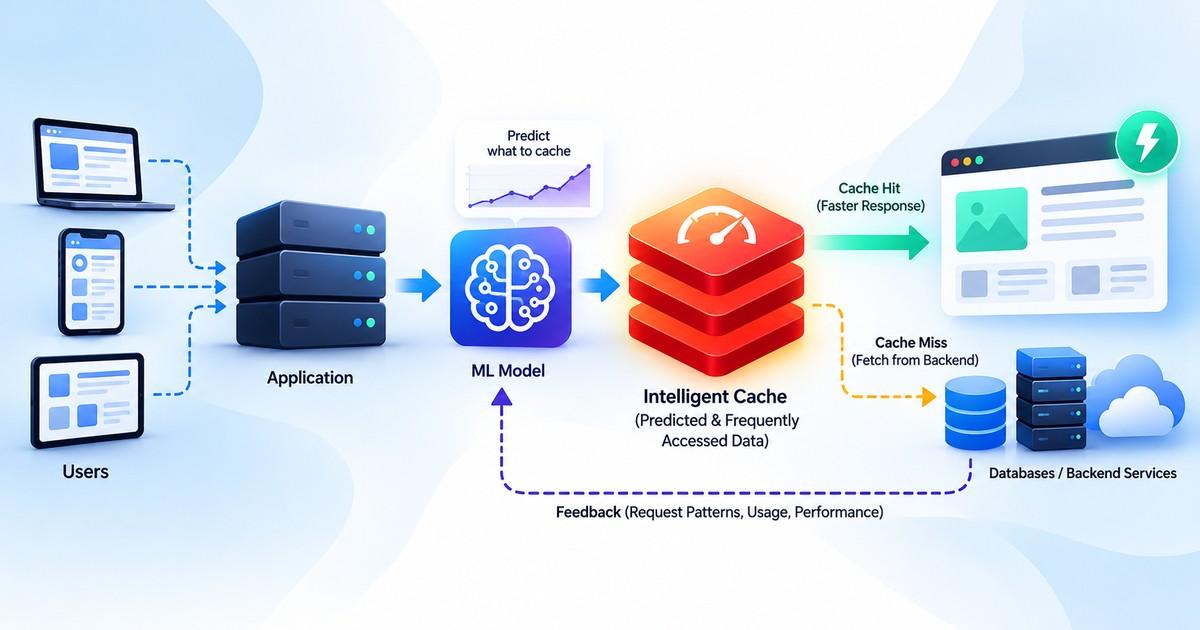
A small internal batch model may not need sophisticated serving infrastructure. A customer-facing recommendation system serving millions of requests may require dedicated model-serving infrastructure, caching, autoscaling, and careful latency management.
This is where production engineering judgment matters. The technically possible architecture is not necessarily the economically sensible one.
Designing for Scale and Reliability
A production ML system needs to remain functional when demand increases and when individual components fail.
Throughput determines how many predictions the system can process within a given period. Engineers need to estimate both average and peak workloads.
A model that works perfectly with 100 requests per second may fail under a sudden 10x increase.
Autoscaling can allow infrastructure to increase capacity as demand grows and reduce resources when traffic falls. However, autoscaling only works effectively when the system's dependencies can scale as well.
Reliability also requires failure recovery.
An inference service may become unavailable. A feature store may experience an outage. An upstream data source may send invalid information.
The application needs to know what happens when these failures occur.
A fallback might use a previous model version, cached predictions, a simpler model, or deterministic business rules.
This is particularly important for critical workflows. A model failure should not automatically become a complete product failure.
Engineers also need to define appropriate service-level objectives around availability and latency and monitor whether those objectives are being met.
The result is a broader system:
Data → Features → Model → Serving → Application → User or business decision
Every layer needs to function well enough for the overall product to succeed.
The hidden work behind this architecture is substantial. "The Hidden Engineering Work Behind Every Successful Machine Learning Product" explores why production ML requires data infrastructure, serving systems, reliability engineering, monitoring, and lifecycle management in addition to the model itself.
Key Takeaway
Turning a model into a production system requires deliberate decisions about batch versus real-time inference, feature pipelines, deployment architecture, scalability, and reliability. Real-time systems must satisfy strict latency and freshness requirements, while batch systems can provide simpler and often more economical processing for less time-sensitive workloads. Features must remain consistent between training and inference, and the system needs capacity planning, failure recovery, and fallbacks. The production model is therefore only one component of a larger architecture designed to deliver predictions reliably at the scale and speed the product requires.
Section 3: Decisions After Deployment
Deploying a machine learning model is not the final milestone in an ML project. Once the model begins processing real production data and influencing actual decisions, the organization enters a new phase of engineering.
The team now needs to determine whether the model continues to perform as expected, whether the data remains suitable, when the model should be retrained, how different model versions should be managed, and whether feedback from users or business processes is changing the system.
These decisions are critical because a production model can degrade without any changes to its code. The environment around it can change, user behavior can evolve, upstream data sources can change, and the model itself can influence the data it later receives.
Monitoring Data and Model Behavior
The first responsibility after deployment is continuous monitoring.
Traditional software systems are typically monitored for availability, latency, errors, and resource utilization. ML systems require these metrics as well, but they also need monitoring for the statistical behavior of their inputs and outputs.
Data drift occurs when the distribution of production data changes compared with the data used during training.
For example, a customer model trained on a particular population may eventually receive a different mix of customers. A fraud model may encounter different transaction patterns. A recommendation system may see substantial changes in what users search for or interact with.
Teams should monitor important feature distributions, missing values, category frequencies, data freshness, and other quality signals.
Model behavior should also be monitored. Depending on the application, teams may track precision, recall, forecasting error, ranking quality, calibration, or other task-specific measures.
The challenge is that ground-truth labels are often delayed. A fraud outcome may take days to confirm, while customer churn may not be known for months.
This means teams often need a combination of immediate operational signals and delayed performance signals.
Prediction monitoring can help identify unusual changes in output distributions before reliable labels become available.
The objective is to detect meaningful changes early rather than discovering model degradation after business performance has already suffered.
Deciding When to Retrain
One of the most important post-deployment decisions is determining when the model should be retrained.
A fixed schedule can be useful for operational simplicity, but it does not necessarily correspond to the rate at which the environment changes.
Retraining may be justified when there is significant performance degradation, meaningful data drift, sufficient new labeled data, or a substantial change in the underlying business environment.
For example, a fraud model may need more frequent updates than a relatively stable demand model because fraudulent behavior can evolve rapidly.
However, new data alone does not necessarily justify retraining.
A temporary event can change the data distribution without representing a lasting shift. Retraining immediately may cause the model to overreact to short-term behavior.
Teams therefore need to distinguish between persistent change and temporary variation.
The quality of new training data also matters. New observations may contain incorrect labels, selection bias, or feedback effects caused by previous model decisions.
The retraining process should therefore include data validation, evaluation, and comparison against the current production model.
In some cases, the best response to changing behavior is not retraining at all. Engineers may need to update a feature, adjust a threshold, modify a business rule, or redesign part of the workflow.
Retraining is one possible response to evidence of change—not an automatic response to every change.
Managing Model Versions
Production ML systems frequently have multiple model versions over their lifetime. This makes model versioning essential.
Every deployed model should have a unique identity and be associated with information about the training data, feature definitions, code, configuration, evaluation results, and deployment history that produced it.
A model registry can provide a central record of these versions and their status.
This becomes particularly important when investigating production incidents.
Suppose performance suddenly declines after a deployment. Engineers need to know which model is currently active, which dataset produced it, what changed from the previous version, and whether the decline coincided with a feature or infrastructure change.
Model lineage connects these pieces.
A useful lineage chain is:
Dataset → Features → Training run → Model → Deployment → Production predictions
This allows teams to reproduce previous states and understand why one version behaved differently from another.
Reproducibility is therefore not merely useful for research. It is part of production reliability.
Versioning also enables controlled rollback. If a new model performs unexpectedly, engineers should be able to return to a previously validated version rather than rebuilding it under pressure.
Handling Feedback Loops
Production models often receive feedback from the users and systems they influence.
A recommendation model generates recommendations, users interact with them, and those interactions become future training signals.
A fraud model identifies transactions for investigation, and investigator decisions become labels for future models.
A search model determines which results users see, and clicks influence future ranking.
These are feedback loops.
Feedback can improve a model, but it can also introduce selection bias and reinforce previous decisions.
For example, a recommendation system may repeatedly expose certain products because they performed well historically. Those products then receive more interactions, creating even more evidence that they should be recommended.
The model is influencing the data it later learns from.
Teams therefore need to distinguish between genuine user behavior and model-induced behavior.
This may require tracking exposure, monitoring selection patterns, introducing controlled exploration, and using experiments to determine whether an intervention actually changes outcomes.
Feedback data should also be validated before becoming part of a future training dataset.
The broader challenge is that the model is not simply observing the environment. It is becoming part of the environment.
"How ML Teams Decide When to Retrain a Model" provides related context on how teams use performance changes, new data, distribution changes, and business signals to determine whether a new model version is actually warranted.
Key Takeaway
After deployment, ML teams must continuously manage data and model monitoring, retraining decisions, model versions, and feedback loops. Production performance can change even when model code remains unchanged, because the underlying environment and user behavior evolve. Strong teams monitor both technical and business signals, retrain based on evidence rather than habit, preserve complete model lineage, and carefully manage feedback so that future models learn from reliable information rather than simply reinforcing previous decisions.
Section 4: Decisions That Determine Long-Term ML Success
Getting a machine learning model into production is an important milestone, but long-term success depends on what happens afterward. Production environments change, data distributions evolve, user behavior shifts, infrastructure costs increase, and business priorities are rarely permanent.
An ML system that performs well today may therefore become less effective or less economical over time.
This makes long-term ML success a continuous decision-making process. Teams must balance model performance with business value, design for changing environments, manage technical debt, and establish a lifecycle that allows the system to improve without becoming increasingly difficult to operate.
Balancing Performance and Business Value
One of the most important long-term decisions is determining whether additional model performance is actually worth pursuing.
ML teams can easily fall into the trap of optimizing technical metrics indefinitely. A model may improve its accuracy, ranking score, or error rate while producing little additional business impact.
The organization should therefore evaluate ROI rather than model performance alone.
Suppose a new model improves prediction quality by a small percentage. That improvement may be highly valuable if the model influences millions of high-value decisions. But if the improvement affects only a small number of low-impact decisions, the additional infrastructure and engineering cost may not be justified.
Infrastructure cost is particularly important at scale. Training compute, storage, inference, monitoring, feature pipelines, and specialized hardware all contribute to the total cost of operating an ML system.
Model complexity also affects long-term ownership. More sophisticated models may require additional dependencies, specialized engineering skills, and more complicated deployment and monitoring.
The correct decision is therefore not:
"Which model has the best score?"
It is:
"Which model provides the best business outcome for its total cost and operational risk?"
Business outcomes can include revenue, conversion, retention, productivity, cost reduction, or risk reduction.
Building for Changing Environments
Long-term ML systems must assume that the environment will change.
Distribution shift can occur when production data differs from the information used during training. New users may arrive, products may change, customer preferences may evolve, or external events may alter behavior.
A model can therefore degrade even when its software implementation remains unchanged.
Engineering teams should build systems capable of identifying these changes through continuous monitoring.
Some environments benefit from periodic retraining, while others may require more adaptive approaches. Systems with rapidly changing information may use incremental updates or online learning where appropriate.
However, adaptation should remain controlled. A model that responds too quickly can overreact to temporary changes or noisy observations.
This is why robust ML architectures often combine current information with historical data and maintain mechanisms for testing changes before fully deploying them.
User behavior is another major source of change. Recommendation and personalization systems can directly influence what users see and do, creating feedback loops that alter future training data.
The system therefore needs to monitor both environmental changes and changes caused by its own decisions.
This makes production adaptability an architectural requirement rather than something that can be added only after a model starts degrading.
Creating a Continuous ML Lifecycle
The strongest ML systems have a structured process for continuous evaluation and improvement.
The lifecycle can be represented as:
Experiment → Validate → Deploy → Monitor → Diagnose → Improve → Revalidate
Each stage should have clear criteria.
Continuous evaluation determines whether the model remains effective.
Experimentation provides a controlled way to test new features, models, and approaches.
Improvement should be based on evidence from production data, business outcomes, and user feedback rather than assumptions.
Governance provides the controls needed to ensure that model changes are traceable and appropriate. Teams should maintain model versions, dataset lineage, evaluation results, and deployment history.
This becomes increasingly important as organizations operate many ML systems simultaneously.
A successful ML lifecycle also includes decisions about when not to change the system. A model can remain stable for long periods if its performance and business value remain strong. Constant modification is not inherently beneficial.
The objective is to change the system when evidence indicates that change is valuable.
This is especially important when models influence one another or participate in feedback loops. Changes should be introduced carefully so that optimization of one component does not unintentionally degrade another.
The hidden engineering work behind this lifecycle is substantial. "The Hidden Engineering Work Behind Every Successful Machine Learning Product" explores why successful ML products require continuous monitoring, infrastructure management, reliability engineering, model lifecycle processes, and long-term ownership, not simply a successful initial experiment.
Key Takeaway
Long-term ML success depends on balancing business value with model performance, preparing for changing environments, controlling technical debt, and establishing a continuous model lifecycle. Production systems must be designed to detect distribution changes, evaluate whether retraining is justified, manage dependencies, and introduce improvements safely. The strongest ML teams treat models as evolving production capabilities and continually ask whether the system is still delivering enough value to justify its complexity.
Conclusion
The journey from a machine learning experiment to a production system is shaped by a long series of decisions. The model itself is only one of them.
Successful ML teams begin by defining the right problem, identifying the decision the system needs to improve, and establishing measurable business and technical requirements. They validate data and labels, prevent leakage, establish credible baselines, and choose a model whose complexity is justified by the problem.
Once the model demonstrates value, the engineering challenge changes. The team must decide how predictions will be generated, how features will be computed, how the model will be deployed, and how the system will scale. Decisions around batch versus real-time inference, feature architecture, serving infrastructure, latency, availability, and failure recovery determine whether the model can function reliably in production.
Deployment is not the end of the lifecycle.
Production introduces new data, new users, changing business conditions, infrastructure failures, and feedback loops. Teams must continuously monitor data quality, feature behavior, model performance, and business outcomes.
Retraining also becomes a strategic decision. A model should not necessarily be retrained simply because new data exists. Teams need evidence that the current system is losing effectiveness or that meaningful new information justifies a new model version.
Model versioning and lineage provide the controls needed to manage these changes. Engineers should be able to trace a production model back to the data, features, training process, and evaluation results that produced it.
Feedback loops add another layer of complexity. A model can influence user behavior and therefore influence the future data used to evaluate or retrain itself. Strong systems monitor exposure and outcomes and use controlled experimentation to distinguish genuine improvement from self-reinforcing behavior.
Frequently Asked Questions (FAQs)
1. What decisions are involved in moving an ML experiment to production?
Teams must decide how to define the business problem, validate data, select the model, design features, choose inference architecture, deploy the model, manage scale, monitor performance, handle failures, and manage future updates.
2. Why does a successful ML experiment often fail in production?
A model may depend on assumptions that do not hold in production. Differences in data, feature generation, user behavior, latency, infrastructure, or business workflows can cause production performance to diverge from offline results.
3. When should production requirements be defined?
Production requirements should be considered before model selection, because latency, scale, availability, cost, explainability, and other constraints can influence which model and architecture are appropriate.
4. How do teams decide between batch and real-time inference?
The decision depends primarily on prediction frequency, required data freshness, latency requirements, workload, and infrastructure cost. Batch inference suits less time-sensitive workloads, while real-time inference is appropriate when predictions must influence immediate decisions.
5. What role does feature engineering play in production ML?
Features must be predictive but also consistently defined, available at prediction time, sufficiently fresh, computationally practical, and maintainable. Feature engineering therefore affects both model quality and production architecture.
6. How should ML models be deployed?
Models can be deployed through APIs, dedicated model-serving systems, application integration, or batch-processing pipelines. The architecture should reflect workload, latency, scalability, reliability, and operational requirements.
7. How do teams make production ML systems scalable?
They use capacity planning, appropriate serving architectures, autoscaling, efficient inference, monitoring, caching where appropriate, and resilient infrastructure designed for peak workloads.
8. What should be monitored after deploying an ML model?
Teams should monitor data quality, feature distributions, drift, prediction behavior, model performance, latency, availability, resource usage, and relevant business outcomes.
9. How do teams decide when to retrain a model?
Retraining can be triggered by meaningful performance degradation, significant distribution changes, new reliable training data, changes in business requirements, or other evidence that the existing model is no longer adequate.
10. Why is model versioning important?
Model versioning allows teams to identify the active model, reproduce historical results, compare versions, investigate incidents, and roll back to a previously validated version when necessary.
11. What role does model complexity play in production decisions?
Complexity affects predictive performance, inference cost, latency, reliability, infrastructure, interpretability, and maintenance. Teams should add complexity only when its incremental value justifies those additional costs.
12. How do feedback loops affect deployed ML systems?
Model decisions can influence user behavior and future observations. This can create selection bias, reinforce previous decisions, reduce exploration, and make future training data partially dependent on the model itself.
13. How should ML teams balance performance and infrastructure cost?
Teams should compare the incremental business value of improved model performance with the additional costs of training, inference, infrastructure, monitoring, and maintenance.
14. How does technical debt affect long-term ML systems?
Technical debt can accumulate through complex feature pipelines, infrastructure dependencies, outdated frameworks, specialized model requirements, and fragmented ownership. This can make future changes more expensive and difficult.
15. What separates an ML experiment from a production-ready ML system?
An experiment demonstrates that a model can learn a useful pattern under controlled conditions. A production-ready system must additionally provide reliable data, consistent features, scalable inference, monitoring, failure recovery, governance, versioning, and continuous lifecycle management while delivering measurable business value.