
Section 1: Why Traditional Caching Needs Predictive Intelligence
Fixed Cache Policies Cannot Anticipate Every Workload
Traditional caching improves application performance by storing frequently accessed data closer to the components that need it, reducing repeated database queries, network communication, and expensive computation. Common eviction strategies such as Least Recently Used (LRU) and Least Frequently Used (LFU) provide practical ways to manage limited cache capacity, while time-to-live policies control how long entries remain available. These techniques work effectively for many applications, but they generally rely on historical access patterns or predetermined rules rather than explicitly estimating what the application will need next.
This limitation becomes more noticeable when request behavior changes rapidly or follows patterns that simple cache policies cannot capture easily. An LRU cache may evict an item that will become important shortly because several other objects were accessed more recently, while an LFU cache may retain an item that was popular historically but is no longer useful. Fixed expiration policies can also remove valuable entries too early or preserve unnecessary data for too long, reducing the effectiveness of limited memory when access patterns evolve throughout the day.
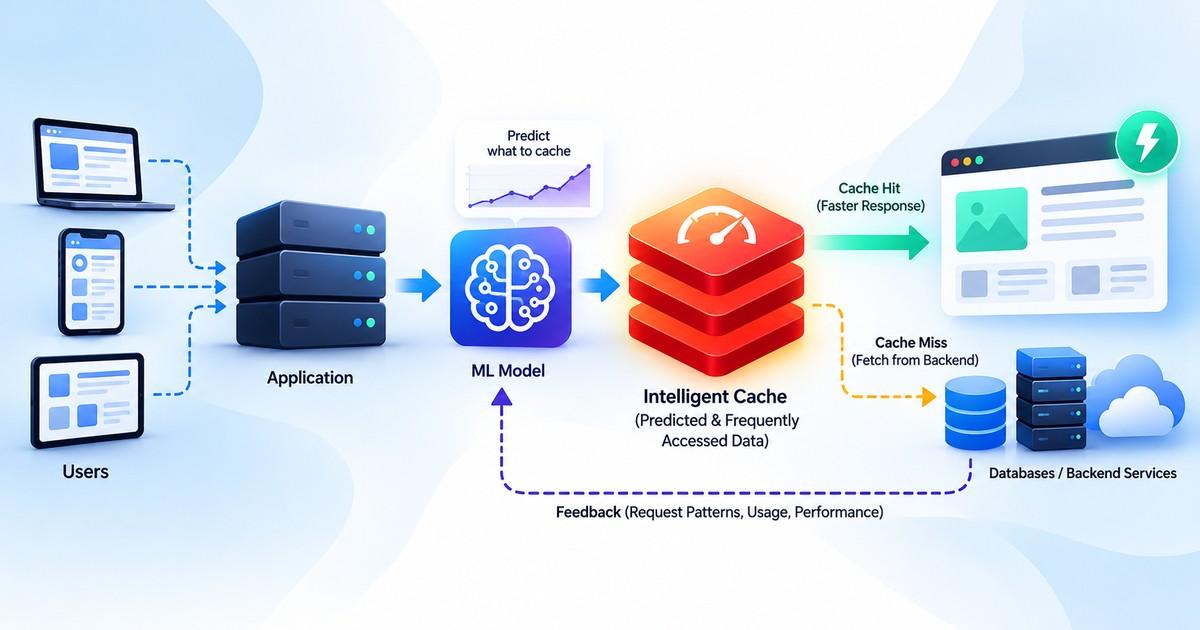
Machine learning can extend conventional caching by estimating the probability of future access and using that estimate to inform admission, eviction, and prefetching decisions. Instead of relying exclusively on recency or historical frequency, an intelligent cache can consider request sequences, time-based patterns, object characteristics, workload context, and retrieval costs when deciding which information deserves limited cache capacity. The objective is not to discard established caching algorithms, but to introduce predictive signals where they offer measurable improvements over existing policies.
Cache Misses Create Different Costs Across Distributed Systems
A cache miss does not have the same consequence for every object because retrieving different kinds of information can involve substantially different computational and network costs. Fetching a small record from an in-memory data service may introduce negligible delay, whereas retrieving a complex query result, generating an embedding, loading a large object from remote storage, or executing an expensive ML inference request can consume considerable time and infrastructure resources. Traditional cache policies that prioritize access patterns without considering retrieval cost may therefore allocate memory inefficiently.
Predictive caching can help prioritize objects according to their expected future usefulness and the cost of recreating or retrieving them. An item that is moderately likely to be requested but extremely expensive to recompute may deserve retention over a frequently accessed item that can be retrieved cheaply. Engineers can combine predicted access probability with object size, retrieval latency, computational cost, and freshness constraints to estimate the value of each cache entry under limited capacity.
This becomes particularly important in distributed applications where a cache miss can propagate through multiple services. A request might trigger a database lookup, call an upstream API, perform feature transformations, and invoke a model before the final response can be returned, making repeated misses a potential source of latency spikes and resource contention.
Dynamic Access Patterns Make Cache Management More Difficult
Production workloads rarely remain static because user behavior, application releases, seasonal demand, new content, and traffic surges can change which objects are valuable to retain. A product that receives little attention for several days may suddenly become popular after a promotion, while an API endpoint that previously generated consistent traffic may experience a sharp decline after a feature change. A cache policy based entirely on past access frequency can respond slowly to these transitions, allowing the cache to retain less useful entries while newly important objects repeatedly miss.
Machine-learning models can identify temporal and contextual patterns that help predict these changes before they are fully reflected in accumulated cache statistics. A predictive system may estimate demand using recent request sequences, time of day, historical seasonality, content attributes, user segments, or application events, enabling the cache to adjust its behavior according to expected demand rather than relying exclusively on past observations. However, prediction quality depends on the relevance and freshness of the input signals, so an intelligent cache must also recognize when its historical assumptions become unreliable.
The relationship between changing workloads and model behavior makes continuous evaluation important because a predictor trained on one access distribution may perform poorly after a major shift in traffic. The broader principles in “Adaptive Machine Learning: How Models Respond to Changing Environments” apply to caching because predictive decisions must remain aligned with current conditions rather than assuming that historical patterns will continue indefinitely.
Key Takeaway
Traditional caching remains effective for many workloads, but fixed policies can struggle when access patterns change, retrieval costs vary, and important requests are difficult to anticipate. ML-powered caching can improve admission, retention, and prefetching by estimating future demand and expected retrieval value, provided that its predictive benefits outweigh the added computational cost and remain reliable as production workloads evolve.
Section 2: How Machine Learning Predicts Cache Demand and Value
Predicting Future Requests From Historical Access Patterns
An ML-powered caching system begins by learning how applications access data over time, using historical request sequences to estimate which objects are likely to be requested again. Traditional policies such as Least Recently Used and Least Frequently Used summarize past activity through recency or frequency, whereas predictive models can incorporate additional signals such as time of day, request sequences, user sessions, object categories, and workload changes. These signals help the system distinguish between an object that is temporarily popular and one whose demand is likely to persist.
Time-series forecasting can be particularly useful when request traffic follows recurring patterns, such as daily activity cycles, scheduled workloads, or predictable demand around application events. A model can estimate future request volumes for particular objects or categories, allowing the cache to retain useful data before the expected increase in demand. Sequential models can provide another approach when the order of previous requests contains information about what is likely to be requested next, such as pages accessed during a session or records repeatedly retrieved during a workflow.
The quality of these predictions depends on how representative the historical data remains as application behavior changes, making continuous evaluation essential for workloads affected by sudden traffic shifts. Engineers should compare predicted access patterns with actual requests and determine whether a forecasting model provides enough improvement over simple frequency and recency statistics to justify its additional complexity.
Intelligent Cache Admission and Eviction
Cache admission determines whether a newly requested object should be stored, while eviction determines which existing entry should be removed when capacity becomes constrained. Traditional systems often apply fixed rules to these decisions, but an intelligent cache can estimate the expected future value of each object by considering its probability of reuse, retrieval cost, size, and freshness requirements. This allows the system to prioritize entries that are likely to deliver meaningful performance benefits rather than retaining objects simply because they were accessed recently or frequently.
A useful admission strategy can prevent one-time requests from displacing reusable objects, particularly when applications process large volumes of unique records or content. A predictive model can estimate whether an incoming item is likely to be requested again and compare that estimate with the expected value of the entries already occupying the cache. When combined with an eviction policy, this approach can improve memory allocation by considering both future demand and the cost of a cache miss.
The decision should also account for object size because a large item can occupy substantial memory while providing relatively few useful cache hits. Engineers can estimate the expected benefit per unit of memory, incorporating access probability and retrieval cost so the cache favors entries whose retention produces greater overall value. These predictions should remain advisory rather than blindly overriding operational constraints, because the cache must still respect capacity limits, freshness requirements, and correctness guarantees.
Combining Predictive Signals With Existing Cache Policies
The strongest cache architectures often combine ML predictions with established algorithms rather than replacing conventional caching mechanisms entirely. A predictive model can estimate future access probability or object value, while a traditional policy handles straightforward admission, expiration, and capacity management, creating a layered design in which ML contributes intelligence without controlling every cache operation. This combination is particularly useful when a model provides informative signals but should not become a critical dependency for every request.
Engineers can begin by running predictions alongside an existing policy in a shadow configuration, comparing the decisions the model would have made with the actual cache behavior before allowing predictions to influence production eviction or prefetching. This provides evidence about potential benefits while limiting operational risk, and it creates a basis for controlled experiments measuring cache hit rate, avoided retrieval latency, bandwidth consumption, memory pressure, and total compute cost.
These measurements matter because a higher cache hit rate does not automatically indicate a better system if the hits mostly avoid cheap retrievals while expensive operations remain unaffected. As discussed in “Caching for AI Applications: The Overlooked Technique for Reducing Inference Costs,” the most useful optimization focuses on eliminating meaningful repeated work rather than maximizing a single cache metric in isolation. Predictive caching should therefore be evaluated by its contribution to end-to-end application performance and infrastructure efficiency.
Key Takeaway
Machine learning can improve cache admission, eviction, and prefetching by estimating future access patterns and the expected value of retaining or retrieving particular objects. The most effective designs combine these predictions with established cache policies and explicit consistency rules, validating improvements through realistic measurements of avoided latency, hit rates, memory usage, and resource cost so that predictive intelligence improves performance without creating unnecessary system overhead.
Section 3: Designing ML-Powered Caching for Distributed Applications
Build a Prediction Pipeline That Does Not Slow Down Cache Access
Integrating machine learning into a distributed cache requires careful architectural separation because cache operations are often expected to complete within extremely small latency budgets. If every cache lookup must synchronously invoke a prediction model before returning a result, the intelligence intended to improve performance can become a new bottleneck. Engineers should therefore design predictive decisions as a supporting layer that can operate alongside conventional cache mechanisms, allowing frequently accessed entries to remain available without waiting for model inference.
A practical architecture can collect request events asynchronously, generate features from access history, and use a predictive model to estimate future demand or the relative value of cache entries. Those estimates can then inform background processes responsible for cache admission, eviction priorities, or prefetching, while the normal request path continues using established lookup and fallback behavior. This separation allows the prediction system to improve cache management over time without making every application request dependent on the availability of an ML service.
The prediction pipeline should also be designed around the freshness requirements of its inputs because historical access patterns may become less useful when traffic changes rapidly. Engineers can combine recent request counts with longer-term access statistics and relevant workload metadata, updating predictions at a frequency that balances responsiveness against processing cost. The model does not need to recalculate every cache decision continuously if periodic updates and incremental features provide sufficient predictive value for the workload.
Coordinate Cache Layers and Distributed Resource Constraints
Modern applications frequently operate with several caching layers, including in-process caches, shared distributed caches, database buffers, content delivery networks, and application-specific storage layers. Each layer has different capacity, access latency, consistency guarantees, and operational costs, making it important for predictive caching to understand where an object should be stored rather than treating all cache capacity as interchangeable. Frequently reused objects may benefit from local caching, while larger objects shared among multiple application instances may be better suited to centralized cache infrastructure.
An intelligent cache manager can estimate future access patterns and use them to distribute objects across these layers according to expected demand and retrieval cost. However, coordinating cache placement becomes more complicated when the same item exists in several locations because updating or evicting one copy may leave other copies stale. Engineers therefore need clear ownership rules, invalidation mechanisms, and consistency policies that account for the behavior of each layer, ensuring that predictive optimization does not compromise application correctness.
Resource constraints add another dimension because prefetching and prediction both consume CPU, memory, bandwidth, and potentially accelerator resources. A model that aggressively preloads objects during peak traffic can compete with production requests for the very resources the cache is intended to save. The serving architecture should therefore impose limits on prefetch volume, concurrent background tasks, and memory consumption, while prioritizing activities that are expected to reduce meaningful retrieval costs rather than maximizing the number of cached objects.
Measure End-to-End Benefits and Preserve Safe Fallbacks
An ML-powered cache should be evaluated by its contribution to application performance rather than by prediction accuracy or cache hit rate alone. Engineers should compare the predictive policy against an appropriate baseline and measure metrics such as avoided retrieval latency, cache hit rate, tail latency, memory utilization, network traffic, computational cost, and the frequency of unused prefetched objects. These measurements help reveal whether the model is avoiding expensive operations or merely increasing cache activity without delivering meaningful benefits to the application.
Shadow evaluation can provide a low-risk way to assess predictive decisions before they influence production cache behavior because the model can generate admission, eviction, or prefetch recommendations while the existing policy remains in control. Once the observed results demonstrate useful gains, controlled experiments can introduce the new policy to a subset of traffic, allowing teams to detect regressions in latency, memory pressure, or data freshness before expanding deployment.
Safe fallback behavior is equally important because prediction services may become unavailable, return stale estimates, or perform poorly after workloads shift. In those conditions, the cache should continue operating through established policies such as LRU, LFU, or time-based expiration rather than blocking requests while waiting for an ML decision. This design reflects the broader engineering principle described in “The Hidden Engineering Work Behind Every Successful Machine Learning Product,” because predictive intelligence creates value only when its surrounding infrastructure preserves reliability, observability, and maintainability.
Key Takeaway
ML-powered caching should use predictive models to improve background decisions about admission, eviction, prefetching, and cache placement without placing expensive inference on the critical request path. By coordinating cache layers, preserving freshness and consistency, controlling resource consumption, measuring end-to-end benefits, and retaining conventional fallback policies, engineers can introduce predictive intelligence while keeping distributed applications fast, correct, and resilient.
Section 4: Evaluating, Operating, and Improving Predictive Cache Systems
Evaluate Predictive Caching Against Meaningful Performance Metrics
An ML-powered caching system should be evaluated according to how much it improves the application's actual performance rather than whether its predictions appear accurate in isolation, because predicting the next requested object correctly does not necessarily translate into reduced latency or lower infrastructure costs. Engineers should compare the predictive policy against established baselines such as LRU, LFU, and the existing production configuration using representative workloads, measuring cache hit rate, avoided retrieval latency, throughput, tail latency, memory consumption, and total compute and network overhead. These comparisons reveal whether predictive decisions eliminate expensive operations or simply introduce additional model execution and prefetch activity without producing sufficient benefits.
Evaluation should also account for the cost of different cache misses because a workload can show an improved hit rate while continuing to experience expensive misses that dominate application response time. Retaining large, frequently accessed objects may increase the number of cache hits but consume disproportionate memory, while prefetching numerous low-cost objects may produce little benefit if retrieving them on demand is already inexpensive. Engineers can therefore estimate the expected value of cached objects using access probability, retrieval cost, memory requirements, and freshness constraints, allowing the system to optimize for meaningful performance improvements rather than maximizing one metric.
Realistic workload replay and controlled experiments provide stronger evidence than synthetic benchmarks alone because production access patterns often contain bursts, recurring sequences, changing popularity, and uneven object sizes. By comparing baseline and predictive policies against the same request traces and operational constraints, teams can determine whether the expected savings persist under realistic conditions before allowing the ML policy to control production cache decisions.
Monitor Prediction Quality and Detect Changing Workloads
Production access patterns change as applications evolve, new content becomes available, user behavior shifts, and traffic moves between different workload categories, potentially reducing the effectiveness of models trained on historical requests. Engineers should monitor actual cache hits against predicted demand, unused prefetched objects, eviction patterns, prediction error, memory pressure, and retrieval latency to determine whether the model continues to allocate cache capacity effectively. A rising rate of unused prefetches, for example, may indicate that the model is overestimating future demand, while more expensive cache misses can suggest that its ranking of object value has become less appropriate.
Workload changes require careful interpretation because a shift in request patterns does not automatically mean the predictive model has failed. A new product launch or planned application release can create a legitimate surge in demand, while an unexpected change in access frequency may indicate a developing problem in the application itself. Engineers should therefore combine model monitoring with request telemetry, deployment events, and workload context to distinguish normal operational changes from changes that warrant model adaptation or investigation.
The principles discussed in “Machine Learning Under Distribution Shift: What Happens When the World Changes” are relevant because predictive caching depends on relationships between historical access patterns and future demand that may not remain stable. Teams should establish clear criteria for refreshing training data, recalibrating predictions, or retraining the model, while retaining a conventional cache policy that can continue operating if prediction quality deteriorates.
Control Infrastructure Costs and Operational Complexity
Predictive caching introduces additional costs through feature collection, model training, inference, prefetching, memory allocation, and monitoring, making economic evaluation essential when deciding whether the approach should be deployed broadly. Engineers need to compare these costs with the resources saved by avoiding database queries, remote service calls, repeated computations, and unnecessary model inference. A predictive strategy that improves the cache hit rate may still be economically unattractive if the model requires expensive hardware or prefetching consumes substantial bandwidth without preventing enough costly misses.
The appropriate optimization strategy depends on the workload's resource constraints because different applications place different values on latency, memory, throughput, and computational cost. A latency-sensitive service may justify additional memory and predictive compute if doing so avoids expensive remote lookups, while a cost-sensitive batch application may benefit more from a lightweight prediction model that reduces repeated computation without requiring dedicated accelerator infrastructure. This makes resource allocation part of the caching design rather than a separate infrastructure decision.
Key Takeaway
Predictive caching delivers lasting value when engineers evaluate it against real performance and cost objectives, monitor changing workloads, control the overhead of predictive decisions, and maintain reliable fallback policies. By combining measured experimentation with continuous evaluation and explicit correctness safeguards, distributed applications can use machine learning to reduce expensive cache misses and improve responsiveness without allowing the prediction system itself to become a source of latency, resource pressure, or operational instability.
Conclusion
ML-powered caching offers a way to improve distributed application performance by combining established caching mechanisms with predictions about future demand, object reuse, and retrieval cost. Traditional strategies such as Least Recently Used, Least Frequently Used, and time-based expiration remain effective across many workloads, but their reliance on predefined policies can limit their effectiveness when access patterns change rapidly or when different cache entries have significantly different operational value. Machine learning can extend these strategies by estimating which objects are likely to be requested, which entries are worth retaining, and when prefetching can prevent expensive operations from occurring on the critical request path.
The most effective implementations begin by identifying a specific caching problem rather than introducing predictive models without a measurable objective. Applications that repeatedly retrieve expensive database records, regenerate embeddings, execute costly computations, or access remote services may benefit from predictive admission, intelligent eviction, or prefetching. Engineers should assess request patterns, cache miss costs, object sizes, freshness requirements, and existing policy performance before determining whether machine learning can deliver sufficient improvement to justify its additional complexity.
Prediction quality alone does not determine whether an intelligent cache is successful because its actual value depends on how its decisions affect the entire application. A model might predict future requests accurately while providing little benefit if the predicted objects are inexpensive to retrieve, and an aggressive prefetching strategy might increase cache activity while consuming memory and bandwidth without reducing meaningful latency. Evaluation should therefore combine cache hit rate with avoided retrieval cost, end-to-end latency, tail performance, resource consumption, and the overhead required to generate predictions.
Distributed deployments introduce further considerations because objects may exist across several cache layers, and predictive decisions must respect data freshness, invalidation, consistency, and resource limits. Machine learning can estimate future access probability, but explicit correctness rules must determine whether cached information remains valid. Keeping predictive decisions outside the critical request path, using conventional cache policies as fallbacks, and controlling background prefetching can help preserve application reliability when predictions become inaccurate or model infrastructure becomes unavailable.
Long-term effectiveness also depends on continuous monitoring because access patterns evolve as users change behavior, applications release new features, and workload distributions shift. Engineers need to observe prediction performance, unused prefetches, cache misses, memory pressure, and retrieval latency while comparing the predictive policy against established baselines under realistic production conditions. Controlled experiments and careful model updates allow teams to improve cache behavior without making every workload change an excuse for unnecessary retraining.
Ultimately, ML-powered caching is most valuable when predictive intelligence complements proven caching mechanisms and improves a measurable production objective. By combining workload-aware prediction, efficient feature collection, freshness safeguards, cost-conscious evaluation, and reliable fallbacks, engineers can reduce expensive cache misses and improve application responsiveness while ensuring that the intelligence introduced into the caching layer does not become a new source of latency, resource consumption, or operational risk.
Frequently Asked Questions
1. What is ML-powered caching?
ML-powered caching uses machine-learning models to improve decisions about which data to cache, retain, evict, or prefetch based on predicted access patterns and expected retrieval costs. It extends traditional caching policies with predictive signals to improve latency and resource utilization when the workload benefits from anticipating future demand.
2. How is predictive caching different from traditional caching?
Traditional caching commonly relies on predefined policies such as LRU, LFU, and time-to-live expiration, whereas predictive caching estimates future demand or the expected value of retaining an object. The approaches can work together, allowing ML predictions to inform cache decisions while established policies continue to manage capacity, expiration, and correctness.
3. Which caching decisions can machine learning optimize?
Machine learning can help with cache admission, eviction prioritization, predictive prefetching, object popularity estimation, and cache placement across different storage layers. The most useful application depends on the workload, the cost of a cache miss, the amount of available historical data, and the operational constraints of the application.
4. What is predictive cache eviction?
Predictive cache eviction uses estimated future access probability or object value to determine which entries should be removed when cache capacity becomes constrained. Instead of considering only recency or frequency, the system can account for likely reuse, object size, retrieval cost, and freshness requirements when deciding which data deserves to remain available.
5. How does ML-powered prefetching work?
ML-powered prefetching estimates which objects an application is likely to request next and retrieves those objects before they are explicitly requested. By moving retrieval work ahead of the demand event, the system can reduce request-time latency when predictions are accurate and sufficient memory, bandwidth, and processing capacity are available.
6. Can ML-powered caching reduce database load?
Yes, predictive caching can reduce database load when it increases the reuse of expensive records or precomputes data that would otherwise require repeated database queries. The resulting benefit depends on whether the cached objects are requested again, how costly their retrieval would have been, and whether caching introduces additional overhead elsewhere in the system.
7. Which machine-learning models are suitable for predictive caching?
Suitable approaches depend on the prediction task and can include time-series forecasting, classification, sequential prediction, and models that estimate object access probability or expected value. Engineers should select the simplest model that provides measurable improvement over existing cache policies rather than assuming a more complex architecture will produce better results.
8. What data is required to build an ML-powered caching system?
Useful inputs can include request timestamps, object identifiers, access sequences, historical request frequencies, object sizes, retrieval latency, cache hit and miss events, workload metadata, and freshness requirements. The quality and relevance of these signals determine how effectively the model can predict future access patterns and estimate the value of cache entries.
9. Does predictive caching always improve cache hit rates?
No, because prediction errors, changing workloads, poor feature quality, and inappropriate admission or eviction policies can reduce performance. Even when the hit rate improves, the overall system may not become faster if the additional hits avoid inexpensive operations while prediction or prefetching overhead consumes more resources than it saves.
10. How should engineers evaluate an ML-powered caching strategy?
Engineers should compare the predictive policy against established baselines using representative request traces and realistic resource constraints. Evaluation should include cache hit rate, avoided retrieval latency, end-to-end and tail latency, memory utilization, network traffic, unused prefetches, computational overhead, and total operational cost.
11. How does cache freshness affect predictive caching?
Cache freshness determines whether a cached value remains valid when the application needs it, which is especially important for rapidly changing information such as inventory, account state, permissions, or transaction data. Predictive models can estimate future demand, but explicit expiration, invalidation, and versioning rules must continue to protect data correctness.
12. Can ML-powered caching work across multiple cache layers?
Yes, predictive decisions can help determine whether an object should be retained in a local cache, shared distributed cache, or another storage layer according to expected demand, retrieval latency, capacity, and operational cost. Multi-layer designs require clear invalidation and consistency mechanisms because the same object may exist in several locations with different freshness guarantees.
13. How does workload drift affect predictive caching?
Workload drift occurs when request patterns change enough that relationships learned from historical access data become less representative of future demand. Engineers can monitor prediction errors, cache misses, unused prefetches, object popularity, and retrieval costs to determine whether the policy needs recalibration, updated training data, or a different prediction strategy.
14. What happens if the prediction model becomes unavailable?
A reliable predictive cache should continue operating through established mechanisms such as LRU, LFU, or time-based expiration when its model cannot provide a timely or valid decision. Keeping predictions off the critical request path and treating them as optional optimization signals helps prevent model failures from interrupting normal cache access.
15. When is ML-powered caching worth implementing?
ML-powered caching is most appropriate when an application has sufficiently informative access patterns and expensive cache misses that predictive decisions could meaningfully reduce latency or infrastructure costs. Engineers should establish a baseline with conventional caching, identify a specific optimization opportunity, and adopt predictive mechanisms only when controlled evaluation demonstrates benefits that justify the additional model, monitoring, and maintenance overhead.