Section 1: Why Complex AI Applications Are Moving Beyond Single-Agent Architectures
The Limitations of General-Purpose Single-Agent Systems
A single-agent architecture uses one primary AI agent to interpret a request, reason about the task, invoke available tools, and generate an outcome. This approach is attractive because it is relatively straightforward to develop, test, and maintain. For simple applications, a single agent with a focused prompt and a small collection of tools can be sufficient.
The difficulty emerges when the application must perform many different types of work. Imagine an enterprise research assistant that receives a request to evaluate a company's technology strategy. The task may require financial analysis, competitive research, product investigation, technical assessment, regulatory review, and report generation. A general-purpose agent must understand all these responsibilities while managing a growing amount of information and an expanding set of tools.
As the application grows, the agent's instructions become increasingly complicated. Different tools may require different permissions, argument formats, and execution policies. A model responsible for all these capabilities must determine which tool is appropriate, when to use it, and how to interpret its results.
This creates several problems. First, the agent may select an inappropriate tool because many available tools have overlapping descriptions. Second, instructions for one task may interfere with another task. Third, the context window may become crowded with unrelated documents, tool responses, and intermediate reasoning. Finally, debugging becomes difficult because multiple types of behavior are concentrated in one execution path.
A larger context window can help accommodate more information, but it does not automatically solve the problem of relevance. Supplying more information may increase token consumption and make it harder for the model to focus on the most important details.
Anthropic's engineering guidance on multi-agent systems identifies context pollution, parallelizable tasks, and specialization as situations where multiple agents can provide advantages. It also cautions that teams sometimes build elaborate multi-agent systems when a better-designed single agent would have been sufficient.
The architectural lesson is that the limitations of a single agent are not determined only by model size or context length. They also depend on how many responsibilities, tools, policies, and independent information domains the application expects one agent to manage.
Task Specialization and Separation of Responsibilities
Multi-agent architectures address complexity by assigning focused responsibilities to different agents. Instead of asking one model to perform every operation, developers create agents with narrower instructions, specialized tools, and clearly defined output contracts.
Consider a software development assistant that investigates a reported defect. A specialized architecture might include a codebase exploration agent, a log analysis agent, a test generation agent, and a review agent. Each component has a distinct responsibility and can operate with a more focused context.
The codebase exploration agent searches relevant files and identifies potentially affected components. The log analysis agent examines error patterns and recent failures. The test generation agent proposes test cases for the suspected issue. The review agent evaluates the combined findings and checks whether the proposed solution addresses the reported behavior.
This division reduces the number of unrelated responsibilities assigned to each agent. It also makes the architecture easier to reason about because each component has a defined purpose and expected output.
Specialization can improve tool selection as well. A database investigation agent may only need read-only query tools, while a deployment analysis agent may need access to release metadata and monitoring information. Providing each agent with a smaller, task-specific toolset reduces ambiguity and limits unnecessary permissions.
However, specialization must be designed around meaningful boundaries. Creating separate agents for every small operation can introduce excessive communication and maintenance overhead. If two tasks require the same context and are tightly coupled, keeping them within one agent may be more effective.
The strongest decomposition strategy considers context boundaries, tool ownership, policy requirements, and execution independence. Agents should be separated when doing so materially improves focus, security, maintainability, or parallel execution—not simply because the application has multiple steps.
Context Isolation, Scalability, and Changing Application Requirements
Context isolation is another important advantage of multi-agent systems. Each agent can maintain a focused working context containing only the instructions, documents, tool results, and state relevant to its responsibility.
In a single-agent application, unrelated information from different tasks may accumulate in the same conversation history. As the task becomes longer, the model may need to process increasingly large amounts of context, including information that is no longer useful.
A multi-agent architecture can reduce this problem by giving each specialist a bounded context. A research agent receives research instructions and source material, while a validation agent receives the claims and evidence it needs to examine. The coordinating component receives summarized outputs rather than every intermediate detail.
This does not mean that context automatically remains isolated. Developers must define what information is passed between agents, which data is shared, and how summaries are validated. Poorly designed handoffs can lose important details or create inconsistencies.
Modularity also helps applications evolve. A system may initially use a research agent and a reporting agent. Later, the engineering team may add a verification agent, a domain-specific specialist, or a compliance review component without redesigning the entire application.
The architecture must still support compatibility between components. Agents need stable input and output contracts, versioned instructions, clear ownership of shared resources, and predictable failure behavior.
For applications that operate under changing data conditions, it is also important to understand how intelligent systems respond to different inputs and environments. InterviewNode's article, Adaptive ML Systems: How Models Respond When the Environment Changes, provides useful background on designing systems that remain responsive as operating conditions evolve.
Key Takeaway
Single-agent systems remain effective for focused tasks, but complex applications may require more specialized reasoning, independent contexts, and parallel execution. Multi-agent architectures address these requirements by distributing responsibilities across coordinated components. Their value comes from reducing specific architectural constraints, not from increasing the number of agents without a clear purpose.
Section 2: Core Multi-Agent Architecture Patterns and Coordination Strategies
Supervisor and Worker Architectures
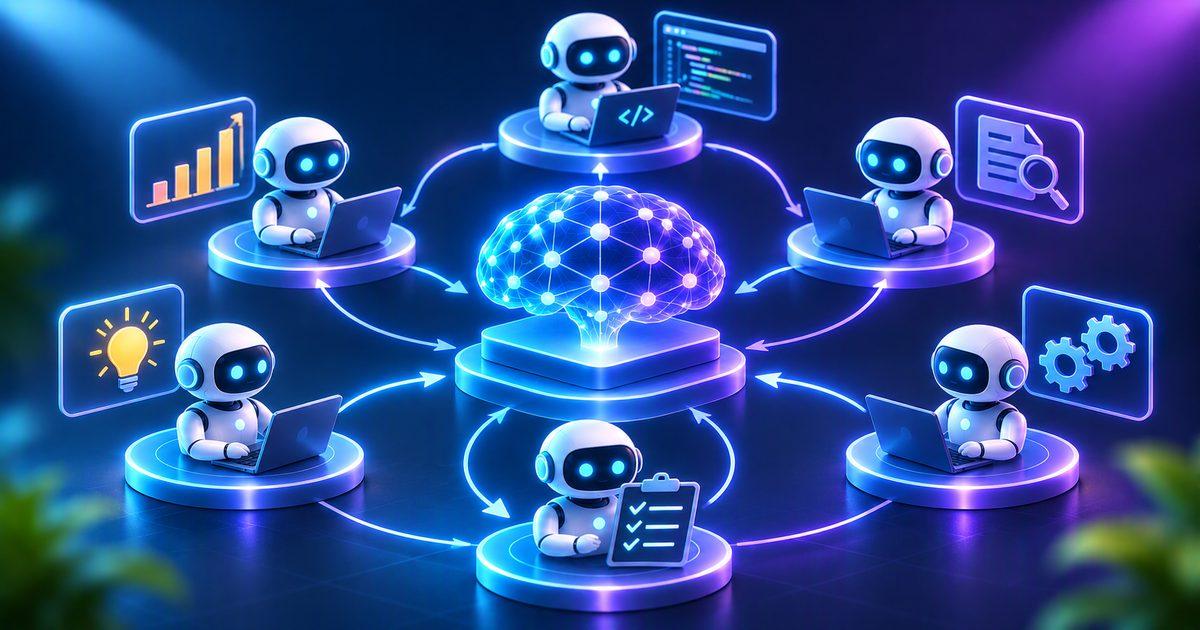
The supervisor-worker pattern is one of the most recognizable multi-agent architectures. A central supervisor receives the user's request, identifies the necessary subtasks, delegates work to specialized agents, and combines their results.
The supervisor acts as the primary coordinator. It determines which specialist should handle each responsibility and maintains control over the overall objective. Worker agents execute bounded tasks and return structured results to the supervisor.
Consider an enterprise financial analysis application. A supervisor receives a request to prepare a quarterly performance report. It delegates revenue analysis to one agent, expense analysis to another, and market comparison to a third. After receiving the results, it checks whether the required information is complete and produces the final report.
The main advantage is centralized coordination. The supervisor has a clear view of the overall task and can determine whether additional work is required. Worker agents can remain focused on their individual responsibilities without needing to manage the entire user interaction.
However, the supervisor can become a bottleneck. If every task depends on one central component, its decisions and response time influence the entire workflow. It may also become overloaded with coordination instructions and intermediate results.
A well-designed supervisor should therefore delegate bounded tasks, use explicit output schemas, enforce execution limits, and avoid repeatedly redistributing work that could be completed locally. It should also have clear rules for handling missing, conflicting, or failed worker results.
OpenAI's agent orchestration documentation describes manager-style architectures in which a central agent invokes specialists as tools while retaining responsibility for the final response. This is useful when specialist agents perform bounded subtasks and the manager must synthesize their results.
Hierarchical and Nested Multi-Agent Systems
Hierarchical architectures extend the supervisor-worker model by introducing multiple levels of coordination. Instead of one supervisor managing every specialist directly, a higher-level coordinator can delegate work to intermediate agents that manage their own sub-agents.
This structure is useful when the application contains several large domains with distinct responsibilities. For example, an enterprise software modernization assistant may have a primary coordinator responsible for the overall migration plan. It can delegate infrastructure analysis to an infrastructure lead agent and application analysis to an application lead agent.
The infrastructure lead may coordinate specialists for cloud configuration, network dependencies, and deployment requirements. The application lead may coordinate specialists for API compatibility, database migration, and test coverage.
The hierarchy creates clearer ownership boundaries. Each intermediate agent manages a smaller portion of the task, reducing the amount of detail that the top-level coordinator needs to process.
However, hierarchical architectures introduce additional handoffs. Information may be summarized several times as it moves between levels, creating opportunities for important details to disappear. Errors made by a lower-level agent may also influence multiple downstream decisions.
The architecture should therefore define how information moves between levels. Structured outputs, source references, task identifiers, and explicit completion states help preserve traceability.
Engineers should also avoid creating unnecessary layers. A three-level hierarchy is not automatically better than a flat supervisor-worker design. Each additional level should solve a genuine coordination or context-management problem.
Hierarchical systems are most appropriate when work can be divided into meaningful domains, each with enough complexity to justify its own coordination boundary.
Peer-to-Peer, Collaborative, and Swarm Architectures
Peer-to-peer architectures allow agents to communicate and coordinate without relying entirely on a single central supervisor. Agents may exchange messages, share task state, negotiate responsibilities, or contribute findings to a common objective.
A collaborative research system illustrates this approach. Several agents investigate different hypotheses, share supporting evidence, and challenge one another's conclusions. Rather than waiting for one supervisor to assign every operation, agents may coordinate through a shared communication mechanism.
Swarm architectures are a related approach in which agents collaborate through more decentralized coordination. Depending on the implementation, an agent may hand off control to another agent when it identifies a task better suited to that specialist.
The benefit is flexibility. Peer agents can contribute different perspectives, and the architecture may avoid making one supervisor responsible for every coordination decision. This can be useful in exploratory research, simulations, or systems where responsibilities change dynamically.
The tradeoff is coordination complexity. Without clear ownership, agents may duplicate work, disagree about the current state, or repeatedly delegate tasks. A decentralized system also makes it harder to identify which component is responsible for the final result.
Communication protocols become essential. Agents need agreed message formats, task identifiers, shared state rules, conflict-resolution mechanisms, and termination conditions. Developers must decide whether agents can communicate directly, use a message broker, or publish results to a shared task store.
Peer-to-peer systems should be introduced only when decentralized collaboration provides a meaningful advantage. For many enterprise applications, a central coordinator with specialist agents is easier to operate and audit.
Key Takeaway
Multi-agent architecture is not a single design pattern. Supervisor-worker, hierarchical, peer-to-peer, sequential, parallel, and evaluator-optimizer structures solve different coordination problems. Strong engineers select the pattern according to task dependencies, ownership requirements, context boundaries, and operational constraints.
Section 3: Engineering Challenges in Building Reliable Multi-Agent Applications
Communication, Shared State, and Coordination Failures
Multi-agent systems depend on communication between components. An agent may need to send a task to another agent, share intermediate findings, request clarification, or return a result to a coordinator.
This communication must be designed carefully. Passing unrestricted conversation histories between agents can increase token usage and introduce irrelevant information. Passing overly compressed summaries can remove details required for accurate decisions.
Structured communication provides a more reliable alternative. Each agent can return a defined object containing its task identifier, status, findings, evidence, confidence indicators where appropriate, and any unresolved questions.
For example, a research agent may return a list of findings with source references and timestamps rather than an unrestricted paragraph. The supervisor can then inspect the evidence, compare results from other agents, and decide whether the task is complete.
Shared state introduces additional challenges. Two agents may attempt to update the same record, work from different versions of the same information, or make conflicting assumptions about task progress. These problems resemble concurrency issues in distributed software systems.
Engineers should consider versioning, transaction boundaries, locking where appropriate, idempotency, and conflict resolution. Shared mutable state should be limited, and each agent should have clear ownership of the resources it modifies.
Coordination failures can also arise when agents disagree or return incompatible outputs. A system needs explicit policies for deciding whether to accept one result, request additional evidence, invoke a verification agent, or escalate the issue to a human.
The objective is to make agent collaboration observable and controlled. Agents should communicate through defined contracts rather than relying on loosely structured exchanges that are difficult to inspect or reproduce.
Error Propagation, Reliability, and Task Completion
A multi-agent system introduces several opportunities for errors to propagate. An early agent may retrieve incorrect information, an intermediate agent may misinterpret the result, and a final agent may produce a convincing conclusion based on flawed inputs.
The problem becomes more difficult when several agents depend on one another. If a workflow contains five stages and each stage has a probability of producing an acceptable result, the overall task reliability depends on the quality of the complete chain.
For illustration, assume five independent stages each succeed with a probability of 95%. The probability that all five succeed is:
[
P(\text{all succeed}) = 0.95^5 \approx 0.774
]
This simplified calculation shows why a system composed of individually reliable components can still have a lower end-to-end success rate. Real agent failures are not necessarily independent, and some workflows can detect or correct earlier mistakes, but the example demonstrates why end-to-end evaluation matters.
One solution is to introduce verification at important boundaries. A retrieval agent can provide source references, a validation agent can inspect factual claims, and the coordinator can reject incomplete results.
However, verification agents are not infallible. If both the generating and evaluating agents share the same underlying model weaknesses or incomplete evidence, they may reinforce the same error. Independent data checks, deterministic validation, and human review remain important.
Task completion should also be explicit. An agent should not be considered successful simply because it returned a response. The application should verify whether the requested operation occurred, whether required data was produced, and whether the result satisfies the business objective.
For example, an agent that is asked to update a customer record should be evaluated on whether the update was authorized, correctly executed, and confirmed by the target system, not merely whether it reported that the update was successful.
Testing, Observability, Security, and Governance
Testing multi-agent applications requires evaluating both individual agents and the complete coordination process. A specialist may perform well in isolation but fail when its output is consumed by another agent. The full workflow may also behave differently when one agent times out, returns incomplete information, or produces an unexpected result.
Unit tests should validate deterministic components such as schemas, authorization checks, tool wrappers, state transitions, and output parsers. Integration tests should verify communication between agents and their connected services. End-to-end evaluations should measure whether the complete system accomplishes realistic tasks.
Observability is critical because debugging a multi-agent workflow requires understanding the sequence of decisions and interactions. Traces should record which agent was invoked, what task it received, which tools it used, what results it returned, and how the coordinator handled those results.
OpenAI's Agents SDK documentation describes tracing that captures model generations, tool calls, handoffs, guardrails, and custom events. These kinds of execution records help developers inspect agent behavior and identify failures across a workflow.
Security must also be enforced at the agent and tool boundaries. Each agent should receive only the data and permissions required for its role. A research agent may need read-only access to documents, while an execution agent may require narrowly scoped write permissions.
Prompt injection is a particular concern because malicious instructions can appear in user input, retrieved documents, or tool results. A specialist agent must not be allowed to override application-level authorization simply because it receives an instruction that appears relevant.
Human approval should be required for high-impact operations such as financial transfers, account deletion, permission changes, or external communications with legal consequences. The system should preserve an audit trail showing which agent proposed an action, which user approved it, and what operation was executed.
For a broader understanding of how non-deterministic systems should be validated, explore InterviewNode's article, ML Testing for Software Engineers: How to Test Systems That Don't Always Produce the Same Output.
Key Takeaway
Multi-agent systems introduce distributed-systems challenges alongside model-specific uncertainty. Communication, shared state, error propagation, latency, cost, testing, and security must all be considered as part of the architecture. A successful implementation needs explicit contracts, end-to-end evaluation, comprehensive tracing, and carefully controlled permissions.
Section 4: Designing Production-Ready Multi-Agent Systems and Their Future
Selecting the Right Agent Decomposition Strategy
The most important design decision in a multi-agent system is determining how to divide the work. Poor decomposition creates unnecessary handoffs, duplicated context, and coordination overhead. Effective decomposition gives each agent a responsibility that can be completed with a clear input, output, and execution boundary.
A useful starting point is to examine the task's information domains. If different parts of the problem require different documents, data sources, or expertise, separate agents may help isolate the relevant context.
The next consideration is execution independence. If two subtasks can be completed without waiting for each other's results, they may be suitable for parallel execution. If one task depends on another, a sequential workflow is more appropriate.
Tool ownership is another useful boundary. Agents that require different tools or permissions may benefit from separation. For example, a read-only analysis agent should not share unrestricted write tools with an execution agent.
The engineering team should also consider whether the output can be evaluated independently. A specialist that produces a structured analysis with clear evidence can be tested more easily than an agent whose responsibilities overlap with every other component.
A practical decomposition process begins by identifying the overall objective, listing the required subtasks, mapping their dependencies, and defining which responsibilities require separate context or permissions. Developers can then determine whether a single agent, a supervisor-worker design, or a parallel workflow is appropriate.
The best architecture is usually the smallest one that satisfies the requirements. A single agent with a few well-defined tools may be sufficient for a basic support assistant. A multi-agent architecture may become justified when the application needs independent research, specialized analysis, or multiple policy boundaries.
Production Architecture, Deployment, and Version Management
Production multi-agent systems need the same operational discipline as other distributed applications. They require stable APIs, authentication, service discovery, data management, monitoring, deployment automation, and recovery procedures.
A typical architecture may contain an API gateway, orchestration service, agent registry, model provider, tool services, shared state store, task queue, observability platform, and evaluation pipeline. Not every application requires all these components, but the architecture should make ownership and execution flow clear.
The orchestration service manages task assignment and execution. The agent registry stores agent configurations, tool definitions, and version information. A state store maintains task progress and intermediate results. A task queue can support asynchronous processing when agents perform long-running operations.
Version management is particularly important because agent behavior depends on more than model weights. Prompts, tool schemas, retrieval indexes, orchestration rules, and evaluation datasets can all influence the final outcome.
These components should be versioned and tested together. If a tool schema changes but an agent still expects the old format, the workflow may fail. If a prompt update changes how a supervisor delegates tasks, previously reliable execution paths may become inconsistent.
Deployment pipelines should therefore include automated tests, evaluation runs, staged releases, and rollback procedures. Teams should be able to identify which configuration produced a particular result and reproduce relevant failures using stored traces and test cases.
For applications using multiple model providers, the architecture should also define fallback behavior and model-routing policies. A fallback model may be suitable for some tasks but not others, so developers should validate its capabilities before allowing it to replace the primary model.
Measuring Business Value and Evaluating Architecture Tradeoffs
Multi-agent systems should be justified through measurable improvements rather than architectural complexity. An application may contain several specialized agents and still perform worse than a simpler system if coordination consumes too much time or introduces errors.
Evaluation should begin with a clear business objective. For a research assistant, success may involve producing a complete, evidence-supported report within a defined time and cost budget. For a customer support application, success may involve resolving a request accurately, reducing unnecessary escalations, and maintaining customer satisfaction.
The team should establish a baseline before introducing multiple agents. This baseline could be a conventional workflow or a single-agent implementation. The multi-agent version should then be evaluated against the same representative test set.
Important metrics include task completion rate, factual accuracy, tool-call success, latency, token consumption, cost per successful task, human intervention rate, and failure recovery time.
Quality metrics should also reflect the application domain. A code analysis system may require test coverage and defect detection measures, while a financial workflow may require exact numerical validation and policy compliance.
Architecture comparisons should consider the complete operating cost. Multiple agents may increase model usage but reduce the amount of manual review required. A system with higher infrastructure cost may still deliver better economics if it consistently completes valuable tasks.
The team should also evaluate whether the architecture can be maintained. More agents mean more instructions, more output contracts, more evaluation cases, and more possible failure combinations. These maintenance costs should be considered before expanding the system.
A useful decision rule is to retain an additional agent only when it provides a measurable improvement in quality, execution time, security isolation, or maintainability that justifies its operational cost.
Key Takeaway
Production-ready multi-agent applications require deliberate task decomposition, versioned components, reliable deployment, and measurable business outcomes. The future may bring more dynamic and interoperable agent systems, but the central engineering requirement will remain the same: coordination must improve the application enough to justify its cost and complexity.
Conclusion
Multi-agent architectures are gaining importance because complex AI applications increasingly need more than one general-purpose model to manage every responsibility. As applications connect to larger tool ecosystems, enterprise data, and multi-step business processes, specialization and coordination become valuable architectural capabilities.
By distributing responsibilities across agents, developers can isolate context, separate permissions, parallelize independent work, and introduce focused evaluation. These advantages make multi-agent systems useful for research platforms, software engineering assistants, enterprise automation, financial analysis, and other applications involving multiple independent areas of work.
However, multi-agent systems also create new engineering challenges. Every additional agent introduces another component that can fail, consume resources, return inconsistent information, or require maintenance. Communication, shared state, error propagation, security, and observability become central concerns.
The strongest approach is not to assume that multiple agents are always better. Engineers should begin with the simplest architecture that satisfies the requirements and introduce specialization only when it solves a measurable problem. A well-designed single agent remains the right choice for many focused applications, while complex tasks may benefit from supervisor-worker, hierarchical, peer-to-peer, or parallel coordination patterns.
Ultimately, the future of multi-agent engineering will be determined by the quality of the systems built around these models. Reliable collaboration requires clear responsibilities, structured communication, controlled permissions, robust evaluation, and measurable business value. Software engineers who combine these principles with strong distributed-systems and AI application knowledge will be well positioned to design the next generation of complex autonomous applications.
Frequently Asked Questions (FAQs)
1. What is a multi-agent architecture in AI?
A multi-agent architecture is a system in which multiple AI agents collaborate to complete a shared objective. Each agent may have specialized instructions, tools, context, and responsibilities, while an orchestration mechanism coordinates their execution and combines results.
2. Why are multi-agent architectures becoming popular?
They help address challenges involving complex tasks, specialized expertise, context management, and parallel execution. They also allow developers to separate responsibilities and permissions across different components.
3. Are multi-agent systems better than single-agent systems?
Not always. Single-agent systems are often simpler, cheaper, and easier to maintain. Multi-agent architectures are useful when specialization, parallelism, or context isolation provides enough benefit to justify additional coordination overhead.
4. What is a supervisor-worker architecture?
It is a multi-agent pattern in which a central supervisor delegates tasks to specialized worker agents. The workers complete their assigned responsibilities and return results for the supervisor to evaluate or combine.
5. What is the difference between hierarchical and peer-to-peer multi-agent systems?
Hierarchical systems organize agents into levels, with higher-level agents coordinating lower-level specialists. Peer-to-peer systems allow agents to communicate and collaborate more directly without relying entirely on a central coordinator.
6. How does parallel execution improve multi-agent performance?
Parallel execution allows independent tasks to run simultaneously instead of sequentially. It can reduce total completion time when subtasks do not depend on one another, although coordination and synthesis still add overhead.
7. What is context isolation in multi-agent systems?
Context isolation means giving each agent a focused set of instructions, information, and task state. It reduces interference from unrelated information and can make specialist responsibilities easier to manage.
8. Which frameworks support multi-agent development?
Developers can explore LangGraph, OpenAI Agents SDK, AutoGen, and other orchestration frameworks. The appropriate choice depends on the required coordination pattern, state management, observability, and integration environment.
9. What are the biggest challenges in multi-agent architectures?
Major challenges include communication overhead, shared-state conflicts, error propagation, latency, token consumption, security, debugging, and evaluation. These challenges become more significant as the number of agents and interactions increases.
10. How do developers prevent agents from producing conflicting results?
They can define clear responsibilities, structured output contracts, source requirements, validation rules, and conflict-resolution mechanisms. A coordinator or verification component can compare results and request additional evidence when necessary.
11. How should multi-agent systems be evaluated?
Evaluation should cover individual agent performance and end-to-end task completion. Useful metrics include task success, factual accuracy, tool-call correctness, latency, cost, failure rates, and human intervention frequency.
12. Are multi-agent systems expensive to operate?
They can be more expensive than single-agent systems because multiple model calls and communication steps may increase token consumption. Cost depends on the architecture, model selection, context reuse, concurrency, and task complexity.
13. Can multi-agent systems work with different AI models?
Yes. Different agents can use different models when the application supports model routing and compatible interfaces. A lightweight model may handle classification while a more capable model performs complex analysis, depending on measured performance.
14. What security risks exist in multi-agent systems?
Risks include prompt injection, unauthorized tool execution, sensitive information exposure, excessive permissions, and insecure communication between agents. Applications should enforce access controls outside the model and apply least-privilege permissions to each agent.
15. What should software engineers learn to build multi-agent applications?
Engineers should learn programming, APIs, distributed systems, LLM fundamentals, tool calling, orchestration, context management, evaluation, observability, and AI security. Practical projects that demonstrate reliable agent coordination are especially valuable.