
Section 1: Understanding the Model Complexity–Value Tradeoff
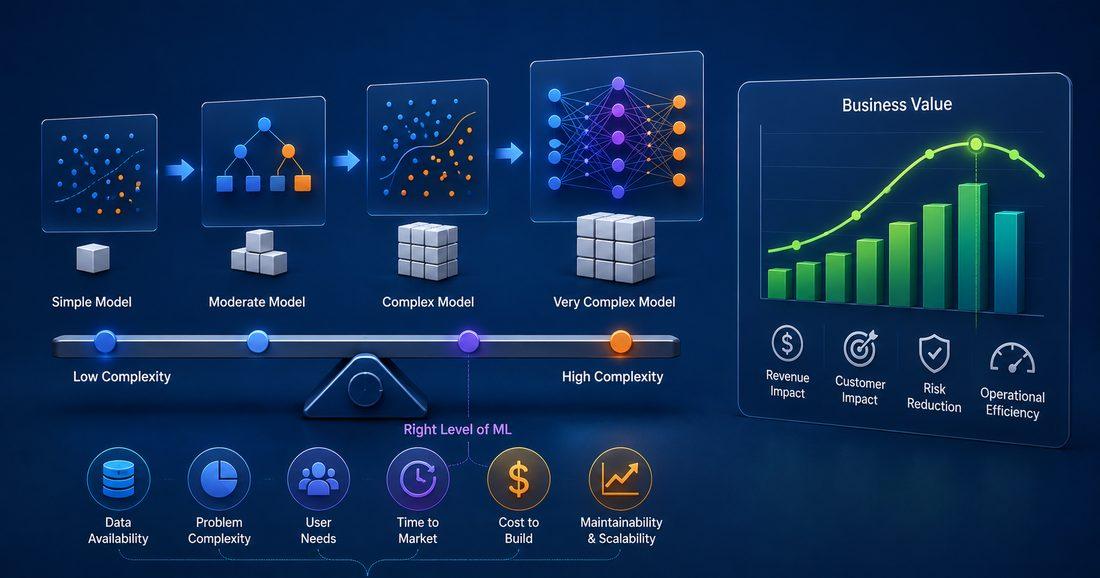
Machine learning teams often assume that increasing model complexity will automatically produce better outcomes. A more sophisticated architecture may achieve a higher benchmark score, capture more nonlinear relationships, or improve prediction accuracy. But in production, technical sophistication and business value are not the same thing.
A model exists to improve a business or operational outcome. The relevant question is therefore not simply whether a more complex model performs better on an evaluation dataset. It is whether the additional performance creates enough incremental value to justify the additional cost, infrastructure, engineering effort, latency, risk, and maintenance burden.
This creates a fundamental tradeoff between model complexity and business value.
What Model Complexity Actually Means
Model complexity can refer to several different dimensions.
One obvious dimension is model size. A model with millions or billions of parameters may have substantially greater representational capacity than a small model. More parameters can allow the system to learn intricate patterns, but they can also increase training and inference requirements.
Another dimension is the number and sophistication of features. A model relying on a small collection of stable features is generally easier to maintain than one requiring hundreds of engineered features derived from multiple production systems.
Architecture complexity also matters. A simple linear model may be straightforward to train and deploy, while an ensemble of multiple models or a deep neural architecture may require substantially more engineering infrastructure.
There is also training complexity. Hyperparameter optimization, multiple training stages, specialized preprocessing, distributed computation, or extensive experimentation can increase development time and computational expense.
These forms of complexity are not necessarily bad. Complex models can be extremely valuable when the business problem genuinely requires them. The important point is that complexity should be treated as a resource with an associated cost.
Why More Complex Models Can Perform Better
Complex models can outperform simpler approaches when the underlying problem contains patterns that simpler models cannot represent effectively.
One reason is the presence of nonlinear relationships. A simple linear model assumes that relationships between features and outcomes can be represented using relatively straightforward combinations. Real-world behavior can be substantially more complicated.
For example, customer response may depend on interactions between price, product category, customer history, seasonality, and timing. Capturing these relationships may require a more expressive model.
Complex models can also capture high-dimensional patterns. Images, natural-language documents, audio, and other unstructured data often contain information that cannot be represented effectively through a small number of manually engineered features.
Deep learning architectures are powerful partly because they can learn representations directly from raw or minimally processed inputs. Instead of requiring engineers to specify every relevant feature, the model can learn useful internal representations.
Another benefit is the ability to model interactions between features. Two variables may individually have limited predictive value but become highly informative when considered together. More expressive architectures can capture these interactions automatically.
Representation learning is particularly important in complex domains. A sufficiently capable model can transform raw information into a representation that makes downstream prediction or ranking easier.
However, greater representational capacity does not guarantee better production performance. A complex model can overfit limited training data, become expensive to serve, or improve an offline metric without creating meaningful business impact.
Why Complexity Has a Cost
Every increase in model sophistication can introduce additional costs.
The first is compute. Larger models and more sophisticated training procedures generally require greater computational resources. Training may require more CPU or GPU capacity, longer training cycles, and more experimentation.
Inference cost can become particularly important at production scale. A model that is inexpensive to run a few thousand times may become expensive when generating millions or billions of predictions.
Latency is another consideration. A complex model may require significantly more computation per request, making it difficult to satisfy strict real-time requirements.
There is also greater engineering effort. Teams need to build and maintain data pipelines, deployment systems, model-serving infrastructure, monitoring, and specialized optimization processes.
Complexity can increase the number of failure points. More dependencies, more components, and more infrastructure can make production systems harder to debug and operate.
Finally, there is maintenance cost. Models change, data distributions evolve, dependencies become outdated, and infrastructure needs to be upgraded. A complex model can require more specialized knowledge to retrain, debug, optimize, and replace.
These costs should be included in the model-selection decision from the beginning rather than discovered after deployment.
When Simpler Models Are Enough
A sophisticated model is unnecessary when a simpler model already provides the required business performance.
Consider a structured dataset where relationships are relatively stable and the signal is strong. A linear model, logistic regression, decision tree, or other compact model may perform sufficiently well while being easier to explain, deploy, and maintain.
The strength of a simple model is not merely its lower compute requirement. Simpler systems are often easier to debug and more predictable under operational constraints.
They can also provide valuable baselines. Before adopting a complex architecture, teams should establish how well a straightforward approach performs. If the complex model produces only a tiny improvement, the additional cost may not be justified.
For example, a simple model might achieve 94% predictive performance while a substantially more complex architecture achieves 95%. If both models generate nearly identical revenue or operational outcomes, the more complex system may provide little additional value.
In contrast, a one-percentage-point improvement can be extremely valuable when the model influences millions of high-value decisions.
This is why model selection should be based on marginal business value, not complexity for its own sake.
The economics of this tradeoff becomes especially important once infrastructure, inference, engineering, and maintenance costs are included. “The Economics of Machine Learning: Measuring the True Cost of a Model" explores why teams should evaluate the complete lifecycle cost of ML systems rather than focusing only on training expenses.
Key Takeaway
Model complexity can improve performance when a problem contains nonlinear relationships, high-dimensional patterns, feature interactions, or representation-learning requirements. But complexity also creates additional compute, inference, engineering, infrastructure, and maintenance costs. A simple model may therefore be the better choice when it delivers essentially the same business outcome. The right objective is not to select the most sophisticated model, it is to select the lowest-complexity model that delivers the required level of business value.
Section 2: Measuring Whether Additional Complexity Creates Value
Choosing between a simple and complex machine learning model should not be based on benchmark performance alone. The key question is whether additional model sophistication creates enough incremental business value to justify the additional cost and operational complexity.
A strong ML team therefore establishes a baseline, measures the improvement generated by increasing model complexity, connects that improvement to business outcomes, and calculates the cost of obtaining it.
Comparing Models Against a Strong Baseline
Every model-selection exercise should begin with a credible baseline model. The baseline represents the simplest reasonable approach to the problem.
Depending on the application, this could be a constant predictor, linear regression, logistic regression, a decision tree, a rules-based system, or an existing production model.
The purpose of the baseline is not to prove that simple models are always better. It provides a reference point for understanding the value of additional sophistication.
Suppose a churn model using logistic regression achieves a particular level of recall and the proposed gradient-boosting model improves that metric. The team should quantify the incremental improvement rather than simply stating that the more advanced model performs better.
The comparison should examine multiple dimensions:
Baseline performance → New model performance → Incremental improvement
The relevant metrics depend on the application. Classification systems may compare precision and recall, forecasting systems may compare error, and ranking systems may compare NDCG or another ranking metric.
But technical improvement is only the first layer.
The team should also examine whether the model reduces business-relevant errors. A small increase in overall accuracy may be less important than a substantial reduction in costly false negatives.
Evaluation should also include important subgroups and operating conditions. A complex model may improve average performance while becoming significantly worse for a critical segment.
This is why a strong baseline creates discipline. It forces the team to answer a specific question:
What does the additional model complexity actually buy us?
Understanding Marginal Model Improvement
Model performance often follows a pattern of diminishing returns.
The first increase in model sophistication can produce a meaningful improvement. Moving from a simple heuristic to a basic ML model may generate a large gain. Moving from that model to a more advanced architecture may generate another improvement, but usually a smaller one. Further complexity may produce progressively smaller gains.
This creates a marginal-value curve.
Suppose three models produce progressively better performance:
Simple model → 90%
Moderate model → 94%
Highly complex model → 94.5%
The highly complex model technically performs best. But the additional 0.5 percentage points must be evaluated against its incremental infrastructure, training, inference, and maintenance costs.
Different metrics create different interpretations.
For classification, the important improvement may be in precision and recall, particularly when one type of error has much greater business impact.
For ranking systems, a small increase in NDCG may be highly valuable if it improves the quality of the first few results shown to millions of users.
For forecasting, a small reduction in prediction error may be economically significant when it influences expensive inventory or capacity decisions.
Therefore, teams should not ask merely whether performance improved. They should ask:
How much did performance improve, and how valuable is that improvement?
This distinction is critical because model complexity should increase only when the expected incremental value remains meaningful.
Connecting Model Improvements to Business Outcomes
Technical metrics become economically meaningful only when they influence business outcomes.
Imagine a recommendation model that improves its ranking metric by 3%. That does not necessarily mean revenue will increase by 3%. The actual impact depends on whether users interact with the improved recommendations and whether those interactions translate into purchases or other valuable outcomes.
The same principle applies to a fraud model. Improving recall may identify more fraudulent transactions, but if the additional alerts create excessive false positives, the organization's investigation costs may increase.
Teams should therefore connect:
Model improvement → Decision improvement → Business outcome
Possible business outcomes include:
- Revenue: additional purchases, conversion, or customer lifetime value.
- Productivity: reduced manual effort or faster processing.
- Cost reduction: lower operational or infrastructure costs.
- Risk reduction: prevented fraud, failures, losses, or security incidents.
For example, a more complex predictive-maintenance model may improve failure prediction accuracy by a modest amount. If that improvement prevents substantial equipment downtime, the additional model complexity could be economically justified.
Conversely, a sophisticated model may achieve a measurable benchmark improvement while changing almost none of the downstream decisions. In that situation, the business value of the added complexity may be negligible.
This is why ML teams should define the decision and business KPI before selecting the final model.
Cost per Unit of Model Improvement
After establishing incremental performance and business impact, teams need to evaluate the cost of obtaining that improvement.
Training cost includes the compute required to train and evaluate the model, as well as experimentation and hyperparameter optimization.
Inference cost can become much more important after deployment. A model serving millions of predictions may generate substantial recurring infrastructure costs.
Infrastructure requirements can include specialized hardware, memory, storage, networking, model-serving systems, and monitoring infrastructure.
There is also engineering effort. A complex model may require more sophisticated feature pipelines, deployment processes, optimization techniques, testing, monitoring, and specialized expertise.
These costs can be expressed relative to the incremental improvement:
Incremental business value ÷ Incremental ML cost
This provides a practical view of economic efficiency.
For example, suppose Model B increases revenue by $1 million annually but costs an additional $100,000 per year to operate. That may represent an attractive investment. If Model C provides another small improvement worth $30,000 but requires $150,000 in additional annual costs, further complexity is not economically justified.
The correct stopping point is therefore not necessarily the model with the highest technical score. It is the point at which additional complexity no longer produces enough incremental value.
This framework also helps teams decide when to compress, simplify, or replace a model. A smaller model that produces nearly identical business outcomes may be economically superior.
The same principle applies when comparing custom ML development with existing AI services or alternative approaches. "From Prediction to Decision: How Machine Learning Creates Business Value" provides broader context on connecting technical model improvements to measurable business outcomes rather than evaluating ML through model metrics alone.
Key Takeaway
The value of increasing model complexity should be measured through incremental performance, incremental business impact, and incremental cost. A strong baseline establishes what the organization can achieve with a simpler approach. Teams should then determine whether additional complexity produces meaningful improvements in revenue, productivity, cost reduction, or risk reduction. The economically optimal model is the one where the marginal business value of additional complexity remains greater than its marginal lifecycle cost.
Section 3: Complexity Beyond Model Accuracy
Model accuracy is only one dimension of production ML quality. A complex model may outperform a simpler model in an offline benchmark while creating substantially greater costs or operational challenges once deployed. In real-world systems, teams must consider latency, scalability, reliability, interpretability, data requirements, monitoring, retraining, and long-term maintenance alongside predictive performance.
This means model selection should be treated as a system-design decision rather than a competition to find the most sophisticated algorithm.
Latency, Scalability, and Reliability
A model that is slightly more accurate but significantly slower may be a poor choice for a real-time application.
Inference latency becomes particularly important when predictions are generated inside customer-facing workflows. Search, recommendations, fraud detection, and interactive AI applications may have strict response-time requirements. A model that requires substantially more computation can increase response latency even when its accuracy improves.
Latency also affects infrastructure costs. Meeting a strict response-time requirement may require additional CPUs, GPUs, memory, replicas, or specialized serving infrastructure.
Throughput is another consideration. A model serving a few thousand predictions per day can tolerate a very different cost structure from one serving millions of predictions per second.
The relationship between complexity and scale is therefore important. A small difference in inference cost can become financially significant when multiplied by a large number of requests.
Availability and reliability must also be considered. More complex models often introduce additional dependencies and infrastructure components. These can create more potential failure points.
For example, a ranking pipeline that requires several feature services, embedding systems, model endpoints, and external dependencies may be more difficult to operate reliably than a compact model using a small number of stable features.
A production model therefore needs to satisfy the complete requirement:
Quality + Latency + Throughput + Availability + Cost
Improving one dimension while significantly damaging another may produce a worse overall system.
Interpretability and Explainability
Model complexity can also affect how easily humans understand and trust predictions.
A simple linear or tree-based model may provide relatively straightforward explanations. A highly complex ensemble or deep neural network can be considerably more difficult to interpret.
Business users may need to understand why a model produced a particular recommendation or risk score. If the model is used to prioritize customers, approve transactions, or allocate resources, stakeholders may reasonably ask what factors influenced the decision.
Interpretability is especially important in high-stakes decisions. A complex model may provide a small improvement in predictive performance but introduce significant difficulty in explaining, auditing, or challenging its decisions.
Explainability also has engineering value. When a model behaves unexpectedly, understandable decision logic can make debugging easier. Engineers can identify whether a feature, data source, or learned relationship is producing an unintended result.
This does not mean simpler models are always preferable. Some business problems genuinely require complex representations, especially when working with images, language, audio, or highly nonlinear data.
The appropriate question is whether the additional performance justifies the additional interpretability burden.
Teams should also distinguish between explanation tools and actual model simplicity. An explanation generated after the fact does not necessarily make the underlying model inherently interpretable.
For applications with significant governance requirements, interpretability should therefore be considered during model selection rather than added as an afterthought.
Technical Debt and Maintenance
The long-term costs of complexity can appear as technical debt.
Dependencies may become outdated, frameworks may change, hardware may be replaced, and team members with specialized knowledge may leave the organization.
A complex model can require specialists to understand its architecture, training procedure, optimization strategy, and serving environment. If only a small number of engineers understand the system, organizational risk increases.
Model lifecycle management also becomes more demanding. Teams must version models, preserve training environments, monitor performance, manage retraining, and maintain rollback mechanisms.
The complexity of these systems can make future changes more expensive. A seemingly simple feature modification may require changes to data pipelines, training processes, validation frameworks, model-serving infrastructure, and monitoring.
This is why teams should evaluate not only the initial development effort but the lifetime ownership cost.
A simple model that can be understood and maintained by multiple engineers may create more long-term value than a more sophisticated model that provides a small improvement but requires specialized expertise indefinitely.
This principle becomes particularly important when models are expected to remain in production for years. The engineering organization that originally built the model may not be the organization maintaining it later.
The broader lesson is that model selection should consider operational sustainability.
"When Machine Learning Should Not Be Used: A Guide to Better Technical Decisions" provides useful context for this tradeoff because a technically stronger solution is not always a better engineering solution when its additional complexity does not create proportional business value.
Key Takeaway
Model complexity affects much more than predictive accuracy. It can influence latency, scalability, reliability, interpretability, data requirements, infrastructure, monitoring, retraining, and technical debt. A more sophisticated model should therefore be adopted only when its additional capabilities justify these broader costs. The right production model is not necessarily the most accurate one; it is the one that delivers the required business outcome while remaining reliable, explainable enough for its context, scalable, and maintainable.
Section 4: Choosing the Right Level of ML for Production
Selecting the right model is ultimately a business and systems engineering decision, not simply a model-selection exercise. Teams need to balance predictive performance against cost, latency, reliability, interpretability, data requirements, and long-term maintainability.
The objective is to identify the lowest level of complexity that reliably delivers the required business outcome. Complexity should increase only when there is clear evidence that additional capability creates meaningful incremental value.
A Practical Model Selection Framework
The first step is to establish the business requirements. Teams should define what decision the model supports, what outcome it is expected to improve, and what level of performance is actually necessary.
A model used for an internal analytical workflow may have very different requirements from one powering a customer-facing application. Similarly, a model supporting a high-stakes decision may require stronger explainability and validation than a recommendation model.
Next, teams should establish the technical requirements. These can include latency, throughput, availability, scalability, infrastructure constraints, data freshness, and security.
The team should then compare several candidate approaches rather than immediately selecting the most sophisticated architecture.
A useful progression is:
Rules or heuristic → Simple ML baseline → Moderate model → Complex model
Each step should demonstrate measurable improvement over the previous approach.
Risk should also be part of the assessment. A complex model may introduce greater operational and governance risk without materially improving the business outcome.
Finally, the team should estimate the complete lifecycle cost. This includes training, inference, infrastructure, monitoring, retraining, engineering support, and maintenance.
The resulting decision should answer four questions:
Does the model perform well enough?
Does it improve the desired business outcome?
Can the organization operate it reliably?
Is the additional complexity economically justified?
When to Upgrade to a More Complex Model
Teams should consider moving to a more sophisticated model when a strong baseline has reached a meaningful limitation.
One signal is baseline performance. If a simple model consistently fails to capture important patterns and those errors have measurable business consequences, additional capacity may be justified.
The nature of the problem matters as well. If the task contains complex nonlinear relationships, high-dimensional inputs, unstructured data, or interactions that simpler models cannot capture, a more expressive architecture may provide meaningful improvements.
A higher-complexity model becomes particularly attractive when it influences high-value decisions at scale.
Suppose a recommendation system serves millions of users every day. A modest improvement in ranking quality could produce substantial additional revenue or engagement. In such a situation, investing in a more sophisticated model may have a strong economic return.
However, the organization should demonstrate that the improvement is real. Offline performance should be followed by appropriate online experimentation and business measurement.
Sufficient data is another requirement. Complex models often need more representative training data. If the dataset is too small or noisy, increasing model capacity may simply increase overfitting.
The decision can therefore be summarized as:
Upgrade complexity when simpler models have demonstrated a meaningful limitation, the data supports the additional capacity, and the expected business return exceeds the added lifecycle cost.
Continuous Model and Cost Optimization
Model selection should not be treated as permanent. Production requirements, data, model capabilities, infrastructure costs, and business priorities change.
Teams should periodically re-evaluate deployed models to determine whether their complexity remains justified.
A model that was economically attractive two years ago may now be unnecessarily expensive because a smaller architecture has become available. Conversely, increased traffic or higher business value may justify investing in a more capable model.
Model compression can provide an intermediate option. Techniques such as quantization, pruning, and knowledge distillation can reduce the computational requirements of a complex model while preserving much of its predictive performance.
This can create a useful middle ground:
High-capability model → Compress or distill → Lower-cost production model
Teams can also compare models based on business value per unit of compute rather than raw performance.
For continuously operated systems, this helps organizations optimize the tradeoff between quality and operating cost.
Monitoring should track both model performance and economics. Important signals can include inference cost, latency, infrastructure utilization, prediction quality, business outcomes, and model maintenance effort.
When these signals change materially, teams should reconsider whether the current model remains the right choice.
This creates a continuous optimization loop:
Deploy → Measure → Compare value and cost → Simplify or upgrade → Validate → Redeploy
The objective is not to continually increase model complexity. It is to continually maintain the right level of complexity for the current business environment.
This principle also applies to strategic choices between building a complex custom model and using an existing foundation model, commercial system, or simpler specialized solution. "Build, Buy, or Fine-Tune? How Companies Choose Their AI Strategy" explores how organizations should evaluate customization, differentiation, cost, operational requirements, and long-term strategic value before selecting an AI approach.
Key Takeaway
The right level of ML complexity is determined by business requirements, technical constraints, risk, and measurable incremental value. Teams should upgrade to more complex models when simpler approaches have demonstrated meaningful limitations and the additional capability creates sufficient ROI. They should prefer simpler models when business outcomes are similar, operational costs are lower, or interpretability and reliability matter more. The best production model is not the most sophisticated available, it is the one that delivers the required outcome with the right balance of performance, cost, reliability, and maintainability.
Conclusion
Model complexity is not a proxy for business value. A more sophisticated machine learning architecture may deliver higher benchmark performance, but the additional capability is valuable only when it produces a meaningful improvement in the business outcome that the model is designed to influence.
The central question for ML teams should therefore be:
What is the simplest model that can reliably deliver the required business outcome?
Answering that question requires more than comparing accuracy scores. Teams need to establish a strong baseline, measure incremental performance, connect model improvements to business outcomes, and account for the full lifecycle cost of additional complexity.
A simple model may outperform a complex model economically when both produce similar customer, operational, or financial outcomes. Simpler models can offer lower inference costs, lower latency, easier debugging, greater interpretability, fewer dependencies, and lower maintenance requirements.
At the same time, simplicity should not become an excuse for underengineering. Some problems genuinely require sophisticated models because they involve nonlinear relationships, high-dimensional data, complex interactions, or unstructured information. When a complex model produces meaningful incremental value at sufficient scale, the additional investment can be highly justified.
The critical concept is marginal value. Teams should determine how much additional business impact results from moving from one level of model complexity to another and compare that benefit with the additional training, infrastructure, inference, engineering, monitoring, and maintenance costs.
Model evaluation should therefore follow a broader sequence:
Model performance → Decision improvement → Business outcome → Economic value
Frequently Asked Questions (FAQs)
1. What is model complexity in machine learning?
Model complexity refers to how sophisticated a model is in terms of its parameters, architecture, features, representations, training requirements, and operational dependencies. Complexity generally increases the model's capacity but can also increase cost and maintenance requirements.
2. Does a more complex ML model always perform better?
No. A more complex model may perform better when the problem contains patterns that simpler models cannot capture, but it can also overfit, require more data, increase operational costs, or produce only marginal improvements.
3. Why does model complexity increase cost?
Complex models can require more training compute, expensive inference infrastructure, larger datasets, specialized hardware, more engineering effort, additional monitoring, and more complicated deployment and maintenance processes.
4. When should a company choose a simple ML model?
A simple model is often preferable when it meets the required business performance, has similar outcomes to more complex alternatives, operates under strict latency or cost constraints, or when interpretability and maintainability are especially important.
5. How do teams compare simple and complex models?
Teams should compare models using technical performance, business outcomes, inference cost, training cost, latency, reliability, interpretability, infrastructure requirements, and long-term maintenance rather than accuracy alone.
6. What is marginal model improvement?
Marginal model improvement is the additional performance gained by moving from one model or level of complexity to another. The important question is whether that additional improvement produces enough business value to justify its additional cost.
7. How should companies measure the business value of better model performance?
Companies should connect model improvements to outcomes such as revenue, conversion, productivity, cost reduction, customer retention, or risk reduction. Controlled experiments can help determine whether the improvement actually affects business results.
8. How does model complexity affect inference cost?
More complex models often require greater computational resources, memory, and specialized hardware during inference. At high prediction volumes, even small increases in per-request cost can become significant operational expenses.
9. How does complexity affect ML model latency?
Complex architectures may require more computation per prediction, increasing response time. This can be particularly important for real-time applications such as search, recommendations, fraud detection, and interactive AI.
10. When is model interpretability more important than accuracy?
Interpretability becomes especially important when models support high-stakes decisions, require human review, face governance requirements, or need to be easily debugged and understood by business stakeholders.
11. What is the relationship between model complexity and technical debt?
Complex models can create additional dependencies, specialized infrastructure, difficult-to-maintain pipelines, and requirements for scarce expertise. These factors can increase long-term technical debt and ownership costs.
12. How much additional data does a complex model require?
There is no universal amount. More expressive models often benefit from larger and more representative datasets. When training data is limited or noisy, increasing model complexity can increase overfitting rather than business value.
13. When should an organization upgrade to a more complex model?
An organization should consider upgrading when a strong baseline has demonstrated a meaningful limitation, the available data supports additional modeling capacity, the new model produces measurable improvement, and the expected business value exceeds the additional lifecycle cost.
14. Can model compression reduce the cost of complex ML models?
Yes. Techniques such as quantization, pruning, and knowledge distillation can reduce model size, inference cost, and latency while retaining much of the original model's useful performance.
15. What framework should ML teams use to choose the right model complexity?
Teams should evaluate business requirements, baseline performance, incremental model improvement, business impact, data availability, latency, reliability, interpretability, total cost of ownership, and operational risk. The preferred model is the simplest approach that reliably delivers the required business outcome.