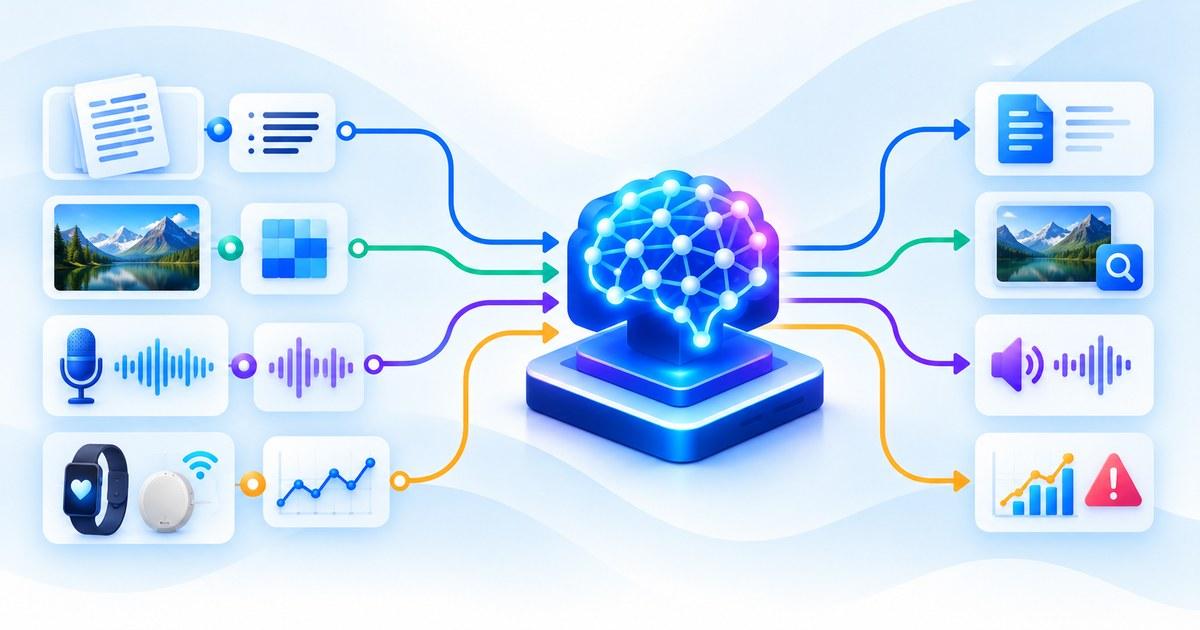
Section 1: Why Multimodal Machine Learning Is an Engineering Challenge
Why Text, Images, Audio, and Sensor Data Require Different Processing Pipelines
Modern software systems increasingly generate information through multiple channels, including written text, images, audio recordings, video frames, and measurements from physical sensors, creating opportunities for machine learning models to understand situations that cannot be represented adequately by a single data source. A healthcare monitoring application, for example, might combine written clinical notes, medical images, recorded speech, and physiological measurements to support a more comprehensive assessment, while an industrial monitoring system could connect maintenance reports, equipment images, vibration measurements, and temperature readings to investigate emerging faults. Although these inputs may describe the same underlying situation, their structures, statistical properties, and processing requirements differ significantly, making multimodal machine learning an engineering challenge that extends beyond selecting a suitable model architecture.
Text pipelines typically involve tokenization, normalization, and contextual representation, whereas image processing may require resizing, normalization, cropping, or specialized visual encoders; audio pipelines introduce sampling rates, waveform transformations, spectrograms, or speech representations, while sensor streams often require calibration, filtering, unit conversion, and time-window aggregation. These transformations must preserve the information needed for the intended prediction without introducing unnecessary inconsistencies between the modalities, particularly when multiple pipelines are developed by different teams or operate on different infrastructure. Engineers must therefore define modality-specific preprocessing contracts while maintaining a coordinated data pipeline that ensures the outputs can be associated correctly during training and inference.
The engineering implications become more significant as the volume and computational cost of different modalities increase, since processing high-resolution images, long audio recordings, or continuously arriving sensor measurements can demand very different resources from those needed to process short text inputs. A production system may need separate preprocessing workers, storage strategies, and inference services for each modality, with the resulting representations combined only when the required inputs are available and compatible. The concepts explored in “Multimodal Machine Learning: Teaching Models to Learn From Text, Images, and Sensors” provide a useful foundation for understanding how different data types contribute complementary information, while the production engineering challenge lies in connecting their processing pipelines without losing the relationships that make the combined information useful.
Aligning Timestamps, Events, Entities, and Context Across Modalities
Combining multiple modalities requires more than placing their records in the same dataset because the information must refer to compatible entities, events, and time periods before a model can learn meaningful cross-modal relationships. In a transportation application, for example, a camera frame, a microphone recording, vehicle speed, and acceleration measurements may all describe the same driving situation, but their timestamps and sampling frequencies may differ substantially. If the system associates a camera frame with sensor readings collected several seconds earlier or later without accounting for the timing difference, the training example may represent an inaccurate combination of conditions, weakening the relationships the model is expected to learn.
Temporal alignment becomes especially important when modalities operate at different frequencies, such as audio sampled thousands of times per second alongside environmental measurements collected at slower intervals. Engineers must decide whether to aggregate high-frequency signals into meaningful time windows, interpolate selected sensor values, synchronize events using timestamps, or associate each observation with the nearest valid context, depending on the physical or business relationships represented by the data. These choices should be documented and applied consistently across training and inference, since different alignment rules can change the meaning of the input representation even when the original records remain unchanged.
Entity alignment introduces a related challenge because text, images, audio, and sensor data may originate from different systems that use different identifiers or recording conventions for the same underlying object. An industrial platform may identify a machine through an equipment identifier in its telemetry pipeline, a maintenance ticket number in its text system, and a file-specific identifier for inspection images, requiring a reliable mapping strategy before the information can be combined. Engineers should establish explicit identity resolution, event definitions, timestamp semantics, and data lineage so that each multimodal training example represents the intended entity and context, rather than an accidental association between records that happen to share a similar timestamp or attribute.
Handling Missing Values, Noisy Signals, and Inconsistent Data Quality
Real-world multimodal datasets are rarely complete because individual sensors may fail, images may be obscured, audio may contain background noise, and text records may omit important context, making missing-modality handling an essential part of a reliable ML architecture. A manufacturing system could receive vibration measurements from a machine while its camera is temporarily unavailable, or a customer support application might process a written message without receiving the corresponding voice recording, requiring the model to determine whether it can produce a useful result from the remaining information. If a production pipeline assumes that every modality will always be present, a temporary data-source failure can interrupt the entire prediction workflow even when the available inputs contain sufficient information for a reasonable decision.
Data quality can also differ substantially across modalities, with an image containing poor lighting, a recording containing background noise, or a sensor reporting a temporary calibration error introducing uncertainty that is not captured by basic schema validation. Engineering teams should validate each modality independently, monitoring characteristics such as image dimensions, audio duration, signal ranges, missing-field rates, and timestamp consistency before combining the representations for model inference. Where appropriate, quality indicators can be included as features or used to determine whether particular inputs should be ignored, transformed, or handled through an alternative inference path, provided that the model has been evaluated for those conditions.
Robustness must also be considered during training because a model developed exclusively on complete, high-quality examples may perform poorly when deployed in environments where inputs are incomplete or degraded. Depending on the application, teams can use carefully designed training examples with missing modalities, modality-specific quality checks, suitable imputation strategies, or separate fallback models, while ensuring that these techniques reflect realistic operating conditions rather than introducing arbitrary data corruption. By monitoring quality both before and after multimodal fusion, engineering teams can distinguish genuine changes in the underlying environment from failures in data collection or preprocessing, making the resulting system easier to diagnose and more reliable under variable production conditions.
Key Takeaway
Multimodal machine learning is an engineering challenge because text, images, audio, and sensor data require different preprocessing methods while still needing to be aligned into coherent examples for training and inference. Reliable systems must manage timestamps, entity identities, missing inputs, noisy signals, and compatible representations before combining information through a fusion architecture. By establishing modality-specific data contracts, preserving cross-modal relationships, and validating data quality throughout the pipeline, engineering teams can build multimodal systems that use complementary information without allowing inconsistent inputs to undermine prediction quality.
Section 2: Designing Multimodal Representations and Fusion Architectures
Building Modality-Specific Encoders for Text, Vision, Audio, and Sensors
Building a multimodal machine learning system begins with converting different input types into representations that downstream models can process meaningfully, because raw text, images, audio waveforms, and sensor measurements have fundamentally different structures. Modality-specific encoders perform this transformation by extracting useful information from each input, with text encoders capturing linguistic meaning, vision encoders identifying visual patterns, audio encoders representing speech or acoustic characteristics, and sensor encoders learning temporal or statistical patterns from measurements. Using specialized encoders allows each modality to benefit from preprocessing methods and model architectures suited to its characteristics before the resulting representations are combined into a shared learning workflow.
For example, an industrial monitoring system might use a vision encoder to examine equipment images, an audio encoder to identify unusual mechanical sounds, and a sensor encoder to interpret vibration and temperature patterns, with each component contributing evidence about the machine's operating condition. The encoders may generate embeddings or other structured representations that preserve relevant information while reducing the complexity of the original inputs, allowing subsequent components to reason across modalities without processing every raw input in the same computational form. However, the representations must still preserve the information needed for the target task, since a compressed embedding that loses a subtle visual defect or a brief acoustic anomaly may prevent the downstream model from making an accurate prediction.
Engineers must also consider whether encoders should be trained from scratch, fine-tuned from pretrained models, or reused without modification, since each approach introduces different requirements for labeled data, computational resources, and model maintenance. Pretrained encoders can provide useful representations when the available training dataset is limited, while fine-tuning may help adapt those representations to specialized industrial, medical, or application-specific data. The principles discussed in “Transfer Learning Beyond LLMs: How Knowledge Moves Between ML Tasks” provide a useful foundation for understanding how pretrained representations can be reused across tasks, while multimodal engineering additionally requires checking whether the representations from different encoders can be combined effectively for the intended prediction objective.
Choosing Between Early Fusion, Intermediate Fusion, and Late Fusion
Fusion architecture determines where information from different modalities is combined, making it one of the most consequential design decisions in a multimodal system. Early fusion combines modality-specific inputs or representations near the beginning of the processing pipeline, allowing the model to learn relationships between modalities from relatively early stages, although this approach requires careful alignment and compatible feature representations. Combining synchronized sensor measurements with visual features, for example, may help a model associate a physical condition with a corresponding visual pattern, but differences in sampling rates, feature dimensions, or missing data can make early fusion difficult to implement reliably.
Intermediate fusion combines representations after each modality has undergone some independent processing, creating opportunities to preserve modality-specific information while allowing the model to learn cross-modal relationships through shared layers, attention mechanisms, or joint representations. This approach is useful when different modalities require distinct encoders but still provide complementary evidence for a common prediction, such as connecting a spoken instruction with the visual objects present in a scene. Because the system retains separate processing paths before combining information, engineers can adjust individual encoders or introduce modality-specific preprocessing without requiring every raw input to be transformed into one uniform representation at the beginning of the pipeline.
Late fusion combines predictions, scores, or higher-level representations produced by separate modality-specific models, making it particularly useful when independent models are already available or when the input sources differ substantially in reliability and availability. A medical decision-support workflow might combine results from an image classifier, a text-based clinical model, and a sensor analysis component, allowing the system to aggregate evidence after each model has independently processed its inputs. Although late fusion can simplify modular deployment and provide greater flexibility when one modality becomes unavailable, it may capture fewer fine-grained interactions than architectures that combine information earlier, so engineers should select the fusion strategy according to the relationships the model needs to learn rather than assuming that one approach is universally superior.
Learning Cross-Modal Relationships Through Embeddings and Attention
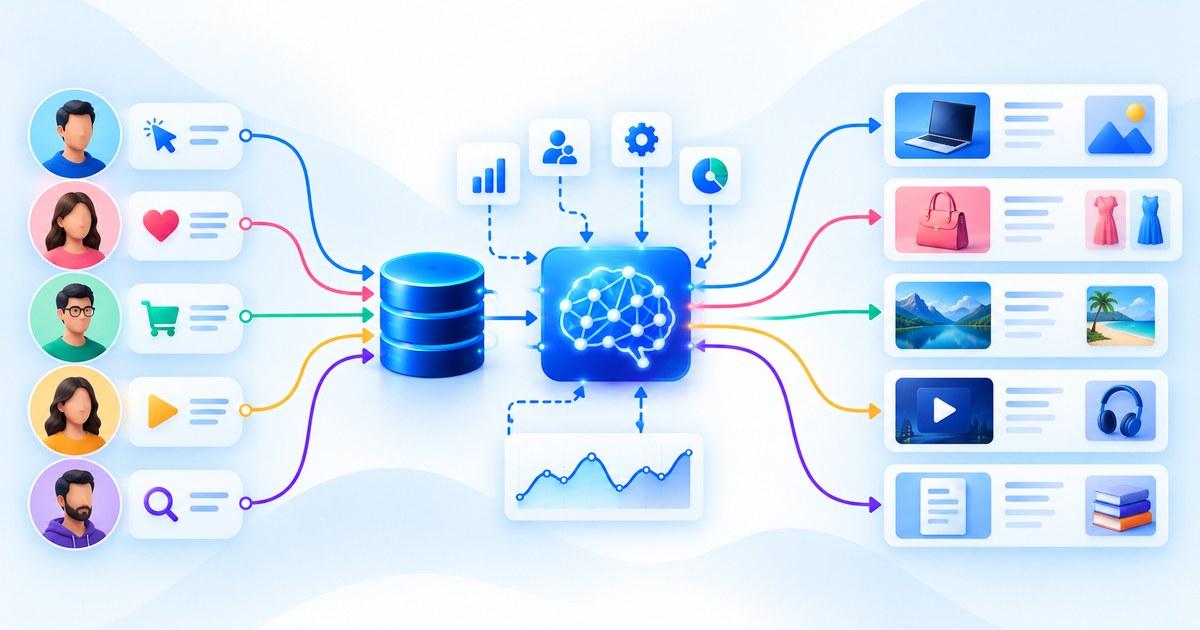
Multimodal systems must learn not only from individual modalities but also from the relationships between them, making cross-modal representation learning essential when the prediction depends on how information from different sources corresponds to the same event or concept. Shared embedding spaces can represent related text, images, audio, or other inputs in compatible numerical spaces, allowing models to compare or retrieve information across modalities through similarity measures and learned relationships. A product discovery application, for example, may use compatible text and image embeddings to retrieve products from a written description or identify visually similar items, allowing users to search across modalities without requiring every query and candidate to have the same data format.
Attention mechanisms provide another way to learn interactions by allowing a model to determine which parts of one representation are most relevant to another, enabling it to connect selected words with image regions, acoustic segments with transcripts, or sensor patterns with relevant contextual information. In a video understanding system, cross-attention may help associate a spoken instruction with the corresponding objects or actions in the visual stream, while a robotics application may combine camera observations with sensor readings to interpret the current physical environment. These techniques can capture relationships that simple feature concatenation might overlook, but they also introduce computational and memory costs that increase with the size and complexity of the representations being compared.
Successful cross-modal learning depends on the quality of the training examples because representations must be associated with meaningful relationships rather than merely processed together. If an image is paired with an unrelated transcript or a sensor window is aligned with the wrong equipment event, the model may learn misleading associations that undermine its ability to generalize, making accurate entity matching, temporal synchronization, and reliable labels important throughout the training pipeline. Engineers should therefore validate cross-modal pairings, evaluate representations using task-relevant metrics, and test whether the learned relationships remain useful when inputs differ from the training distribution, ensuring that shared embeddings and attention-based fusion provide practical value rather than additional model complexity without measurable benefit.
Key Takeaway
Designing multimodal representations requires selecting appropriate encoders, aligning their outputs, and choosing a fusion architecture that captures the relationships needed for the target prediction task. Early, intermediate, and late fusion offer different trade-offs in cross-modal interaction, modularity, missing-input handling, and computational cost, while shared embeddings and attention mechanisms can improve the model's ability to relate information across different modalities. By validating data alignment, measuring representation quality, and benchmarking the complete architecture against production constraints, engineering teams can build multimodal systems that combine text, vision, audio, and sensor information effectively and reliably.
Section 3: Building Production Pipelines for Multimodal Training and Inference
Ingesting and Transforming Heterogeneous Data at Scale
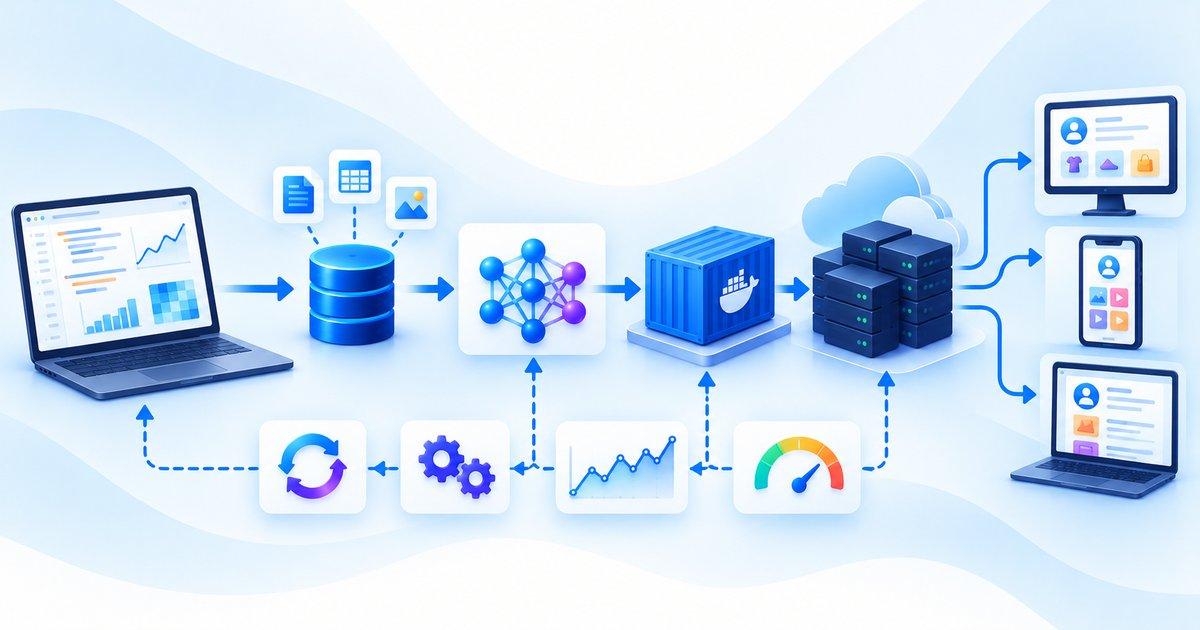
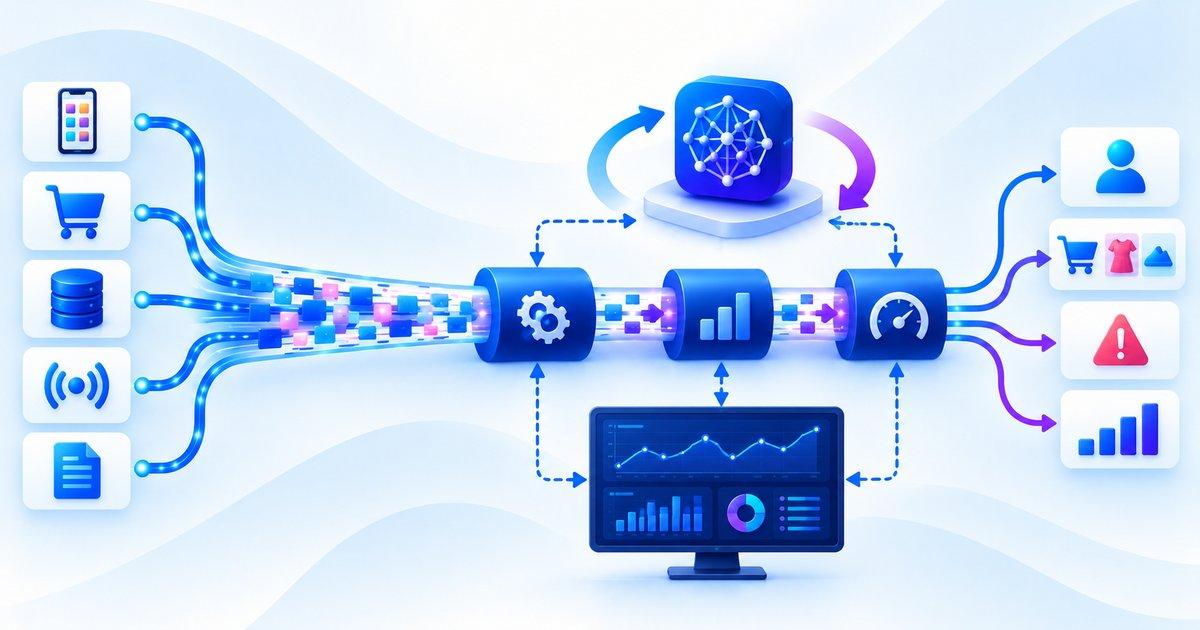
Building a production multimodal ML system requires data ingestion pipelines that can accommodate the different formats, volumes, and processing requirements of text, images, audio, and sensor measurements while preserving the relationships among them. A conventional data pipeline may primarily process structured records or text documents, whereas a multimodal workflow may need to ingest large image files, decode audio recordings, extract video frames, process continuous sensor streams, and associate all these inputs with the correct users, devices, or events. Engineering teams must therefore establish modality-specific ingestion and preprocessing stages that validate incoming data, standardize metadata, and produce compatible representations without forcing fundamentally different data types through an identical transformation process.
For example, an industrial monitoring platform might combine maintenance descriptions from an enterprise database, inspection images from field technicians, audio recordings from equipment, and vibration measurements from sensors, with each source arriving through a different application or ingestion mechanism. The pipeline must validate each source independently, associate records with the appropriate equipment identifier, preserve event timestamps, and apply the transformations needed to prepare each modality for downstream training or inference. Because images and audio can consume substantially more storage and processing resources than ordinary structured records, the architecture may also need separate processing workers, object storage, asynchronous queues, and modality-specific scaling policies to avoid allowing a computationally expensive input source to slow the entire workflow.
Reliable ingestion also requires explicit handling of invalid files, incomplete metadata, inconsistent encodings, duplicate events, and delayed observations, since these problems can compromise the integrity of multimodal training examples even when individual preprocessing jobs complete successfully. By using versioned schemas, validation checks, reproducible transformations, and well-defined error-handling policies, engineers can identify defective inputs before they reach the model while retaining sufficient metadata to investigate failures and reproduce previous processing decisions. These practices provide a dependable foundation for the broader multimodal pipeline, allowing each modality to be processed according to its characteristics while preserving the shared context needed for cross-modal learning.
Managing Feature Storage, Embeddings, and Cross-Modal Data Lineage
Once raw data has been processed, multimodal systems need storage strategies that support both the original inputs and the representations generated by modality-specific encoders, because training and inference may require different forms of access to the same information. Original images, audio recordings, text documents, and sensor records may be retained in object storage, databases, or analytical data platforms, while extracted embeddings and engineered features can be stored in systems optimized for downstream retrieval and model consumption. Separating large source artifacts from their derived representations helps engineers manage storage costs and processing requirements while allowing frequently reused embeddings to be retrieved without repeatedly executing expensive encoders.
The storage architecture must also preserve the relationships among related records, feature definitions, and model representations so that engineers can reconstruct how a particular multimodal example was created. A video frame embedding, for instance, may need to remain associated with its source video, capture timestamp, preprocessing configuration, and the text or sensor observations describing the same event, allowing training pipelines to retrieve correctly aligned examples. Without these associations, a system may accidentally combine embeddings from different events or incompatible preprocessing versions, making it difficult to reproduce training datasets and investigate unexpected model behavior after a deployment.
Data lineage becomes especially valuable when modality-specific encoders evolve independently or when a team replaces an embedding model with a newer version that generates representations with different dimensions or semantics. By tracking the source artifacts, transformation versions, encoder identifiers, feature schemas, and downstream model dependencies, engineering teams can determine which embeddings must be regenerated and which models require validation before updated representations are introduced into production. The engineering considerations discussed in “Multimodal Data Pipelines: The New Engineering Challenge Behind Modern ML” are relevant because dependable multimodal systems require coordinated management of source data, derived features, and representation versions rather than treating embeddings as anonymous numerical vectors detached from their origins.
Serving Multimodal Predictions Under Latency and Throughput Constraints
Serving multimodal predictions introduces additional latency and computational challenges because a single request may require several encoders, feature retrieval operations, and fusion layers before the final prediction can be produced. An application that receives a customer support recording alongside a written query, for example, may need to transcribe or encode the audio, tokenize the text, retrieve relevant context, generate modality-specific representations, and pass those inputs through a fusion model before returning a response. If every stage executes sequentially, preprocessing and network overhead can dominate the total response time, making it essential to measure the complete inference pipeline rather than evaluating the fusion model in isolation.
Engineers can improve throughput and responsiveness by precomputing representations for static content, executing independent preprocessing operations concurrently, batching compatible requests, and caching stable features where reuse is appropriate. A visual search system might compute image embeddings when new products enter the catalog and retrieve those stored representations during user queries, avoiding the need to encode every catalog image for each incoming request. In contrast, inputs such as live sensor measurements or the latest spoken commands may require immediate processing, so the architecture should distinguish between information that can be prepared in advance and data whose value depends on the current interaction.
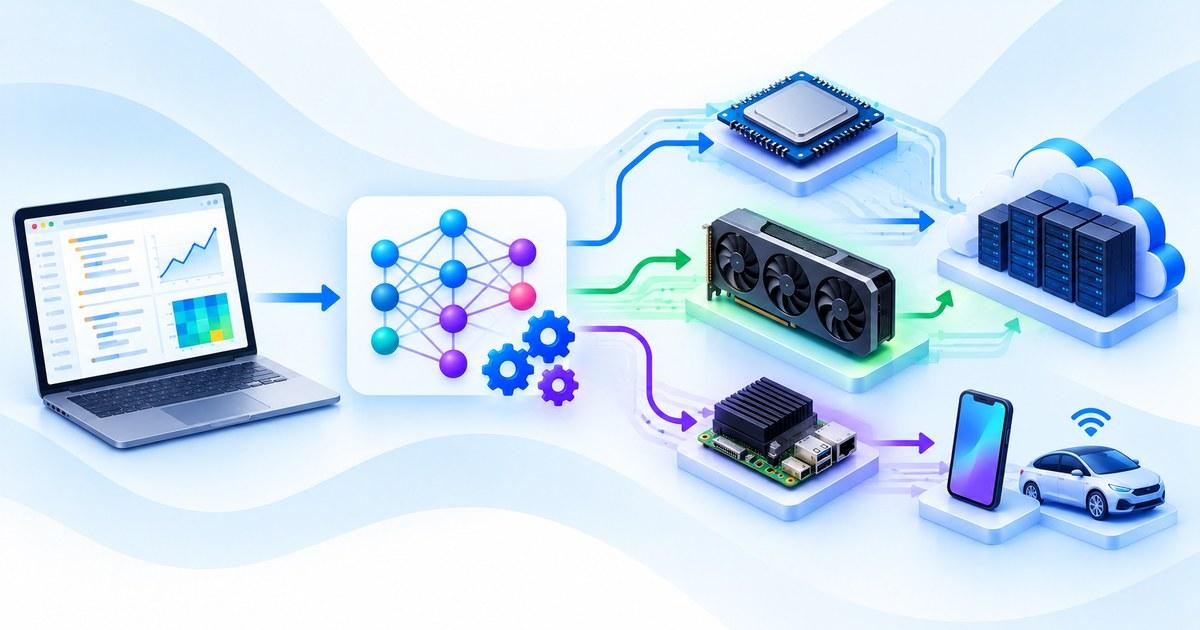
Resource allocation must also reflect the different computational demands of modality-specific encoders and fusion components, since image processing, speech models, large text encoders, and sensor inference may benefit from different hardware configurations and scaling strategies. Engineers should monitor latency percentiles, throughput, memory usage, accelerator utilization, and request failures across each stage, while testing what happens when one modality takes longer to process than the others. By defining end-to-end latency objectives and controlling the amount of work performed for each request, teams can deliver multimodal predictions efficiently without allocating expensive compute resources indiscriminately or compromising the quality of the information combined by the model.
Key Takeaway
Production multimodal ML requires coordinated data ingestion, modality-specific preprocessing, traceable feature storage, and inference pipelines that can combine heterogeneous representations within practical performance constraints. Engineers must preserve cross-modal relationships through identifiers, timestamps, feature metadata, and versioned encoders while handling the different storage and processing demands of batch media and continuously arriving sensor data. By combining scalable ingestion, reliable lineage, efficient inference, and consistent streaming and batch workflows, teams can build multimodal systems that integrate diverse data sources without compromising operational reliability or prediction quality.
Conclusion: Engineering Systems That Connect Multiple Forms of Data
Multimodal machine learning enables software systems to interpret complex situations by combining information from text, images, audio, and sensor measurements rather than relying on a single source of evidence. These modalities provide complementary perspectives, allowing applications to connect written descriptions with visual observations, interpret speech alongside contextual information, and combine physical measurements with records describing the events that produced them. However, realizing these benefits requires more than selecting a powerful multimodal model, because the effectiveness of the complete system depends on how reliably data is collected, transformed, synchronized, represented, and processed across the entire pipeline.
Building a production-ready multimodal system begins with establishing dependable data ingestion and preprocessing workflows for each input type, since text, images, audio, and sensor measurements have different formats, sampling characteristics, computational requirements, and quality constraints. Engineering teams must preserve relationships among entities and events through reliable identifiers, timestamps, metadata, and data lineage, ensuring that the resulting training examples accurately represent the situations the model is expected to understand. When inputs are misaligned, incomplete, or associated with the wrong context, even an advanced model may learn misleading relationships, making data engineering and validation fundamental components of multimodal development.
Architecture selection introduces another important decision because modality-specific encoders, shared embeddings, attention mechanisms, and fusion strategies offer different trade-offs in representation quality, flexibility, and computational cost. Early fusion can expose relationships between modalities at an early stage, intermediate fusion combines learned representations, and late fusion allows independently developed models to contribute their predictions, with the appropriate strategy depending on how closely the data sources interact and how the system must respond when certain inputs are unavailable. By comparing these designs against representative datasets and deployment requirements, engineering teams can avoid unnecessary model complexity while ensuring that the selected architecture captures the cross-modal relationships required by the application.
Production deployment introduces additional challenges involving media storage, embedding management, inference latency, resource allocation, and the coordination of batch and streaming pipelines. A multimodal service may need to process large image or audio inputs alongside rapidly arriving sensor events, requiring separate processing strategies that preserve consistency when data sources update at different rates. Effective systems combine scalable ingestion, traceable representations, efficient inference, and modality-aware monitoring, allowing engineers to identify where delays or data-quality problems originate without treating the multimodal model as an isolated component.
Reliability must also be evaluated across individual modalities and the combined model, since improvements in aggregate performance can conceal weaknesses that emerge when inputs become noisy, unavailable, or different from those seen during training. Engineering teams should test modality-specific behavior, monitor input quality and prediction performance, and define explicit fallback strategies for situations in which essential data sources become unavailable. Privacy considerations also require attention throughout the data lifecycle, particularly when combining potentially sensitive information from text, images, voice recordings, and connected devices, making data minimization, appropriate access controls, and controlled retention important architectural requirements.
Ultimately, effective multimodal machine learning engineering depends on coordinating data infrastructure, representation learning, model architecture, inference systems, and operational governance as parts of one integrated solution. The most successful implementations do not necessarily use the largest model or combine every available modality, but instead select the information and computational components that materially improve the intended prediction task. By preserving cross-modal relationships, validating model behavior under realistic conditions, and balancing prediction quality against reliability, privacy, latency, and cost, engineering teams can build multimodal systems that turn heterogeneous data into dependable production capabilities.
Frequently Asked Questions
1. What Is Multimodal Machine Learning Engineering?
Multimodal machine learning engineering is the discipline of designing, building, deploying, and maintaining ML systems that process and combine different types of data, such as text, images, audio, video, and sensor measurements. It encompasses data ingestion, modality-specific preprocessing, temporal and entity alignment, representation learning, fusion architecture, inference optimization, and production monitoring, ensuring that information from different sources can be combined reliably for a defined prediction task.
2. How Is Multimodal Machine Learning Different From Traditional Machine Learning?
Traditional machine learning applications often operate on one primary data modality, such as structured records, text, or images, whereas multimodal systems combine complementary information from multiple data types within the same learning workflow. This introduces additional requirements for synchronization, modality-specific encoders, cross-modal representation alignment, and missing-input handling, allowing multimodal models to use relationships between sources that a single-modality model may be unable to capture.
3. Which Data Modalities Can Be Combined in a Multimodal ML System?
A multimodal ML system can combine text, images, video, audio, structured records, and sensor measurements, depending on the information required by the application. For example, an industrial monitoring platform may integrate equipment images, vibration readings, audio recordings, and maintenance reports, while a conversational application might combine spoken input, transcripts, visual observations, and contextual information to interpret a user's request more effectively.
4. Why Is Data Alignment Important in Multimodal Machine Learning?
Data alignment ensures that different modalities describe compatible entities, events, and time periods, allowing the model to learn meaningful relationships rather than accidental associations. Engineers must coordinate timestamps, identifiers, sampling intervals, and event definitions when combining sources such as camera frames, audio segments, and sensor measurements, since incorrect alignment can introduce misleading training examples and reduce prediction reliability.
5. What Are Modality-Specific Encoders?
Modality-specific encoders transform raw inputs into representations suited to the structure and characteristics of each data type, such as contextual representations for text, visual features for images, acoustic features for audio, and temporal patterns for sensor measurements. These encoders allow each modality to be processed using appropriate techniques before its representation is combined with other inputs through a fusion architecture, although their outputs must preserve the information required by the final prediction task.
6. What Is the Difference Between Early Fusion, Intermediate Fusion, and Late Fusion?
Early fusion combines inputs or representations near the beginning of the model pipeline, allowing relationships between modalities to influence subsequent processing, while intermediate fusion combines learned representations after modality-specific encoding. Late fusion combines predictions or higher-level outputs from independently processed modalities, making it useful when modularity and independent operation are important, with the best approach depending on cross-modal dependencies, computational constraints, and the system's ability to handle missing inputs.
7. What Are Cross-Modal Embeddings?
Cross-modal embeddings are numerical representations designed to make information from different modalities comparable or meaningfully related within a shared representation space. For example, a model trained with compatible text and image embeddings may retrieve relevant pictures from a written description, while cross-modal representations can also support matching audio with transcripts or relating sensor patterns to descriptions of physical events, provided that the training data establishes reliable relationships between the modalities.
8. How Is Attention Used in Multimodal Machine Learning?
Attention mechanisms allow a model to determine which parts of one representation are most relevant to another, helping it learn relationships between different modalities rather than treating all input features equally. Cross-attention can connect words with image regions, audio segments with text, or sensor patterns with contextual observations, although these interactions may increase memory use and computational cost, especially when the input sequences or feature representations are large.
9. How Should Engineers Handle Missing Modalities?
Engineers should define the expected behavior when one or more input modalities are missing, delayed, corrupted, or unavailable, based on whether the remaining information is sufficient for a reliable prediction. Appropriate strategies may include modality-specific fallbacks, models trained to handle missing inputs, quality-aware fusion, or controlled rejection of requests that lack essential data, with validation against realistic incomplete-input scenarios needed to ensure that the chosen approach behaves predictably.
10. How Can Multimodal Machine Learning Systems Be Evaluated?
Multimodal systems should be evaluated at both the individual-modality and combined-model levels, using task-specific metrics such as precision, recall, classification accuracy, calibration, or other measures suited to the intended application. Engineers should also test performance when modalities are noisy or missing, compare fusion approaches against single-modality baselines, and measure inference latency, memory consumption, and operating cost to determine whether combining the inputs produces meaningful benefits.
11. What Are the Main Data Engineering Challenges in Multimodal ML?
The main challenges include processing heterogeneous file formats, synchronizing timestamps, matching entities across systems, maintaining data quality, and preserving relationships among raw inputs and their derived representations. Multimodal pipelines must also manage the different storage and computational requirements of media files and streaming measurements, making versioned schemas, validation, data lineage, and coordinated batch and streaming processing important for maintaining reliable training and inference workflows.
12. How Can Engineers Reduce Multimodal Inference Latency?
Inference latency can be reduced by precomputing stable representations, reusing embeddings, executing independent preprocessing operations concurrently, and optimizing model execution on suitable hardware. Engineers should also minimize unnecessary data transfers, manage batch sizes carefully, cache reusable features where freshness permits, and profile the complete request path, since preprocessing and communication overhead can dominate response time even when the fusion model itself executes efficiently.
13. How Can Multimodal Systems Handle Noisy or Unreliable Inputs?
Multimodal systems can improve robustness by validating each input independently, monitoring modality-specific quality indicators, and testing the model against realistic noise, corruption, and missing-data scenarios. Depending on the architecture, quality signals can inform feature weighting, input rejection, modality exclusion, or fallback behavior, while evaluation across degraded conditions helps establish whether the model continues producing dependable predictions when one or more sources become less informative.
14. What Privacy Considerations Apply to Multimodal Machine Learning?
Multimodal systems may combine personal information from written communications, images, voice recordings, and connected devices, making data minimization, access control, security, and retention policies essential throughout the data lifecycle. Engineering teams should collect only the information needed for the intended task, apply appropriate consent and preference handling, restrict access to raw and derived data, and ensure that deletion or retention requirements are reflected consistently across source systems, embeddings, training datasets, and deployed services.
15. When Should an Organization Invest in a Multimodal ML System?
A multimodal architecture is worth considering when multiple data sources provide complementary information that materially improves a decision compared with simpler single-modality approaches. Before committing to the additional infrastructure and computational complexity, engineering teams should establish a measurable use case, assess data availability and alignment, compare modality-specific baselines with fused models, and evaluate the benefits against latency, memory, operating cost, robustness, and privacy requirements.