Section 1: Why AI Systems Need Graceful Degradation
Machine learning systems are fundamentally different from many traditional software components because they operate under uncertainty. A conventional software function is generally expected to follow explicitly defined logic: given a valid input, it executes a deterministic set of operations and returns an expected result. A machine learning model, by contrast, produces predictions based on statistical patterns learned from historical data. Even when the model is technically functioning, its prediction may be uncertain, incorrect, or inappropriate for an input it has never encountered before.
This difference changes how production AI systems need to be engineered.
A model can fail because its serving infrastructure becomes unavailable, an upstream feature pipeline stops producing data, an external dependency times out, or the input distribution changes. It can also fail in a less obvious way: the model may return a valid prediction that falls outside the conditions where its learned behavior is trustworthy.
For this reason, reliable AI systems should not be designed around the assumption that the model will always be available and correct. They should be designed around the expectation that models, data, and dependencies will occasionally behave differently from what the system expects.
Models Are Not Deterministic Infrastructure Components
One of the most important reasons AI systems require graceful degradation is that a model is not simply another deterministic software component.
Traditional infrastructure failures are often relatively straightforward to identify. A service may be unavailable, a database connection may fail, or an API may return an error. A machine learning system can experience these failures as well, but it has an additional category of failure: the model can remain operational while its prediction quality deteriorates.
A model may receive a valid request and return a mathematically valid output, yet that output can still be unreliable.
Imagine a recommendation system trained on historical customer behavior. The model may continue producing recommendations successfully after a major product catalog change, but its predictions may become less useful because the environment has changed. Similarly, a fraud-detection model may continue scoring transactions normally while new fraud patterns make its predictions progressively less effective.
This creates an important distinction between availability and reliability.
Availability asks whether the model can respond. Reliability asks whether the resulting behavior can still be trusted for the decision being made.
A production architecture therefore needs to consider both.
The system should be capable of detecting when the preferred prediction path is unavailable and, where possible, recognizing when the model's output should not be trusted. This may involve health checks, feature validation, confidence thresholds, drift indicators, output monitoring, or application-level safeguards.
The objective is not to make models behave like deterministic software. It is to design the surrounding system so that the statistical uncertainty inherent in ML does not become an uncontrolled product risk.
Different Types of AI Failure
AI failures can occur at several different layers, and each requires a different response.
The most obvious case is model-service failure. The inference server may crash, become overloaded, run out of memory, or exceed a latency threshold. In this situation, the prediction capability may simply become unavailable.
A second category is data failure. Required features may be missing, malformed, stale, or outside expected ranges. An upstream application may stop emitting an event, change a schema, or introduce a different interpretation for an existing field.
A third category involves dependency failure. The model may rely on feature stores, databases, external APIs, retrieval systems, or other services. A failure in any of these dependencies can prevent the model from generating a useful prediction even when the model itself is healthy.
Then there are statistical failures.
The model may encounter a distribution that differs substantially from its training environment. User behavior may change, products may evolve, new categories may appear, or external conditions may alter the relationship between inputs and outcomes. The model can continue returning predictions while becoming less effective.
Finally, there are low-confidence or ambiguous cases.
Some inputs may simply fall outside the model's strongest operating region. For these cases, forcing the model to produce a definitive answer can be worse than acknowledging uncertainty and using another decision path.
Recognizing these categories matters because graceful degradation should not be a generic “backup everything” mechanism. A missing feature, a model timeout, and a low-confidence prediction represent different conditions and may require different fallback behavior.
Designing for Failure From the Beginning
Graceful degradation is most effective when it is part of the architecture from the beginning.
Adding a fallback after a production incident often produces a narrow solution that addresses one specific failure but does not account for the broader range of ways the ML system can become unreliable.
During system design, teams should identify the model's critical dependencies, determine which failure conditions are realistic, define acceptable degraded behavior, and establish the criteria for switching between operating modes.
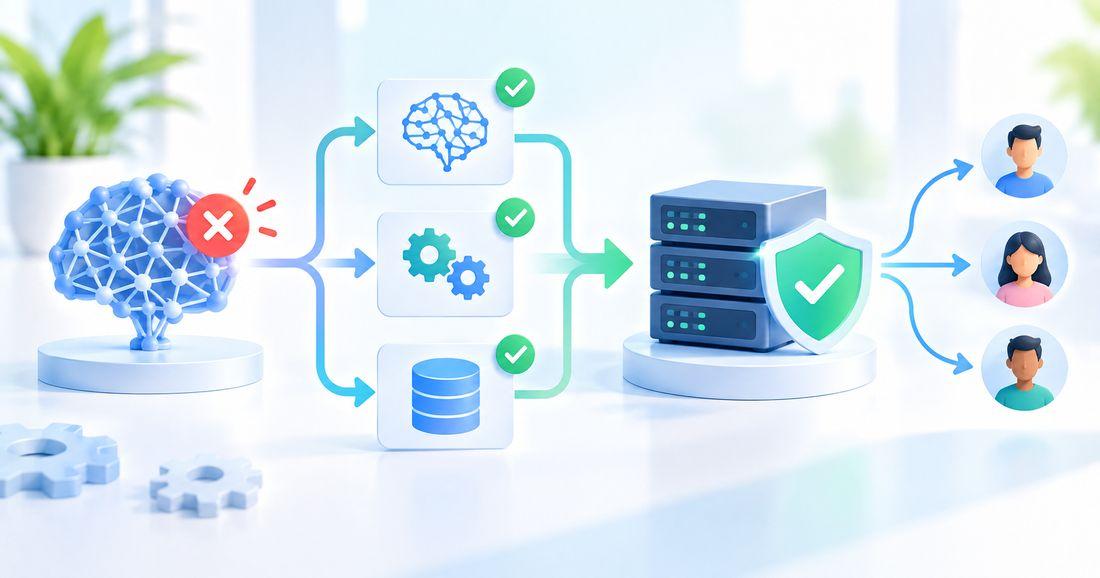
For example, an online prediction service may have a normal path where all required features are available and the primary model responds within its latency target. A degraded path may use a smaller model that requires fewer features. Another fallback may use a deterministic business rule. A final escalation path may route selected cases to a human.
The design should also account for recovery.
Once the underlying failure is resolved, the system needs to return safely to the primary model rather than remaining indefinitely in degraded mode.
Testing these transitions is equally important. A fallback that exists in architecture diagrams but has never been exercised under realistic failure conditions may not work when it is actually needed.
Production AI therefore benefits from the same resilience mindset used in other critical software systems: assume components will fail, understand the consequences, and define how the system should respond before the failure occurs.
This broader perspective is reflected in "Failure Modes of Modern AI Systems and How Engineers Prevent Them" AI failures rarely originate from the model alone. They can emerge from data, infrastructure, dependencies, deployment processes, or changing operating conditions, which is why resilient design must extend around the model.
Graceful degradation adds another layer to that principle.
The goal is not to prevent every failure. That is often impossible.
The goal is to ensure that when the preferred AI capability becomes unavailable or unreliable, the surrounding product can continue operating in a safe, predictable, and useful state.
Key Takeaway
AI systems need graceful degradation because models can fail in more ways than simply becoming unavailable. Infrastructure failures, missing data, dependency outages, distribution shifts, and low-confidence predictions can all reduce the reliability of an ML component. A resilient AI architecture separates model failure from product failure by defining appropriate degraded operating modes, fallback paths, and recovery mechanisms before production incidents occur.
Section 2: Designing Effective AI Fallback Strategies
Once an AI team accepts that model failure is a normal possibility, the next engineering challenge is deciding what the system should do when the primary prediction path is unavailable or unreliable. A fallback is not simply a backup server waiting for the main model to crash. It is an intentionally designed alternative pathway that allows the product to continue delivering useful behavior under degraded conditions.
The strongest fallback strategies are designed around the specific role the model plays in the product. A recommendation system may tolerate a simpler ranking mechanism, while a high-risk decision system may require human escalation. An interactive application may use cached information during a short outage, whereas a transaction-processing system may need to stop certain operations entirely when critical safeguards are unavailable.
The goal is therefore not to find one universal fallback mechanism. It is to create a hierarchy of acceptable alternatives that preserves as much useful functionality as possible while respecting the consequences of model failure.
Fallback to Simpler Models
One of the most practical approaches is to maintain a simpler model that can take over when the primary model is unavailable or too expensive to use.
A production system may normally use a large, sophisticated model that provides highly personalized predictions. If that model becomes unavailable, the system could switch to a smaller model with fewer dependencies and lower computational requirements.
The simpler model does not need to reproduce every capability of the primary model.
Its purpose is to provide an acceptable level of functionality under degraded conditions.
For example, a recommendation system may normally use a complex personalization model based on real-time behavioral features. During a feature-service outage, it could fall back to a simpler model based on recent activity or broad popularity signals. The recommendations may become less personalized, but the product continues to function.
This approach is particularly attractive when the fallback can operate using a smaller set of features.
Reducing dependencies can make the fallback more reliable precisely when the primary system is experiencing problems. A smaller model may also have lower latency and lower resource requirements, which can make it suitable as an emergency operating mode during periods of high infrastructure pressure.
However, the fallback should be evaluated before it is needed.
Teams need to understand how much performance is lost when switching from the primary model and whether that degradation is acceptable for the affected use case. The fallback should also be tested under realistic traffic and failure conditions rather than assuming that a smaller model will automatically behave reliably.
"Why Simpler Machine Learning Models Sometimes Win in Production" provides a useful perspective here. Simpler models can offer advantages in latency, cost, interpretability, and operational reliability. Those same properties can make them valuable as deliberate fallback mechanisms even when a more sophisticated model is normally preferred.
Rules and Heuristics as Safety Nets
A fallback does not always need to involve another machine learning model.
In many systems, deterministic rules can provide a predictable and controlled alternative when probabilistic predictions are unavailable or unreliable.
Consider a fraud-detection system. The primary model may use hundreds of features to estimate transaction risk. If that model becomes unavailable, a small set of deterministic rules may still identify clearly suspicious transactions based on conditions established by the business.
These rules may not provide the same level of predictive sophistication as the ML system, but their behavior is understandable and predictable.
That predictability can be especially valuable when uncertainty is high.
Rules can also serve as safeguards around model outputs. A model may recommend an action, but the application can enforce constraints that prevent clearly unsafe or invalid outcomes.
This creates an important architectural distinction between prediction and policy.
The model estimates what is likely to happen. Deterministic logic can define what the system is allowed to do.
Separating these responsibilities can make the overall system more resilient because critical constraints do not depend entirely on the statistical behavior of the model.
However, rules should not become a hidden replacement for the ML system without ongoing evaluation. Business environments change, and hard-coded logic can become outdated. A rule-based fallback should therefore have clear ownership and documented assumptions.
Its purpose is to provide a controlled degraded state, not to accumulate indefinitely into an unmaintainable parallel system.
Key Takeaway
Effective AI fallbacks provide controlled alternatives to the primary model, ranging from simpler models and deterministic rules to cached results, safe defaults, and human escalation. The correct fallback depends on the application's risk and operational requirements. Strong systems design multiple levels of degraded behavior so that a model failure reduces capability without unnecessarily stopping the entire product.
Section 3: Making Degradation Intelligent and Measurable
A fallback mechanism is only useful when the system knows when to use it.
Simply having a backup model, a set of rules, or a cached response does not guarantee resilience. If the application cannot distinguish between a trustworthy prediction and an uncertain one, it may continue using a degraded model output when it should have switched to a safer pathway. Conversely, if the system becomes overly conservative and falls back too frequently, users may receive unnecessarily reduced functionality even when the primary model is performing normally.
This makes graceful degradation an intelligent decision-making problem.
The system needs to understand its operating state, recognize when model behavior has become unreliable, choose the appropriate degradation level, and measure what happens after the transition. The best implementations make these decisions explicit through confidence thresholds, layered operating modes, observability, and systematic failure testing.
Confidence-Aware Decision Making
One of the most useful mechanisms for graceful degradation is allowing the system to consider how confident the model is in its prediction.
A model may be technically available while still producing an output that should not automatically trigger an important action. For classification systems, predicted probabilities can sometimes provide a useful signal for determining whether a result is sufficiently confident. Other applications may use uncertainty estimates, agreement across multiple models, retrieval quality, input validation, or domain-specific thresholds.
The important idea is to distinguish between “the model returned an answer” and “the system has enough evidence to trust the answer.”
Suppose a customer-support model classifies incoming requests into well-defined categories. A high-confidence classification may proceed automatically, while an ambiguous request can be routed to a fallback classifier or a human agent.
A similar approach can be used in recommendation or ranking systems. Strong predictions can use the primary model, while unusual requests or insufficiently observed users can receive a simpler recommendation strategy.
However, confidence values should not automatically be treated as absolute measures of correctness.
A model can be confidently wrong. Calibration, validation, and domain-specific testing are therefore important when confidence thresholds are used to make operational decisions.
Thresholds should also be evaluated against business consequences.
If an incorrect prediction is inexpensive to recover from, the system may tolerate lower confidence. If an incorrect prediction can create significant financial, safety, or customer impact, the system may require much stronger safeguards.
The result is a decision boundary between normal automation and degraded operation.
Designing Degradation Levels
Graceful degradation works best when the system does not have only two states, fully operational and completely unavailable.
Instead, engineers can design a series of operating modes.
The primary mode may use the full model and all normal features. A first degraded mode may remove optional dependencies or use a simpler model. A second mode may fall back to deterministic rules or cached information. A higher-risk condition may route requests for human review.
This layered structure allows the system to preserve as much functionality as possible.
For example, an e-commerce recommendation system could normally use real-time personalization. If real-time behavioral features become unavailable, it could fall back to recommendations based on recent history. If those signals are also unavailable, it could use popularity-based ranking. Only when none of these paths are appropriate would it need to display a generic product experience.
The benefit is that a temporary failure in one component does not immediately result in complete loss of functionality.
Degradation levels should also have explicit transition conditions.
Engineers need to define what causes the system to leave normal operation and what evidence is required before it returns. These conditions can be based on service health, latency thresholds, feature availability, confidence, error rates, or other relevant signals.
The architecture should avoid rapid oscillation between modes.
If the primary model repeatedly crosses a threshold, the system could continuously switch between primary and fallback behavior. This can create unstable user experiences and complicate debugging. Practical implementations may therefore use hysteresis, recovery windows, or other controls that prevent unnecessary mode switching.
The important principle is that degraded operation should be predictable and deliberate rather than an accidental side effect of component failure.
Testing Failure Scenarios Before Production
Graceful degradation should never exist only on an architecture diagram.
Failure pathways need to be tested deliberately.
Engineers can simulate model-service outages, feature-store failures, dependency timeouts, malformed inputs, unexpected feature distributions, overloaded inference services, or elevated prediction latency. The objective is to determine whether the system actually transitions into the intended degraded mode.
This type of testing is particularly important for distributed AI systems because failures can propagate across multiple dependencies.
A model might depend on a feature service, which depends on a database, which depends on another upstream system. A failure deep within that chain can eventually appear as a model-serving problem even though the model itself is functioning correctly.
Fault injection and controlled failure testing allow teams to observe these interactions before they occur unexpectedly in production.
The team should verify more than whether the fallback activates.
It should confirm that the fallback receives valid inputs, maintains acceptable latency, produces outputs in the expected format, and does not introduce a secondary failure. Recovery should also be tested. Once the primary dependency is restored, the system should transition back safely without losing requests or repeatedly oscillating between operating modes.
This is a critical part of AI reliability because fallback paths are often exercised far less frequently than the primary path. A bug in a rarely used fallback can remain undetected for months until a real incident activates it.
Regular resilience testing reduces that risk.
The broader production engineering principle is closely connected to "From Experiment to Production: The Decisions That Shape an ML System" A production ML system must be evaluated under the conditions in which it will actually operate, including failures, operational dependencies, and real-world constraints. Graceful degradation extends that thinking by asking not only whether the normal path works, but whether the system behaves predictably when the normal path does not.
Intelligent degradation therefore requires four things working together: a mechanism for recognizing reduced trust, defined levels of fallback behavior, observability into degraded operation, and deliberate testing of failure conditions.
The objective is not to eliminate uncertainty from AI.
It is to make the system's response to uncertainty explicit.
Key Takeaway
Graceful degradation becomes effective when the system can recognize when a model should not be trusted, transition through predefined degradation levels, measure the impact of those transitions, and verify the behavior through failure testing. Confidence thresholds, layered fallbacks, monitoring, and fault injection turn resilience from an architectural concept into an operational capability.
Section 4: Building AI Systems That Fail Safely
Graceful degradation is ultimately a question of system design: what level of failure can an AI product tolerate without creating unacceptable consequences? Not every ML application requires the same fallback strategy. A recommendation engine can often continue operating with less personalization, while a system involved in financial transactions, industrial control, or other high-impact decisions may need to stop, escalate, or require additional verification when its primary model becomes unreliable.
This is why resilience cannot be designed independently of the business context.
The engineering team needs to understand the consequences of an incorrect prediction, the consequences of delaying a decision, and the consequences of reducing functionality. Only then can it determine what the system should do when the preferred AI capability is unavailable.
The strongest AI architectures therefore do not simply maximize uptime. They maximize safe and useful continuity.
Align Degradation With Business Risk
The appropriate fallback behavior depends directly on the cost of failure.
Consider a recommendation system. If personalization becomes unavailable, the application may continue showing popular or category-based products. The user experience may become less relevant, but the system remains functional and the consequences are generally recoverable.
Now consider a fraud-detection system. A fallback that simply approves every transaction may preserve availability while creating unacceptable financial exposure. A more appropriate degraded mode could involve stricter deterministic rules, additional authentication, or manual review for selected transactions.
The same principle applies to other high-impact systems.
A model used for an operational decision may be allowed to fall back to a conservative rule set. A model involved in a sensitive workflow may require human approval before proceeding. In some cases, the safest response is not to make the automated decision at all.
This means graceful degradation should be defined using risk thresholds, not only technical thresholds.
Engineers should identify which failures are tolerable, which require reduced functionality, and which require the system to stop or escalate.
The decision should also account for reversibility.
An incorrect recommendation can usually be ignored or changed during the next interaction. An incorrect financial transaction, industrial action, or other high-impact decision may be much harder to reverse.
The less reversible the consequence, the stronger the safeguards should be.
Critical vs Non-Critical AI Applications
The distinction between critical and non-critical systems becomes especially important when defining fallback policies.
In lower-risk applications, graceful degradation often means preserving availability and accepting lower-quality predictions. A search system may use a simpler ranking algorithm. A content platform may reduce personalization. A conversational application may provide a more generic response.
In these cases, the primary objective is often continuity of service.
High-risk systems require a different philosophy.
When an incorrect prediction can produce significant financial, operational, legal, safety, or customer consequences, the system should avoid treating every failure as an opportunity to keep operating automatically. A degraded state may need stronger validation, restricted functionality, or direct human intervention.
This creates a useful concept of a safe operating envelope.
The system can operate automatically when conditions remain within that envelope. When data quality, model confidence, service health, or other conditions move outside it, the system reduces autonomy and introduces additional safeguards.
This approach avoids treating AI as a component that must make a decision under every possible condition.
Instead, the model becomes one part of a broader decision architecture with explicitly defined boundaries.
The distinction is particularly important as organizations deploy AI into increasingly consequential workflows. The more significant the consequences of an incorrect prediction, the less appropriate it becomes to rely on a single model without additional safeguards.
Making Resilience Part of AI Engineering Culture
The most reliable AI systems treat graceful degradation as a normal engineering requirement rather than an exceptional incident-response technique.
During system design, teams should document critical dependencies, define fallback modes, specify failure thresholds, identify acceptable degraded behavior, and establish recovery procedures.
During development, engineers should test those paths.
During deployment, teams should verify that fallbacks and rollback mechanisms behave as expected.
During operations, monitoring should make degraded states visible and provide enough information to determine why the transition occurred.
This requires clear ownership.
When an AI system enters degraded mode, someone needs to know which team investigates the model, which team owns the upstream dependency, and who decides when normal operation can safely resume.
The organization should also treat repeated degradation as a design signal.
If a system enters fallback mode every week because a particular feature service frequently times out, the correct long-term solution may not be improving the fallback. The underlying dependency itself may need to be redesigned.
Similarly, if a model frequently produces low-confidence predictions for a particular population, the answer may be better training data, improved model design, or a different product workflow rather than simply increasing the frequency of fallback behavior.
Graceful degradation should therefore provide containment without masking systemic problems.
This is part of the broader production engineering discipline described in "The Hidden Engineering Work Behind Every Successful Machine Learning Product" Reliable AI products depend not only on model quality but also on data pipelines, deployment infrastructure, monitoring, failure handling, recovery processes, and clear operational ownership.
Key Takeaway
Graceful degradation should be designed around business risk, not merely technical availability. Low-risk applications may tolerate reduced functionality, while high-impact systems may require conservative rules, additional safeguards, or human intervention. Reliable AI products define degradation and recovery paths in advance, test them deliberately, monitor their use, and treat recurring fallback events as signals for deeper system improvement.
Conclusion
Machine learning systems are often designed around their ideal operating condition. The model is available, the required features arrive on time, dependent services respond normally, inputs remain within familiar patterns, and predictions are sufficiently reliable to drive automated decisions.
Production systems rarely remain in that ideal state indefinitely.
Models can become unavailable. Feature pipelines can fail. External dependencies can time out. Data distributions can shift. Users can generate inputs outside the model's strongest operating range. Even when every software component is healthy, a model can produce an uncertain or inappropriate prediction.
The question for AI engineering is therefore not whether failure can be eliminated.
It is whether the system can continue operating safely and usefully when failure occurs.
That is the purpose of graceful degradation.
A resilient AI product recognizes that the primary model is only one component of a larger decision system. When that component becomes unavailable or unreliable, the product can move to an alternative operating mode rather than failing completely. The alternative might be a simpler model, a deterministic rule, a cached response, a safe default, or a human-review workflow.
The appropriate response depends on the application.
A recommendation system can often tolerate reduced personalization. A search system may continue using a simpler ranking mechanism. A fraud system may require stricter rules or additional verification. A high-impact decision system may need human approval rather than attempting to automate an uncertain outcome.
Frequently Asked Questions
1. What is graceful degradation in AI?
Graceful degradation in AI is the practice of designing a system so that when its primary model becomes unavailable, unreliable, or unsuitable for a particular input, the overall product can continue operating through a safer or simpler alternative.
2. Why is graceful degradation important for machine learning systems?
Machine learning systems can fail because of infrastructure outages, missing features, dependency failures, distribution shifts, unexpected inputs, or uncertain predictions. Graceful degradation prevents these model-level failures from automatically becoming complete product failures.
3. What happens when an AI model fails in production?
The appropriate response depends on the application. The system may switch to a simpler model, use deterministic rules, serve cached results, provide a safe default, reduce functionality, escalate to a human, or stop a high-risk operation until the underlying issue is resolved.
4. What is an AI fallback strategy?
An AI fallback strategy defines what the application should do when the preferred model or prediction pathway cannot be used safely. It can include alternative models, business rules, cached outputs, safe defaults, or human-review processes.
5. Can a simpler model be used as an AI fallback?
Yes. A simpler model can be an effective fallback because it may require fewer features, dependencies, and computational resources than the primary model. Its performance should be evaluated beforehand to ensure that the resulting degradation is acceptable.
6. When should AI systems use rules instead of models?
Rules can be valuable when deterministic behavior is required, when the primary model is unavailable, or when certain business or safety constraints must always be enforced. Rules can also provide a predictable fallback for clearly defined scenarios.
7. How do confidence thresholds support graceful degradation?
Confidence thresholds can help determine whether a model prediction is reliable enough for automatic action. High-confidence cases may proceed through the primary path, while uncertain cases can be routed to a simpler model, another safeguard, or human review. Confidence signals should be validated because models can sometimes be confidently incorrect.
8. What role does human review play in resilient AI systems?
Human review provides an escalation path for ambiguous, high-risk, or uncertain cases. It is especially useful when the cost of an incorrect automated decision is greater than the cost of additional human intervention. The human workflow must still be designed for realistic review volumes.
9. How can cached results help when an AI model is unavailable?
Previously generated recommendations, rankings, forecasts, or other outputs can sometimes be reused temporarily when real-time inference is unavailable. Cached information can preserve product continuity without introducing a new prediction pathway during an incident.
10. What is the difference between graceful degradation and failover?
Failover generally refers to moving from a failed component to another available component or service. Graceful degradation is broader: it allows the system to operate with reduced or modified functionality when the preferred capability is unavailable or cannot be trusted.
11. How should AI degradation be monitored?
Teams should monitor fallback frequency, operating mode, duration of degraded periods, latency, error rates, prediction quality, and relevant business outcomes. This helps determine whether degradation is occasional and expected or evidence of a recurring system problem.
12. How can teams test AI systems for failure resilience?
Teams can deliberately simulate realistic failures such as model-service outages, missing features, dependency timeouts, malformed inputs, unusual data distributions, and excessive latency. They should verify both the transition into degraded mode and the eventual recovery to normal operation.
13. How should graceful degradation differ for high-risk AI systems?
High-risk systems generally require stronger safeguards because incorrect decisions can have significant or irreversible consequences. Instead of automatically falling back to a weaker prediction, the system may require stricter validation, conservative rules, additional verification, or human approval.
14. Why should fallback behavior be designed before production?
Designing fallbacks before production allows engineers to understand failure consequences, establish clear operating modes, test them under controlled conditions, and define recovery procedures. Designing only after an incident often results in incomplete or unreliable emergency mechanisms.
15. What makes an AI system resilient when its model fails?
A resilient AI system has explicit failure boundaries, appropriate fallback strategies, monitoring, tested degradation paths, risk-aware decision rules, and reliable recovery mechanisms. Its defining characteristic is not that the model never fails, but that model failure is contained so the broader product can remain safe and useful.