Section 1: Understanding Traditional Database Indexing and the Foundations of Learned Index Structures
Why Database Indexing Matters for Modern Data Systems
Database indexing is a fundamental optimization technique that reduces the amount of data a database must examine when executing queries. Without an appropriate index, a query searching for a particular customer, transaction, product, or timestamp may require scanning a large portion of a table. As datasets grow into millions or billions of records, such scans can increase query latency, consume processing resources, and reduce the throughput available to concurrent applications.
Consider an e-commerce database containing hundreds of millions of product records. When an application requests a product using its unique identifier, the database must locate the corresponding row efficiently. An index on the product identifier allows the database engine to navigate an optimized search structure rather than examining every record. Similar benefits apply to user lookups, financial transactions, event timestamps, and application logs.
Indexes also influence query execution beyond individual record retrieval. Database engines use them to support range queries, sorting, joins, uniqueness constraints, and other operations. For example, a query retrieving transactions within a particular date range can benefit from an ordered index that helps identify the starting and ending positions of the relevant records. The efficiency of this operation depends on the index structure, data organization, storage layout, and the selectivity of the query.
However, indexes introduce their own costs. They consume memory or disk space, require maintenance when records are inserted or deleted, and can increase write amplification in storage systems. A database with too many indexes may experience slower write operations because each relevant index must be updated alongside the underlying data. Consequently, database engineering involves balancing lookup efficiency against storage overhead and maintenance complexity.
The growing scale of modern workloads has encouraged research into alternative indexing approaches. Learned index structures explore whether machine learning models can represent the relationship between ordered keys and record positions more efficiently than conventional data structures under particular workload conditions.
Traditional Database Indexes: B-Trees, B+ Trees, and Hash Indexes
B-trees and B+ trees are among the most widely used structures for database indexing. They organize keys hierarchically, allowing search operations to eliminate large portions of the search space at each level. Rather than comparing a requested key against every record, the database traverses internal nodes until it reaches the appropriate leaf node.
A B+ tree stores actual indexed entries in its leaf nodes, while internal nodes contain separator keys used for navigation. Leaf nodes are commonly linked, making range scans and ordered traversal efficient. Their balanced structure ensures that searches, insertions, and deletions can be performed with predictable logarithmic complexity, generally expressed as (O(\log N)) for a dataset containing (N) indexed entries.
Hash indexes follow a different approach. They apply a hash function to a search key to determine the bucket where the corresponding record can be found. This can provide efficient equality lookups when the hash structure is appropriately maintained. However, ordinary hash indexes do not naturally support ordered traversal or range queries because their organization does not preserve key ordering.
Bitmap indexes represent the presence of values through bitmaps and are particularly useful for selected analytical workloads involving low-cardinality columns. Database systems can combine bitmap operations to evaluate certain filtering conditions efficiently, although their suitability depends on data characteristics and update patterns.
Each traditional index structure has different performance characteristics. B+ trees support ordered queries and dynamic updates, hash indexes optimize equality lookups, and bitmap indexes can accelerate certain analytical filtering operations. These structures have also benefited from decades of optimization involving cache locality, page organization, concurrency control, and storage management.
Learned index structures do not simply eliminate these advantages. Instead, they examine whether the mapping performed by an index can be approximated using a model, potentially reducing the search work required for specific operations while retaining a mechanism for locating the exact record.
What Are Learned Index Structures, and How Do They Work?
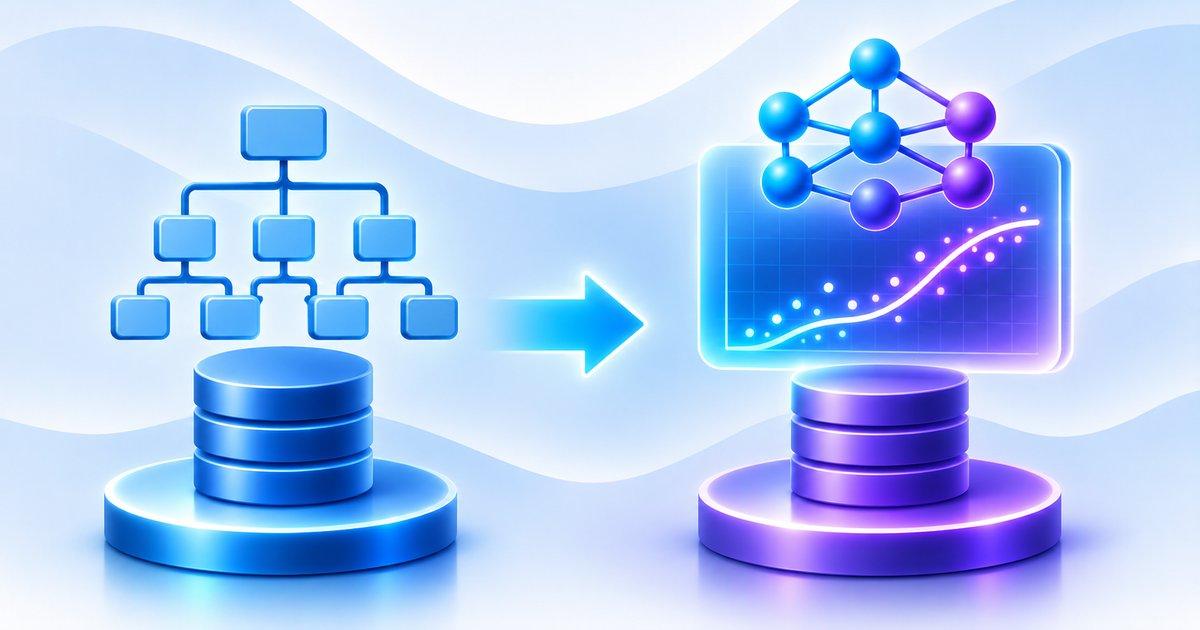
A learned index structure is a database indexing mechanism that uses a machine learning model or another learned approximation to predict the position of a search key within an ordered dataset. The central observation is that an index can be viewed as a function mapping an input key to the position of its corresponding record. If the relationship between keys and positions can be approximated accurately, the database may be able to reduce the amount of searching required.
Suppose a database contains one billion records sorted by customer identifier. A conventional B+ tree navigates its internal nodes to locate the relevant leaf page. A learned index instead attempts to estimate the position associated with the requested identifier using a model trained on the sorted key distribution.
Conceptually, the model learns an approximation of the cumulative distribution function of the keys. If the sorted keys are represented by (K), a model estimates the rank or position associated with a key (x). The prediction can be expressed as:
[
\hat{p}(x) \approx F(x)\times N
]
Here, (F(x)) represents the estimated cumulative distribution function, (N) is the number of indexed records, and (\hat{p}(x)) is the predicted position.
The model does not need to predict the exact position in every case. Instead, the implementation can maintain an error bound that identifies a small search region around the predicted location. The database then performs a local search to find the exact key or determine that it does not exist. This correction mechanism is essential because database correctness cannot depend on approximate predictions alone.
The distinction between prediction and retrieval is important. A learned index predicts where a record should be located, but the database must still verify the key and return the correct record. If the model's prediction is inaccurate, the correction structure must still locate the record or establish its absence without violating correctness.
This approach is particularly attractive for sorted, read-heavy datasets where key distributions remain relatively stable. In such environments, a compact model may approximate record positions while requiring less indexing metadata than a conventional structure.
Why Learned Index Structures Represent a Different Approach to Database Engineering
The main difference between traditional and learned indexing lies in how the relationship between search keys and record positions is represented. Conventional structures use algorithmically defined navigation rules, whereas learned indexes use data-dependent models to approximate the mapping. This introduces an opportunity to exploit patterns in the underlying dataset rather than treating every search operation as an identical tree traversal.
For example, consider a database containing timestamp-ordered events generated by a large application platform. If events are distributed relatively consistently over time, a learned model may estimate the location of a timestamp with relatively low error. A local search around the predicted position can then identify the exact record without traversing multiple levels of a traditional tree.
Another example involves analytical databases containing large collections of sorted identifiers. If the data distribution is predictable, a learned index may provide compact position estimates that reduce memory overhead and accelerate selected lookup operations. However, a highly skewed or frequently changing distribution can make prediction more difficult and increase the cost of maintaining accuracy.
Learned indexing also changes how database engineers think about index construction and maintenance. Instead of selecting a data structure exclusively according to its algorithmic properties, engineers must consider the underlying key distribution, model architecture, prediction error, training overhead, and update behavior.
The approach also introduces new engineering questions. How should a model handle records inserted between existing keys? When should it be retrained? How can its prediction error be bounded? What happens when data is reorganized or the underlying distribution changes? These questions demonstrate why learned indexing is a database systems problem as much as a machine learning problem.
Understanding the relationship between data distribution, model behavior, and retrieval performance provides the foundation for evaluating these structures. Engineers exploring this intersection can also benefit from "Neuro-Symbolic Machine Learning: When Neural Networks Meet Logic", particularly when considering how learned predictions can operate alongside deterministic rules and correctness requirements.
Key Takeaway
Traditional database indexes use carefully engineered data structures to map search keys to records, while learned index structures use models to approximate this mapping from the underlying data distribution. Their potential advantages include reduced indexing overhead and faster lookups for suitable datasets, but exact retrieval and database correctness must remain guaranteed. The fundamental engineering opportunity is not to replace every index with a neural network, but to identify workloads where learned approximations can improve the performance of existing indexing mechanisms.
Section 2: How Machine Learning Models Build and Optimize Learned Index Structures
Learning the Data Distribution: From Search Keys to Position Predictions
The foundation of a learned index is its ability to understand the distribution of keys in an ordered dataset. Traditional indexes organize records according to predefined navigation structures, whereas learned indexes attempt to discover a mathematical relationship between key values and their corresponding positions.
Consider a database table sorted by transaction timestamp. If the records are distributed uniformly over a particular period, a relatively simple linear model may approximate the position of a timestamp accurately. However, if transaction activity increases significantly during certain hours, the distribution becomes uneven. A single linear model may then produce substantial prediction errors in high-density regions.
The training process begins with an ordered collection of keys and their actual positions. Each training example can be represented as a pair containing the key value and its rank in the sorted dataset. The model learns a mapping from the input key to its approximate position.
For example, a training dataset might contain timestamp values and their corresponding row positions. A regression model can learn how the expected position changes as the timestamp increases. Once trained, the model estimates the likely position of a new query key.
The choice of model depends on the complexity of the distribution. Linear regression may work well when the relationship is relatively simple, while piecewise-linear models can represent different local patterns. More complex distributions may require hierarchical models that divide the key space into smaller regions and apply specialized models to each region.
An important consideration is prediction error. If the predicted position differs substantially from the actual position, the local search region must become larger, reducing the performance advantage. Consequently, learned index implementations generally use error bounds or correction mechanisms to guarantee that the exact key can still be located.
Recursive Model Indexes: Hierarchical Learning for Large Datasets
Recursive Model Indexes (RMI) are among the foundational architectures proposed for learned indexing. Instead of using a single model to predict the position of every key, an RMI uses multiple levels of models arranged hierarchically. The first model directs a search key toward a more specialized model, which then predicts a more precise position.
The architecture resembles a traditional tree in the sense that the search space is progressively narrowed. However, the navigation process is based on learned functions rather than exclusively on separator-key comparisons. The models at higher levels identify which regions of the dataset should be handled by lower-level models.
For example, an RMI indexing a large collection of sorted transaction identifiers may use a root model to divide the key space into several partitions. Each partition has a specialized model trained to predict positions within that region. This structure allows different parts of the dataset to have different predictive relationships.
The hierarchy is useful when the overall key distribution is too complex for a single model. A global approximation may perform poorly when certain regions contain dense clusters of keys while others contain relatively few records. By introducing multiple specialized models, an RMI can represent these variations more effectively.
The final prediction is followed by a correction search to identify the exact record. The size of this search depends on the model's prediction error and the implementation's error-bound strategy.
RMI demonstrates how model composition can replace portions of conventional index navigation. However, it also introduces model-management complexity. Engineers must determine the number of model stages, the architecture of individual models, and the amount of training required to maintain accurate predictions as the dataset changes.
The original learned-index research demonstrated promising performance and memory results under selected benchmark conditions, but static-data assumptions limited the applicability of early designs to frequently updated databases.
Advanced Learned Index Architectures: PGM-Index, RadixSpline, and ALEX
Research into learned indexing has produced several architectures designed to address different performance and maintenance requirements. PGM-Index, RadixSpline, and ALEX illustrate how learned models can be combined with carefully designed data structures to support practical indexing operations.
The Piecewise Geometric Model Index, commonly known as PGM-Index, uses piecewise-linear models to approximate the mapping between ordered keys and their positions. Instead of fitting one global function, it divides the key space into segments that can represent local changes in the data distribution. An error parameter controls the maximum prediction deviation, allowing the implementation to balance index size and search effort.
RadixSpline combines a radix-based structure with a piecewise-linear spline approximation. The spline represents the key-to-position relationship, while the radix component helps locate the relevant spline segment efficiently. This approach provides a compact representation and supports bounded-error searching for suitable static ordered datasets.
ALEX, or Adaptive Learned Index, addresses an important limitation of early learned indexes by supporting dynamic workloads. It combines learned models with a tree-like structure and uses gapped arrays to provide space for insertions. When the distribution changes or a node becomes inefficient, the structure can adapt by reorganizing its layout or modifying its model.
These architectures illustrate that learned indexing is not a single algorithm. Some approaches prioritize compact representations for static data, while others focus on efficient updates or predictable search bounds. Their performance depends on workload characteristics, storage layout, hardware, and the frequency of modifications.
Engineers should therefore evaluate these structures against the actual operations performed by their database rather than selecting an architecture based only on published lookup benchmarks.
Model Training, Prediction Error, and Index Optimization
Training a learned index involves more than fitting a model to a collection of keys. The objective is to create an approximation that supports fast and reliable database retrieval under defined operating conditions. Model complexity, training time, memory consumption, prediction error, and correction-search overhead all influence the final indexing performance.
A model that achieves extremely low prediction error may require more parameters and additional computational resources. Conversely, a compact model may produce larger errors and require more comparisons during the final search. The best design balances these competing requirements rather than minimizing prediction error independently.
One important optimization is to use error-bounded models. Instead of requiring exact predictions, the system establishes a maximum acceptable position error. If the predicted position is within a known distance of the actual position, the database can search a limited surrounding region to locate the exact key.
For example, suppose a model predicts that a key is located at position 500,000, while the actual position is 500,012. If the implementation maintains a suitable error bound, a short local search can find the record without traversing the entire index structure. The correctness of the lookup is preserved because the prediction is treated as an estimate rather than the final answer.
Training strategies may also vary according to the underlying data distribution. Static datasets can be processed offline, allowing the model to be trained before the index becomes available for queries. Dynamic datasets require additional mechanisms for tracking changes, updating model parameters, reorganizing index regions, or periodically rebuilding the learned structure.
Another important consideration is hardware efficiency. A theoretically compact model may not provide better real-world performance if inference requires expensive computations or introduces unpredictable memory access. Database engineers must therefore evaluate cache behavior, branch prediction, memory layout, CPU utilization, and the cost of moving between model inference and exact record retrieval.
The broader lesson is that a learned index must be optimized as a complete retrieval mechanism. Model accuracy, local search, memory organization, and maintenance operations collectively determine whether it can outperform a traditional database index.
Key Takeaway
Learned index architectures use data-dependent models to estimate the position of search keys within ordered datasets. RMI introduces hierarchical model prediction, PGM-Index and RadixSpline use piecewise approximations, and ALEX combines learned prediction with adaptive structures to support updates. Their effectiveness depends on bounded prediction error, efficient correction searches, model complexity, and the ability to maintain performance as data changes. Successful learned indexing requires optimizing the entire retrieval process rather than focusing exclusively on model accuracy.
Section 3: Applying Learned Index Structures to Modern Database Systems and Query Optimization
Optimizing Point Lookups and Range Queries With Learned Indexes
Point lookups and range queries are among the most important operations performed by database indexing systems. A point lookup retrieves a specific record using a search key, while a range query retrieves records whose keys fall within a defined interval. Learned index structures can potentially improve these operations by estimating record positions more directly.
Consider a large event database containing records sorted by timestamp. An application may repeatedly request the event associated with a particular timestamp or retrieve all events generated during a specified time interval. A learned index can estimate the position corresponding to the requested timestamp and use a bounded local search to locate the exact starting record.
For point lookups, the advantage depends on how accurately the model predicts the position and how much work is required to verify the result. When the key distribution is relatively stable and predictable, a compact learned model may reduce the number of search operations compared with a conventional index traversal.
Range queries introduce an additional requirement. The system must locate the beginning of the requested interval and then retrieve all matching records in the correct order. Although a learned model may help identify the starting position, efficient range retrieval also depends on the underlying data layout and the ability to scan consecutive records.
This distinction matters because faster initial positioning does not automatically translate into faster execution for large range queries. When a query returns thousands or millions of records, data movement and record processing may dominate the overall execution time.
Learned indexes are therefore most promising when the model accelerates the search component without introducing significant overhead during result retrieval. Their suitability should be evaluated separately for point queries, short range scans, and large analytical scans.
Learned Indexes in Analytical Databases, Data Warehouses, and Cloud Data Platforms
Analytical databases and data warehouses frequently process large collections of structured records using filtering, sorting, aggregation, and range-based retrieval. These environments can provide favorable conditions for learned indexes because many analytical datasets are organized into sorted or partially sorted representations.
Consider a cloud analytics platform containing billions of time-series observations from application monitoring systems. Analysts may repeatedly query specific time windows, customer segments, or ordered event identifiers. A learned index can potentially approximate the position of frequently queried values and reduce the search overhead associated with locating relevant records.
Columnar storage systems offer another possible application. Such systems frequently use metadata, sorted columns, dictionaries, and zone maps to eliminate irrelevant data blocks during query execution. Learned indexing techniques can complement these mechanisms by improving the estimation of where particular values occur within ordered data regions.
However, a learned index is not a replacement for every analytical optimization. Partition pruning, column statistics, compression, vectorized execution, and predicate pushdown solve different performance problems. A database query may be limited by scanning and decompressing large data blocks rather than locating the first matching key.
Cloud infrastructure also introduces considerations involving memory allocation and distributed execution. A learned index may be useful within an individual storage partition, but coordinating models across distributed shards requires additional metadata and consistency mechanisms. When records are redistributed or partitions are reorganized, model predictions may become outdated.
Consequently, practical adoption requires identifying the specific query-processing stage where learned indexing provides measurable benefits. It should complement existing database optimizations rather than be introduced as a universal replacement for indexing, partitioning, and query-planning mechanisms.
Integrating Learned Indexes With Database Engines and Distributed Architectures
Integrating learned index structures into a production database engine requires coordination with storage management, query execution, concurrency control, and transaction processing. A model that performs well in an isolated benchmark may behave differently when multiple queries access the index concurrently or when records are being modified.
Database engines must preserve fundamental correctness properties. If a model predicts an incorrect position, the index must still locate the actual record or establish that the requested key does not exist. The correction mechanism must account for concurrent inserts, deletes, page splits, and changes in the underlying storage layout.
Transaction processing introduces further requirements. Database operations must respect isolation guarantees, and index updates must remain consistent with changes to the underlying records. A learned index cannot independently modify its model representation without coordinating with the database's transaction and recovery mechanisms.
Distributed databases create additional complexity because indexing information may be partitioned across multiple machines. A query may first identify the relevant shard and then use a local index to locate the record. Learned indexes can potentially optimize local retrieval, but they do not eliminate the need for shard routing, replication consistency, distributed transaction handling, or network communication.
Storage engines based on Log-Structured Merge Trees (LSM trees) present another interesting application area. These systems organize data across multiple levels of sorted files and use structures such as filters and indexes to locate records efficiently. Learned indexing techniques can potentially improve selected lookup operations, although compaction, file reorganization, and write-heavy workloads introduce additional maintenance challenges.
The practical engineering challenge is therefore system integration. Learned indexes must operate within existing storage and execution architectures while maintaining correctness, concurrency safety, recovery behavior, and predictable performance. Database teams exploring this area should also understand "Vector Databases Explained: How They Power Modern AI Applications", which provides context on indexing and retrieval architectures used in modern data-intensive applications.
Key Takeaway
Learned indexes can improve selected point lookups and range-query positioning, particularly in large, ordered, and read-heavy datasets. Their potential extends to analytical databases, time-series systems, and distributed storage engines, but query performance depends on more than the initial position prediction. Workload characteristics, storage layout, concurrency, transaction correctness, and distributed execution must all be considered. Hybrid indexing strategies may provide a practical path by combining learned components with established database structures.
Conclusion
Learned index structures represent an important development in database engineering by exploring how machine learning can improve the way records are located within large datasets. Instead of relying entirely on predefined navigation structures, these indexes learn the relationship between ordered keys and record positions, allowing predictive models to estimate where requested records are likely to be stored.
Architectures such as Recursive Model Indexes, PGM-Index, RadixSpline, and ALEX demonstrate different approaches to combining learned predictions with efficient search and maintenance mechanisms. Their potential benefits include faster lookups, compact indexing representations, and improved performance for selected read-heavy and predictable workloads.
However, learned indexes introduce challenges that traditional database structures have addressed over decades. Data updates can change key distributions, model retraining consumes resources, and prediction errors require reliable correction mechanisms. Production databases must also preserve transaction consistency, concurrency control, crash recovery, and exact query results.
For software engineers and database architects, the important question is not whether machine learning can replace every traditional index. It is whether a learned component can provide a measurable improvement for a specific dataset and workload without introducing unacceptable maintenance or operational complexity.
A hybrid indexing architecture provides a practical direction for adoption. By combining learned prediction with conventional data structures, database systems can exploit patterns in their data while retaining the reliability of established indexing mechanisms. As research progresses, workload-aware learning, adaptive index maintenance, and tighter database integration may make learned indexing increasingly relevant to next-generation data infrastructure.
Frequently Asked Questions
1. What are learned index structures in database systems?
Learned index structures use machine learning models to predict the location of records within an ordered dataset. Instead of relying entirely on traditional index navigation, they estimate record positions and use a correction search to retrieve the exact data.
2. How are learned indexes different from traditional B-tree indexes?
B-tree indexes use hierarchical nodes and key comparisons to locate records, whereas learned indexes use models to estimate record positions based on data distributions. Learned indexes can reduce lookup overhead for suitable datasets, but B-trees generally provide more predictable behavior across diverse and frequently updated workloads.
3. How does machine learning improve database indexing?
Machine learning identifies patterns in the relationship between ordered keys and their corresponding record positions. By learning this relationship, models can provide approximate positions that reduce the search effort required for selected database queries.
4. What is a Recursive Model Index (RMI)?
A Recursive Model Index uses multiple machine learning models organized hierarchically to predict record positions. Higher-level models direct search keys toward specialized lower-level models, which provide more precise position estimates.
5. What is the PGM-Index in learned indexing?
PGM-Index uses piecewise-linear models to approximate the relationship between search keys and their positions. It supports error-bounded searches, allowing engineers to balance index memory consumption against lookup performance.
6. What is ALEX in learned database indexing?
ALEX, or Adaptive Learned Index, is an indexing structure designed to support dynamic database workloads. It combines learned models with adaptive tree structures and gapped arrays to accommodate insertions and other modifications.
7. Can learned indexes replace B-tree indexes completely?
No. Learned indexes are more suitable for particular data distributions and workload characteristics, while B-trees remain effective for general-purpose indexing and dynamic transactional workloads. Hybrid architectures can combine both approaches.
8. How do learned indexes improve database query performance?
Learned indexes estimate where requested records are located, potentially reducing the number of search operations required. Their effectiveness depends on prediction accuracy, correction-search overhead, data distribution, and the type of query being executed.
9. What is the role of data distribution in learned indexing?
Data distribution determines how accurately a model can learn the relationship between keys and record positions. Uniform or predictable distributions may be easier to approximate, while highly skewed or frequently changing distributions can increase prediction errors.
10. How do learned indexes handle insertions and deletions?
Dynamic learned indexes use techniques such as auxiliary storage, gapped arrays, incremental updates, and model rebuilding to accommodate changes. These mechanisms help maintain indexing correctness but introduce additional memory and maintenance costs.
11. Can learned indexes support range queries?
Yes. A learned index can estimate the starting position of a requested key range and use an exact search to locate the first matching record. Efficient range retrieval also depends on the underlying storage layout and the cost of scanning consecutive records.
12. What are the main challenges of learned index structures?
Major challenges include maintaining prediction accuracy, handling frequent updates, supporting different key types, controlling memory consumption, and integrating with database transaction mechanisms. Engineers must also ensure that approximate predictions never compromise exact query results.
13. How are learned indexes evaluated against traditional database indexes?
Engineers compare lookup latency, range-query performance, insertion throughput, deletion throughput, memory usage, and index construction costs. Testing should include different key distributions, mixed workloads, and realistic storage configurations.
14. Are learned indexes useful for distributed databases and cloud data platforms?
They can optimize selected retrieval operations within distributed database partitions and cloud storage systems. However, engineers must also address shard routing, replication consistency, data redistribution, and synchronization of indexing information across nodes.
15. What is the future of learned index structures in database engineering?
Future developments are likely to focus on adaptive learned indexes, workload-aware model selection, efficient updates, and tighter integration with production database engines. Hybrid indexing approaches that combine machine learning with conventional data structures are particularly promising.