Section 1: Understanding Determinism and Reproducibility in Machine Learning
What Does Deterministic Machine Learning Actually Mean?
Deterministic machine learning refers to designing and executing machine learning workflows so that identical inputs, configurations, and controlled execution conditions produce consistent outputs. In a deterministic process, repeating an operation under the same conditions should produce the same result rather than introducing unexplained variation between executions. This principle applies to different stages of the ML lifecycle, including data preprocessing, model initialization, training, evaluation, and inference, although achieving deterministic behavior across every stage requires controlling the specific sources of randomness and computational variability involved.
Consider a neural network trained to classify customer transactions. During training, the model initializes its weights, processes batches of examples, calculates gradients, and updates its parameters repeatedly until the optimization process reaches its stopping condition. If the experiment is configured deterministically, the same dataset, initialization, random-number sequences, software configuration, and supported computational operations should reproduce the same training behavior under the defined environment. However, if the same experiment is executed using different hardware or numerical libraries, small computational differences may still appear even when the source code and random seed remain unchanged.
It is also important to distinguish deterministic training from deterministic inference because the two processes have different computational requirements. Training frequently involves stochastic operations such as random initialization, data shuffling, dropout, and sampling, whereas inference generally uses fixed model parameters and performs predictions on supplied inputs. A model can therefore produce deterministic inference outputs under controlled conditions even when its original training process was stochastic, provided that randomness-dependent layers are configured appropriately and the inference operations themselves do not introduce nondeterministic behavior. Engineers should define precisely which part of the workflow must be deterministic rather than assuming that one configuration setting guarantees identical behavior across the entire system.
Why Machine Learning Training Produces Different Results Across Runs
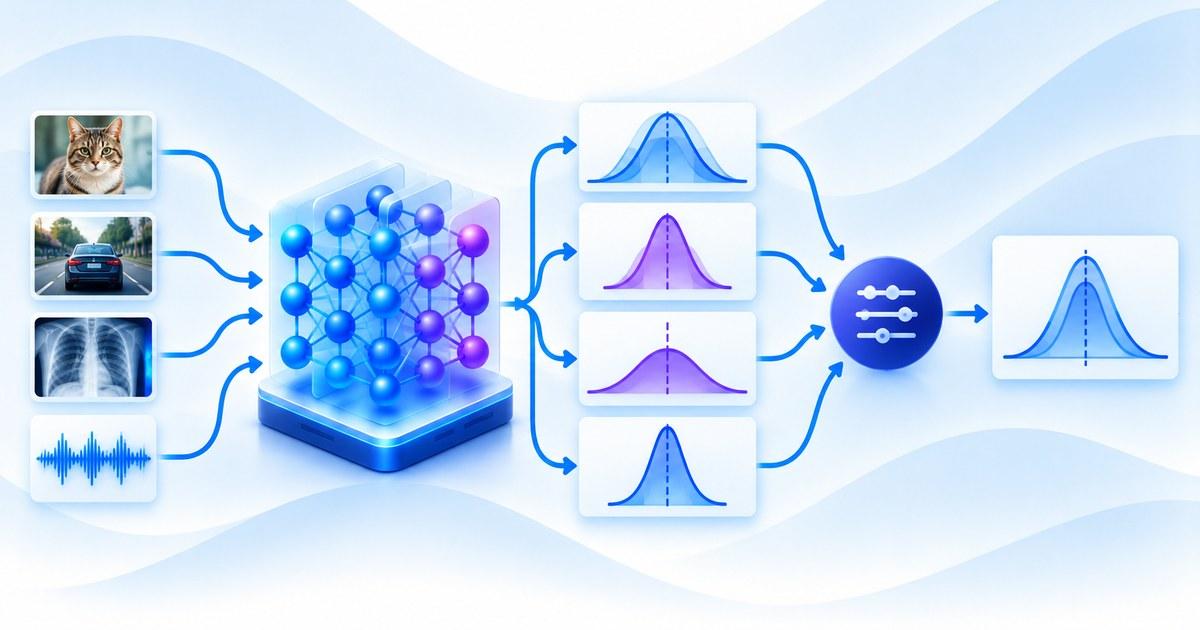
Machine learning training often produces different results because optimization algorithms and data-processing workflows involve random operations that influence how a model learns from its training dataset. Neural networks commonly begin with randomly initialized parameters, allowing different training runs to start from different points in the optimization landscape. Stochastic gradient descent and its variants also process selected batches of training examples, meaning that changes in batch ordering can alter the sequence of gradient updates and lead to different parameter values by the end of training.
Additional variation can originate from data transformations and model components that intentionally introduce randomness. Techniques such as dropout randomly deactivate selected neurons during training, while data augmentation may generate different versions of an image or other input during separate executions. Random sampling, dataset splitting, negative-example selection, and data-loader worker behavior can introduce further differences when their random states are not controlled consistently. Even when engineers use the same training script, these independent sources of randomness can produce different optimization trajectories and evaluation metrics.
Computational execution can introduce another category of variation that is not necessarily eliminated by controlling random seeds. Modern ML frameworks frequently execute mathematical operations in parallel across CPUs and GPUs, and the order in which parallel operations complete may affect the numerical results of floating-point calculations. For example, gradient aggregation across multiple workers may occur in a different order depending on execution scheduling, communication timing, or the implementation of a particular GPU kernel. Since floating-point addition is not perfectly associative, changing the order of operations can produce small numerical differences that may propagate through repeated optimization updates and eventually result in different model parameters.
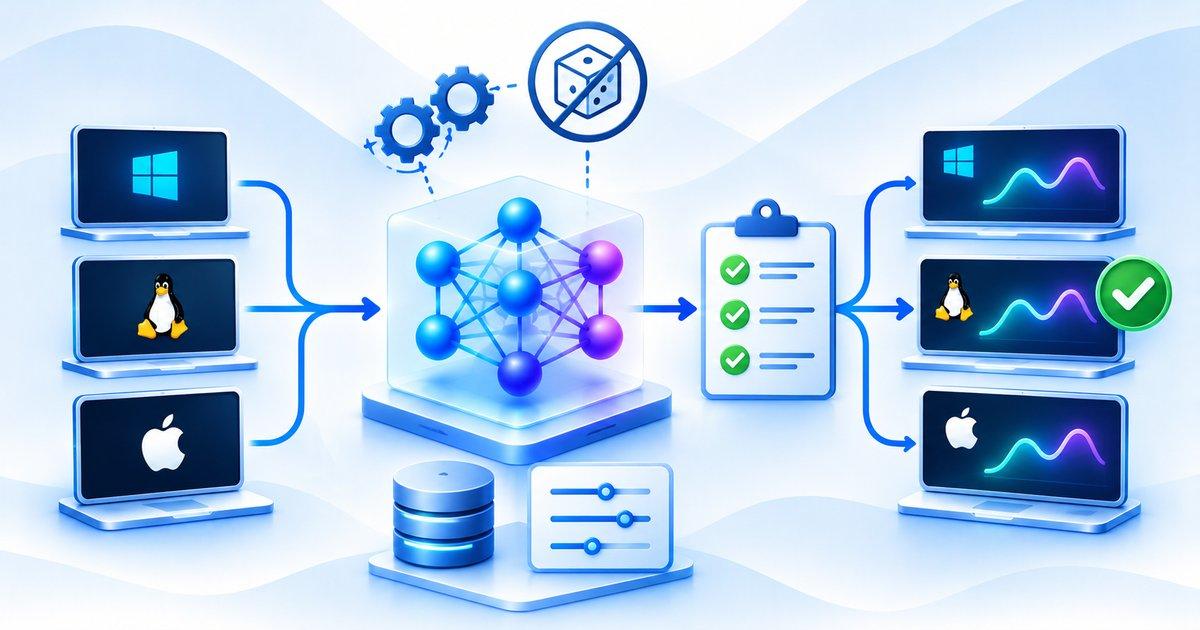
This behavior becomes particularly challenging when a team attempts to reproduce a model across different environments. A model trained on one GPU may produce slightly different results when the same experiment runs on another accelerator architecture or a different version of a numerical library, even when the dataset and training configuration appear identical. These differences do not necessarily indicate an implementation defect, but they can make it difficult to determine whether an observed performance change is caused by a genuine model improvement, an environmental difference, or an uncontrolled source of randomness.
Why Deterministic Behavior Matters in Production ML Systems
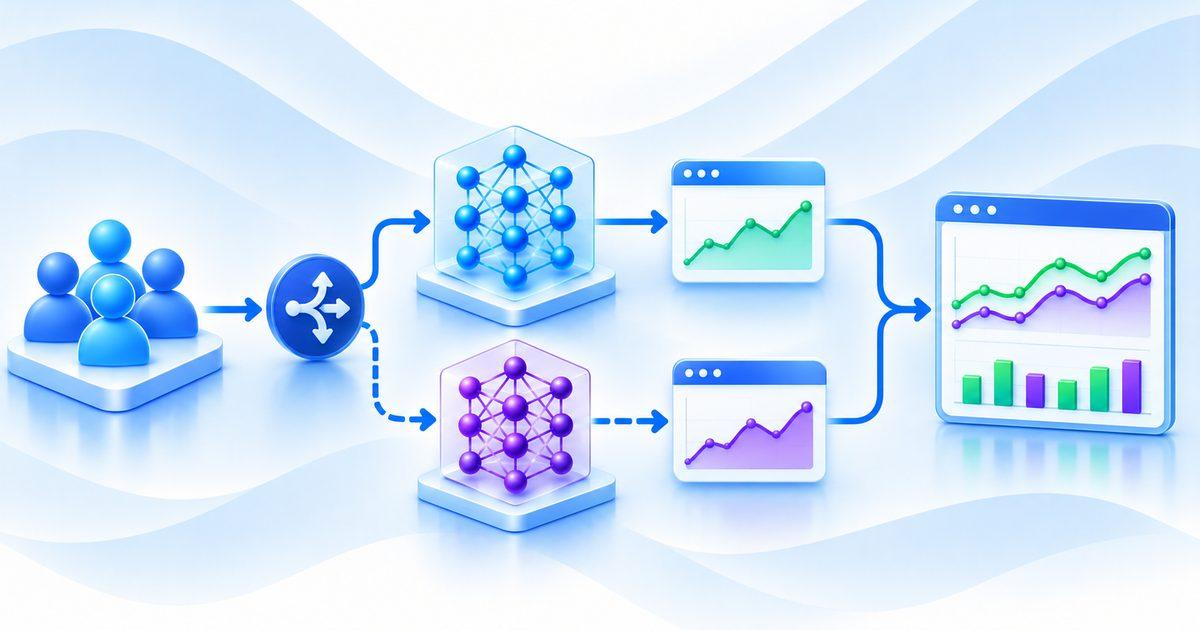
In production machine learning systems, inconsistent behavior can make it difficult to diagnose model failures, compare model versions, validate improvements, and investigate changes in business outcomes. Suppose an engineering team deploys a fraud detection model that begins producing a higher number of suspicious transaction classifications than the previous release. If the training and deployment environments are not sufficiently reproducible, the team may struggle to determine whether the change resulted from updated training data, different model parameters, a software dependency change, altered numerical precision, or an unexpected difference in inference execution. Controlling these variables makes debugging more systematic because engineers can compare known configurations and identify which changes are responsible for the observed behavior.
Reproducibility is also important when teams conduct experiments to evaluate new architectures, optimization strategies, feature engineering methods, or training configurations. Without sufficient execution control, an apparent improvement in model performance may result from random variation rather than a genuine improvement in the underlying approach. Maintaining consistent datasets, configurations, and environment specifications allows engineers to perform more meaningful comparisons and determine whether an observed performance change is repeatable across multiple runs. These practices become especially valuable in systems such as financial forecasting, healthcare prediction, recommendation engines, and fraud detection, where model behavior may need to be explained, audited, or investigated after deployment.
The broader engineering challenge is not limited to producing identical model outputs, but also involves preserving enough information to understand how a particular model was created and why it behaves as observed. The practices discussed in “The Reproducibility Crisis in Machine Learning: What Engineering Teams Can Do” highlight why reliable ML experimentation depends on maintaining data lineage, code versions, configurations, dependencies, and execution metadata alongside model artifacts. When these elements are recorded consistently, engineering teams can reconstruct training workflows, compare releases, and investigate unexpected behavior with greater confidence, even when exact bitwise reproducibility across different hardware environments is not achievable.
Key Takeaway
Deterministic machine learning aims to control execution variability so that identical inputs and defined computational conditions produce consistent results, while repeatability and reproducibility describe broader expectations about recreating experiments within the same or different environments. Random initialization, stochastic optimization, data processing, floating-point arithmetic, parallel execution, and hardware-specific operations can all influence model behavior across training runs and deployment environments. By understanding these distinctions and identifying the sources of variation, engineering teams can establish realistic reproducibility requirements and create a stronger foundation for reliable experimentation, debugging, model validation, and production ML operations.
Section 2: Controlling Randomness, Numerical Computation, and Hardware Variability
Managing Random Seeds and Pseudorandom Number Generators
Random seed management is one of the first steps toward making machine learning experiments more reproducible because many training operations depend on pseudorandom number generators (PRNGs). These generators produce sequences of values that appear random but are determined by an initial internal state, allowing the same sequence to be recreated when the generator is initialized and used under equivalent conditions. Machine learning frameworks use these sequences for operations such as weight initialization, dataset shuffling, dropout, random sampling, and data augmentation, which means uncontrolled random states can produce different training behavior even when the model architecture and source code remain unchanged.
Setting a seed in one library is not sufficient when an experiment uses multiple components with independent random-number generators. A Python-based training workflow, for example, may use Python's built-in random module, NumPy for numerical operations, and PyTorch or TensorFlow for model initialization and training, with each component maintaining its own random state. Engineers should initialize the relevant generators consistently and document the seed configuration alongside the experiment parameters, while recognizing that framework-specific operations and external libraries may require additional configuration. In distributed training, each worker may also need a carefully managed random state so that data sampling and augmentation remain predictable without unintentionally causing every worker to process identical random sequences.
Data-loader workers introduce another source of variation because they may perform random transformations or sampling independently from the main training process. If workers are initialized without a reproducible seeding strategy, the order and content of the batches can change across executions, even when the primary training seed remains fixed. Engineers should configure worker initialization, use explicit random-number generator objects where supported, and control dataset shuffling and sampling behavior to ensure that the intended sequence of training examples is preserved. For workflows that require exact continuation after interruption, saving the relevant random-number generator states alongside model and optimizer checkpoints is also important, because restarting with only the original seed may not recreate the state reached at the interruption point.
Floating-Point Precision, Parallel Execution, and Nondeterministic Operations
Floating-point arithmetic is a significant source of numerical variation in machine learning because computers represent real numbers using finite-precision formats rather than unlimited mathematical precision. As a result, calculations that are mathematically equivalent may produce slightly different numerical results depending on the order in which operations are performed. Floating-point addition, for example, is not perfectly associative, meaning that evaluating ((a+b)+c) can produce a different result from evaluating (a+(b+c)) when the values have substantially different magnitudes or precision characteristics. These differences may be extremely small in an individual operation, but repeated computations during model training can allow them to influence gradient values, parameter updates, and eventual optimization outcomes.
Parallel execution makes this issue particularly relevant in modern machine learning systems because CPUs and GPUs distribute computational work across multiple processing units. Operations such as gradient aggregation, matrix multiplication, and reduction calculations may be executed through parallel kernels in which the order of partial results is not always fixed. For example, multiple GPU threads may calculate partial gradients simultaneously before combining them into a final update, and variations in the order of accumulation can produce small numerical differences. Some optimized operations also use atomic updates or implementation-specific execution paths that may not guarantee identical results across repeated executions, depending on the hardware, framework, and operation involved.
Numerical differences can become more noticeable during iterative optimization because training repeatedly applies parameter updates based on calculated gradients. A small change in one update can alter the model's subsequent state, leading to a different sequence of gradients and optimization steps in later iterations. This does not necessarily mean that the training process is unstable or incorrect, since different runs may still converge to models with comparable predictive performance, but it complicates exact reproduction when engineers expect every parameter and metric to match. Teams should therefore identify which operations introduce nondeterminism, use deterministic alternatives when available, and establish whether their application requires exact numerical equality or performance consistency within an acceptable tolerance.
Standardizing Numerical Precision and Compute Configuration
Numerical precision and compute configuration must be documented because machine learning frameworks may execute the same model using different data types and hardware-specific optimizations. Full precision formats such as FP32 provide a different numerical representation from reduced-precision formats such as FP16 and BF16, which are commonly used to improve computational throughput and reduce memory consumption on supported hardware. Mixed-precision training combines different numerical formats across operations, sometimes retaining higher precision for sensitive calculations while using lower precision for computationally intensive operations. Although these techniques can improve training efficiency, they may also change rounding behavior, gradient calculations, convergence characteristics, and inference outputs, making precision configuration an important part of reproducibility.
Hardware and software dependencies can further influence which numerical algorithms are selected during execution. Changes to GPU architecture, accelerator drivers, CUDA, cuDNN, compiler versions, numerical libraries, or framework releases may alter kernel implementations and optimization strategies, potentially producing results that differ from those obtained in an earlier environment. Engineers should therefore record the hardware model, framework and library versions, driver configuration, precision settings, and relevant runtime parameters as part of the experiment metadata. Container images and dependency lockfiles can help preserve software consistency, although they do not independently guarantee identical results across different host hardware or accelerator configurations.
These considerations make hardware-aware design an important part of reproducible machine learning, because model computation and numerical behavior are closely connected to the infrastructure executing the workload. The engineering principles discussed in “Hardware-Aware Machine Learning: Designing Models Around the Compute They Run On” are relevant when evaluating how accelerator architecture, execution kernels, precision choices, and parallel computation influence ML workloads. Teams should define an appropriate compute configuration for each experiment, preserve that configuration in versioned environment specifications, and test whether moving a workload between environments produces acceptable numerical and predictive differences. This approach allows organizations to balance reproducibility with the performance benefits of optimized hardware instead of assuming that every production workload must use identical hardware or strictly identical floating-point outputs.
Key Takeaway
Improving determinism requires controlling more than the initial random seed because pseudorandom number generators, floating-point arithmetic, parallel execution, hardware-specific kernels, and distributed computation can all influence machine learning results. Engineers should manage random states across libraries and workers, use deterministic framework operations where supported, document numerical precision and compute configurations, and validate the actual behavior of their hardware and software environment. By understanding the trade-offs between strict determinism and computational efficiency, teams can establish reproducibility controls that make model training and inference more predictable without unnecessarily sacrificing performance.
Section 3: Building Reproducible ML Environments and Deterministic Pipelines
Versioning Dependencies, Frameworks, and Runtime Environments
Reproducible machine learning requires controlling the software environment in which experiments are executed because changes in dependencies, framework implementations, and runtime configurations can influence model behavior even when the training code remains unchanged. A model developed using one version of PyTorch, NumPy, or a numerical library may behave differently when executed using another version because underlying algorithms, mathematical operations, default configurations, or optimized implementations may have changed. Similar differences can arise from GPU drivers, CUDA, cuDNN, compiler versions, and system-level libraries, making software environment management an essential component of reproducible ML engineering.
Dependency management begins with explicitly recording the versions of frameworks and libraries used during development and training rather than relying on whichever versions happen to be installed on a machine. Dependency lockfiles and environment specifications help preserve these requirements by documenting exact package versions and, where supported, their dependency relationships. For example, an engineering team can maintain a locked environment for model training and use the same dependency specification when rebuilding the workflow in a staging environment. This reduces the possibility that an experiment produces different results simply because a library was updated or an indirect dependency resolved to a newer version.
Containerization provides another mechanism for standardizing machine learning environments because a container image can package application code, runtime dependencies, framework libraries, and supporting configuration into a versioned execution unit. By using the same container image across development, training, testing, and production, teams can reduce inconsistencies caused by different operating-system packages or manually installed dependencies. However, containers do not completely isolate workloads from the host environment, because GPU drivers, accelerator architecture, device configuration, and some hardware-dependent operations remain influenced by the underlying infrastructure. Engineers should therefore record container image versions alongside hardware details, driver versions, precision settings, and framework configurations rather than assuming that containerization alone guarantees identical execution.
Making Data Ingestion and Feature Engineering Deterministic
Data pipelines are another major source of reproducibility problems because the same training code can produce different model inputs when the underlying data or preprocessing behavior changes. Source datasets may receive new records, database queries may return rows in different orders, and time-dependent transformations may calculate different values depending on when the pipeline executes. Joins across multiple datasets can also produce inconsistent results when key handling, duplicate records, null values, or ordering assumptions are not explicitly defined. These differences can affect the training dataset before the model begins learning, making it difficult to determine whether a change in model performance originated from the training algorithm or the data preparation process.
Dataset versioning helps address this issue by preserving the exact collection of records used in a particular training experiment. Teams can create immutable dataset snapshots, maintain source identifiers, record extraction timestamps, and document filtering conditions so that a later experiment can reconstruct the same input population. Deterministic preprocessing should also use explicit sorting rules when record order matters, stable joins with well-defined keys, consistent handling of missing values, and controlled timestamp conversions that account for time zones and aggregation windows. Data splitting and sampling should use documented random states, while preprocessing transformations should preserve their configuration and fitted parameters as part of the model's training lineage.
Feature engineering requires similar discipline because small differences between training and serving transformations can produce different feature values for the same underlying entity. A customer activity feature calculated using one aggregation window during training may differ from the corresponding production feature if the serving pipeline uses another time boundary or handles delayed events differently. Engineering teams should therefore standardize feature definitions, schema versions, transformation logic, and timestamp semantics across environments, using shared feature computation components where practical. Maintaining consistent data contracts and validating feature outputs before training and inference makes it easier to identify whether a model's changed behavior comes from its learned parameters or from differences in the data supplied to it.
Reproducing Model Behavior Across Development, Testing, and Production
Machine learning systems frequently operate across several environments, including local development machines, shared training infrastructure, CI pipelines, staging services, and production inference systems, each of which may differ in hardware, dependencies, data access, or execution configuration. A model trained locally may use a different preprocessing implementation in production, while a staging service may run a newer framework version or use a different numerical precision setting from the training environment. These differences can cause prediction mismatches even when the same model artifact is loaded, making environment consistency and inference validation important parts of the deployment process.
Standardized runtime images, dependency specifications, shared feature definitions, and versioned model artifacts help reduce these differences by preserving the components that influence model execution. Before deployment, teams can run inference parity tests using representative input examples and compare the predictions generated in development, staging, and production-like environments. For deterministic CPU execution, exact output comparison may be appropriate when the same runtime and numerical conditions are maintained, whereas GPU and mixed-precision environments may require tolerance-based comparisons that account for small floating-point differences. These tolerances should be defined according to the application because a small numerical deviation may be harmless for a continuous prediction but significant when it changes a classification threshold, ranking order, or downstream business decision.
The testing principles discussed in “ML Testing for Software Engineers: How to Test Systems That Don't Always Produce the Same Output” are particularly relevant when validating model behavior across environments, since regression tests must distinguish acceptable numerical variation from meaningful changes in predictions. Engineering teams should preserve representative test datasets, model versions, feature schemas, and runtime configurations so that the same evaluation cases can be executed consistently after software or infrastructure updates. When differences occur, engineers can compare input features, preprocessing outputs, model parameters, numerical precision, and dependency versions to identify the source rather than assuming that the model itself has become less reliable. This makes cross-environment validation a repeatable engineering activity and provides a stronger foundation for maintaining predictable model behavior after deployment.
Key Takeaway
Reproducible machine learning environments require coordinated control over software dependencies, runtime configurations, datasets, preprocessing transformations, training state, and model artifacts. Dependency lockfiles and container images reduce software inconsistencies, while dataset snapshots, deterministic feature pipelines, comprehensive checkpoints, and experiment tracking preserve the information needed to reconstruct training workflows. By validating inference behavior across development, testing, staging, and production with appropriate numerical tolerances, engineering teams can identify environmental differences before they become production problems and maintain greater confidence in their model releases.
Conclusion: Making Machine Learning More Reproducible Across Environments
Deterministic machine learning plays an important role in making model development, experimentation, testing, and production deployment more predictable and easier to validate. As machine learning systems become increasingly complex, engineers must understand why identical training scripts can produce different results across execution environments and how seemingly minor variations in random initialization, data processing, numerical precision, hardware, and software dependencies can influence model behavior. Controlling these sources of variation allows teams to investigate performance changes more systematically and establish greater confidence in the results generated by their experiments.
Achieving reproducibility requires more than fixing a random seed because machine learning workflows depend on several interconnected computational components. Random-number generators must be managed across libraries and distributed workers, while floating-point operations, parallel execution, GPU kernels, and numerical precision settings must be considered when defining the expected level of determinism. Engineers should also recognize that deterministic training and deterministic inference represent different requirements, since a model can produce consistent predictions after training even when its original optimization process involved randomness. Understanding these distinctions helps teams establish realistic expectations about exact numerical equality, repeatability, and cross-environment reproducibility.
A standardized software and data environment provides another essential foundation for reproducible machine learning. Dependency lockfiles, container images, dataset snapshots, deterministic preprocessing, versioned feature definitions, comprehensive training checkpoints, and experiment-tracking systems preserve the information required to reconstruct a model development workflow. These controls become particularly valuable when experiments move between local development machines, shared training infrastructure, CI environments, staging services, and production systems, where differences in hardware, dependencies, and execution configurations can introduce unexpected prediction changes. Cross-environment inference testing and numerical tolerance checks help identify these differences before they affect important application decisions.
Operationalizing determinism requires integrating reproducibility into the broader MLOps lifecycle through automated testing, CI/CD validation, model registries, artifact versioning, and production monitoring. Engineering teams should define whether each workflow requires bitwise determinism, numerical consistency within an acceptable tolerance, or statistical reproducibility, because the appropriate requirement depends on the workload and the consequences of prediction variation. Strict determinism may introduce additional computational costs or restrict certain hardware optimizations, making it important to balance reproducibility requirements against infrastructure performance and operational efficiency.
Ultimately, deterministic machine learning should be treated as an engineering discipline that extends from the first experiment to the long-term maintenance of production models. Organizations that preserve data lineage, control execution environments, document computational configurations, and continuously validate model behavior can make their ML systems easier to debug, reproduce, audit, and improve. The objective is not necessarily to guarantee identical numerical outputs across every machine and hardware configuration, but to ensure that differences are understood, measurable, and manageable, allowing machine learning systems to evolve without losing control over how their results are generated.
Frequently Asked Questions
1. What is deterministic machine learning?
Deterministic machine learning is an approach to building and executing ML workflows in which identical inputs and controlled computational conditions are expected to produce consistent outputs. It involves managing randomness, numerical operations, data processing, and execution configurations so that repeated operations behave predictably. This is particularly useful for reproducing experiments, debugging model behavior, validating model releases, and maintaining consistency across development and production environments.
2. Why do machine learning models produce different results across training runs?
Machine learning models can produce different results because training often involves randomized weight initialization, data shuffling, stochastic gradient descent, dropout, and random data augmentation. Computational factors such as floating-point precision, parallel execution, GPU scheduling, and nondeterministic algorithms can introduce additional variation even when the source code remains unchanged. These differences may alter optimization trajectories and final model parameters, resulting in different evaluation metrics or predictions across repeated training runs.
3. What is the difference between deterministic execution and reproducibility?
Deterministic execution means that the same operation produces the same result when its inputs and relevant execution conditions remain unchanged. Reproducibility is broader because it involves reconstructing an experiment or obtaining equivalent results across different executions, environments, or teams using sufficiently documented procedures. A workflow may therefore be repeatable within one controlled environment but not produce bitwise-identical results when executed using different hardware or numerical libraries.
4. Does setting a random seed guarantee deterministic machine learning?
Setting a random seed helps reproduce pseudorandom sequences used for operations such as weight initialization, data shuffling, and random sampling, but it does not guarantee deterministic execution across the entire machine learning pipeline. Different libraries may maintain independent random-number generators, while data-loader workers, GPU kernels, parallel operations, and distributed execution can introduce additional sources of variation. Engineers must combine seed management with deterministic framework settings, controlled data processing, standardized environments, and appropriate execution configurations to improve reproducibility.
5. Why can GPU-based model training produce nondeterministic results?
GPU-based training frequently uses parallel execution to accelerate operations such as matrix multiplication, gradient aggregation, and tensor reductions, where the order of computational operations may vary. Since floating-point arithmetic is sensitive to operation ordering, different execution sequences can produce slightly different numerical results even when the same inputs and parameters are used. Certain GPU kernels and optimized algorithms may also use atomic operations or hardware-specific execution strategies that do not guarantee identical outputs across repeated runs.
6. How do floating-point operations affect ML reproducibility?
Floating-point operations represent numerical values using finite precision, which means calculations may involve rounding and representation errors that differ according to the order and format of computation. For example, adding several values in one order may produce a slightly different result from adding them in another order because floating-point addition is not perfectly associative. During machine learning training, these small differences can influence gradients and parameter updates, potentially producing different optimization trajectories after many iterations.
7. What are deterministic algorithms in machine learning frameworks?
Deterministic algorithms are computational implementations designed to produce consistent results when executed repeatedly under supported and equivalent conditions. Machine learning frameworks may provide settings that select deterministic implementations for supported operations or report errors when an operation cannot meet the requested deterministic requirements. However, the availability and scope of these controls depend on the framework, operation, hardware, and external libraries, so engineers must validate the specific workload rather than assuming that one setting guarantees complete determinism.
8. How can engineers make PyTorch or TensorFlow training more reproducible?
Engineers can improve reproducibility in PyTorch and TensorFlow by configuring random seeds across relevant libraries, controlling data-loader or input-pipeline randomness, and enabling supported deterministic execution options. They should also document framework versions, numerical precision, hardware configuration, data sampling behavior, and distributed training settings because these factors can influence computational results. Saving model, optimizer, scheduler, and random-number generator states in checkpoints further helps reproduce or resume training workflows, provided that the remaining execution conditions are sufficiently consistent.
9. Can machine learning results be reproduced across different hardware environments?
Machine learning results can often be reproduced across different hardware environments within an acceptable numerical or statistical tolerance, although achieving bitwise-identical outputs is more difficult. CPU and GPU implementations may use different numerical libraries, precision formats, execution kernels, and parallel computation strategies, creating small differences in intermediate calculations and final predictions. Engineers should use cross-environment inference tests, document hardware and runtime configurations, and establish application-specific tolerances to determine whether these differences are operationally meaningful.
10. How do containers help create reproducible ML environments?
Containers help standardize machine learning environments by packaging application code, runtime dependencies, framework libraries, and supporting software into a versioned execution image. Running the same container image across development, training, testing, and production reduces inconsistencies caused by manually installed packages or different operating-system configurations. However, containers do not completely isolate workloads from host hardware, GPU drivers, accelerator architecture, and other system-level components, so these dependencies must also be documented and validated.
11. Why are dataset versioning and deterministic preprocessing important?
Dataset versioning preserves the exact records used during a training experiment, allowing engineers to reconstruct the same training population when reproducing or investigating model behavior. Deterministic preprocessing ensures that transformations such as filtering, sorting, feature calculation, missing-value handling, and data splitting produce consistent results under the same conditions. Without these controls, a model may generate different parameters or evaluation metrics because its input data changed, even when the training code and hyperparameters remained identical.
12. How can teams make distributed machine learning training more reproducible?
Distributed machine learning training requires consistent control over worker initialization, data partitioning, random-number generator states, batch construction, synchronization, and gradient aggregation. Different worker configurations or communication schedules can change the order in which computational results are combined, potentially introducing numerical variation during training. Teams should document the number of workers, communication settings, sampling strategies, synchronization methods, and framework configurations, while using deterministic distributed operations where supported and appropriate.
13. How should ML engineers test deterministic model behavior?
Engineers should develop automated tests that execute the same preprocessing, training, and inference operations under controlled conditions and compare their outputs against predefined expectations. Exact equality may be suitable for deterministic data transformations, while numerical tolerance checks are more appropriate for operations that can produce small floating-point differences across hardware environments. For stochastic or distributed workflows where exact equality is not practical, repeated experiments and statistical comparisons can help establish whether model performance remains sufficiently consistent.
14. Does deterministic machine learning reduce training performance?
Deterministic machine learning can introduce computational overhead because certain deterministic implementations may use less optimized algorithms, additional synchronization, or more restrictive execution strategies. These limitations can increase training time, memory consumption, or resource utilization, particularly in large-scale GPU and distributed training workloads. Engineers should evaluate the performance trade-off for each application and enforce strict determinism where necessary, while using numerical or statistical reproducibility when exact output equality is not a practical requirement.
15. What should a production ML reproducibility checklist include?
A production ML reproducibility checklist should include versioned datasets, source-code revisions, dependency specifications, random seed configurations, preprocessing definitions, training hyperparameters, numerical precision settings, hardware details, and model artifacts. It should also preserve relevant checkpoint states, experiment metadata, evaluation reports, runtime configurations, and inference validation results so that engineers can reconstruct and compare model executions. Integrating these records with CI/CD checks, model registries, automated reproducibility tests, and production monitoring helps organizations maintain predictable model behavior as their machine learning systems evolve.