Section 1: Understanding Model Degradation and When Rollback Is Necessary
Why a Newly Deployed Model Can Perform Worse Than Its Predecessor
Deploying a new machine learning model is intended to improve prediction quality, reduce operational costs, or support new application requirements, but a model that performs well during offline evaluation can still produce worse results after reaching production. This discrepancy can arise because validation datasets rarely reproduce every condition encountered by a live application, including changing input distributions, unusual user behavior, concurrent requests, upstream data changes, and differences between training and serving environments. A replacement model may therefore pass its evaluation benchmarks yet introduce unexpected errors, increase response latency, or weaken business outcomes once real users and production workloads begin interacting with it.
One common cause is training-serving skew, where the features used during model training differ from those supplied by the production inference pipeline. A new model might depend on a feature whose calculation has changed, rely on a different treatment of missing values, or expect a normalization procedure that is not consistently applied by the deployed service, causing its predictions to differ from those observed during testing. Data distribution changes can create similar problems when the incoming traffic contains patterns that were poorly represented in the training dataset, such as unusual transaction behavior, shifting recommendation preferences, or new categories of customer activity. Even when the model and its preprocessing code are correct, these environmental differences can make the previous production version perform more reliably than the newly deployed alternative.
Deployment changes can also introduce regressions through runtime configuration, model-serving dependencies, hardware differences, or changes in how requests are routed and processed. For example, a newly deployed fraud detection model may improve offline recall but increase prediction latency enough to disrupt a payment workflow, while a recommendation model may improve average ranking metrics but produce less relevant results for a particular user segment. Engineering teams must therefore compare the new model against the previous production version using operational metrics and relevant business outcomes, rather than assuming that a newer model is necessarily a better production model. A dependable rollback strategy starts with recognizing that model releases introduce risk and that the ability to restore a known-good version is an essential part of deployment design.
Distinguishing Model Quality Regressions From Infrastructure and Data Pipeline Failures
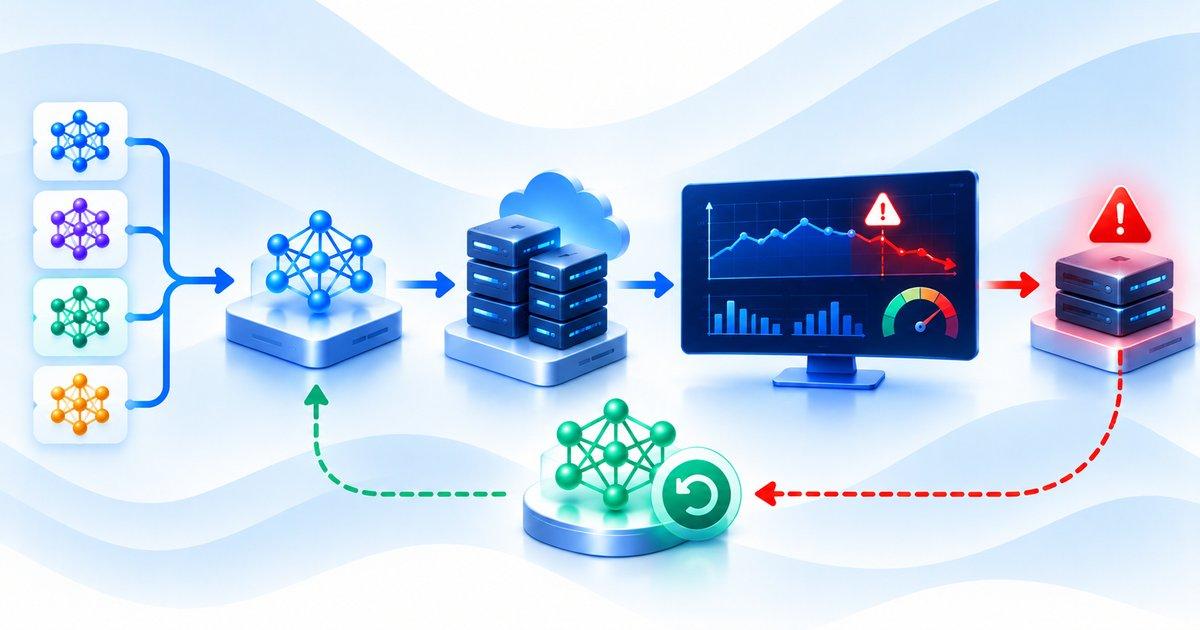
A drop in prediction quality does not automatically mean that the model itself is defective, because production ML applications depend on a broader pipeline that includes data ingestion, feature transformation, inference services, storage systems, and downstream business logic. Missing features, delayed updates, schema changes, stale caches, and preprocessing failures can all produce poor predictions even when the deployed model behaves exactly as designed. If engineers immediately replace the model without investigating these dependencies, they may fail to resolve the underlying issue or introduce another regression by rolling back to a model that is incompatible with the current data pipeline.
Infrastructure symptoms can also resemble model degradation, making it important to examine service health and prediction quality together. Increased inference latency, timeout rates, memory pressure, or accelerator utilization may indicate a serving problem rather than a decline in the model's predictive capability, while a sudden increase in missing or out-of-range features may point to an upstream data issue. Engineers should compare model outputs and feature distributions with established baselines, inspect serving errors, review recent configuration changes, and determine whether the degradation is concentrated in particular request types, customer segments, or deployment instances. These signals help distinguish a model-specific regression from an infrastructure incident that requires a different recovery procedure.
The investigation principles discussed in “Debugging Machine Learning Systems: A Software Engineer's Guide to Finding Model Failures” are particularly relevant because dependable recovery depends on identifying where the failure originates before selecting the corrective action. If a feature pipeline has stopped producing valid inputs, restoring an older model may not resolve the incident, whereas a regression directly associated with the new model may justify immediate rollback even while the deeper cause is still under investigation. Teams should therefore establish clear incident criteria and preserve the ability to restore a known-good deployment quickly, while conducting a parallel diagnosis of the model, data, serving infrastructure, and downstream dependencies.
Defining Rollback Triggers Using Model Metrics and Business Outcomes
A rollback strategy becomes actionable when engineering teams define measurable conditions that indicate when a deployment is no longer performing within acceptable limits. Model-quality indicators such as precision, recall, classification accuracy, ranking quality, calibration, or prediction error can reveal changes in predictive behavior, while operational metrics such as latency, timeout rates, throughput, and resource consumption show whether the model remains suitable for the serving environment. The relevant measurements depend on the application's purpose, since a fraud detection system may prioritize missed fraudulent transactions and false alerts, whereas a recommendation service may focus on engagement, relevance, conversion, or other meaningful outcomes.
Rollback thresholds should account for expected variation and the reliability of the signals used to measure model quality, because normal traffic fluctuations can produce temporary metric changes that do not justify reversing a deployment. Prediction-quality metrics may also depend on labels that arrive hours, days, or weeks after inference, making immediate assessment difficult for applications such as fraud detection and predictive maintenance. In these situations, teams can combine early operational indicators, input-quality metrics, prediction-distribution monitoring, and faster proxy measurements with delayed outcome-based evaluation, while recognizing that proxy signals do not replace reliable labels when assessing actual predictive performance. Alert thresholds should be validated against historical behavior and representative test scenarios so that the system can distinguish meaningful deterioration from ordinary variation.
Business impact is an equally important factor because a statistically detectable model regression may not always justify an immediate rollback, while a small change in a critical metric may have serious consequences for users or the organization. For example, a modest increase in false positives could create substantial operational overhead for a high-volume fraud system, while a latency increase in a time-sensitive application might violate a service-level objective even if prediction accuracy remains unchanged. A robust policy defines which conditions require immediate rollback, which trigger closer investigation, and which can be addressed through controlled monitoring or a targeted correction. By connecting technical thresholds with operational and business requirements, teams can make rollback decisions consistently instead of relying entirely on subjective judgments during an incident.
Key Takeaway
Safe ML rollback begins with recognizing production degradation, distinguishing model failures from data and infrastructure problems, and defining measurable triggers that reflect both predictive quality and business impact. Teams should choose among rollback, retraining, targeted fixes, and fallback behavior according to the cause and urgency of the incident, while ensuring that restored components remain compatible with the current production pipeline. By preparing these decisions before deployment and preserving a validated recovery path, engineering teams can limit the impact of model regressions and restore dependable application behavior more quickly.
Section 2: Designing Deployment Architectures That Make Rollbacks Safe
Managing Model Versions, Registries, and Reproducible Deployment Artifacts
A safe machine learning rollback depends on the ability to restore a previously validated production configuration without introducing new compatibility problems or losing essential deployment information. Simply retaining an older set of model weights is insufficient when prediction behavior also depends on preprocessing code, feature definitions, runtime libraries, environment variables, and serving configurations, because reverting only one component can leave the application executing an incompatible combination of artifacts. Engineering teams should therefore treat each model release as a versioned deployment unit that captures the components required to reproduce its behavior, making it possible to identify precisely what was running before a regression occurred and what must be restored to recover reliable service.
A model registry provides a central mechanism for organizing model versions, recording their evaluation results, and tracking their progression through development, testing, staging, and production. Each candidate should have an identifiable version associated with its training dataset references, model artifacts, feature schema, preprocessing transformations, dependency versions, and relevant performance metrics, allowing engineers to compare a newly deployed model with its predecessor during an incident. Recording deployment timestamps, approval decisions, and the production environments in which each version has been validated further improves traceability, particularly when multiple models or configuration changes are released within a short period.
Reproducibility also requires preserving the exact artifacts and dependencies needed to reconstruct a previous deployment rather than assuming that rebuilding an older model will produce identical behavior. Changes in software libraries, numerical execution, data transformations, or hardware configuration can alter results even when the model architecture and nominal parameters remain unchanged, making immutable artifacts and version-controlled deployment manifests valuable safeguards. By retaining known-good model packages and their associated runtime requirements, engineering teams can restore a validated configuration directly instead of introducing additional uncertainty through emergency retraining or rebuilding during an incident.
Using Canary Releases, Shadow Deployments, and Champion-Challenger Testing
Safe deployment architecture should detect performance regressions before a new model becomes responsible for the entire production workload, since defects are generally easier to contain when exposure is limited. Canary deployment achieves this by directing a controlled portion of production traffic to a new model while the existing model continues serving the remaining requests, allowing engineers to compare latency, error rates, prediction behavior, and available quality indicators under real operating conditions. If the candidate begins violating predefined thresholds, the deployment system can stop the rollout and redirect traffic to the established model before the problem affects a larger proportion of users.
Shadow deployment provides another risk-reduction mechanism by sending copies of production inputs to a candidate model while keeping its predictions separate from the outputs used by the live application. This allows teams to compare the candidate's responses with those of the current production model without exposing users to its decisions, which is particularly useful when labels are delayed or when changing predictions could affect important downstream actions. Although shadow traffic provides valuable evidence about serving behavior, input distributions, and differences between model outputs, it cannot by itself establish which model is more accurate when reliable ground-truth outcomes are unavailable, requiring subsequent evaluation against suitable labels or task-specific validation criteria.
Champion-challenger testing extends this comparison by evaluating the incumbent model against one or more alternatives using predefined performance objectives and comparable inputs or workloads. Engineers can examine differences in prediction quality, resource consumption, latency, and business outcomes before promoting a candidate, while retaining the incumbent as the preferred version until the challenger meets the required acceptance criteria. These deployment approaches complement one another because shadow testing supports low-risk observation, canary releases expose a candidate to limited live use, and champion-challenger evaluation helps establish whether a replacement produces sufficient measurable benefit to justify wider deployment.
Building Traffic Switching, Rollback Automation, and Recovery Checkpoints
Once a production regression has been detected, the deployment architecture should provide a controlled way to stop traffic from reaching the affected version and redirect requests to a previously validated alternative. Traffic routing can support this process through versioned endpoints, service configuration, routing weights, or deployment-controller mechanisms that allow an incumbent model to resume handling requests without requiring the entire application to be redeployed. The system should also confirm that the target version is available, initialized, and compatible with the current request format before completing the switch, since redirecting traffic to an unavailable or incompatible artifact can extend an incident rather than resolve it.
Automated rollback can reduce recovery time when an objective condition indicates that the current release is violating a predefined operational or quality threshold. For example, a deployment controller may reduce or remove traffic from a canary when error rates exceed an established limit, latency breaches a service-level objective, or a reliable model-quality signal falls below its acceptance threshold, while recording the trigger and action for subsequent investigation. Automation should nevertheless account for noisy metrics and delayed labels, because reacting to a temporary fluctuation or an unreliable proxy can repeatedly switch models without resolving the underlying problem. Teams should establish appropriate observation windows, severity thresholds, and escalation procedures, with immediate rollback reserved for conditions where continued exposure presents unacceptable risk.
Recovery checkpoints and deployment records further support reliable switching by preserving the configuration required to return to a known-good state, including the model artifact, feature transformation version, serving configuration, and routing settings. The engineering principles discussed in “From Experiment to Production: The Decisions That Shape an ML System” are particularly relevant because reliable production deployment depends on controlled releases, reproducible configurations, measurable acceptance criteria, and prepared recovery procedures. By testing the rollback mechanism before an incident, recording each deployment transition, and validating the restored service after traffic switches, engineering teams can reduce recovery time while preserving the evidence required to understand and prevent similar failures.
Key Takeaway
Safe ML rollback depends on more than retaining an older model; it requires versioned deployment artifacts, compatible feature pipelines, controlled traffic routing, and tested recovery procedures. Model registries, canary releases, shadow deployments, and explicit data contracts help detect regressions early and prevent incompatible components from disrupting recovery, while automated rollback can shorten incidents when its triggers are designed to avoid unnecessary switching. By treating rollback as a core capability of the deployment architecture, engineering teams can restore a validated production configuration more reliably while maintaining service availability and operational traceability.
Section 3: Executing a Production Model Rollback Without Disrupting Applications
Establishing Incident Severity, Rollback Authority, and Decision Criteria
Executing a production model rollback requires a clear incident-response process that allows engineering teams to restore reliable behavior without introducing unnecessary delays or making recovery decisions based on incomplete evidence. When a newly deployed model begins producing unreliable predictions, increasing response latency, or negatively affecting business outcomes, teams must determine the severity of the incident, identify the affected services, and establish whether continued exposure to the model presents an unacceptable risk. The response should be guided by predefined criteria that distinguish critical incidents requiring immediate rollback from less severe regressions that can be investigated under controlled monitoring, helping teams avoid both delayed recovery and unnecessary deployment reversals.
Incident severity should reflect the technical consequences of the regression and its potential impact on users, downstream systems, and business operations. A fraud detection model that begins allowing suspicious transactions may require an immediate rollback, whereas a recommendation model experiencing a modest decline in engagement might permit a controlled investigation before a final decision is made. Engineering teams should consider the magnitude of the performance deterioration, the confidence in the monitoring signals, the availability of a validated replacement, and the consequences of leaving the current model in production, while accounting for situations where delayed labels make direct measurement of predictive quality temporarily unavailable.
Rollback authority must also be established before an incident occurs, particularly when model deployment decisions involve multiple teams responsible for ML development, platform infrastructure, data pipelines, and application operations. A predefined incident process should identify who can initiate an emergency rollback, who is responsible for verifying the recovered service, and how decisions are communicated when an incident affects several interconnected systems. Automated safeguards can execute immediate recovery actions when clear thresholds are violated, while designated engineers investigate the cause and determine whether additional intervention is required, ensuring that incident response does not depend on locating the appropriate decision-maker during a production failure.
Reverting Model Artifacts, Configuration, and Traffic Routing Consistently
Once a rollback decision has been made, the recovery process must restore a compatible production configuration rather than simply replacing the current model weights with an older artifact. Prediction behavior depends on several connected components, including preprocessing logic, feature transformations, dependency versions, model-serving configuration, runtime libraries, and the interfaces through which applications send requests and receive predictions. If any of these components changed during the deployment, restoring only the previous model may introduce a new incompatibility, making it essential to identify and recover the complete set of artifacts and configurations associated with the previously validated release.
A controlled rollback should begin by identifying the known-good deployment version and confirming that its model artifact, feature schema, preprocessing pipeline, and runtime dependencies remain available. The deployment system can then restore the corresponding configuration and direct traffic back to the previous endpoint, versioned service, or model-serving instance, while preserving the ability to verify that the restored model is ready to handle production requests. Where the architecture supports multiple model versions simultaneously, traffic weights can be adjusted to remove exposure to the degraded candidate, but engineers should ensure that routing changes are applied consistently across relevant services so that requests are not distributed between incompatible model and feature configurations.
Recovery validation should confirm that the restored model receives valid inputs, produces expected outputs, and satisfies essential service requirements before the incident is considered resolved. Engineers should check inference error rates, response latency, feature availability, resource utilization, and any task-specific indicators that can be evaluated immediately, while recording which model and configuration versions are active after the switch. Preserving deployment logs, routing changes, and recovery timestamps also supports later investigation by making it possible to reconstruct the sequence of events and establish whether the rollback restored the previous behavior or exposed another problem that requires additional remediation.
Maintaining Service Availability Through Fallback Models and Graceful Degradation
A rollback may not always be completed immediately, particularly when the previous model depends on unavailable infrastructure, incompatible feature transformations, or a serving environment that has also changed during the incident. In these situations, production applications need a fallback strategy that allows essential functionality to continue while the engineering team restores a validated model or repairs the affected dependencies. Depending on the application, the fallback may involve a simpler model, deterministic business rules, a conservative prediction policy, cached results that remain valid, or a restricted feature set that allows the service to operate with reduced capabilities.
The appropriate fallback depends on which operations can remain safe and useful when the primary model becomes unreliable. A recommendation service might temporarily use a stable popularity-based ranking instead of a degraded personalized model, while a transaction-risk application could apply conservative rules or route uncertain cases for additional review if the business process supports that behavior. An inference API may also return a controlled error or an explicit uncertainty response when it cannot produce a sufficiently reliable prediction, provided that downstream services are designed to handle the response without interpreting it as a valid model output. These mechanisms help prevent a model failure from becoming a complete application outage, although their suitability must be evaluated against the consequences of incorrect, delayed, or unavailable predictions.
Graceful degradation is particularly important in applications where the ML component is only one part of a wider service, because the surrounding application may still provide useful functionality when prediction capabilities are temporarily reduced. The principles discussed in “Graceful Degradation in AI: Designing Systems That Still Work When Models Fail” are relevant because recovery planning should define how the application behaves when its primary model or a related dependency cannot be trusted. Engineers should specify which fallback paths are permitted, how long they can remain active, what monitoring indicates that the primary service is ready to return, and which actions require human approval, ensuring that temporary recovery measures do not silently become permanent substitutes for reliable model behavior.
Key Takeaway
Executing a safe production rollback requires coordinated decisions about incident severity, deployment authority, compatible model artifacts, and traffic routing, while maintaining a controlled fallback when immediate restoration is not possible. Engineers must also account for mutable feature state, caches, feedback loops, and online learning updates, since reverting model weights alone may not restore the previous production behavior. By combining predefined incident procedures, validated recovery configurations, graceful degradation, and explicit state-management policies, teams can reduce recovery time while protecting application availability and prediction reliability.
Conclusion: Making Model Rollback a Core MLOps Capability
Machine learning models can perform well during offline evaluation and still introduce regressions when deployed into production, where real-world data distributions, infrastructure conditions, application traffic, and business requirements may differ from the assumptions used during development. A new model may reduce prediction accuracy, increase inference latency, produce poorly calibrated outputs, or negatively affect business outcomes, making the ability to restore a previously validated model an essential part of production ML engineering. Rather than treating rollback as an emergency action improvised during an incident, engineering teams should design it as a standard capability of the model deployment lifecycle.
Reliable rollback begins with detecting degradation early and distinguishing model-quality problems from infrastructure failures, feature inconsistencies, and upstream data issues. Teams should establish measurable recovery triggers based on prediction quality, serving latency, error rates, and relevant business outcomes, while accounting for delayed labels and normal fluctuations in production metrics. These signals help determine whether an immediate rollback is necessary or whether a targeted correction, retraining process, or temporary fallback can resolve the problem more effectively. Clear incident ownership and predefined decision criteria further reduce recovery delays by establishing who can initiate a rollback and which conditions require urgent intervention.
A dependable rollback architecture requires versioned model artifacts, reproducible deployment configurations, and compatibility across model inputs, feature transformations, runtime dependencies, and downstream interfaces. Model registries, canary releases, shadow deployments, champion-challenger testing, and explicit data contracts help teams identify weaknesses before a new version reaches the entire production workload. When a rollback becomes necessary, the recovery process must restore a compatible deployment configuration rather than merely replacing model weights, especially when the new release has also changed preprocessing logic, feature schemas, caches, or other stateful components.
Production recovery must also preserve application availability and maintain a predictable response when the previous model cannot be restored immediately. A simpler model, deterministic rules, conservative decision policies, or restricted functionality can provide temporary alternatives while engineers investigate the underlying failure, provided that the fallback behavior remains appropriate for the application's risk requirements. After the rollback, teams should verify model identity, feature compatibility, prediction behavior, latency, and service health, while continuing to monitor outcome-based metrics as reliable labels become available and investigating whether the incident originated in the model or one of its dependencies.
Long-term reliability depends on converting rollback experience into improvements to testing, deployment controls, monitoring, and model evaluation. Failure-injection exercises, rollback drills, automated release gates, regression tests, and incident reviews help expose weaknesses before they affect production users, while versioned recovery checkpoints and documented procedures make subsequent incidents easier to manage. By treating rollback as a continuously tested component of MLOps, engineering teams can shorten recovery time, reduce the impact of model regressions, and introduce new model versions with greater confidence in their ability to restore reliable service when production performance deteriorates.
Frequently Asked Questions
1. What Is an ML Model Rollback?
An ML model rollback is the process of restoring a previously validated model deployment when the current production version causes unacceptable performance, reliability, or business problems. A complete rollback may involve reverting the model artifact alongside compatible preprocessing code, feature definitions, runtime configurations, and traffic-routing settings, ensuring that the application returns to a known-good configuration rather than simply loading older model weights.
2. When Should a Machine Learning Model Be Rolled Back?
A model should be considered for rollback when reliable monitoring indicates that its predictions or operational behavior have deteriorated beyond predefined acceptance thresholds, particularly when the regression creates material risk for users or business operations. Examples include a sustained decline in classification quality, increased false positives, unacceptable inference latency, rising timeout rates, or significant deterioration in business outcomes, with the decision informed by the severity of the problem, the reliability of the measurement signals, and the availability of a validated alternative.
3. Which Metrics Should Trigger an Automated Model Rollback?
Automated rollback triggers should reflect the application's technical and business requirements, using indicators such as prediction accuracy, precision, recall, calibration, inference latency, timeout rates, and error frequency where appropriate. Business-specific metrics, including fraud losses, conversion rates, recommendation relevance, or operational costs, can provide additional evidence, although delayed labels and normal metric variation require carefully designed thresholds and observation windows to prevent the deployment system from reacting to misleading or temporary fluctuations.
4. What Is the Difference Between Model Rollback and Retraining?
Model rollback restores a previously validated model or deployment configuration, while retraining creates an updated model using training data and an optimization procedure intended to improve performance or adapt to changed conditions. Rollback is often the faster recovery option when a recent release introduces a regression, whereas retraining may be more appropriate when a model has become less effective because of changing data distributions or newly available training examples, provided that the replacement model passes the required evaluation and release checks.
5. How Does Model Versioning Support Safe Rollback?
Model versioning identifies individual model releases and preserves the information required to compare, reproduce, and restore their behavior when a production incident occurs. Reliable version records should include the model artifact, training-data references, preprocessing logic, feature definitions, dependency versions, deployment configuration, and evaluation results, allowing engineers to recover a compatible release instead of attempting to reconstruct an earlier deployment from incomplete records.
6. What Is the Role of a Model Registry in Rollback?
A model registry organizes model versions and records their lifecycle, evaluation results, deployment status, and associated artifacts, providing a central reference for selecting a known-good version during recovery. When integrated with deployment automation, the registry can help teams identify approved models, retrieve the correct artifacts, verify compatibility requirements, and maintain traceability between production incidents and the model versions involved.
7. How Do Canary Deployments Reduce Rollback Risk?
Canary deployment limits exposure to a new model by directing a controlled portion of production traffic to the candidate while the existing model continues serving the remaining requests. Engineers can compare latency, errors, prediction behavior, and available business or quality indicators before increasing traffic, allowing the rollout to be stopped and traffic redirected to the incumbent model when the candidate violates predefined acceptance criteria.
8. What Is the Difference Between Shadow Deployment and Rollback?
Shadow deployment evaluates a candidate model by sending it production inputs while keeping its predictions separate from the outputs used by the live application, reducing user exposure during testing. Rollback, in contrast, is a recovery action that restores a previously validated version after the active deployment has caused or is suspected of causing a regression, although shadow evaluation can help prevent the need for rollback by exposing weaknesses before a candidate becomes authoritative.
9. How Can Teams Roll Back a Model Without Interrupting Application Traffic?
Teams can reduce service interruption by maintaining the previous model as an available deployment, using versioned endpoints or traffic-routing controls that allow requests to be redirected without redeploying the entire application. A reliable procedure confirms that the restored model is initialized and compatible with the active feature pipeline before switching traffic, while health checks and controlled routing changes help prevent requests from reaching unavailable or incompatible model instances.
10. Why Is Reverting Model Weights Sometimes Insufficient?
Model behavior depends on more than learned parameters because preprocessing logic, feature transformations, schemas, runtime dependencies, caches, and downstream interfaces can change alongside the model release. Reverting only the model weights may leave the restored version receiving incompatible inputs or operating against modified state, making it necessary to identify and restore the compatible deployment components while preserving legitimate production data that should not be discarded.
11. How Should Teams Handle Incompatible Feature Schemas During Rollback?
Teams should maintain explicit compatibility rules that identify which model versions can consume particular feature schemas, data types, preprocessing transformations, and output formats. When a new release introduces a breaking change, the deployment architecture should preserve the adapters or compatible transformations required by the previous model until rollback is no longer needed, while automated compatibility tests should verify that the restored model receives valid inputs and produces outputs that downstream applications can interpret correctly.
12. How Do Fallback Models Support Recovery?
Fallback models and other degraded-operation strategies preserve essential application functionality when the primary model is unreliable or cannot be restored immediately. Depending on the application, a fallback may use a simpler model, deterministic business rules, conservative prediction policies, valid cached outputs, or restricted functionality, with explicit limits and validation ensuring that the alternative remains safe and appropriate for the task rather than silently replacing the primary model indefinitely.
13. How Can Rollback Procedures Be Tested Before Production Incidents?
Engineering teams can test rollback procedures through deployment drills, failure injection, staging exercises, and automated regression tests that simulate degraded predictions, incompatible schemas, inference timeouts, and unavailable dependencies. These exercises should verify that monitoring detects the problem, the recovery mechanism restores the intended model and compatible configuration, and the service returns to acceptable operating conditions within the required recovery time.
14. What Should Engineers Monitor After Restoring a Previous Model?
Post-rollback monitoring should confirm that the expected model version is active, the feature pipeline is compatible, and the service has returned to acceptable levels of latency, error rates, resource utilization, and prediction behavior. Teams should continue tracking task-specific quality and business outcomes as trustworthy labels become available, while investigating the original incident to determine whether the rollback corrected the underlying problem or only reduced its visible effects.
15. How Can Organizations Automate Safe ML Rollback Workflows?
Organizations can automate rollback by connecting versioned model artifacts, deployment manifests, compatibility checks, monitoring thresholds, traffic-routing controls, and post-recovery validation into a coordinated deployment process. Automation should use validated triggers and suitable observation windows to avoid unnecessary switching, preserve recovery logs for incident analysis, and provide a safe fallback when the preferred rollback path fails, while maintaining clear escalation procedures for incidents that require human judgment or additional diagnosis.