
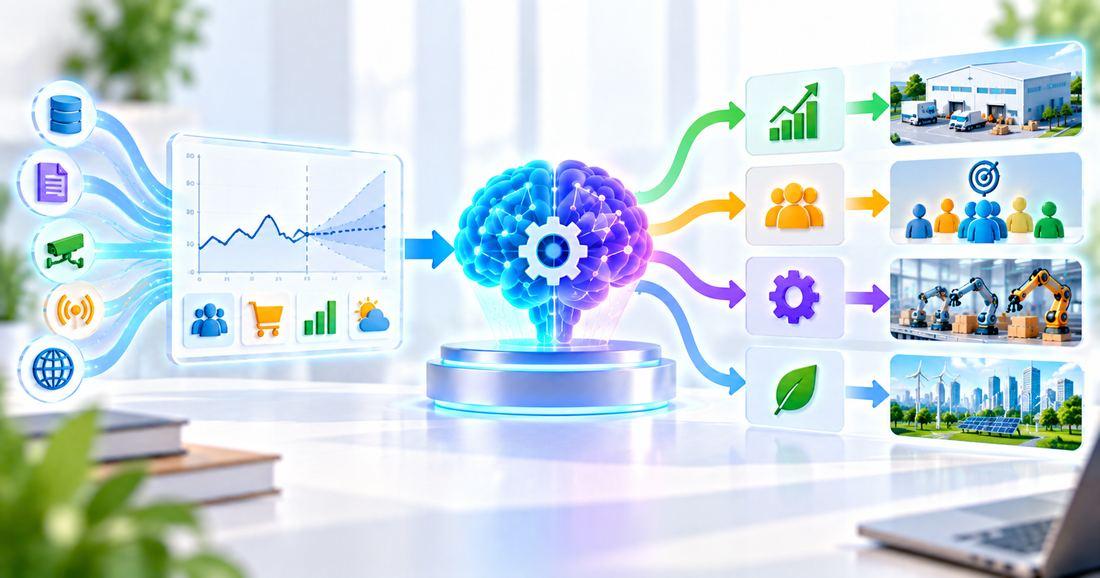
Section 1: Why Prediction Alone Is Not Enough for Real-World Decision-Making
Machine learning has become highly effective at answering predictive questions. Models can estimate whether a customer will churn, how much demand a product may receive, whether a transaction appears fraudulent, or how likely a machine is to fail. These predictions can be valuable, but prediction is only one part of a real-world decision.
Organizations ultimately need to determine what action should follow the prediction.
A forecast that demand will increase does not specify how much inventory should be ordered. A model predicting a high probability of equipment failure does not automatically determine whether the machine should be stopped, repaired immediately, or monitored until a scheduled maintenance window. A fraud score does not by itself decide whether a transaction should be blocked, reviewed, or allowed.
This gap between prediction and action is where prescriptive machine learning becomes important.
Prediction Does Not Contain the Decision
A predictive model estimates an outcome under some set of conditions. A decision system must compare possible actions and determine which one best satisfies the organization's objectives.
Suppose a retailer's model predicts that demand for a product will increase significantly during the next two weeks. Several responses may be possible. The company could increase production, purchase additional inventory, adjust pricing, redistribute stock among warehouses, or accept some level of shortage.
The prediction alone does not identify the optimal response.
Each action has consequences.
Increasing inventory may reduce stockouts but increase holding costs. Increasing production may improve availability but consume manufacturing capacity. Raising prices may reduce demand while improving margins. Redistributing inventory may solve a regional shortage but increase transportation costs.
The decision therefore depends on more than the predicted demand.
It depends on constraints, objectives, costs, risks, and available actions.
This is why prescriptive machine learning extends predictive systems rather than simply replacing them.
The Best Prediction Does Not Guarantee the Best Decision
A model can have excellent predictive accuracy and still support poor decisions.
Consider a demand forecasting system that predicts sales extremely well on average. A planner may use those predictions to determine inventory levels. If the forecast does not account for the financial cost of excess inventory, the operational cost of stockouts, warehouse capacity, or supplier constraints, the resulting decision can still be inefficient.
This distinction is fundamental.
Prediction quality measures how accurately the system estimates what may happen. Decision quality measures how effectively the system uses that information to determine what should happen next.
These are related but different objectives.
The principle is captured directly in “From Prediction to Decision: How Machine Learning Creates Business Value” Machine learning generates practical value when predictions are connected to actions and measurable outcomes rather than treated as the final output of the system.
Decisions Usually Involve Multiple Objectives
Real-world decisions rarely optimize a single metric.
A delivery system may want to minimize transportation cost while maintaining delivery-time commitments.
A hospital scheduling system may want to improve resource utilization while respecting staffing requirements and patient priorities.
A financial system may want to maximize expected return while controlling exposure to risk.
A manufacturing system may want to maximize production while minimizing downtime and operating within capacity constraints.
These competing objectives create a more difficult problem than simple prediction.
Prescriptive machine learning must therefore represent trade-offs explicitly.
An action that looks optimal from one perspective may be inferior when the complete objective function is considered.
Constraints Change What Is Possible
Many predictions are followed by decisions that must satisfy hard constraints.
A logistics system cannot assign more packages to a vehicle than its capacity allows. A scheduling system cannot assign one employee to two overlapping shifts. An infrastructure system may not be permitted to execute an operation without authorization. A manufacturing system may be unable to increase output beyond physical capacity.
These constraints are not statistical relationships that a model needs to discover.
They are conditions that the decision must satisfy.
This is one reason prescriptive machine learning often works alongside optimization algorithms, business rules, simulation, or other explicit decision mechanisms. The predictive model can estimate uncertain quantities, while the decision layer determines which actions remain feasible.
Uncertainty Makes Action Selection Harder
Predictions themselves are uncertain.
A model may estimate a 70% probability of customer churn, forecast a range of future demand, or assign several possible outcomes to a particular operational event.
A prescriptive system must determine how that uncertainty should influence the decision.
Should the system act conservatively because the cost of failure is high? Should it choose the action with the highest expected value? Should it gather additional information before acting?
These questions move the problem beyond predictive modeling and into decision intelligence.
The system needs to evaluate not only what is likely to happen, but also what could happen under different actions and how costly those outcomes would be.
Key Takeaway
Prediction provides an estimate of what may happen, but real-world organizations must decide what action to take in response. Prescriptive machine learning bridges this gap by combining predictions with objectives, constraints, uncertainty, costs, and possible interventions. The central shift is from forecasting outcomes to evaluating actions and their consequences, transforming machine learning from a prediction engine into a component of a broader decision-making system.
Section 2: How Prescriptive Machine Learning Turns Predictions Into Actions
Once a machine learning system can predict likely outcomes, the next challenge is deciding how those predictions should influence action. This is where prescriptive machine learning extends beyond conventional predictive analytics. Instead of treating the model's output as the final answer, a prescriptive system evaluates possible actions, estimates their consequences, applies constraints, and identifies an action that best aligns with the defined objective.
The architecture therefore connects several capabilities that are traditionally developed separately: predictive modeling, optimization, simulation, business rules, and decision analysis.
Start With a Clear Decision Problem
A prescriptive system should begin with the decision rather than the prediction.
Engineers first need to establish what action can actually be changed, which objectives matter, what constraints exist, and how success will be measured. The predictive model is then designed to provide the information required by that decision.
Consider an airline trying to manage cancellations. A machine learning model may estimate the probability that individual passengers will miss a flight. The prescriptive problem is different: which passengers should receive an intervention, what intervention should they receive, and how should limited resources be allocated?
Defining the action space first prevents teams from building accurate predictions that do not meaningfully improve the final decision.
Combine Predictions With Optimization
Optimization is one of the most common mechanisms for converting predictions into actions.
A predictive model estimates uncertain quantities such as demand, travel time, failure probability, or customer response. An optimization algorithm then searches for an action that maximizes or minimizes a defined objective while satisfying constraints.
A logistics system might predict delivery demand across thousands of locations and then optimize vehicle assignments.
A manufacturing system may predict equipment failures and optimize maintenance schedules around production requirements.
A retailer may forecast demand and optimize inventory allocation across warehouses.
In each case, the machine learning model supplies estimates, while the optimizer determines how those estimates should influence decisions.
This separation is powerful because the predictive model does not need to learn every operational constraint. The optimization layer can represent those constraints explicitly.
Objective Functions Define What “Best” Means
Prescriptive machine learning cannot determine the best action without knowing what the organization is trying to optimize.
A retailer may want to maximize profit.
A logistics company may want to minimize cost while maintaining delivery targets.
A healthcare operation may want to improve resource utilization while respecting capacity and scheduling constraints.
These objectives can conflict.
Increasing inventory may reduce stockouts but increase holding costs. Increasing staffing may improve service levels but increase labor expenses. Maximizing revenue may increase operational risk.
The objective function provides a formal way to represent these trade-offs.
This is one reason prescriptive systems require closer collaboration between machine learning engineers and domain experts. The mathematical objective must reflect the actual decision problem rather than an abstract model metric.
Hard Constraints and Soft Preferences
Not every requirement has the same status.
Some constraints are hard and cannot be violated. A delivery vehicle cannot exceed its physical capacity. A system cannot assign an employee to overlapping shifts. A financial workflow may require authorization before executing a transaction.
Other preferences are softer.
A planner may prefer to minimize overtime, reduce travel distance, or maintain balanced workloads, but small deviations may be acceptable.
Prescriptive systems can represent this distinction by treating certain conditions as mandatory constraints and others as optimization preferences.
This allows the system to produce solutions that are not merely mathematically attractive but operationally feasible.
Simulation Can Evaluate Possible Futures
Optimization is not the only tool available.
Simulation allows engineers to explore what might happen under different decisions before executing those decisions in the real world.
Suppose a manufacturing system is considering several maintenance schedules. A simulation can estimate how each schedule might affect downtime, production output, maintenance costs, and future failures.
The simulation can then provide evidence for the decision layer.
This becomes particularly useful when the relationship between an action and its outcome is too complex to represent through a simple mathematical equation.
Simulation can also allow organizations to explore scenarios that have limited historical data, although the quality of the decision still depends on how accurately the simulated environment represents reality.
Balancing Complexity With Business Value
A prescriptive architecture can become extremely sophisticated, combining multiple predictive models, optimization algorithms, simulations, causal models, and policy engines.
But greater complexity does not automatically produce better decisions.
A simpler decision rule may outperform a complicated system if the business problem is stable and well understood. Engineers should therefore evaluate whether every additional component generates measurable value.
This principle aligns with “Model Complexity vs Business Value: Finding the Right Level of ML” The appropriate architecture is the one that improves decisions sufficiently to justify its computational, operational, and maintenance costs.
Key Takeaway
Prescriptive machine learning turns predictions into actions by combining predictive models with optimization, objective functions, constraints, rules, simulation, and counterfactual reasoning. The strongest systems begin with a clearly defined decision problem, evaluate alternative actions rather than predictions alone, and learn from the outcomes of those actions over time. The central engineering challenge is connecting uncertainty in prediction with explicit business objectives and feasible real-world decisions.
Section 3: Designing Reliable Prescriptive ML Systems Under Real-World Constraints
A prescriptive machine learning system does more than generate predictions. It influences actions, allocates resources, and can change the environment it is attempting to model. This makes reliability particularly important. An inaccurate prediction is problematic, but an inaccurate prediction that automatically triggers a business decision can create much larger consequences.
Designing reliable prescriptive systems therefore requires engineers to consider prediction quality, decision quality, constraints, uncertainty, feedback loops, and operational controls together.
Start With a Reliable Prediction Layer
Prescriptive systems depend on predictions, so the quality of the underlying predictive models still matters.
A demand optimization system cannot produce sensible inventory decisions if its demand forecasts are systematically biased. A maintenance scheduler cannot make good decisions if failure probabilities are poorly calibrated. A pricing system can optimize aggressively around incorrect demand estimates and produce decisions that are theoretically optimal but operationally poor.
However, predictive accuracy alone is not sufficient.
The model must provide the type of information required by the decision layer. Point predictions may be insufficient when uncertainty is important. A decision system may instead need probability distributions, prediction intervals, quantiles, or scenario forecasts.
The representation of uncertainty should therefore match the decision problem.
Optimize for Decision Quality, Not Just Model Metrics
The predictive model should ultimately be evaluated based on how its outputs affect decisions.
A small improvement in forecast accuracy may have little operational value if it rarely changes the resulting decision. Conversely, a modest predictive improvement in a highly sensitive area can create substantial business impact.
Consider inventory management. Improving the forecast for a low-volume product may not materially change inventory decisions, while a small improvement for a high-demand product with tight capacity constraints could significantly affect costs.
This means prescriptive ML requires decision-centric evaluation.
Engineers should measure not only model metrics but also business outcomes produced after predictions are converted into actions.
Make Constraints Explicit
Real-world decisions operate within boundaries.
A transportation system cannot assign more deliveries to a vehicle than its capacity allows. A workforce planner cannot schedule someone during overlapping shifts. A cloud infrastructure system cannot allocate more resources than physically available. A financial process may require approval before a transaction can be executed.
These constraints should be represented explicitly wherever possible.
Trying to force a machine learning model to learn every hard constraint from historical examples can create unnecessary uncertainty. Explicit constraint handling provides stronger guarantees and makes the system easier to reason about.
This is a core principle of “How ML Teams Choose Between Rules, Statistics, and Machine Learning” Different parts of a decision problem require different computational approaches, and explicit rules or optimization constraints can be more appropriate than learned behavior when requirements are deterministic.
Handle Uncertainty Explicitly
Predictions are rarely certain, and prescriptive systems need to understand that uncertainty.
Suppose a model estimates that demand next month will be 10,000 units, but the realistic range could span from 7,000 to 14,000. An optimizer that treats 10,000 as perfectly certain may produce a plan that performs poorly when demand moves toward either extreme.
More robust systems can incorporate uncertainty into the decision process.
They may evaluate several scenarios, optimize expected outcomes, or explicitly penalize high-risk decisions.
The appropriate approach depends on the organization's risk tolerance.
A system responsible for critical infrastructure may favor conservative decisions, while a low-risk recommendation application may tolerate greater uncertainty.
Avoid Optimizing the Wrong Objective
A prescriptive system can produce mathematically correct decisions while still solving the wrong problem.
Suppose a delivery optimizer is instructed to minimize transportation cost without considering customer delivery commitments. The optimizer may produce a low-cost solution that results in unacceptable service levels.
The issue is not the optimization algorithm.
The objective function was incomplete.
This makes objective design one of the most important components of prescriptive ML.
Engineers must identify which outcomes matter, how competing priorities should be balanced, and what trade-offs the organization is willing to accept.
Account for Actions That Change the Data
Prescriptive systems can create feedback loops because their decisions influence future observations.
A pricing model changes prices, which changes demand.
A recommendation system changes what users see, which changes future interactions.
A maintenance system schedules repairs, which changes failure rates.
A retention system contacts selected customers, which affects subsequent churn behavior.
Historical data generated under one decision policy may therefore not accurately represent what will happen under a new policy.
This makes continuous monitoring and carefully designed experimentation important.
Teams need to distinguish between changes caused by the environment and changes caused by the system's own interventions.
Test Decisions Before Automating Them
A prescriptive model should not automatically control a real-world process immediately after development.
Historical backtesting can provide an initial evaluation. Simulation can allow engineers to test alternative decisions under controlled assumptions. Offline scenario analysis can expose cases where the recommended action violates practical expectations.
Shadow deployment is another useful approach.
The system can generate recommendations while existing operational processes continue making the actual decisions. Engineers can then compare proposed actions with real outcomes before granting the model greater authority.
This provides an additional layer of protection when consequences are significant.
Use Human Oversight Where Appropriate
Prescriptive ML does not always need full automation.
Some decisions can be executed automatically because they are low-risk and reversible. Others may require human approval because the consequences are significant or because the available information is incomplete.
A useful system can therefore present recommended actions along with the expected outcomes, constraints, and uncertainty associated with each option.
Human experts can review ambiguous cases while routine decisions continue automatically.
This creates a spectrum between fully manual and fully autonomous decision-making.
Monitor the Decision Layer
Traditional ML monitoring focuses on input drift, prediction distributions, and model performance. Prescriptive systems need additional monitoring of the decisions themselves.
Engineers may need to track how often recommendations are accepted, rejected, overridden, or modified. They can also monitor the business outcomes associated with different decision strategies.
A model may remain statistically stable while its recommended actions gradually become less effective because the environment has changed.
Decision-level monitoring can reveal this degradation earlier.
Build Safe Failure Modes
Every prescriptive system should define what happens when the model, optimizer, data pipeline, or external information source becomes unreliable.
The system may fall back to a previous decision policy, use a conservative rule set, pause automated execution, or request human intervention.
The appropriate fallback depends on the risk of failure, but the principle remains the same: uncertainty in an automated decision should lead to controlled behavior rather than uncontrolled action.
Key Takeaway
Reliable prescriptive ML requires more than accurate prediction. Engineers must evaluate decision quality, encode constraints explicitly, represent uncertainty, design appropriate objectives, account for feedback loops, test recommendations before automation, and monitor the decisions produced by the system. The strongest architectures combine machine learning with optimization, simulation, rules, human oversight, and safe fallback mechanisms so that automated decisions remain aligned with real-world objectives and constraints.
Section 4: Why Prescriptive Machine Learning Could Change the Future of AI-Driven Decisions
Machine learning has traditionally been evaluated through the quality of its predictions. As AI becomes increasingly integrated into business operations, however, the more important question may become what organizations can do with those predictions. A forecast, risk score, or probability is useful only when it helps someone or something make a better decision.
Prescriptive machine learning represents a shift toward systems that connect prediction directly to action.
Instead of stopping after estimating what is likely to happen, a prescriptive system evaluates possible interventions, considers constraints and trade-offs, and recommends what should happen next. This creates an opportunity to move machine learning from an analytical capability into an operational decision-making layer.
From Predictive Intelligence to Decision Intelligence
Predictive machine learning answers questions about likely future states.
Prescriptive systems extend that capability by evaluating possible responses to those states.
A demand model may predict that sales will increase. A prescriptive system can determine how much additional inventory should be ordered, where that inventory should be positioned, and when replenishment should occur.
A predictive-maintenance model may estimate that a machine has a high probability of failure. A prescriptive system can compare alternative maintenance schedules against production requirements, technician availability, replacement-part inventory, and expected downtime.
The difference is significant.
Prediction creates information.
Prescription creates an actionable decision.
This distinction could become increasingly important as organizations build AI systems intended to improve operational outcomes rather than simply produce analytical dashboards.
Prescriptive AI Can Connect More Parts of the Enterprise
Many organizations operate separate systems for forecasting, planning, optimization, workflow management, and execution. Prescriptive machine learning can provide a connecting layer between them.
A forecasting model can generate estimates.
An optimization engine can determine feasible actions.
A policy system can verify whether those actions are permitted.
A workflow platform can execute the approved decision.
The resulting architecture connects previously separate capabilities into a coordinated decision process.
This can reduce the gap between data science and operations because the output of machine learning is no longer an isolated score. It becomes an input into a measurable operational workflow.
Real-Time Decision-Making Will Become More Important
Many business environments change faster than humans can manually evaluate every decision.
Pricing systems respond to changing demand. Cloud infrastructure responds to changing workloads. Fraud systems evaluate transactions continuously. Logistics systems respond to traffic and inventory conditions. Recommendation systems adjust to rapidly changing user behavior.
Prescriptive machine learning can support these environments by continuously evaluating new information and updating recommendations.
The challenge is ensuring that the decision process remains stable and reliable.
A system that changes its recommendations every time a small prediction changes may create operational instability. Prescriptive systems therefore need mechanisms for controlling decision frequency, enforcing thresholds, and balancing responsiveness with consistency.
The Rise of Autonomous Decision Systems
As AI becomes more capable, some prescriptive systems may move from recommendations toward automated execution.
This could happen gradually.
Initially, a system might provide a recommendation to a human operator.
Later, the recommendation could be automatically approved for low-risk cases while higher-risk decisions remain under human review.
Eventually, narrowly defined decisions with well-understood constraints may become fully automated.
This creates a spectrum of autonomy rather than a simple distinction between manual and automated systems.
The appropriate level depends on the consequences of mistakes, reversibility, uncertainty, and the organization's risk tolerance.
Prescriptive Systems Must Learn From Their Own Decisions
One of the most interesting characteristics of prescriptive machine learning is that its actions can change the data used for future decisions.
A recommendation system influences what users click.
A pricing system influences demand.
A retention system influences customer behavior.
A maintenance system changes equipment failure patterns by preventing some failures.
This creates a feedback loop in which the system's previous decisions become part of the environment being modeled.
The problem is discussed more broadly in “The Challenge of Feedback Loops in Production Machine Learning” Prescriptive systems make this challenge especially important because they do not merely observe the environment; they actively intervene in it.
Future systems will therefore need to account for policy changes and intervention effects when learning from historical outcomes.
Causal Reasoning Could Become More Important
Prediction is often based on correlations observed in historical data.
Prescription requires stronger reasoning about consequences.
If a company changes a price, what is likely to happen?
If a hospital changes a scheduling policy, how will resource utilization change?
If a customer receives an intervention, does that actually reduce the probability of churn?
These questions are closer to causal inference than ordinary prediction.
As prescriptive machine learning develops, organizations may increasingly combine predictive models with experiments, causal inference, counterfactual modeling, and simulation to estimate the consequences of alternative actions.
The goal is not merely to identify relationships.
It is to understand what may happen because of an intervention.
Optimization Will Remain a Core Capability
Despite advances in machine learning, optimization is unlikely to disappear from prescriptive systems.
Many operational decisions involve explicit constraints and competing objectives that can be represented mathematically.
Machine learning can provide forecasts, probability estimates, demand distributions, or other uncertain inputs. Optimization can then determine an action that best satisfies the specified objective.
This division allows each technology to focus on its strengths.
Machine learning handles uncertainty and pattern recognition.
Optimization handles constrained decision selection.
The combination is particularly powerful for complex planning problems where simply predicting the most likely outcome would not be enough.
Key Takeaway
Prescriptive machine learning could change the future of AI by moving systems beyond prediction toward action-oriented decision intelligence. By combining predictive models with optimization, causal reasoning, simulation, constraints, and execution systems, organizations can build AI that not only estimates what may happen but evaluates what should happen next. As these systems become more autonomous, feedback loops, decision explainability, human oversight, and responsible control will become essential parts of the architecture.
Conclusion
Machine learning has traditionally been focused on prediction. Organizations build models to estimate demand, forecast failures, identify risks, predict customer behavior, or classify events. These capabilities are valuable, but prediction alone does not answer the operational question that ultimately matters: what should we do next?
Prescriptive machine learning addresses this gap by connecting predictions to decisions.
A predictive model estimates what is likely to happen. A prescriptive system evaluates possible actions in response to those predictions while considering objectives, constraints, uncertainty, costs, and potential consequences. This transforms machine learning from an analytical capability into a component of a broader decision-making system.
The distinction is important because the most accurate prediction does not automatically produce the best decision.
A demand forecast can be highly accurate while an inventory strategy remains inefficient. A machine learning model can correctly identify a high-risk machine while the resulting maintenance decision ignores production schedules or spare-part availability. A churn model can identify customers likely to leave while an intervention strategy fails to consider whether the proposed action actually changes customer behavior.
Prescriptive systems therefore need to optimize for decision quality, not simply predictive accuracy.
This requires combining multiple technologies.
Machine learning provides estimates about uncertain outcomes. Optimization algorithms can select actions under explicit constraints. Simulation can evaluate possible scenarios. Rules can enforce policies and hard boundaries. Causal methods can help estimate the consequences of interventions. Human oversight can provide additional judgment when decisions are ambiguous, high-risk, or difficult to reverse.
The resulting architecture is fundamentally different from a standalone predictive model.
It is a decision system.
One of the most important challenges is representing uncertainty correctly. Predictions are rarely certain, and an action that looks optimal under one forecast may perform poorly if the actual outcome falls elsewhere in the possible range. Prescriptive systems therefore need to consider uncertainty and risk rather than treating every prediction as a guaranteed future state.
Another challenge is that actions can change the environment.
A pricing system changes demand. A recommendation system changes user behavior. A maintenance system changes equipment reliability. A retention campaign changes customer outcomes.
This means prescriptive machine learning creates feedback loops. Historical data generated under one decision policy may not accurately predict the results of another policy. Future systems will therefore increasingly need experimentation, causal reasoning, counterfactual analysis, and careful monitoring of interventions.
Frequently Asked Questions
1. What is prescriptive machine learning?
Prescriptive machine learning combines machine learning predictions with decision-making techniques to recommend actions. It considers factors such as objectives, constraints, uncertainty, costs, and potential outcomes rather than stopping at a prediction.
2. How is prescriptive machine learning different from predictive machine learning?
Predictive machine learning estimates what is likely to happen. Prescriptive machine learning uses those predictions to evaluate possible actions and determine which response best aligns with a defined objective and real-world constraints.
3. What is prescriptive analytics?
Prescriptive analytics is the broader discipline of using data, predictive models, optimization, simulation, and analytical methods to recommend actions. Prescriptive machine learning is a machine-learning-oriented implementation of this decision-making approach.
4. Why is prediction alone not enough?
A prediction does not specify what action should follow. For example, forecasting higher demand does not determine how much inventory to order, where to place it, or how to balance stockout risk against holding costs.
5. How does optimization work with prescriptive machine learning?
A predictive model provides estimates such as demand, failure probability, or travel time. An optimization algorithm then uses those estimates to select an action while satisfying constraints such as capacity, budget, staffing, or timing.
6. What role do business rules play in prescriptive ML?
Business rules can enforce conditions that must be satisfied regardless of a model's prediction. They can define permissions, regulatory requirements, safety conditions, eligibility criteria, or operational boundaries.
7. What is the difference between prediction and decision-making?
Prediction estimates possible outcomes. Decision-making selects an action after considering those outcomes alongside objectives, constraints, costs, risk, and available alternatives.
8. Why is uncertainty important in prescriptive machine learning?
Predictions are uncertain. A decision based on a single point prediction may perform poorly when the actual outcome differs significantly. Prescriptive systems can account for uncertainty by evaluating ranges of outcomes, scenarios, probabilities, or risk levels.
9. What is counterfactual reasoning in prescriptive AI?
Counterfactual reasoning asks what might happen under an alternative action. Instead of asking only what happened historically, the system considers questions such as what would happen if action A were taken instead of action B.
10. Does prescriptive machine learning require causal inference?
Not always, but causal reasoning can be valuable when decisions involve interventions. If an organization's action can change the outcome being predicted, understanding the causal effect of that action can be more useful than relying solely on historical correlations.
11. Can prescriptive machine learning be used for supply-chain optimization?
Yes. Machine learning can forecast demand, delivery times, disruptions, or supplier behavior, while optimization algorithms can use those predictions to allocate inventory, schedule shipments, and manage resources under operational constraints.
12. Can prescriptive ML automate decisions completely?
Some decisions can be automated when they are well-defined, low-risk, and reversible. Higher-impact or uncertain decisions may require human approval. Prescriptive systems can therefore support different levels of automation depending on the application.
13. What are feedback loops in prescriptive machine learning?
A feedback loop occurs when the system's decisions influence future data. For example, a pricing decision changes customer demand, or a recommendation changes user behavior. This means future observations are partly created by previous system actions.
14. How should prescriptive ML systems be evaluated?
Evaluation should include both predictive and decision-level metrics. Engineers should examine prediction quality, feasibility, business outcomes, constraint violations, stability under uncertainty, intervention effects, and the performance of recommendations under realistic operating conditions.
15. What is the future of prescriptive machine learning?
Prescriptive machine learning is likely to become increasingly important as AI systems move toward action-oriented and semi-autonomous workflows. Future systems may combine prediction, optimization, causal reasoning, simulation, rules, retrieval, and execution capabilities to continuously evaluate what is happening, determine what could happen next, and select appropriate actions under real-world constraints.