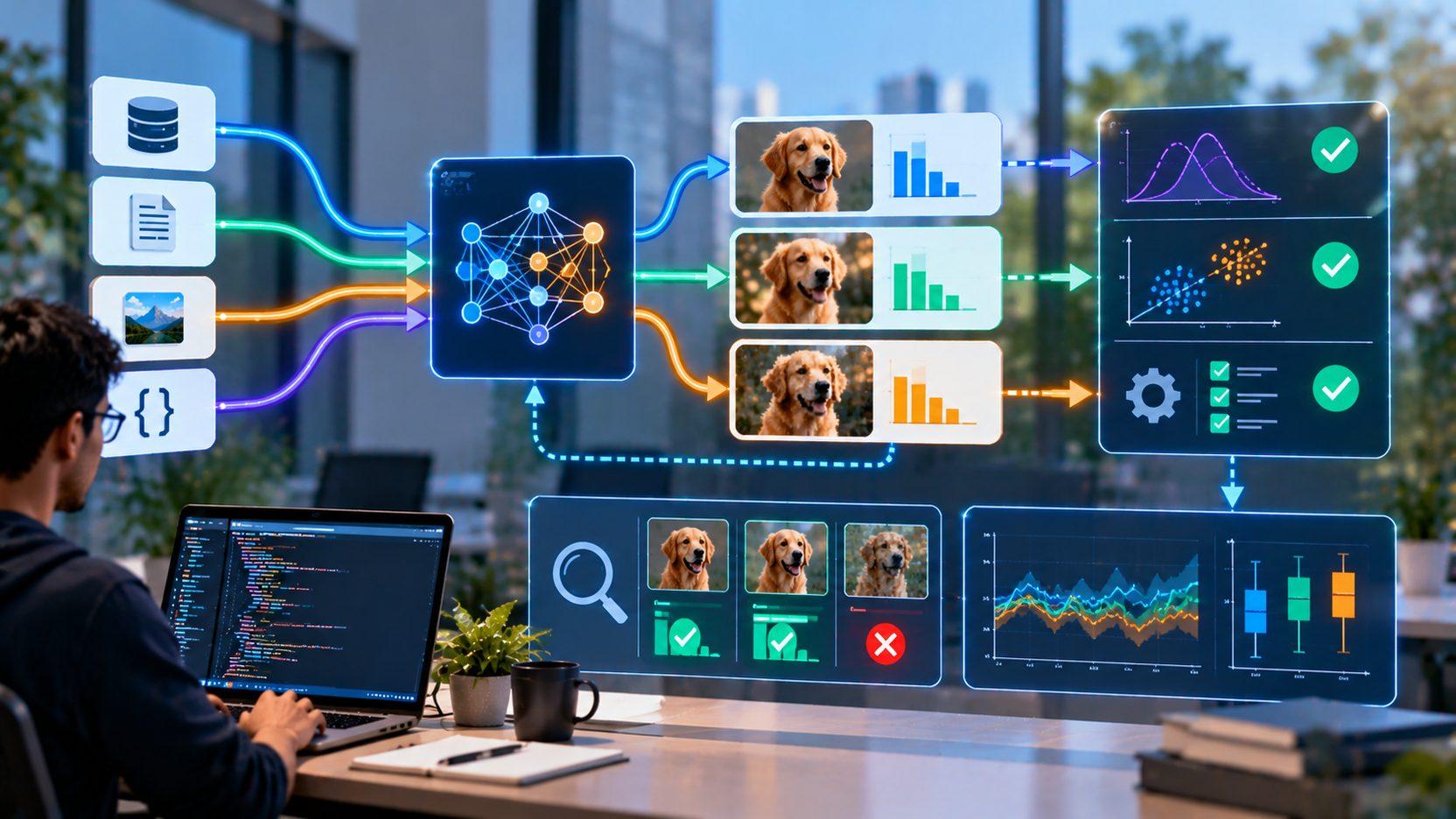

Section 1: Why Traditional Machine Learning Creates Privacy Risks
Machine learning depends on data, and some of the most valuable datasets are also the most sensitive. Healthcare organizations process clinical records, financial institutions analyze transactions, enterprises manage customer and employee information, and connected devices continuously generate behavioral and operational signals. These datasets can enable powerful machine learning applications, but the traditional approach of collecting and centralizing data introduces significant privacy risks.
A conventional machine learning workflow often assumes that data can be gathered from multiple sources, copied into a centralized environment, cleaned, transformed, and used for training. This approach simplifies model development because engineers can work with a unified dataset. However, centralization also creates a concentrated location where sensitive information must be stored, accessed, processed, and protected.
Privacy-preserving machine learning challenges this architecture by asking whether useful models can be trained while minimizing unnecessary exposure of the underlying data.
Centralized Data Creates a Larger Exposure Surface
When sensitive information is copied into a centralized training environment, several systems may gain access to it. Data pipelines, storage platforms, preprocessing jobs, experimentation environments, and training infrastructure can all become potential points of exposure.
The risk is not limited to external attackers.
Internal permissions, accidental misconfiguration, excessive data access, insecure development environments, or unnecessary copies can also increase exposure.
The more places sensitive data exists, the more difficult it becomes to maintain strict control over that information.
This creates an architectural tension.
Machine learning benefits from centralized access to data, while privacy engineering generally favors minimizing unnecessary data movement and access.
Privacy-preserving techniques attempt to reduce that tension by changing where computation happens and what information needs to leave its original environment.
Sensitive Data Can Be Revealed Through More Than Raw Records
Protecting the original dataset is important, but machine learning introduces additional privacy considerations.
A model trained on sensitive records can potentially encode information from those records. Depending on the model, training procedure, and access to the resulting system, attackers or unauthorized users may attempt to infer information about the training population.
This means deleting the original data after training does not necessarily eliminate every privacy concern.
Model parameters, gradients, embeddings, intermediate representations, and outputs can all become part of the privacy analysis.
For example, a model that has memorized unusual or highly specific examples may behave differently when presented with those examples or closely related inputs. This creates potential information leakage even when users never receive direct access to the training database.
Privacy-preserving machine learning therefore treats the entire learning pipeline as part of the privacy problem.
Multiple Organizations May Need to Collaborate
Some of the most valuable machine learning applications require data from multiple organizations.
Several hospitals may want to improve a model using broader clinical experience. Financial institutions may benefit from detecting patterns that span multiple transaction networks. Organizations operating the same type of infrastructure may want to learn from shared failure patterns.
However, these organizations may not be willing or permitted to transfer their raw datasets to one another.
This creates a fundamental collaboration problem.
Each participant has useful information, but the data cannot simply be pooled into one central repository.
Federated and cryptographic approaches provide ways to explore this type of collaboration by allowing computation to occur closer to where the data resides or by limiting what participants can observe during training.
The broader objective is to share learning without necessarily sharing raw data.
Privacy and Data Utility Can Conflict
Privacy protection is not free.
Techniques designed to prevent sensitive information from being inferred can sometimes reduce model utility or increase computational requirements.
For example, adding statistical noise can make it harder to identify individual contributions, but excessive noise can also make it harder for the model to learn useful patterns.
Cryptographic protection can reduce the visibility of data during computation, but encrypted operations may require substantially more computation than conventional operations.
Distributed training can reduce centralized data exposure, but it creates additional communication and coordination requirements.
This means privacy-preserving machine learning is fundamentally a trade-off between privacy, utility, performance, and cost.
Engineers need to identify the level of privacy protection required for a particular application rather than assuming that the strongest possible mechanism is automatically the best production solution.
Data Minimization Becomes an Engineering Principle
Traditional machine learning pipelines sometimes collect more data than the model ultimately requires because additional information may appear useful during experimentation.
Privacy-aware engineering encourages a different mindset.
Teams should ask which data is actually required for the intended task, how long it needs to be retained, who needs access to it, and whether the same objective can be achieved with less sensitive information.
Data minimization can reduce both privacy exposure and infrastructure requirements.
It can also simplify governance because fewer sensitive fields and fewer copies need to be controlled.
This connects with the broader principle in “When Machine Learning Should Not Be Used: A Guide to Better Technical Decisions” Privacy should be considered alongside technical feasibility and business value when deciding how a machine learning system should be designed, rather than being treated as an issue after the model architecture has already been selected.
Key Takeaway
Traditional machine learning creates privacy risks because centralized data collection increases exposure, while trained models and intermediate artifacts can also reveal information beyond the original records. Sensitive data may need to be analyzed across organizations or devices without being directly shared, creating a need for architectures that separate learning from raw-data exposure. Privacy-preserving machine learning addresses this challenge through data minimization, distributed computation, protected training, and privacy-aware inference, while balancing privacy guarantees against model utility, performance, and cost.
Section 2: How Privacy-Preserving Techniques Let Models Learn Without Centralizing Sensitive Data
Privacy-preserving machine learning changes the traditional assumption that all training data must be collected in one place. Instead of moving sensitive records into a centralized repository and giving a training system direct access to them, privacy-preserving approaches change where computation happens, what information is shared, and how much individual information can be inferred from the learning process.
Several techniques can be used to achieve this, including federated learning, differential privacy, secure multiparty computation, homomorphic encryption, and trusted execution environments. These approaches solve different parts of the privacy problem and can also be combined to provide stronger protection.
Federated Learning Keeps Raw Data at Its Source
Federated learning is one of the most practical approaches to privacy-aware model training.
Instead of sending raw data to a central server, each participating device or organization trains a model locally using its own data. The participants then send selected model updates to a coordinating system, which aggregates those updates into a shared model.
For example, several hospitals could collaboratively train a diagnostic model while keeping patient records within their own environments. A mobile application could similarly learn from user behavior without continuously transferring individual activity records to a central training database.
The key architectural change is straightforward:
The model moves to the data instead of the data moving to the model.
However, federated learning does not automatically guarantee privacy. Model updates can themselves contain information about local training data. Additional protections such as secure aggregation or differential privacy may therefore be required.
Federated learning also introduces practical challenges around communication costs, unreliable participants, inconsistent data distributions, and coordinating updates across many devices or organizations.
Differential Privacy Limits Individual Information Leakage
Differential privacy takes a different approach.
Instead of primarily changing where computation occurs, it mathematically limits how much the output of a data-analysis process can reveal about any individual record.
Noise is introduced into the computation in a controlled manner so that the presence or absence of a particular person's data has limited influence on the released result.
In machine learning, differential privacy can be incorporated into the training process. One widely used strategy limits the influence of individual training examples on model updates and then adds carefully calibrated noise.
The result is a formal privacy guarantee under a defined privacy budget.
The trade-off is important.
Too little protection may leave unacceptable privacy risk. Too much noise can reduce model utility.
Engineers therefore need to determine an appropriate privacy-utility balance for the specific application rather than treating differential privacy as a binary feature.
Secure Aggregation Protects Federated Updates
In federated learning, a central server may need to combine model updates from many participants.
A privacy concern arises if the server can inspect each participant's update individually.
Secure aggregation addresses this by enabling the system to calculate an aggregate result without exposing the individual contributions to the coordinating server.
The server can obtain the combined update while remaining unable to inspect the contribution of a particular participant.
This is especially useful when individual data sources are sensitive and organizations are willing to contribute to collective model training but do not want their updates exposed to other participants.
Secure aggregation can therefore strengthen federated learning without requiring raw data centralization.
Secure Multiparty Computation Enables Joint Computation
Secure multiparty computation, or MPC, takes privacy protection further by allowing multiple parties to jointly compute a function while limiting what any individual participant can learn about the others' private inputs.
Imagine several organizations want to calculate a joint statistical quantity or contribute to a collaborative machine learning process without revealing their underlying datasets.
MPC protocols can allow that computation to occur through cryptographic mechanisms.
The major advantage is strong protection against direct data exposure.
The trade-off is computational complexity.
Cryptographic operations can be significantly more expensive than ordinary computation, making MPC challenging for large-scale machine learning workloads unless the computation and protocol are carefully optimized.
The Privacy-Utility Trade-Off
One of the defining challenges of privacy-preserving machine learning is balancing protection with model usefulness.
Differential privacy may reduce leakage while also reducing the statistical signal available during training. Federated learning can improve data locality while increasing communication and coordination overhead. Cryptographic techniques can protect computation while increasing latency and compute requirements.
This creates a multidimensional engineering trade-off involving privacy, accuracy, scalability, cost, latency, and operational complexity.
Teams need to define acceptable privacy guarantees first and then evaluate which architecture provides those guarantees at an acceptable performance level.
This broader systems perspective connects with “The Reproducibility Crisis in Machine Learning: What Engineering Teams Can Do” Privacy-preserving training introduces additional distributed and cryptographic components, making reproducibility, configuration management, and consistent evaluation even more important.
Key Takeaway
Privacy-preserving machine learning uses techniques such as federated learning, differential privacy, secure aggregation, secure multiparty computation, homomorphic encryption, and trusted execution environments to reduce exposure of sensitive data during model development and deployment. Each approach provides different protections and introduces different costs, so effective systems often combine several mechanisms based on their privacy, accuracy, latency, scalability, and infrastructure requirements. The key principle is to protect the entire learning lifecycle rather than treating privacy as a feature of the training algorithm alone.
Section 3: Designing Privacy-Preserving ML Systems for Real-World Production
Privacy-preserving machine learning becomes significantly more difficult when a model moves from an experimental environment into production. A prototype may successfully demonstrate that data can remain distributed or that a privacy mechanism can be applied during training. A production system must solve a much larger problem: protecting sensitive information across data collection, preprocessing, training, communication, model storage, inference, monitoring, and eventual deletion.
The central engineering challenge is to make privacy part of the system architecture rather than treating it as an additional control added after the model has already been built.
Start With a Clear Privacy Threat Model
Before selecting a privacy-preserving technique, engineers need to determine what information must be protected, from whom it must be protected, and during which stages of the machine learning lifecycle.
A healthcare system may need to protect individual patient records from other participating institutions. An enterprise may want to prevent a cloud provider from accessing proprietary training data. A mobile application may need to reduce exposure of individual user activity.
These are different threat models.
A privacy mechanism that is appropriate for one scenario may not provide the required protection in another.
Engineers therefore need to identify potential observers, attack surfaces, trusted parties, and privacy guarantees before deciding whether federated learning, differential privacy, encryption, trusted execution, or a combination of methods is appropriate.
Minimize Data Before Protecting It
Privacy-preserving technology should not become an excuse to collect unnecessary information.
Data minimization remains one of the most effective privacy strategies because information that is never collected does not need to be protected.
Engineers should evaluate which fields are actually required for the learning objective, whether sensitive attributes can be removed or transformed, and how long different information needs to be retained.
This can simplify the privacy architecture and reduce storage, processing, and governance requirements at the same time.
The principle becomes particularly important in machine learning because experimentation can encourage teams to retain large numbers of features simply because they might become useful later.
Keep Sensitive Data Close to Its Source
When practical, production architectures can minimize unnecessary movement of raw data.
Federated learning is a common example. Individual organizations or devices retain their data locally while participating in a shared training process.
This architecture can reduce centralization risk, but it introduces another important requirement: the local environments must be capable of executing the training process securely and consistently.
Local systems may differ in hardware, software versions, network availability, data volume, and schema.
The training process therefore needs strong coordination without requiring centralized control over the underlying raw records.
Protect the Communication Layer
Privacy does not end when raw data remains local.
Distributed machine learning systems exchange information. That information may include model updates, gradients, metrics, or other intermediate representations.
Engineers need to determine whether these artifacts themselves could reveal sensitive information.
Secure communication protects information while it is transmitted, but transport encryption alone does not guarantee privacy. A central server may still be able to inspect individual model updates after receiving them.
This is why techniques such as secure aggregation can be important in federated architectures.
The broader system should minimize what any individual participant or coordinating service can observe.
Manage Privacy Budgets and Repeated Access
When differential privacy is used, privacy protection must be managed across repeated analyses and model updates.
A privacy mechanism typically operates under a defined budget that reflects how much information can be released while maintaining the intended guarantee. Repeated queries or repeated training procedures can consume that budget.
This creates an operational challenge.
A model may initially satisfy a privacy target but gradually weaken the effective guarantee if an organization releases many related outputs without tracking cumulative exposure.
Production systems therefore need mechanisms for accounting, policy enforcement, and monitoring of privacy expenditure.
Privacy should be treated as a measurable resource rather than a one-time configuration setting.
Test for Leakage Before Deployment
Privacy evaluation should include deliberate attempts to identify whether sensitive information can be inferred from the trained system.
Depending on the threat model, testing can examine membership inference, reconstruction risks, model-update exposure, or leakage through outputs and embeddings.
The objective is not to assume that a theoretical privacy mechanism automatically eliminates every practical risk.
Security and privacy testing should validate how the complete implementation behaves.
This complements the broader reliability principles discussed in “Failure Modes of Modern AI Systems and How Engineers Prevent Them” Privacy should be tested as an operational property of the complete AI system, including its interfaces and supporting infrastructure.
Key Takeaway
Production privacy-preserving machine learning requires more than selecting a privacy technique. Engineers need a clear threat model, data minimization, controlled data locality, protected communication, privacy accounting, secure operational tooling, privacy-aware inference, leakage testing, versioned controls, and safe failure behavior. The strongest systems embed privacy throughout the machine learning lifecycle so that sensitive information is protected not only during training, but across the entire path from data collection to production inference.
Section 4: Why Privacy-Preserving Machine Learning Will Shape the Future of AI
Artificial intelligence is increasingly being built around data that organizations cannot freely centralize or share. Healthcare, finance, enterprise operations, connected devices, and consumer applications all generate information where privacy is not merely a policy consideration but a fundamental architectural constraint.
As AI systems become more dependent on larger and more diverse datasets, the ability to learn from sensitive information without unnecessarily exposing it could become a major differentiator in how machine learning systems are designed.
This is why privacy-preserving machine learning is likely to become an increasingly important part of AI infrastructure.
Privacy Could Become a Design Requirement
Traditional machine learning architectures often begin with a simple assumption: collect the required data, move it into a centralized environment, and train the model.
Privacy-preserving approaches challenge that assumption by making data locality, access, and exposure part of the architecture from the beginning.
Instead of asking how to protect a centralized dataset after it has been created, engineers can ask whether that dataset needs to be centralized at all.
This can lead to fundamentally different designs.
Data may remain within individual institutions or devices. Computation can be performed closer to the source. Only aggregated information may leave local environments. Cryptographic mechanisms can restrict what participating systems can observe.
This changes privacy from a governance layer into an engineering constraint.
Collaborative AI Could Expand Without Centralized Data
One of the most significant opportunities is collaborative machine learning.
Organizations often possess complementary data but cannot simply combine it. Multiple hospitals may have different patient populations. Financial institutions may observe different transaction patterns. Enterprises may operate different infrastructures while encountering related operational problems.
Privacy-preserving techniques can allow these organizations to contribute to shared learning while maintaining stronger control over their underlying datasets.
Federated learning is particularly relevant here, but the broader concept extends beyond any one technique.
The objective is to create shared model intelligence without requiring unrestricted data sharing.
This could enable machine learning applications that are currently difficult because useful information is fragmented across organizational boundaries.
Edge AI Makes Privacy More Distributed
The expansion of AI to phones, cameras, industrial devices, vehicles, and other edge environments creates another important privacy opportunity.
When computation occurs locally, raw information may not need to be continuously transmitted to centralized infrastructure.
A device can process sensitive information locally and send only the information required for a broader service.
For example, a device could perform local feature extraction or model inference while minimizing transmission of raw personal or operational data.
This can reduce data movement, although local processing does not automatically eliminate privacy risks. Devices still need secure storage, access controls, protected software, and carefully designed communication channels.
The architecture simply creates another opportunity to minimize unnecessary exposure.
Privacy-Preserving AI Could Support More Data Collaboration
Privacy constraints can sometimes prevent organizations from using data that would otherwise be valuable for machine learning.
Privacy-preserving methods can change the economics of collaboration by making certain forms of shared learning technically possible without requiring unrestricted access to raw datasets.
This could be especially important in domains where data is both highly valuable and highly sensitive.
The value proposition is therefore not limited to privacy protection.
Privacy-preserving infrastructure can potentially expand the usable data ecosystem available to machine learning.
More organizations may be able to participate in collaborative models because the architecture provides stronger controls over what information is exposed.
Privacy Will Become Part of Model Evaluation
Traditional model evaluation focuses on predictive quality, latency, cost, and related metrics.
Privacy-preserving machine learning introduces another dimension.
A model may need to satisfy a defined privacy guarantee while maintaining acceptable utility.
This means teams increasingly need to evaluate models across multiple dimensions simultaneously.
How much predictive performance is lost?
What computational overhead does the privacy mechanism introduce?
How much communication is required?
What information can participants observe?
How does repeated model use affect privacy?
These questions make privacy part of system-level model evaluation rather than a separate compliance exercise.
This broader trade-off aligns with “The Economics of Machine Learning: Measuring the True Cost of a Model” The practical cost of an AI system can include not only compute and infrastructure, but also the engineering and operational requirements necessary to achieve appropriate privacy protection.
Key Takeaway
Privacy-preserving machine learning could shape the future of AI by enabling organizations and devices to learn collaboratively while reducing unnecessary exposure of sensitive information. Federated learning, differential privacy, cryptographic techniques, trusted execution, local inference, and layered privacy controls can support new forms of AI collaboration across organizational and technical boundaries. The long-term goal is not simply to protect data after it has been centralized, but to redesign machine learning so useful intelligence can be created with substantially less exposure of the underlying sensitive information.
Conclusion
Privacy-preserving machine learning is becoming increasingly important because some of the most valuable datasets available to AI systems are also among the most sensitive.
Healthcare records, financial transactions, customer information, employee data, proprietary enterprise information, and device-generated behavioral signals can provide powerful learning opportunities. At the same time, centralizing and processing these datasets can create significant privacy, security, governance, and operational challenges.
The traditional machine learning workflow assumes that data can be collected and moved into a common training environment. Privacy-preserving machine learning challenges that assumption by asking a more fundamental question:
Can useful machine learning be performed while minimizing unnecessary exposure of sensitive data?
This shift leads to a different way of designing AI systems.
Federated learning can keep raw data within local environments while allowing multiple participants to contribute to a shared model. Differential privacy can limit the influence that any individual record has on released results. Secure aggregation can protect individual model updates while allowing collective computation. Secure multiparty computation and homomorphic encryption can provide cryptographic protections for certain collaborative computations, while trusted execution environments can isolate sensitive workloads within protected hardware environments.
Each technique addresses a different part of the privacy problem.
None should be treated as a universal solution.
Privacy-preserving machine learning involves trade-offs among privacy, model utility, computational cost, communication overhead, scalability, latency, and implementation complexity. Adding stronger privacy protections can sometimes reduce predictive performance or increase infrastructure requirements.
This makes privacy engineering an optimization problem.
The objective is not necessarily to maximize privacy mechanisms regardless of cost. It is to achieve the privacy guarantees required by the application while preserving enough model utility and operational performance to make the system practical.
One of the most important principles is that privacy must be considered across the entire machine learning lifecycle.
Sensitive information can be exposed during collection, preprocessing, training, communication, model storage, debugging, logging, monitoring, inference, or data retention. Protecting only the training algorithm does not guarantee privacy for the complete system.
A federated learning architecture, for example, may keep raw data on local devices while still exposing information through model updates or operational logs. Similarly, a privacy-aware training process can still be undermined if a production API returns unnecessarily detailed outputs or stores sensitive inference inputs.
This is why a strong privacy architecture begins with a clear threat model.
Engineers need to understand what information must be protected, who should not be able to access it, which components are trusted, and what information is allowed to leave the original environment.
Frequently Asked Questions
1. What is privacy-preserving machine learning?
Privacy-preserving machine learning refers to techniques and architectures that allow machine learning models to be trained or used while reducing unnecessary exposure of sensitive information. Approaches include federated learning, differential privacy, secure aggregation, cryptographic computation, and trusted execution environments.
2. Why is privacy important in machine learning?
Machine learning often uses highly sensitive information, including health records, financial data, customer information, employee records, and behavioral data. Privacy-preserving approaches can reduce the amount of sensitive information that needs to be centralized or exposed during training and inference.
3. Does privacy-preserving machine learning mean raw data never leaves the device?
Not necessarily. Some approaches, such as federated learning, are specifically designed to keep raw data local, while other approaches protect data through cryptographic or hardware-based mechanisms. The architecture depends on the privacy requirements and threat model.
4. What is federated learning?
Federated learning is a distributed machine learning approach in which participating devices or organizations train models using their local data and share model updates rather than directly sharing their raw datasets. A coordinating system can aggregate those updates into a shared model.
5. Does federated learning guarantee privacy?
No. Federated learning reduces the need to centralize raw data, but model updates or other training artifacts can potentially reveal information. Additional protections, such as secure aggregation or differential privacy, may be needed depending on the threat model.
6. What is differential privacy?
Differential privacy is a mathematical framework designed to limit how much the output of a data-analysis process can reveal about any individual record. In machine learning, controlled noise can be introduced so that individual contributions have limited influence on released information.
7. What is secure aggregation?
Secure aggregation is a technique often used with federated learning that allows a central system to obtain an aggregate of participants' model updates without learning the individual update contributed by each participant.
8. What is homomorphic encryption?
Homomorphic encryption enables certain computations to be performed on encrypted data without first decrypting it. This can allow a computing system to process protected information while limiting its ability to access the underlying plaintext.
9. What is secure multiparty computation?
Secure multiparty computation allows multiple parties to jointly compute a result while limiting what each participant can learn about the others' private inputs. It can support collaborative computation where direct data sharing is undesirable.
10. What are trusted execution environments?
Trusted execution environments are hardware-supported isolated environments designed to protect sensitive code and data during computation. They can provide a protected execution boundary for machine learning workloads under specific hardware and trust assumptions.
11. Does privacy-preserving machine learning reduce model accuracy?
It can. Some privacy mechanisms introduce noise, restrict available information, or create distributed-training constraints that affect model utility. The impact depends on the technique, privacy requirements, model architecture, and dataset.
12. What is the privacy-utility trade-off?
The privacy-utility trade-off describes the relationship between the level of privacy protection and the usefulness of the resulting machine learning system. Stronger protection can sometimes require additional noise, computation, or restrictions that reduce predictive performance or increase cost.
13. Can multiple organizations train a model without sharing their raw data?
Yes. Federated learning and other privacy-preserving approaches can allow multiple organizations to contribute to collaborative machine learning while reducing the need to exchange raw datasets directly. The appropriate architecture depends on the privacy and security requirements of the participants.
14. What are the biggest challenges of privacy-preserving machine learning?
Major challenges include defining the threat model, balancing privacy and accuracy, managing computational and communication overhead, preventing leakage through model updates and outputs, securing operational tooling, maintaining reproducibility, and ensuring privacy across the complete machine learning lifecycle.
15. What is the future of privacy-preserving machine learning?
Privacy-preserving techniques are likely to become increasingly integrated into AI infrastructure, particularly for healthcare, finance, enterprise AI, edge computing, collaborative learning, and AI agents. Future systems may combine federated learning, differential privacy, secure aggregation, encryption, trusted execution, local inference, and conventional security controls to make sensitive-data machine learning more practical without requiring unrestricted data centralization.