Section 1: From Rule-Based Software to Intelligent Systems
For decades, software development followed a relatively predictable philosophy. Developers analyzed business requirements, translated them into logical rules, implemented those rules through programming languages, tested the resulting application, and deployed it into production. Every user interaction was anticipated by engineers, every workflow was explicitly defined, and every decision the software made originated from conditions carefully written into the source code. This deterministic approach powered everything from operating systems and banking applications to e-commerce platforms and enterprise resource planning software. It enabled organizations to automate repetitive processes, improve operational efficiency, and scale digital services across increasingly connected environments.
Although this approach remains foundational to modern computing, it also exposes significant limitations in an increasingly dynamic world. Today's organizations generate enormous volumes of structured and unstructured data, customer expectations evolve continuously, business environments change rapidly, and digital interactions have become significantly more complex than traditional rule-based systems were designed to handle. Software can no longer rely solely on predefined logic when users expect applications to understand natural language, recognize context, anticipate needs, personalize experiences, and assist with complex decision-making. These evolving expectations are driving one of the most profound transformations in the history of software engineering: the evolution from deterministic software toward intelligent systems capable of reasoning, learning, and adapting.
Artificial intelligence provides the missing layer that enables this transformation. Rather than replacing traditional software engineering, AI extends it by introducing probabilistic reasoning alongside deterministic logic. Conventional software remains responsible for ensuring reliability, security, governance, compliance, and transactional consistency, while artificial intelligence contributes contextual understanding, pattern recognition, language comprehension, predictive analysis, and adaptive decision-making. Together, these capabilities create applications that not only execute instructions but also interpret intent, respond intelligently to changing conditions, and continuously improve the quality of user interactions. This convergence represents the foundation of AI-native software and defines the direction in which the software industry is rapidly moving.
The Evolution from Traditional Applications to AI-Native Software
Understanding this transformation begins with examining the evolution of software engineering. Early software systems focused primarily on automation. Applications performed repetitive calculations, stored information, processed transactions, and enforced predefined business rules with exceptional reliability. As computing advanced, object-oriented programming, web technologies, cloud computing, DevOps, and microservices enabled software to become increasingly modular, scalable, and interconnected. Despite these advances, the underlying philosophy remained largely unchanged. Software executed exactly what developers instructed it to do and nothing more. Every possible outcome had to be anticipated during development because the application possessed no ability to reason beyond its programmed logic.
These constraints became increasingly evident as digital ecosystems grew more sophisticated. Traditional software limitations emerged whenever applications encountered ambiguity, incomplete information, rapidly changing environments, or natural human communication. Search systems relied heavily on keyword matching instead of understanding intent. Customer support platforms struggled with nuanced conversations because workflows followed rigid decision trees. Enterprise software required users to navigate numerous menus and configuration screens rather than interacting conversationally. Business analytics platforms generated dashboards but rarely interpreted trends or recommended actions. While these systems successfully automated structured processes, they lacked the cognitive capabilities necessary to support modern knowledge work.
Artificial intelligence fundamentally changes these capabilities by enabling AI-powered applications that augment deterministic logic with intelligent reasoning. Large Language Models, machine learning algorithms, computer vision systems, and multimodal AI allow applications to understand human language, analyze complex relationships, summarize large documents, generate software, recommend solutions, identify anomalies, and automate sophisticated business processes. Instead of requiring users to adapt their behavior to software interfaces, AI-powered applications increasingly adapt to users by interpreting requests naturally and providing contextually appropriate responses. This shift dramatically reduces friction while making software substantially more accessible and productive across diverse industries.
Readers interested in understanding how this evolution is reshaping engineering organizations should also explore "Why Every Software Team Will Have an AI Engineer by 2030," which examines how AI-native development is creating entirely new engineering roles and transforming the structure of modern software teams.
Key Takeaway
The future of software lies in the transition from deterministic, rule-based applications to intelligent systems capable of understanding context, personalizing experiences, supporting decision-making, predicting outcomes, and continuously adapting to changing environments. AI-powered applications are redefining enterprise software by combining traditional engineering reliability with artificial intelligence, creating a new generation of software that functions not merely as a tool but as an intelligent collaborator capable of driving innovation, productivity, and long-term business transformation.
Section 2: How AI Is Transforming Software Development
The evolution of artificial intelligence is changing far more than the software products organizations deliver, it is fundamentally reshaping how software itself is created. For decades, software development followed a well-established lifecycle. Product managers gathered requirements, architects designed system structures, developers translated specifications into source code, quality assurance teams tested functionality, operations engineers deployed applications, and maintenance teams resolved issues after release. Although Agile methodologies, DevOps practices, cloud-native architectures, and continuous integration significantly accelerated delivery, the underlying process remained largely dependent on human effort. Every feature, bug fix, architectural decision, test case, deployment pipeline, and documentation update required engineers to manually execute numerous repetitive tasks throughout the software development lifecycle.
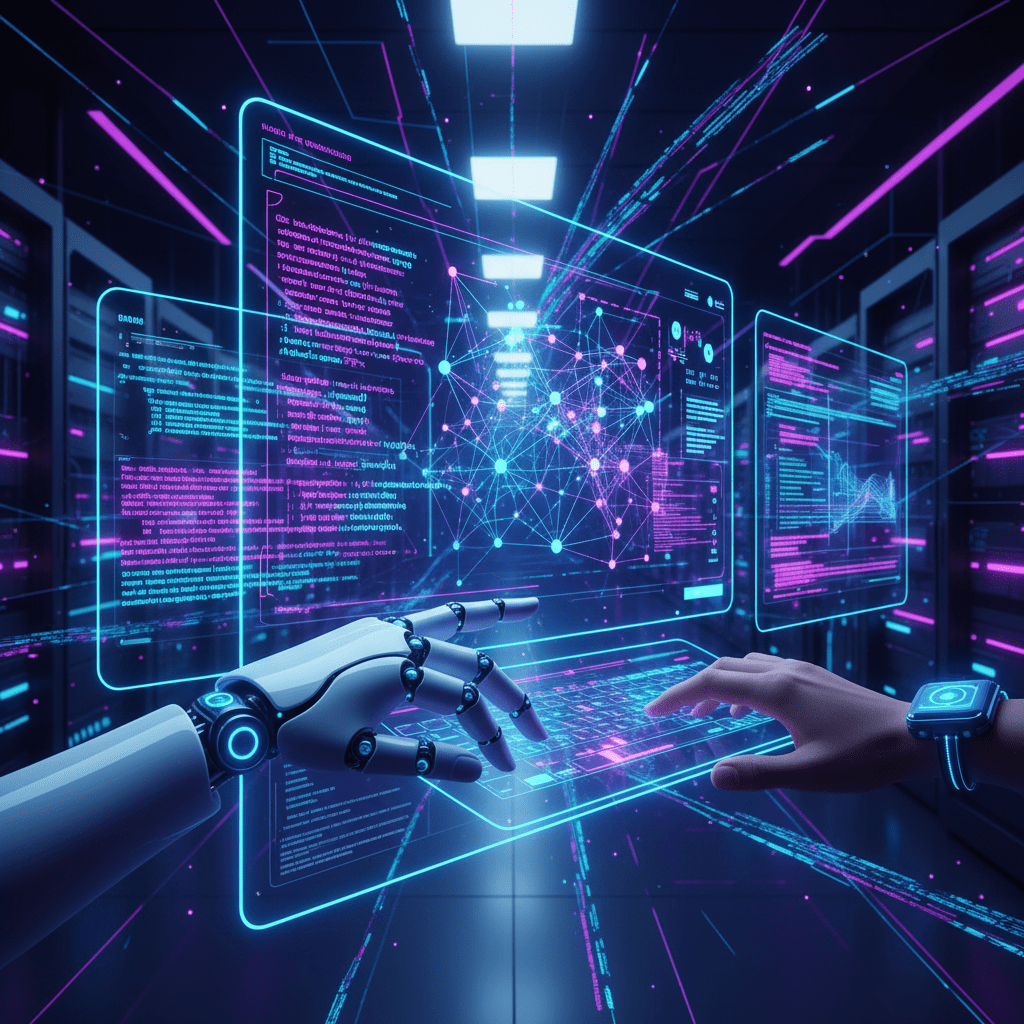
Artificial intelligence is fundamentally altering this paradigm by introducing intelligent automation into nearly every stage of engineering. Rather than functioning solely as coding assistants that generate snippets of source code, modern AI systems increasingly participate in software architecture, requirements analysis, testing, documentation, deployment, debugging, optimization, maintenance, and operational decision-making. Engineering teams are beginning to collaborate with AI throughout the development process, allowing human expertise to focus on higher-level design, product strategy, architectural thinking, and business innovation while intelligent systems automate repetitive implementation activities. The result is a software development model where engineers and artificial intelligence work together continuously instead of operating independently.
This transformation extends beyond productivity improvements. AI is changing the very nature of software engineering by enabling systems capable of understanding project requirements, reasoning about architectural decisions, coordinating multiple development activities simultaneously, and continuously improving software after deployment. As these capabilities mature, organizations will increasingly shift from manually writing every component of an application toward supervising intelligent development systems capable of implementing, validating, and optimizing software autonomously. Software development itself is becoming an intelligent workflow powered by AI-native engineering practices.
The Rise of AI-Native Development Workflows
The first visible stage of this transformation emerged through AI coding assistants. Platforms such as GitHub Copilot, Claude Code, Cursor, Windsurf, Amazon Q Developer, and Microsoft Copilot demonstrated that Large Language Models could understand programming languages, generate functional code, explain complex implementations, identify bugs, and assist developers throughout the coding process. Initially viewed as productivity tools for accelerating routine programming, these assistants quickly evolved into intelligent engineering companions capable of understanding project context, suggesting architectural improvements, generating unit tests, and supporting developers across multiple programming languages and frameworks.
Although coding assistants represent an important advancement, they are only the beginning of a much broader transformation. The software industry is increasingly moving toward autonomous software development, where artificial intelligence performs entire sequences of engineering tasks with minimal human intervention. Rather than merely generating isolated functions, autonomous development systems can interpret requirements, decompose complex projects into manageable components, implement multiple modules simultaneously, validate software behavior, resolve dependencies, generate documentation, and propose architectural improvements. Engineers remain responsible for defining objectives, reviewing outcomes, and ensuring alignment with business requirements, but much of the repetitive implementation work becomes automated through intelligent orchestration.
This evolution becomes even more powerful through Agentic AI. Traditional AI assistants typically respond to individual prompts before waiting for additional instructions. Agentic AI systems consist of multiple specialized AI agents capable of collaborating to accomplish larger engineering objectives. One agent may analyze product requirements, another designs system architecture, additional agents generate source code, create automated tests, review security vulnerabilities, optimize performance, produce technical documentation, and prepare deployment pipelines. These agents communicate continuously, exchange contextual information, validate one another's work, and coordinate activities much like specialized engineering teams operating within a shared development environment. Agentic AI therefore transforms software development into a collaborative ecosystem where multiple intelligent systems work together toward common engineering goals.
Readers interested in understanding how autonomous orchestration is enabling this transformation should also explore "The Engineering Behind Autonomous AI Workflows," which examines how AI agents, orchestration frameworks, and intelligent automation are redefining the future of software engineering.
Key Takeaway
Artificial intelligence is transforming software development from a manually intensive engineering process into an intelligent, collaborative workflow. AI coding assistants, autonomous software development, Agentic AI, specification-driven development, AI-assisted testing, automated documentation, DevOps automation, intelligent software maintenance, continuous optimization, and AI-native development workflows are redefining how software is built, deployed, and evolved. The future of software development belongs to engineering teams that combine human creativity, architectural expertise, and strategic thinking with AI-driven automation, enabling faster innovation, higher software quality, and more resilient digital products.
Section 3: Building the Next Generation of AI-Native Software
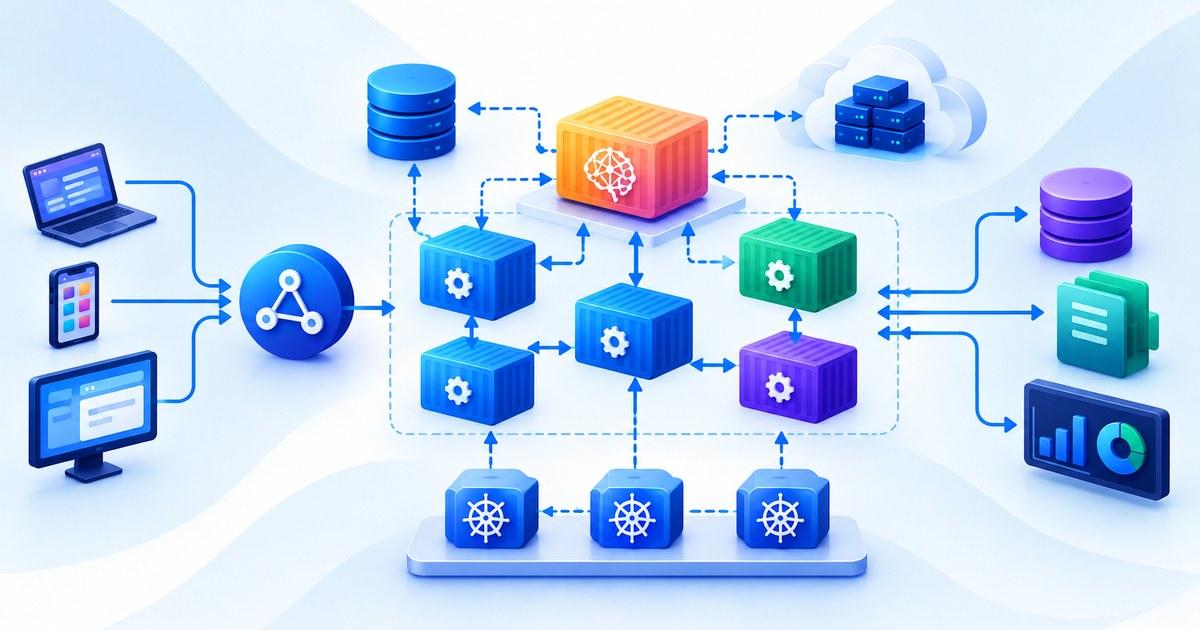
The widespread adoption of artificial intelligence is not simply changing how software is developed; it is fundamentally redefining how software systems are architected. For decades, enterprise software followed well-established architectural principles centered around databases, business logic, application servers, APIs, user interfaces, and cloud infrastructure. These architectures proved highly effective for transactional applications where software executed deterministic rules, processed structured information, and responded predictably to predefined business workflows. However, intelligent applications introduce entirely new engineering challenges because they must reason, retrieve knowledge, understand natural language, generate content, process multiple forms of data, and adapt continuously to changing contexts.
As organizations move beyond adding AI features into existing products, they are increasingly designing software around intelligence itself. Instead of treating AI as an external service invoked only when necessary, enterprises are embedding Large Language Models, Retrieval-Augmented Generation (RAG), multimodal capabilities, autonomous reasoning systems, and continuous learning mechanisms directly into the application's architecture. Intelligence becomes a foundational platform component rather than an isolated feature. This architectural transformation requires engineers to rethink scalability, infrastructure, governance, observability, security, and operational reliability from the ground up.
Building AI-native software also introduces greater engineering responsibility. Unlike traditional enterprise systems where application behavior remains predictable once deployed, AI-powered applications continuously process probabilistic outputs generated from evolving models and dynamic knowledge sources. Engineers must therefore ensure these systems remain trustworthy, explainable, secure, observable, and resilient despite increasing architectural complexity. The challenge extends far beyond integrating an AI model into an existing application. It involves constructing an intelligent software ecosystem where every architectural component works together to deliver reliable, scalable, and responsible AI experiences.
Designing Software Around Intelligence
The foundation of modern intelligent applications begins with AI-first architecture. Traditional software architectures generally place business logic at the center of application design, with databases supplying structured information and user interfaces facilitating interaction. AI-first architectures reorganize this model by positioning intelligence as a core architectural capability that influences every user interaction, business workflow, and decision-making process. Instead of routing requests exclusively through predefined rules, applications continuously evaluate user intent, contextual information, organizational knowledge, and historical interactions before determining appropriate responses. Business logic and artificial intelligence operate together, allowing software to remain reliable while adapting intelligently to increasingly complex user needs.
At the heart of these architectures are Large Language Models (LLMs). Modern LLMs serve as reasoning engines capable of interpreting natural language, generating content, summarizing information, writing code, analyzing documents, answering questions, and supporting complex business workflows. Rather than functioning as standalone chatbots, LLMs increasingly integrate deeply into enterprise applications where they enhance productivity, automate repetitive work, simplify user interactions, and improve decision-making. Enterprise software platforms now incorporate language models into customer relationship management systems, productivity suites, financial applications, cybersecurity tools, healthcare platforms, educational technologies, and software development environments. Their ability to understand context and generate human-like responses enables software to become significantly more intuitive than traditional graphical interfaces.
However, language models alone cannot satisfy enterprise requirements because they possess limited knowledge beyond their training data. This challenge has accelerated the adoption of Retrieval-Augmented Generation (RAG). Instead of relying exclusively on model parameters, RAG systems retrieve relevant information from enterprise knowledge bases, documentation repositories, vector databases, internal policies, customer records, and business data before generating responses. This architecture enables AI systems to provide accurate, context-aware, and up-to-date answers without requiring constant retraining of foundational models. Organizations increasingly deploy RAG across internal knowledge management, customer support, legal research, healthcare documentation, financial analysis, software engineering, and enterprise search because it significantly improves factual accuracy while reducing hallucinations. AI-native software therefore evolves from isolated reasoning systems into intelligent applications capable of combining learned knowledge with continuously updated enterprise information.
Readers interested in understanding why successful AI adoption depends as much on business strategy and governance as on technical implementation should also explore "The Business of AI: What Every ML Engineer Should Know Beyond Coding," which examines how organizations build scalable AI initiatives that create long-term business value while maintaining responsible engineering practices.
Key Takeaway
The next generation of software will be built around AI-native architectures where intelligence functions as a foundational platform capability rather than an optional feature. AI-first architecture, Large Language Models, Retrieval-Augmented Generation, multimodal AI, AI observability, security, governance, scalability, Responsible AI, and enterprise production systems collectively define how future software will be designed, deployed, and operated. Organizations that embrace these architectural principles will build intelligent applications that are not only more capable but also more reliable, trustworthy, scalable, and prepared to support the evolving demands of an AI-driven world.
Section 4: What the Future Software Engineer Will Look Like
Artificial intelligence is transforming software engineering more rapidly than any previous technological advancement. Every major shift in computing, from personal computers and the internet to cloud computing, mobile development, and DevOps, introduced new tools and methodologies while leaving the core responsibilities of software engineers largely unchanged. Developers continued writing code, designing architectures, debugging applications, and maintaining production systems, even as programming languages and infrastructure evolved. The AI revolution, however, represents a far more profound change because it is redefining the nature of software engineering itself rather than simply improving the tools engineers use.
The future software engineer will spend significantly less time implementing repetitive code and considerably more time designing intelligent systems capable of solving increasingly complex business problems. Artificial intelligence is rapidly automating routine implementation tasks including code generation, documentation, testing, debugging, dependency management, infrastructure provisioning, and deployment orchestration. These capabilities do not eliminate the need for engineers; instead, they elevate engineering responsibilities toward architecture, systems thinking, product strategy, governance, validation, and intelligent workflow orchestration. Engineers will increasingly supervise AI-powered development ecosystems while focusing on decisions that require creativity, domain expertise, ethical judgment, and long-term architectural vision.
This transformation also reflects the increasing complexity of modern software itself. Future applications will combine Large Language Models, autonomous AI agents, multimodal reasoning, distributed cloud infrastructure, Retrieval-Augmented Generation (RAG), edge computing, intelligent automation, and enterprise governance into unified software platforms. Building and operating these systems requires expertise extending well beyond traditional programming. Engineers must understand how intelligent components interact, how AI systems scale across distributed environments, how governance and security influence software architecture, and how to ensure AI remains trustworthy throughout its operational lifecycle. Software engineering therefore becomes increasingly interdisciplinary, combining computer science with artificial intelligence, distributed systems, cloud engineering, cybersecurity, infrastructure optimization, and business strategy.
Engineering Careers in the Age of AI
The first major evolution involves the rapid expansion of AI Engineering as a core software discipline. Traditionally, artificial intelligence existed primarily within specialized machine learning teams responsible for developing predictive models and conducting research. Today, AI Engineering has become an integral component of mainstream software development because intelligent capabilities are increasingly embedded into nearly every enterprise application. Future software engineers will routinely integrate Large Language Models, retrieval systems, AI agents, multimodal capabilities, recommendation engines, and intelligent automation into business platforms. Understanding how AI systems interact with software architecture will therefore become as fundamental as understanding APIs, databases, or cloud infrastructure.
As software becomes increasingly intelligent, the responsibilities of Software Architects will also evolve dramatically. Traditional architecture focused primarily on scalability, modularity, reliability, and maintainability. AI-native architectures introduce additional considerations including model orchestration, retrieval pipelines, inference infrastructure, observability, governance, security, reasoning workflows, and AI lifecycle management. Future architects will design systems where deterministic software components collaborate seamlessly with probabilistic AI services while maintaining predictable business outcomes. Rather than simply organizing application components, architects will define how intelligence flows throughout the software ecosystem, ensuring AI capabilities remain scalable, trustworthy, and aligned with organizational objectives.
Supporting these architectures will be a growing demand for Platform Engineers specializing in AI-native infrastructure. Enterprise organizations increasingly require centralized platforms that enable multiple development teams to build, deploy, monitor, and optimize intelligent applications efficiently. Platform Engineers create reusable deployment pipelines, AI serving frameworks, model registries, observability systems, governance controls, vector database integrations, security frameworks, and infrastructure automation that standardize AI development across the enterprise. Instead of solving isolated technical problems for individual projects, they establish the engineering foundations that allow hundreds of AI applications to operate consistently at scale.
Equally critical is the emergence of AI Performance Engineering as one of the most valuable technical specialties of the coming decade. Future software applications will rely on computationally intensive inference workloads requiring sophisticated optimization across GPUs, memory systems, networking, caching, distributed infrastructure, and cloud environments. AI Performance Engineers ensure that intelligent systems deliver low latency, high throughput, efficient resource utilization, operational reliability, and sustainable infrastructure costs despite rapidly increasing demand. As AI workloads continue expanding across industries, performance engineering will become as indispensable to AI-native software as Site Reliability Engineering became to cloud computing.
Readers interested in understanding how practical engineering experience bridges the gap between AI research and enterprise implementation should also explore "Research to Real-World ML Engineering: Bridging the Gap," which examines how engineers translate cutting-edge AI innovations into scalable production systems that deliver measurable business value.
Key Takeaway
The future software engineer will evolve from primarily writing code to designing intelligent systems, orchestrating AI-powered development workflows, validating autonomous implementations, governing responsible AI, and shaping long-term product strategy. AI Engineering, Software Architecture, Platform Engineering, AI Performance Engineering, human-AI collaboration, interdisciplinary technical expertise, and AI-native organizational practices will define the next generation of engineering careers. As artificial intelligence becomes deeply integrated into every aspect of software development, the engineers who successfully combine architectural thinking, systems design, business understanding, and AI collaboration will lead the future of software innovation.
Conclusion
The software industry has experienced numerous transformational moments throughout its history, from the emergence of personal computing and the internet to cloud computing, smartphones, and distributed systems. Each technological revolution expanded the capabilities of software while introducing new engineering practices that fundamentally changed how applications were built and delivered. The AI revolution, however, represents a transformation of an entirely different magnitude because it is not simply introducing another software platform or development framework. Artificial intelligence is becoming the intelligence layer that will underpin virtually every software application, enabling systems to reason, learn, adapt, and collaborate alongside human users. This marks the beginning of a new era where software evolves from deterministic tools into intelligent digital partners capable of continuously creating value.
Throughout this article, we explored how software is transitioning from traditional rule-based systems toward AI-native applications. Conventional software relied on predefined business logic, static workflows, and deterministic decision-making that required developers to anticipate every possible scenario before deployment. Modern AI-powered applications, by contrast, understand context, personalize user experiences, support complex decision-making, generate insights, and continuously improve through interaction with users and enterprise knowledge. This shift enables software to move beyond automation into intelligent collaboration, allowing organizations to solve increasingly sophisticated business challenges while significantly improving productivity and customer experience.
We also examined how artificial intelligence is fundamentally transforming the software development lifecycle itself. AI coding assistants, autonomous software development, Agentic AI, specification-driven engineering, intelligent testing, automated documentation, DevOps automation, continuous software optimization, and AI-native development workflows are redefining how software is designed, implemented, deployed, and maintained. Rather than replacing software engineers, these technologies eliminate repetitive implementation work and allow engineering teams to focus on architecture, innovation, systems thinking, product strategy, and solving higher-order business problems. Software development is evolving into a collaborative discipline where human expertise and artificial intelligence complement one another throughout the engineering lifecycle.
Equally important, we explored the architectural principles required to build reliable AI-native software. Future applications will rely on AI-first architectures, Large Language Models, Retrieval-Augmented Generation (RAG), multimodal intelligence, AI observability, enterprise security, governance frameworks, scalable infrastructure, and Responsible AI practices to ensure intelligent systems remain trustworthy, resilient, and operationally efficient. Building AI-native software extends far beyond integrating a language model into an existing application. It requires designing complete software ecosystems where intelligence, infrastructure, governance, performance, and business objectives work together seamlessly to deliver consistent value at enterprise scale.
Finally, we examined how the role of the software engineer will evolve during the coming decade. Programming will remain an essential technical skill, but future engineers will increasingly distinguish themselves through their ability to design architectures, orchestrate autonomous AI systems, validate AI-generated implementations, optimize intelligent infrastructure, govern responsible AI, and align software capabilities with long-term business strategy. New specialties such as AI Engineering, AI Platform Engineering, AI Performance Engineering, AI Infrastructure Engineering, and Autonomous Systems Engineering will become central to modern software organizations. Engineers who embrace these interdisciplinary skills will help define how the next generation of intelligent software is created and operated.
Frequently Asked Questions (FAQs)
1. What is the future of software after the AI revolution?
The future of software lies in AI-native applications that combine traditional software engineering with artificial intelligence to create systems capable of reasoning, learning, personalizing experiences, automating workflows, and continuously adapting to changing user and business needs.
2. How is AI changing software development?
AI is transforming software development by automating coding, testing, documentation, debugging, deployment, maintenance, and optimization while enabling engineers to focus more on architecture, product design, innovation, and strategic decision-making.
3. What are AI-native applications?
AI-native applications are software systems designed with artificial intelligence as a foundational architectural component rather than as an optional feature. They use AI to understand context, generate insights, automate decisions, and deliver personalized user experiences.
4. What is autonomous software development?
Autonomous software development is an AI-driven engineering approach where intelligent systems assist or automate multiple stages of the software lifecycle, including requirements analysis, implementation, testing, deployment, maintenance, and optimization under human supervision.
5. How do Large Language Models power modern software?
Large Language Models enable software to understand natural language, generate content, summarize information, answer questions, write code, analyze documents, and provide intelligent conversational interfaces that improve user productivity and engagement.
6. What is Retrieval-Augmented Generation (RAG)?
Retrieval-Augmented Generation combines Large Language Models with external knowledge sources such as enterprise documents, vector databases, and organizational repositories to produce more accurate, context-aware, and up-to-date responses.
7. How does Agentic AI differ from traditional AI?
Traditional AI typically performs individual tasks based on specific prompts, whereas Agentic AI consists of multiple autonomous agents that collaborate, plan, reason, execute workflows, and coordinate complex activities to achieve broader objectives.
8. Why is AI observability important?
AI observability enables organizations to monitor model behavior, inference latency, retrieval quality, hallucinations, infrastructure performance, user interactions, and operational reliability, ensuring AI systems remain trustworthy and efficient in production.
9. How will AI affect software engineering jobs?
AI will automate many repetitive programming tasks, but software engineers will remain essential by focusing on architecture, AI orchestration, systems design, governance, validation, infrastructure optimization, and strategic product development.
10. What skills will future software engineers need?
Future engineers will require expertise in AI engineering, cloud computing, distributed systems, Large Language Models, Retrieval-Augmented Generation, AI observability, cybersecurity, platform engineering, systems architecture, and human-AI collaboration alongside strong programming fundamentals.
11. How do enterprises build AI-native software?
Enterprises build AI-native software by adopting AI-first architectures, integrating Large Language Models and RAG systems, implementing scalable cloud infrastructure, ensuring AI observability, establishing governance frameworks, and following Responsible AI principles throughout development.
12. What are the biggest challenges of AI-powered software?
Key challenges include scalability, inference performance, data privacy, security, governance, hallucination management, infrastructure costs, regulatory compliance, operational reliability, and maintaining user trust.
13. How does Responsible AI influence software development?
Responsible AI ensures intelligent software operates fairly, transparently, securely, ethically, and in compliance with regulatory requirements through practices such as bias mitigation, explainability, human oversight, privacy protection, and continuous monitoring.
14. Which industries will benefit most from AI-native software?
Healthcare, finance, manufacturing, retail, education, cybersecurity, telecommunications, logistics, software development, legal services, government, and enterprise productivity platforms are expected to benefit significantly from AI-native software.
15. What does the future of software engineering look like?
The future of software engineering centers on collaboration between humans and artificial intelligence. Engineers will increasingly design intelligent architectures, supervise autonomous development workflows, optimize AI infrastructure, validate AI-generated systems, and lead product innovation while AI automates much of the repetitive implementation work, resulting in faster software delivery, higher quality, and more adaptive digital products.