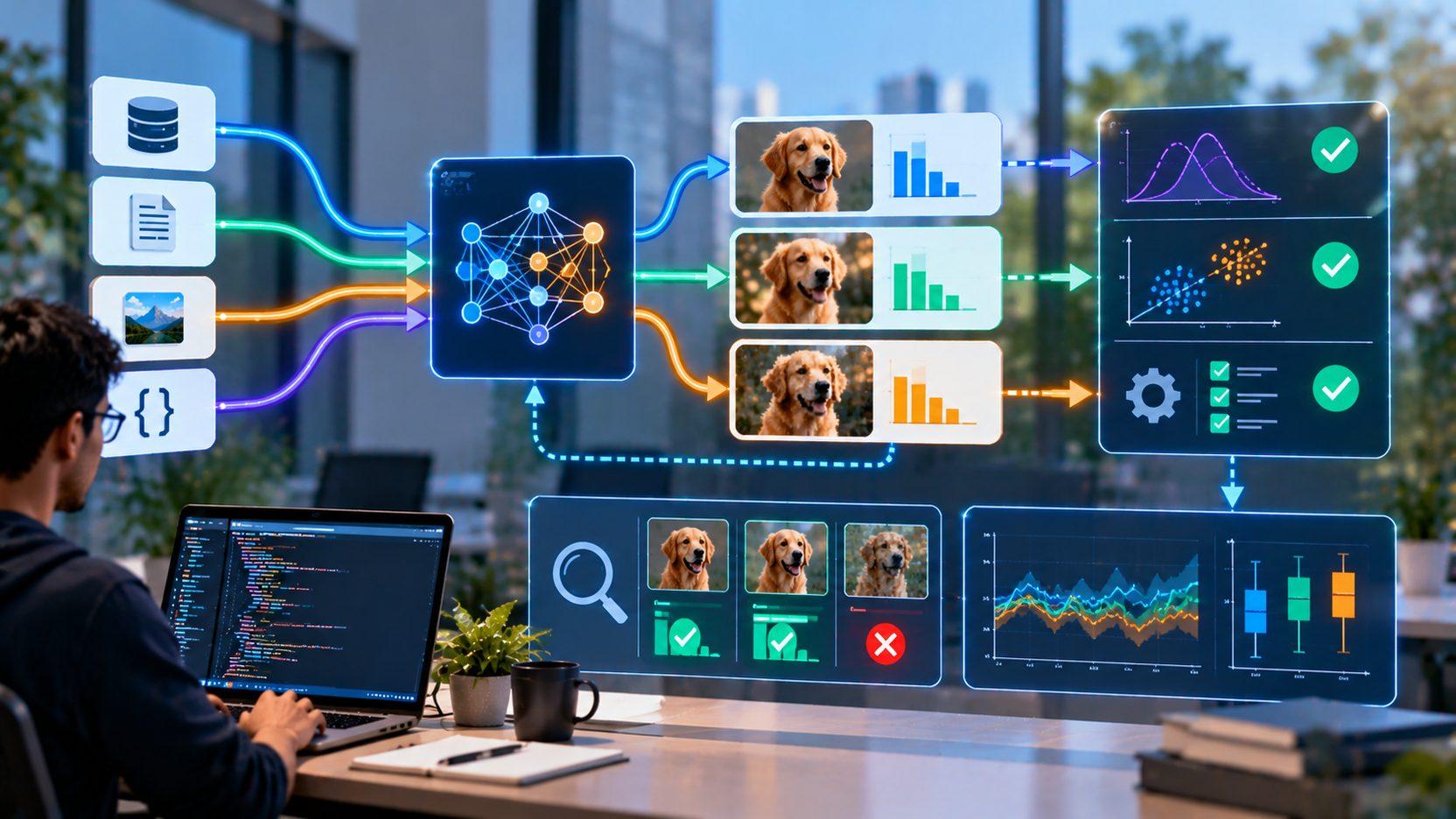

Section 1: The Journey from Machine Learning Model to Real Customer Value
Training a machine learning model is often celebrated as the defining milestone of an AI project. Teams spend weeks or even months collecting data, engineering features, selecting algorithms, tuning hyperparameters, and evaluating performance metrics until they finally achieve an accuracy score that meets their objectives. From the outside, it may appear that the hardest part of building an AI product is complete once the model reaches production-ready performance. In reality, however, model training represents only the beginning of a much longer engineering journey. The true challenge lies in transforming a trained model into a reliable, scalable, secure, and user-friendly product that consistently delivers value to customers.
This gap between model training and customer experience is one of the least understood aspects of artificial intelligence. Organizations frequently celebrate impressive benchmark scores only to discover that users remain dissatisfied because the AI system is slow, unreliable, difficult to integrate into existing workflows, or unable to handle real-world scenarios that differ from training data. Customers rarely judge an AI application by its validation accuracy or loss curves. Instead, they evaluate whether it solves their problems quickly, consistently, and intuitively. A technically impressive model therefore creates little business value unless the surrounding engineering systems enable customers to experience its capabilities effectively.
Modern AI products illustrate this reality across every industry. A recommendation engine must return personalized suggestions within milliseconds. A fraud detection system must identify suspicious activity before transactions are completed. An AI coding assistant must generate useful recommendations while developers are actively writing software. A healthcare diagnostic application must provide accurate insights while remaining compliant with strict privacy regulations. In each case, the trained model represents only one component of a much larger ecosystem involving cloud infrastructure, APIs, databases, monitoring systems, security controls, user interfaces, orchestration frameworks, and continuous operational management. The customer experiences the complete system rather than the model operating independently.
Model Training Is Only the Starting Point
Machine learning research often emphasizes model performance because accuracy, precision, recall, F1 scores, and other evaluation metrics provide measurable indicators of technical progress. These metrics are undeniably important because poorly performing models cannot generate reliable predictions. However, they rarely reflect how an AI system behaves after deployment into production environments where users, business processes, infrastructure constraints, and operational requirements introduce entirely new challenges.
Once a model leaves the training environment, engineers must solve problems that extend well beyond machine learning itself. The model needs to be packaged, deployed, exposed through secure APIs, integrated with business applications, connected to real-time data sources, monitored for failures, optimized for latency, protected against security threats, and scaled to support fluctuating customer demand. Each of these responsibilities influences whether customers perceive the AI product as valuable, regardless of how accurately the underlying model performs during offline evaluation.
Latency provides an excellent example of this transition. A recommendation model achieving outstanding predictive accuracy may still frustrate customers if recommendations require several seconds to appear. Likewise, an image recognition model capable of exceptional classification accuracy becomes significantly less useful if inference costs make large-scale deployment financially unsustainable. Engineers therefore optimize infrastructure, caching strategies, model serving frameworks, hardware utilization, and request routing to ensure AI systems meet both technical and business expectations simultaneously.
Customer Experience Depends on Engineering, Not Just AI
The ultimate success of an AI product is determined not by its model architecture but by the experience customers have while interacting with it. End users rarely know which neural network architecture powers an application or which optimization techniques engineers applied during training. What customers notice instead is whether the application responds quickly, produces useful results, protects their information, explains its recommendations clearly, and integrates naturally into their daily workflows. Every one of these characteristics depends upon software engineering decisions surrounding the model rather than the model itself.
This reality explains why customer-centric AI development requires close collaboration across multiple engineering disciplines. Software engineers build scalable applications and APIs that expose AI capabilities reliably. Platform engineers manage cloud infrastructure supporting inference workloads. DevOps and Site Reliability Engineers ensure continuous availability through automated deployment pipelines and monitoring systems. Security engineers protect sensitive customer data while implementing authentication and access controls. Product managers define customer requirements that guide AI implementation, while designers create interfaces enabling users to interact naturally with intelligent systems. Together, these teams transform machine learning models into products that customers trust and use every day.
Customer feedback also becomes an essential component of the engineering lifecycle after deployment. Unlike traditional software where behavior remains relatively predictable, AI systems continuously encounter new inputs, changing user behavior, evolving business requirements, and shifting operational environments. Engineers therefore monitor user interactions, analyze feedback, identify failure patterns, evaluate prediction quality, and refine both the model and surrounding software infrastructure to improve customer satisfaction over time. Production AI is therefore an ongoing engineering process rather than a one-time deployment activity.
Perhaps the most important lesson is that customers evaluate complete experiences instead of isolated technologies. They remember whether an AI assistant understood their request, whether recommendations felt relevant, whether automated decisions appeared fair, whether applications remained responsive during peak usage, and whether the product consistently helped them accomplish meaningful tasks. These experiences emerge from the combined efforts of software engineering, infrastructure, security, product design, operations, and machine learning working together rather than from model training alone.
Readers interested in understanding how production engineering transforms AI into business value should also explore "From Model to Product: How to Discuss End-to-End ML Pipelines in Interviews," which explains how modern AI systems progress from experimentation to scalable production deployments while highlighting the engineering decisions that employers increasingly evaluate during technical interviews.
Key Takeaway
Training a machine learning model is only the first step in building a successful AI product. The real journey begins after training, when engineers transform models into reliable, scalable, secure, and customer-focused applications through software engineering, cloud infrastructure, monitoring, deployment, governance, and continuous optimization. Ultimately, customers experience the complete AI system, not the trained model and organizations achieve lasting success by investing equally in engineering excellence and machine learning innovation.
Section 2: Building the Systems That Customers Never See
Once a machine learning model has been trained and validated, the focus of the engineering team shifts dramatically. The challenge is no longer improving accuracy by another fraction of a percentage point but ensuring that the model can operate reliably under real-world conditions where thousands or even millions of customers interact with the application every day. This stage of AI development is rarely discussed outside engineering organizations, yet it is responsible for determining whether an intelligent product succeeds or fails after launch.
Many AI projects struggle precisely because organizations underestimate this transition. A model that performs exceptionally well in a controlled development environment often encounters completely different conditions in production. Customer requests arrive unpredictably, network latency fluctuates, cloud infrastructure experiences failures, data formats change, user behavior evolves, and business requirements continue expanding long after deployment. None of these challenges can be solved by retraining the model alone. They require disciplined software engineering, cloud architecture, platform engineering, security, observability, and operational excellence working together to ensure that AI consistently delivers value.
This is why experienced engineering organizations treat AI products as distributed software systems rather than isolated machine learning models. The model becomes one service within a larger architecture that includes APIs, authentication, databases, caching layers, messaging systems, monitoring platforms, feature stores, deployment pipelines, and user-facing applications. Every component contributes to the final customer experience, and weaknesses in any layer can undermine the effectiveness of even the most accurate machine learning model.
As AI adoption continues accelerating across industries, organizations increasingly recognize that competitive advantage comes not only from developing intelligent algorithms but also from building engineering ecosystems capable of supporting those algorithms throughout their entire lifecycle. The companies delivering the best AI experiences are often distinguished less by superior models than by superior engineering practices that enable those models to operate reliably, securely, and efficiently at scale.
Production Infrastructure Determines Whether AI Scales Successfully
Moving from experimentation to production introduces a completely new set of engineering responsibilities. During development, data scientists typically evaluate models using carefully prepared datasets within controlled environments where computational resources are readily available and system performance can be measured without external constraints. Production environments operate very differently because customer expectations introduce strict requirements for speed, reliability, availability, and scalability.
One of the first considerations is model serving. Engineers must determine how trained models receive requests, generate predictions, and return responses efficiently. Instead of running models within notebooks or local development environments, organizations deploy them as scalable services capable of processing thousands of concurrent requests while maintaining consistent response times. APIs become the primary interface through which applications communicate with AI services, making reliability and performance essential components of the overall customer experience.
Infrastructure scalability quickly becomes another major concern. Customer demand rarely remains constant throughout the day. Retail applications experience seasonal shopping spikes, financial platforms encounter fluctuating transaction volumes, healthcare systems respond to varying patient activity, and enterprise software supports users across multiple time zones. Engineering teams therefore design cloud-native architectures capable of automatically scaling computational resources while controlling operational costs. Load balancing, container orchestration, autoscaling policies, distributed computing, and intelligent resource management all contribute to ensuring that AI applications remain responsive regardless of demand.
Caching strategies also play an important role in improving customer experience. Not every AI request requires fresh inference from a large language model or prediction service. Frequently requested responses, repeated searches, recommendation results, and static knowledge can often be cached, significantly reducing latency while lowering infrastructure expenses. Engineers carefully determine where caching improves performance without compromising response quality or data freshness.
Monitoring and Continuous Improvement Keep AI Useful
Unlike conventional software, AI systems cannot simply be deployed and forgotten. Traditional applications generally produce predictable outputs when provided with identical inputs, allowing engineers to validate functionality before release. AI applications operate differently because they interact with changing data, evolving customer behavior, dynamic business environments, and continuously expanding knowledge sources. Maintaining high-quality customer experiences therefore requires ongoing monitoring and continuous optimization long after deployment.
Observability has become one of the most important disciplines in production AI engineering. Teams monitor latency, throughput, error rates, infrastructure utilization, inference costs, API availability, customer feedback, retrieval quality, and model performance simultaneously. These operational metrics provide early warning signals when AI services begin behaving differently from expected production standards, enabling engineers to respond before customers experience noticeable degradation.
Data drift presents another significant challenge. Over time, customer behavior, market conditions, and operational environments naturally evolve, causing production data to differ from the datasets originally used during model training. An AI system trained on historical purchasing behavior, for example, may gradually become less accurate as consumer preferences change. Engineers continuously evaluate incoming data, compare prediction quality against business outcomes, and determine when retraining or architectural improvements become necessary to maintain customer satisfaction.
Feedback loops further strengthen AI performance. Every customer interaction provides valuable information about how effectively intelligent systems solve real-world problems. Organizations increasingly analyze user feedback, support tickets, click behavior, search refinement patterns, and operational metrics to identify opportunities for improvement. Engineers use these insights not only to refine models but also to improve prompts, retrieval pipelines, interfaces, business workflows, and supporting infrastructure. The result is an AI product that evolves continuously based on customer needs rather than remaining fixed after deployment.
Perhaps the most important aspect of production AI is recognizing that responsibility extends well beyond machine learning teams. Software engineers, platform engineers, Site Reliability Engineers, DevOps professionals, cybersecurity specialists, product managers, and customer success teams all contribute to maintaining AI performance after launch. Their collaboration ensures that intelligent systems remain reliable, scalable, secure, and aligned with changing business objectives throughout their operational lifecycle.
Readers interested in understanding how these production responsibilities influence modern AI careers should also explore "Research to Real-World ML Engineering," which explains how organizations transform experimental machine learning projects into scalable production systems while highlighting the engineering practices that distinguish successful enterprise AI implementations.
Key Takeaway
The period between model training and customer experience is dominated by engineering rather than machine learning. Production infrastructure, scalable deployment, security, monitoring, observability, feedback loops, and continuous optimization determine whether an AI model becomes a dependable customer-facing product. Organizations that invest in these engineering capabilities consistently deliver AI systems that remain fast, reliable, trustworthy, and valuable long after the initial model has been trained.
Section 3: Where AI Products Win or Fail: The Customer Experience Layer
After an AI model has been trained, deployed, and integrated into production infrastructure, another equally important phase begins, delivering an experience that customers genuinely trust and enjoy using. This is the stage where many technically impressive AI projects either become successful products or fail to gain meaningful adoption. Customers rarely evaluate artificial intelligence by looking at model architectures, benchmark scores, inference pipelines, or engineering diagrams. They judge AI entirely through their interactions with the product. If responses are slow, recommendations appear irrelevant, explanations are confusing, or the application behaves inconsistently, users quickly lose confidence regardless of how sophisticated the underlying machine learning model may be.
This difference between technical performance and customer perception explains why customer experience has become one of the most important disciplines in modern AI engineering. Organizations increasingly understand that deploying a model into production is not the final objective. The ultimate goal is creating an intelligent product that feels reliable, intuitive, responsive, and trustworthy every time a customer interacts with it. Achieving this requires engineers to think beyond prediction quality and consider every aspect of the customer's journey, including interface design, response speed, personalization, transparency, accessibility, and operational consistency.
The challenge becomes even greater because AI products continue evolving after deployment. Unlike traditional software that follows fixed business rules, intelligent systems learn from changing customer behavior, new enterprise data, updated knowledge sources, and continuous operational feedback. Customer experience therefore depends upon maintaining a balance between technological innovation and engineering stability. Organizations that successfully achieve this balance create AI products that customers naturally incorporate into their daily workflows because the technology consistently solves problems without creating unnecessary complexity.
Trust Is Built Through Consistency Rather Than Intelligence Alone
One of the biggest misconceptions surrounding AI products is that smarter models automatically create better customer experiences. While advanced models certainly improve reasoning capabilities, customers value consistency far more than occasional demonstrations of extraordinary intelligence. An AI assistant that reliably answers common questions within seconds often creates greater customer satisfaction than a highly sophisticated system that produces exceptional responses inconsistently or experiences frequent failures.
Consistency begins with predictable performance. Customers expect AI applications to respond quickly regardless of traffic conditions, geographical location, or time of day. Engineering teams therefore invest heavily in infrastructure optimization, intelligent request routing, caching strategies, autoscaling, and resilient cloud architectures that minimize delays while maintaining service availability. Although customers rarely recognize these engineering efforts directly, they immediately notice when intelligent applications become slow or unreliable.
Transparency also plays an important role in building trust. AI systems inevitably encounter situations where confidence is low or available information is incomplete. Rather than presenting uncertain answers as definitive facts, well-designed AI products communicate limitations clearly, explain their reasoning where appropriate, and encourage users to verify important information. Engineers implement these safeguards through thoughtful interface design, confidence thresholds, retrieval validation, and governance mechanisms that prioritize reliability over unnecessary automation.
Security and privacy further influence customer confidence. Enterprise AI applications frequently process confidential business documents, financial information, healthcare records, customer communications, and proprietary organizational knowledge. Customers expect this information to remain protected throughout every interaction. Engineering teams therefore implement encryption, authentication, authorization, audit logging, secure APIs, and data governance policies that ensure sensitive information remains protected without disrupting usability.
Continuous Feedback Turns AI Products Into Better Products
Perhaps the greatest difference between successful AI products and unsuccessful ones is the ability to improve continuously after deployment. Traditional software development often follows predictable release cycles where new functionality is introduced periodically through planned updates. AI products operate differently because every customer interaction generates valuable information that can strengthen future performance. Organizations increasingly treat production environments as learning systems where engineering teams continuously evaluate customer behavior, operational metrics, and business outcomes to refine intelligent applications over time.
Customer feedback forms one of the most valuable sources of improvement. Explicit ratings, support requests, correction suggestions, user comments, and satisfaction surveys provide direct insight into how customers perceive AI-generated outputs. Equally valuable are implicit behavioral signals such as repeated searches, abandoned workflows, follow-up questions, response acceptance rates, and interaction duration. Together, these indicators help engineers understand where intelligent systems succeed and where improvements remain necessary.
Engineering teams combine this customer feedback with operational observability to create comprehensive improvement pipelines. Monitoring dashboards reveal latency trends, infrastructure bottlenecks, API failures, inference costs, retrieval effectiveness, hallucination rates, and service availability. When analyzed alongside customer behavior, these metrics allow organizations to identify whether problems originate from model performance, infrastructure limitations, interface design, knowledge quality, or workflow integration. Improvements therefore extend beyond retraining models and often involve optimizing the surrounding engineering ecosystem.
Continuous experimentation also plays an important role in refining customer experience. Organizations frequently evaluate alternative prompts, retrieval strategies, ranking algorithms, user interface designs, response formats, and orchestration workflows through controlled experimentation before introducing large-scale changes. These iterative improvements allow engineering teams to enhance customer satisfaction gradually while minimizing operational risk. Instead of relying solely on assumptions, product decisions become grounded in measurable customer outcomes supported by real production data.
Perhaps most importantly, successful organizations recognize that improving customer experience is a multidisciplinary responsibility. Machine learning engineers optimize models, software engineers strengthen applications, platform engineers improve infrastructure, Site Reliability Engineers maintain availability, product managers define customer priorities, designers refine usability, and customer success teams communicate emerging user needs. Together, these teams transform operational insights into continuous product improvements that keep AI applications aligned with changing customer expectations.
Readers interested in understanding how these production improvements influence enterprise AI adoption should also explore "Building Enterprise AI That Employees Actually Trust," which explains how engineering excellence, governance, user experience, and organizational adoption work together to create AI systems that employees confidently use in their daily work.
Key Takeaway
The final stage between model training and customer experience is where engineering excellence becomes visible to end users. Trust, consistency, security, usability, and continuous improvement determine whether customers embrace or abandon an AI product. Organizations that combine production engineering, customer feedback, operational monitoring, and iterative product refinement create intelligent systems that deliver lasting business value because they focus not only on building accurate models but also on building experiences that customers genuinely trust and rely upon.
Section 4: Measuring Success After Deployment: The Metrics That Truly Matter
Once an AI system reaches production, the focus of engineering shifts from building the solution to proving that it delivers consistent business value. This transition is where many organizations discover that traditional machine learning metrics alone are insufficient for evaluating the success of customer-facing AI products. During model development, engineers primarily monitor measurements such as accuracy, precision, recall, F1 score, AUC, perplexity, or loss functions because these metrics indicate how well a model performs under controlled conditions. While these measurements remain valuable, they do not fully represent how customers experience an AI-powered product in real-world environments.
Customers rarely know whether an AI recommendation model achieves 95 percent accuracy or whether a large language model has improved its benchmark performance by several percentage points. Instead, they judge whether the application responds quickly, provides relevant information, protects sensitive data, integrates naturally into their workflow, and consistently helps them accomplish meaningful tasks. Business leaders evaluate different outcomes altogether. They measure customer satisfaction, product adoption, operational efficiency, revenue growth, support ticket reduction, retention, and return on investment. Engineering teams therefore operate at the intersection of technical performance and business impact, ensuring that AI systems continue delivering measurable value long after deployment.
This broader perspective has fundamentally changed how organizations evaluate AI success. Engineering excellence is no longer defined solely by building highly accurate models but by maintaining intelligent systems that improve customer experiences while supporting organizational objectives. Consequently, software engineers, AI engineers, platform engineers, product managers, Site Reliability Engineers, and business stakeholders increasingly collaborate around shared performance indicators that combine technical reliability with customer and business outcomes.
Engineering Metrics and Business Metrics Must Work Together
One of the defining characteristics of mature AI organizations is that they evaluate technical performance and business performance simultaneously rather than treating them as independent objectives. An AI application may demonstrate excellent model accuracy while still creating poor customer experiences if latency is excessive, infrastructure becomes unreliable, or recommendations fail to support meaningful business goals. Conversely, a model with slightly lower benchmark performance may generate greater organizational value because it integrates more effectively into customer workflows and consistently delivers dependable results.
Engineering teams therefore monitor a broad collection of production metrics that extend far beyond model evaluation. Infrastructure reliability remains essential because customers expect AI services to remain available regardless of traffic fluctuations or operational disruptions. Engineers continuously monitor API availability, request throughput, system uptime, infrastructure utilization, response latency, cache efficiency, and inference costs to ensure production environments remain stable while supporting growing customer demand.
Application performance metrics provide another important perspective. Teams analyze response quality, retrieval accuracy, hallucination frequency, successful task completion rates, user interaction patterns, and workflow completion times to determine whether AI capabilities genuinely improve customer productivity. These measurements reveal how effectively intelligent systems function within real operational environments instead of isolated testing scenarios.
Business metrics complete the picture by connecting engineering work directly to organizational outcomes. Product leaders evaluate customer retention, feature adoption, conversion rates, employee productivity, operational cost reduction, revenue contribution, customer satisfaction, and support ticket resolution times to determine whether AI investments generate measurable value. Engineers increasingly participate in these discussions because architectural decisions directly influence every one of these business indicators.
Continuous Optimization Creates Long-Term Customer Loyalty
Successful AI products are never truly finished. Unlike traditional software that may remain relatively stable after deployment, intelligent applications continuously evolve as customer expectations change, enterprise knowledge expands, business priorities shift, and new AI capabilities become available. Organizations that recognize this reality establish continuous optimization processes designed to improve every aspect of the customer experience rather than waiting for major product releases.
Optimization begins with data-driven decision-making. Engineering teams regularly analyze customer interactions, operational telemetry, infrastructure performance, and business outcomes to identify opportunities for refinement. They evaluate whether response times can be reduced, retrieval quality improved, prompts refined, workflows simplified, interfaces redesigned, or infrastructure optimized to create smoother customer experiences. These incremental improvements often generate greater long-term value than dramatic architectural redesigns because they address real production challenges observed through customer behavior.
A culture of experimentation also plays a central role in successful AI engineering. Organizations increasingly conduct controlled evaluations of different prompts, retrieval strategies, ranking algorithms, user interface improvements, model configurations, and orchestration workflows before deploying changes broadly. This systematic experimentation minimizes operational risk while enabling engineering teams to improve customer satisfaction through evidence-based decisions rather than intuition alone.
Customer trust remains the ultimate objective throughout this optimization process. Every engineering improvement should strengthen reliability, transparency, security, responsiveness, and usability because these characteristics determine whether customers continue relying on intelligent applications over time. AI products that consistently deliver dependable experiences gradually become integrated into daily workflows, creating stronger customer loyalty and higher long-term business value.
Perhaps the most significant lesson from the complete AI lifecycle is that model training represents only a small portion of what customers ultimately experience. Production engineering, cloud infrastructure, security, monitoring, governance, observability, interface design, customer feedback, and continuous optimization collectively determine whether an AI application succeeds in the marketplace. Organizations investing across this entire lifecycle consistently outperform those focusing exclusively on model development because they recognize that engineering excellence extends far beyond machine learning itself.
Readers interested in understanding how modern organizations build complete production AI systems should also explore "The Engineering Behind Autonomous AI Workflows," which explains how orchestration, infrastructure, monitoring, intelligent automation, and production engineering work together to transform AI capabilities into scalable enterprise solutions.
Key Takeaway
The journey between model training and customer experience concludes with continuous measurement and optimization. While machine learning metrics validate model quality, long-term success depends on engineering reliability, operational excellence, customer satisfaction, business impact, and continuous improvement. Organizations that measure every stage of the AI lifecycle and refine their systems based on real customer behavior create intelligent products that remain valuable, trustworthy, and competitive long after the original model has been trained.
Conclusion
The journey between model training and customer experience is where artificial intelligence transforms from an academic achievement into a business capability. Training a machine learning model is undoubtedly an essential milestone, but it represents only one stage within a much larger engineering process. The success of an AI product is determined not simply by how accurately it predicts outcomes during development but by how effectively it serves customers after deployment. Every interaction that a user has with an AI-powered application reflects the combined efforts of software engineering, infrastructure, cloud architecture, security, observability, product design, governance, and continuous optimization working together behind the scenes.
One of the most important lessons for engineers is that customers never experience a machine learning model in isolation. They experience an entire software ecosystem. When an AI assistant answers a question instantly, when a recommendation engine provides relevant suggestions, when fraud is detected before financial loss occurs, or when an autonomous workflow completes a task seamlessly, customers are interacting with much more than a trained model. They are benefiting from carefully designed APIs, resilient cloud infrastructure, intelligent caching, monitoring systems, secure authentication, scalable deployment pipelines, and production engineering practices that make those AI capabilities reliable and trustworthy.
This distinction explains why modern AI development has become increasingly multidisciplinary. Building production AI systems requires collaboration between machine learning engineers, software engineers, platform engineers, Site Reliability Engineers, cybersecurity specialists, DevOps professionals, product managers, UX designers, and business stakeholders. Each discipline contributes unique expertise that collectively shapes the customer experience. A highly accurate model cannot compensate for unreliable infrastructure, poor system integration, weak security, confusing interfaces, or inadequate monitoring. Likewise, excellent engineering cannot fully compensate for poor model performance. Sustainable AI success emerges only when machine learning innovation and engineering excellence evolve together.
Frequently Asked Questions
1. What happens after a machine learning model is trained?
After training, the model must be deployed, integrated into applications, exposed through APIs, monitored, secured, optimized for performance, and continuously improved before customers can use it effectively.
2. Why isn't model accuracy enough for a successful AI product?
High accuracy alone does not guarantee a good customer experience. Factors such as latency, reliability, scalability, security, usability, and seamless integration often have a greater impact on customer satisfaction.
3. What is the biggest challenge between model training and production?
The biggest challenge is transforming a research model into a reliable production system that performs consistently under real-world conditions while meeting customer and business expectations.
4. Why is software engineering important in AI development?
Software engineering provides the infrastructure, APIs, cloud architecture, monitoring, testing, deployment, and security that allow machine learning models to function as production-ready applications.
5. What role do APIs play in AI products?
APIs enable applications to communicate with machine learning models securely and efficiently, allowing AI capabilities to be integrated into websites, mobile applications, enterprise software, and cloud services.
6. How does cloud infrastructure support AI systems?
Cloud platforms provide scalable computing resources, storage, networking, container orchestration, autoscaling, and managed AI services that enable applications to handle varying customer demand efficiently.
7. Why is monitoring important after deployment?
Monitoring helps engineers detect performance degradation, infrastructure failures, latency issues, data drift, API errors, and operational anomalies before they negatively affect customers.
8. What is data drift?
Data drift occurs when real-world production data changes over time, causing it to differ from the data used during model training and potentially reducing prediction quality if left unaddressed.
9. How do customer feedback loops improve AI systems?
Customer interactions, ratings, support tickets, usage patterns, and behavioral analytics help engineering teams identify weaknesses, refine models, improve workflows, and enhance the overall user experience.
10. Who is responsible for delivering a successful AI customer experience?
Successful AI products require collaboration among machine learning engineers, software engineers, platform engineers, DevOps teams, Site Reliability Engineers, cybersecurity specialists, product managers, designers, and business stakeholders.
11. Why is latency critical for customer-facing AI applications?
Customers expect immediate responses. Even highly accurate AI systems lose value if recommendations, search results, or conversational responses are delayed by slow infrastructure or inefficient deployment.
12. How do organizations measure AI success after deployment?
Organizations evaluate technical metrics such as latency, uptime, throughput, error rates, and inference costs alongside business metrics including customer satisfaction, adoption, retention, productivity improvements, and revenue impact.
13. What skills help engineers bridge the gap between model training and production?
Engineers benefit from expertise in software architecture, cloud computing, APIs, distributed systems, DevOps, Kubernetes, observability, cybersecurity, MLOps, AI deployment, and production monitoring.
14. Why is customer experience considered the final stage of AI development?
Customers interact with the complete software product rather than the machine learning model itself. Their experience reflects the quality of engineering, infrastructure, security, interfaces, and operational excellence supporting the AI system.
15. What is the most important lesson about the journey between model training and customer experience?
The most important lesson is that successful AI products are built through engineering excellence as much as machine learning innovation. A trained model creates potential, but production engineering, continuous optimization, customer feedback, and reliable software systems transform that potential into meaningful customer value and long-term business success.