Section 1: Understanding Why Generalization Sits at the Core of Machine Learning
Machine Learning Is Ultimately About Performance Beyond Training Data
At its core, machine learning is built around a deceptively simple objective: learn patterns from existing data and apply them successfully to new situations. While modern AI systems have achieved remarkable advances in language understanding, computer vision, recommendation systems, robotics, and scientific discovery, the fundamental challenge remains unchanged.
Can a model perform well on data it has never seen before?
This question lies at the heart of generalization.
A machine learning model that performs perfectly on training data but fails when exposed to new inputs has not truly learned meaningful patterns. Instead, it has memorized examples without developing a robust understanding of underlying relationships.
This distinction is critical.
Many AI breakthroughs are often measured through benchmark performance, training efficiency, or model scale. However, real-world success depends on whether models can generalize effectively under changing conditions, unexpected inputs, and evolving environments.
For example, a fraud detection system trained on historical financial transactions must identify new forms of fraud that did not exist during training. A recommendation engine must adapt to changing user preferences. A self-driving vehicle must navigate scenarios that developers never explicitly anticipated.
These challenges reveal why generalization remains difficult.
The real world is constantly changing. Data distributions shift. User behavior evolves. Environmental conditions vary. New situations emerge continuously. Machine learning systems must operate effectively despite these uncertainties.
Another important factor is complexity.
Modern AI systems often process enormous datasets containing billions of examples. Yet even massive training datasets represent only a tiny fraction of possible real-world scenarios. Models therefore need mechanisms that allow them to extrapolate beyond direct experience.
This requirement makes generalization one of the most important, and difficult, problems in artificial intelligence.
Bigger Models Do Not Automatically Solve Generalization
One of the most common misconceptions in AI is that larger models naturally generalize better simply because they contain more parameters and have access to more data.
While scale has undeniably improved performance across many domains, it has not eliminated generalization challenges.
Large language models provide a useful example.
Modern models demonstrate extraordinary capabilities across reasoning, coding, writing, translation, and knowledge retrieval tasks. Yet they can still struggle with unfamiliar scenarios, adversarial inputs, distribution shifts, and tasks that differ significantly from their training experience.
This highlights an important reality.
Scale improves capability, but capability and generalization are not identical concepts.
A model may perform exceptionally well across thousands of benchmark tasks while still exhibiting unexpected failures when confronted with novel situations. These failures often emerge because the model learned statistical correlations rather than deeper causal relationships.
Another major challenge involves data diversity.
Even internet-scale datasets cannot fully represent the complexity of the real world. New technologies, cultural shifts, business processes, scientific discoveries, and social behaviors continuously create situations that did not exist during model training.
This creates a moving target.
As environments evolve, models must generalize beyond historical examples rather than relying exclusively on memorized patterns.
Another important factor is robustness.
True generalization requires consistent performance across varying conditions. Small changes in wording, image quality, environmental context, or user behavior can sometimes produce disproportionately large effects on model outputs.
This remains an active research area.
Despite massive advances in model scale, researchers continue exploring techniques that improve robustness, adaptability, and out-of-distribution performance.
The challenge of generalization therefore remains central even as models become larger and more capable.
Real-World AI Systems Live in Dynamic Environments
One reason generalization remains so difficult is that machine learning systems rarely operate in static environments.
Most benchmarks assume relatively stable evaluation conditions. Real-world systems face a different reality.
User behavior changes continuously.
Market conditions evolve. Infrastructure environments shift. Regulatory requirements emerge. Language evolves. New products appear. Adversarial actors adapt. Organizations modify workflows.
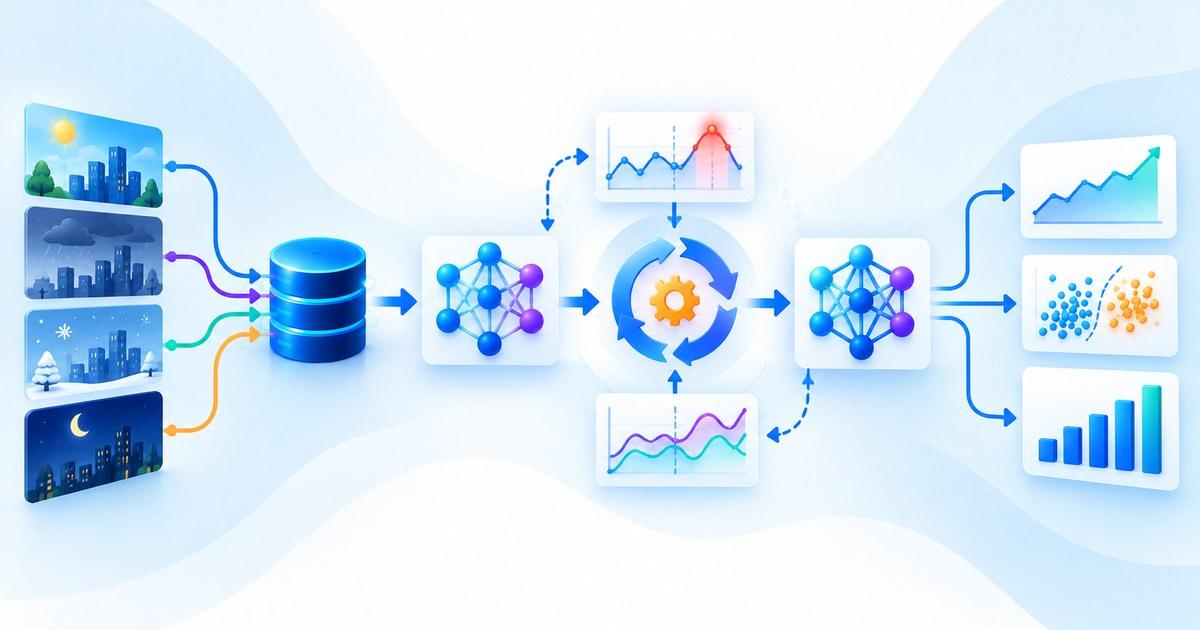
This constant change creates what researchers often call distribution shift.
A model may perform extremely well when training and deployment environments closely resemble one another. Performance can degrade significantly when real-world conditions diverge from historical training data.
For example, recommendation systems often encounter changing user interests. Healthcare systems must adapt to evolving patient populations. Cybersecurity platforms face constantly changing attack strategies.
Each scenario introduces new patterns that were not fully represented during training.
The challenge of dynamic environments closely aligns with trends explored in How ML Engineers Are Using Simulation Environments to Train Smarter Models, where organizations increasingly use simulated environments to expose models to broader ranges of conditions and improve generalization before deployment.
The more diverse the training experience, the better the chances of robust performance under changing circumstances.
Generalization Is the Ultimate Measure of Intelligence
One of the clearest long-term lessons in machine learning is that intelligence cannot be measured solely by memorization, scale, or benchmark performance.
The true test of an intelligent system is its ability to apply knowledge successfully in situations it has never encountered before.
This is exactly what generalization requires.
As AI systems become more integrated into business operations, scientific research, infrastructure management, healthcare, education, and autonomous environments, generalization will remain one of the most important challenges researchers and engineers must solve.
Key Takeaways
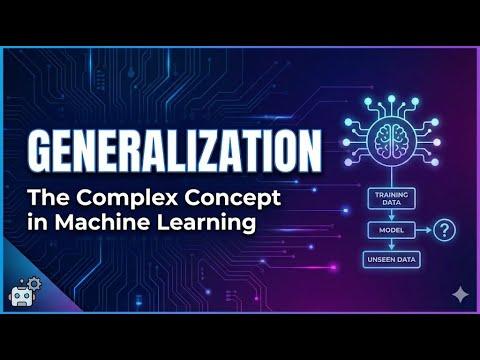
Generalization measures how effectively models perform on unseen data rather than training examples.
Strong benchmark performance does not automatically guarantee robust real-world generalization.
Larger models improve capability but do not eliminate generalization challenges.
Dynamic real-world environments continuously create new situations beyond training data.
Generalization remains one of the most important indicators of true machine learning intelligence.
Section 2: Why Models Struggle to Generalize Beyond Their Training Experience
Overfitting Is Still One of Machine Learning’s Biggest Challenges
One of the most fundamental obstacles to generalization is overfitting. Despite decades of research and enormous advances in model architecture, overfitting remains one of the most common reasons machine learning systems fail when deployed in real-world environments.
Overfitting occurs when a model learns the training data too well.
Instead of identifying broad patterns that apply across different situations, the model begins memorizing details that are specific to the training dataset. This often leads to excellent training performance while producing disappointing results on new data.
The challenge becomes increasingly complicated as models grow larger.
Modern AI systems contain billions or even trillions of parameters. These models have enormous capacity to represent complex relationships, but they also possess the ability to memorize patterns that may not generalize beyond training conditions.
This creates a difficult balance.
Engineers want models that are powerful enough to capture meaningful relationships but not so dependent on training-specific details that they fail under new conditions. Techniques such as regularization, data augmentation, validation testing, and early stopping help reduce overfitting, but they do not eliminate the problem entirely.
Another important factor is hidden complexity within datasets.
A model may appear to learn meaningful relationships while actually relying on shortcuts. For example, a computer vision system might identify irrelevant visual cues correlated with labels instead of learning the underlying concept engineers intended it to recognize.
This creates brittle intelligence.
When those shortcuts disappear in real-world environments, performance often declines unexpectedly. Such failures reveal that the model learned statistical associations rather than robust representations.
Another major issue involves evaluation limitations.
Even carefully designed validation datasets may contain hidden similarities to training data. Models can therefore appear to generalize successfully during testing while struggling when deployed in truly novel environments.
This is why production performance often becomes the ultimate test of generalization quality.
The challenge of overfitting demonstrates that learning patterns and understanding patterns are not always the same thing.
Distribution Shift Constantly Challenges Deployed AI Systems
One of the biggest reasons generalization remains difficult is that the world does not stay still.
Most machine learning systems are trained using historical data collected under specific conditions. However, deployment environments continuously evolve. User behavior changes, markets shift, infrastructure evolves, and external conditions introduce new patterns that models have never encountered before.
This phenomenon is known as distribution shift.
Distribution shift occurs when the data encountered during deployment differs significantly from the data used during training. Even highly accurate models can experience substantial performance degradation under these circumstances.
The challenge affects nearly every machine learning domain.
Recommendation systems encounter changing user interests. Financial models face evolving economic conditions. Healthcare systems interact with new patient populations. Cybersecurity platforms confront novel attack techniques. Language models encounter emerging terminology, technologies, and cultural trends.
Each example introduces new conditions beyond historical training experience.
Another important factor is the speed of change.
Some environments evolve gradually, allowing models to adapt through retraining. Others change rapidly and unpredictably, making adaptation significantly more difficult. In fast-moving domains, models may become outdated surprisingly quickly.
This creates ongoing operational challenges.
Organizations increasingly invest in monitoring systems that track model performance continuously after deployment. Engineers analyze data drift, prediction quality, user behavior changes, and operational metrics to identify when retraining becomes necessary.
Another major trend involves adaptive learning systems.
Rather than relying exclusively on periodic retraining, some modern AI systems increasingly incorporate retrieval architectures, memory systems, and dynamic adaptation mechanisms that help respond to changing conditions more effectively.
The rise of adaptive infrastructure closely aligns with trends explored in The Rise of AI Memory Systems: How Modern Models Retain Context, where memory architectures help systems incorporate evolving contextual information without relying solely on static training data.
Distribution shift remains one of the most persistent barriers to robust generalization.
Correlation Is Easier to Learn Than Causation
One of the deepest reasons generalization remains difficult is that machine learning systems often learn correlations more easily than causal relationships.
Most modern machine learning algorithms optimize predictions based on patterns present in training data. They identify statistical associations that help improve performance, regardless of whether those associations represent true causal mechanisms.
This approach works surprisingly well in many situations.
However, problems emerge when environments change.
A model that relies on correlations may perform effectively as long as those correlations remain stable. Once conditions shift, performance can degrade because the model never understood why relationships existed in the first place.
For example, a healthcare model may learn associations between certain patient characteristics and medical outcomes without understanding the underlying biological mechanisms. A recommendation system may learn behavioral patterns without understanding the motivations driving user decisions.
These systems can appear intelligent while remaining fundamentally dependent on statistical regularities.
Another important challenge is shortcut learning.
Models frequently discover easier predictive signals than the ones engineers intended them to learn. If those shortcuts produce strong training performance, optimization algorithms often reinforce them.
This creates fragile behavior.
A model may perform exceptionally well under familiar conditions while failing when shortcut signals disappear. Such failures reveal weaknesses in underlying generalization capability.
Researchers increasingly explore causal inference, representation learning, and robust optimization techniques to address these limitations. The goal is to help models learn deeper structures that remain stable across varying conditions.
This remains one of the most active research areas in modern machine learning.
Generalization Requires Learning Beyond the Dataset
One of the clearest lessons from decades of machine learning research is that datasets alone cannot fully capture the complexity of reality.
No matter how large a dataset becomes, future environments will inevitably contain situations that differ from historical examples. Models must therefore learn principles that extend beyond direct observations.
This requirement makes generalization extraordinarily difficult.
The most successful AI systems are not necessarily those that memorize the most information. They are the ones that learn representations capable of adapting to unfamiliar situations.
Achieving this remains one of the central goals of artificial intelligence research.
Key Takeaways
Overfitting remains a major obstacle to robust machine learning generalization.
Distribution shift causes real-world environments to differ from training conditions continuously.
Machine learning systems often learn correlations more easily than causal relationships.
Shortcut learning can create fragile behavior that fails under changing conditions.
Generalization ultimately requires models to learn principles that extend beyond their training datasets.
Section 3: Why Generalization Becomes Even Harder in Modern Foundation Models
Scaling Models Improves Performance, But Generalization Remains Unpredictable
One of the most fascinating developments in artificial intelligence over the past few years has been the emergence of foundation models. Large language models, multimodal systems, and increasingly capable AI architectures have demonstrated remarkable improvements across a wide range of tasks.
At first glance, it might seem that scale is solving the generalization problem.
Larger models often perform better on unseen tasks, demonstrate stronger reasoning abilities, and adapt to new domains with minimal additional training. This phenomenon has led many researchers to explore scaling laws and investigate how model size, dataset size, and compute resources influence capability growth.
However, a deeper examination reveals a more complicated reality.
While scaling improves performance, it does not guarantee robust generalization. Even the most advanced models continue exhibiting unexpected failures when faced with unfamiliar situations, ambiguous instructions, adversarial inputs, or tasks requiring reasoning beyond patterns encountered during training.
This creates a paradox.
Modern models can solve highly sophisticated problems while simultaneously making simple mistakes that humans would avoid. They may perform well on benchmark evaluations yet struggle with subtle variations of the same problem.
The reason lies partly in how these systems learn.
Large models are exceptionally effective at discovering statistical regularities across enormous datasets. As datasets grow, models encounter increasingly diverse examples, improving their ability to recognize patterns. However, pattern recognition alone does not necessarily produce robust understanding.
Another important factor involves emergent capabilities.
Many foundation models display behaviors that were not explicitly programmed or anticipated during development. While these capabilities can be impressive, they can also make generalization behavior difficult to predict. Engineers often discover strengths and weaknesses only after extensive deployment and testing.
This unpredictability remains one of the defining challenges of modern AI.
Despite extraordinary advances, researchers still lack a complete understanding of why some capabilities generalize effectively while others remain fragile.
Benchmark Success Does Not Always Translate to Real-World Performance
One of the most persistent challenges in machine learning is the gap between benchmark performance and real-world effectiveness.
Benchmarks play an essential role in AI research. They provide standardized methods for comparing models, measuring progress, and evaluating improvements across different approaches.
However, benchmarks have limitations.
Most benchmark datasets represent controlled environments with clearly defined objectives. Real-world environments are rarely so structured. Users behave unpredictably, data changes continuously, and operational constraints introduce challenges that benchmarks often fail to capture.
This creates what many engineers refer to as the benchmark-to-production gap.
A model may achieve state-of-the-art results on evaluation datasets while performing inconsistently when deployed in practical applications. Small variations in inputs, unexpected user behavior, or changing environmental conditions can expose weaknesses that were not visible during testing.
Another major challenge is benchmark optimization.
As benchmarks become widely used, researchers naturally optimize models to perform well on those specific tasks. Over time, systems may become increasingly specialized for benchmark success without achieving equivalent improvements in broader generalization.
This phenomenon resembles studying for an exam.
A student may learn how to answer specific questions extremely well without developing a deeper understanding of the underlying subject. Similarly, models can become highly effective at benchmark tasks while remaining vulnerable to novel scenarios.
Another important issue involves coverage.
No benchmark can represent the full complexity of the real world. Human behavior, organizational workflows, environmental variability, and unexpected edge cases create an almost infinite range of possible situations.
As a result, strong benchmark performance should be viewed as evidence of capability rather than proof of generalization.
Organizations increasingly recognize this distinction.
Many leading AI teams now emphasize real-world evaluation, human feedback systems, red teaming exercises, operational monitoring, and continuous testing alongside traditional benchmark assessments.
The growing importance of deployment-focused evaluation closely aligns with trends explored in How ML Engineers Are Optimizing AI Systems for Cost, Speed, and Accuracy, where production performance increasingly matters as much as theoretical capability.
The future of AI evaluation will likely extend far beyond benchmark scores alone.
Reasoning, Transfer Learning, and Adaptation Remain Open Research Problems
One reason generalization remains difficult is that many of the mechanisms required for robust adaptation are still not fully understood.
Human beings generalize remarkably well.
People can apply concepts learned in one context to entirely different situations. They can reason about unfamiliar problems, adapt to changing environments, and transfer knowledge across domains with relatively little experience.
Machine learning systems still struggle with many aspects of this process.
For example, transfer learning has become one of the most important techniques in modern AI. Models trained on large datasets often adapt successfully to new tasks with minimal additional training. This capability represents significant progress toward broader generalization.
However, limitations remain.
Transfer performance often depends heavily on how closely new tasks resemble prior training experiences. Models may adapt effectively within related domains while struggling with situations that require fundamentally different reasoning patterns.
Another important challenge involves abstraction.
Humans naturally create high-level mental models that help explain relationships between concepts. These abstractions support reasoning across diverse contexts. Machine learning systems often rely more heavily on pattern recognition, making abstraction more difficult.
Another major area of research involves reasoning itself.
Researchers continue exploring methods that improve planning, causal understanding, problem decomposition, memory integration, and adaptive decision-making. These capabilities may ultimately play a critical role in improving generalization.
The challenge is that robust reasoning appears to require more than statistical pattern matching alone.
As AI systems become more sophisticated, understanding how reasoning contributes to generalization remains one of the field's most important unanswered questions.
Generalization Remains the Frontier of Machine Learning
One of the clearest lessons from modern AI is that achieving high performance is not the same as achieving robust generalization.
The industry has made extraordinary progress in scaling models, improving datasets, and expanding capabilities. Yet the ability to perform reliably across unfamiliar situations remains one of the most difficult challenges in artificial intelligence.
This is why generalization continues to sit at the center of machine learning research.
Key Takeaways
Scaling improves capability but does not automatically solve generalization challenges.
Strong benchmark performance does not always translate to robust real-world effectiveness.
Foundation models still exhibit unpredictable behavior under unfamiliar conditions.
Transfer learning and reasoning represent important pathways toward better generalization.
Generalization remains one of the most important unsolved problems in artificial intelligence.
Section 4: How Researchers and Engineers Are Trying to Solve the Generalization Problem
Better Data Is Becoming Just as Important as Better Models
For many years, machine learning research focused heavily on developing larger models and more sophisticated architectures. While these efforts produced impressive advances, researchers increasingly recognize that improving generalization requires more than simply increasing model size.
Data quality is becoming a central focus.
A model can only learn from the information it receives. If training data lacks diversity, contains biases, overrepresents certain patterns, or fails to capture real-world variability, generalization inevitably suffers.
This realization has shifted attention toward data-centric AI.
Rather than concentrating exclusively on architecture improvements, organizations increasingly invest in better datasets, improved labeling processes, synthetic data generation, and broader scenario coverage. The goal is to expose models to a wider range of conditions before deployment.
Another major trend involves data augmentation.
Researchers deliberately modify training examples to create additional variability. Images may be rotated, cropped, or distorted. Text may be paraphrased or rewritten. Simulation environments may generate new scenarios dynamically.
These techniques help models encounter broader distributions during training.
Another important development is synthetic data generation.
Modern AI systems increasingly create realistic training examples that supplement real-world datasets. This approach is particularly useful in domains where collecting large amounts of high-quality data is expensive, dangerous, or impractical.
For example, autonomous vehicle systems often rely heavily on simulated driving environments because it is impossible to collect real-world examples for every possible road condition and safety scenario.
Another major benefit involves rare events.
Many important failures occur under unusual conditions that appear infrequently in historical data. Synthetic generation allows engineers to expose models to these edge cases more systematically.
The growing emphasis on diverse training environments closely aligns with trends explored in How ML Engineers Are Using Simulation Environments to Train Smarter Models, where simulation platforms help improve robustness by exposing systems to a broader range of operating conditions before deployment.
The future of generalization may depend as much on better training experiences as on better models.
Retrieval, Memory, and Adaptation Are Creating New Paths Forward
One reason generalization remains difficult is that traditional machine learning systems rely heavily on static training data.
Once training is complete, model knowledge becomes relatively fixed. If environments change significantly after deployment, models often struggle to adapt without retraining.
Modern AI architectures are increasingly addressing this limitation.
Rather than relying solely on stored parameters, many systems now incorporate retrieval mechanisms, external knowledge sources, and memory infrastructures that allow access to new information during runtime.
This represents an important shift.
Instead of forcing models to memorize everything during training, engineers increasingly design systems that retrieve relevant information dynamically when needed. This improves flexibility while reducing dependence on historical training data alone.
Retrieval-augmented generation systems provide a useful example.
These architectures combine language models with retrieval pipelines that access external information sources during inference. As a result, systems can incorporate newer and more contextually relevant information without requiring complete retraining.
Another important trend involves memory systems.
Modern AI platforms increasingly maintain contextual memory across interactions, workflows, and operational environments. Memory architectures help systems adapt to evolving circumstances by incorporating recent experiences into decision-making processes.
Another major area involves online adaptation.
Researchers continue exploring techniques that allow models to learn incrementally during deployment rather than relying entirely on periodic retraining cycles. While this remains challenging, it offers potential pathways toward stronger long-term generalization.
The combination of retrieval, memory, and adaptive learning may ultimately become one of the most promising strategies for addressing distribution shift and evolving environments.
Causal Learning and Reasoning May Be the Next Frontier
Many researchers believe that solving generalization fully may require fundamentally different approaches to learning.
One of the core limitations of current machine learning systems is their heavy reliance on correlations. Models identify statistical relationships effectively, but they often struggle to understand why those relationships exist.
This distinction matters enormously.
Correlations can change when environments change. Causal relationships tend to remain more stable.
For example, a model trained to predict outcomes based on superficial patterns may fail when those patterns disappear. A model that understands underlying causal mechanisms may continue performing effectively even when surface-level details change.
This idea has inspired growing interest in causal machine learning.
Researchers are investigating methods that help systems reason about cause-and-effect relationships rather than relying exclusively on statistical associations. While significant challenges remain, causal approaches offer a potentially powerful pathway toward stronger generalization.
Another important area involves reasoning systems.
Modern AI increasingly demonstrates impressive reasoning capabilities, but researchers continue exploring ways to make reasoning more robust, interpretable, and transferable across domains.
The goal is to help systems develop abstractions that extend beyond individual training examples.
Another major research direction involves world models.
Some researchers believe future AI systems may require richer internal representations of how environments function. These representations could help models predict outcomes, reason about unfamiliar situations, and adapt more effectively under changing conditions.
While these approaches remain active areas of research, many experts believe they may play a critical role in the next generation of machine learning systems.
Generalization Will Continue Defining the Future of AI
One of the clearest conclusions emerging from modern AI research is that generalization is not a problem that can be solved through scale alone.
Larger datasets, larger models, and greater compute resources have produced remarkable capabilities, but robust performance under unfamiliar conditions remains difficult.
This is why generalization continues to define the frontier of artificial intelligence.
The organizations and researchers who make significant progress in this area may ultimately unlock some of the most important breakthroughs in machine learning.
Key Takeaways
Improving data diversity and training quality is becoming a major strategy for enhancing generalization.
Retrieval systems and memory architectures help models adapt beyond static training knowledge.
Online learning and adaptive systems offer promising approaches to handling changing environments.
Causal learning and reasoning research aim to move beyond correlation-based intelligence.
Generalization remains one of the most important challenges shaping the future of machine learning and artificial intelligence.
Conclusion
Generalization has always been the central challenge of machine learning, and despite enormous advances in model scale, compute infrastructure, and training methodologies, it remains one of the hardest problems in artificial intelligence. At its core, machine learning is not simply about recognizing patterns in historical data, it is about applying those patterns successfully to situations that have never been seen before.
This distinction is what makes generalization so difficult.
A model can achieve exceptional performance on training datasets and benchmark evaluations while still struggling when exposed to new environments, changing user behavior, unexpected inputs, or evolving real-world conditions. Success in machine learning therefore depends not only on learning from data but on learning the right abstractions from data.
Over the years, researchers have made significant progress. Larger foundation models have demonstrated impressive capabilities across language, vision, reasoning, and multimodal tasks. Transfer learning has enabled models to adapt to new domains with less training. Retrieval systems, memory architectures, and simulation environments have expanded the range of situations models can handle effectively.
Yet the fundamental challenge remains.
The real world is dynamic. User preferences evolve, industries change, regulations emerge, technologies advance, and entirely new situations appear constantly. No training dataset can fully represent the complexity of future environments. As a result, machine learning systems must continuously bridge the gap between historical experience and future uncertainty.
One reason generalization remains difficult is that modern AI systems often learn correlations rather than deeper causal relationships. Statistical associations can produce strong performance under familiar conditions but may fail when environments shift. Researchers are increasingly exploring causal inference, reasoning systems, world models, and adaptive learning architectures to address these limitations.
Another major development is the rise of retrieval and memory systems.
Instead of relying solely on information learned during training, modern AI architectures increasingly retrieve relevant information dynamically and maintain contextual awareness across interactions. These approaches improve adaptability and help systems respond more effectively to changing conditions.
The future of machine learning will likely involve a combination of strategies. Better datasets, richer simulation environments, retrieval-augmented systems, memory architectures, adaptive learning methods, causal reasoning frameworks, and more robust evaluation techniques will all play important roles.
Perhaps the most important lesson is that generalization is not merely a technical challenge, it is a measure of intelligence itself.
The ability to apply knowledge beyond direct experience is what allows humans to solve unfamiliar problems, adapt to new environments, and learn continuously. Achieving similar capabilities in artificial intelligence remains one of the field's most ambitious goals.
As AI becomes increasingly integrated into healthcare, finance, education, scientific research, infrastructure, robotics, and enterprise systems, solving the generalization problem will become even more important. The organizations and researchers that make meaningful progress in this area may ultimately shape the next generation of intelligent systems.
Frequently Asked Questions
1. What is generalization in machine learning?
Generalization refers to a model's ability to perform well on new, unseen data rather than only on the examples used during training.
2. Why is generalization important?
Without generalization, machine learning systems cannot reliably operate in real-world environments where new situations constantly emerge.
3. What is the difference between training performance and generalization?
Training performance measures how well a model fits known data, while generalization measures how well it performs on unseen data.
4. What is overfitting?
Overfitting occurs when a model memorizes training data instead of learning patterns that apply more broadly to new situations.
5. Why do larger models still struggle with generalization?
Although larger models learn more patterns, they can still rely on correlations and may fail under unfamiliar conditions or distribution shifts.
6. What is distribution shift?
Distribution shift occurs when real-world deployment data differs significantly from the data used during training.
7. How does data quality affect generalization?
High-quality and diverse datasets help expose models to broader patterns, improving their ability to perform under new conditions.
8. What role does data augmentation play?
Data augmentation creates additional training variability, helping models become more robust and less dependent on specific examples.
9. What is transfer learning?
Transfer learning allows models trained on one task or dataset to adapt more efficiently to new tasks or domains.
10. How do retrieval systems improve generalization?
Retrieval systems provide access to relevant external information during inference, reducing dependence on static training knowledge.
11. What are AI memory systems?
Memory systems store and retrieve contextual information across interactions, helping models adapt to changing environments and user needs.
12. Why is causal reasoning important for generalization?
Causal reasoning helps models understand why relationships exist, making them more robust when environments change.
13. Can benchmarks accurately measure generalization?
Benchmarks provide useful signals, but they cannot fully capture the complexity and variability of real-world environments.
14. What are simulation environments used for?
Simulation environments expose models to diverse scenarios and edge cases that may be difficult or expensive to collect in the real world.
15. Will generalization ever be fully solved?
It is difficult to predict. However, many researchers believe significant progress will require advances in reasoning, causality, memory systems, adaptive learning, and richer representations of the world beyond traditional pattern recognition approaches.