Section 1: What Are World Models and Why Do They Matter?
Moving Beyond Pattern Recognition
Most modern AI systems excel at recognizing patterns.
Large Language Models predict the next token in a sequence. Recommendation systems predict which content users may prefer. Computer vision models identify objects within images. These capabilities have enabled tremendous progress across industries.
However, prediction alone has limitations.
Many real-world tasks require understanding how actions influence future outcomes. For example, a robot navigating a warehouse must anticipate obstacles before encountering them. An AI assistant managing workflows must understand how different actions affect business processes. An autonomous vehicle must predict how surrounding vehicles and pedestrians will behave.
These situations require more than pattern matching.
They require an understanding of dynamics.
World models address this challenge by helping AI systems learn how environments evolve over time. Rather than simply predicting outputs, they learn representations of how actions affect future states.
This ability allows systems to reason more effectively about consequences.
A World Model Is an Internal Simulation of Reality
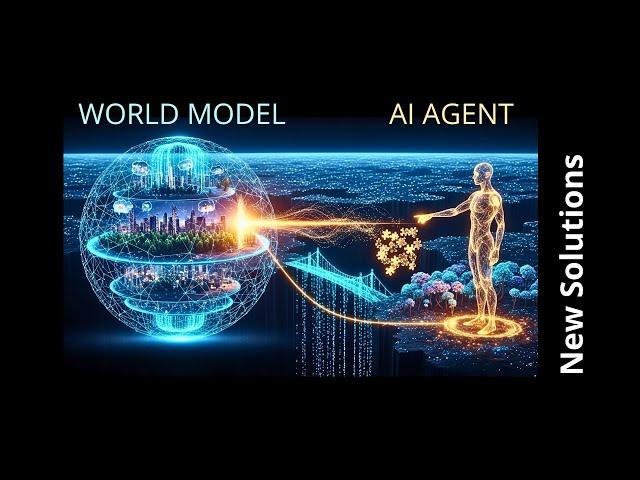
At a high level, a world model is an internal representation of an environment.
The goal is not necessarily to reproduce reality perfectly. Instead, the model captures enough information to predict what is likely to happen next.
For example, a self-driving car may use a world model to estimate how nearby vehicles will move. A robotic system may predict how objects will respond when manipulated. A virtual assistant may anticipate how users are likely to interact with future recommendations.
In each case, the system develops an internal understanding of cause-and-effect relationships.
This capability enables planning.
Rather than testing every possible action in the real world, the AI system can simulate outcomes internally and choose actions that appear most effective.
Humans perform similar reasoning constantly.
We imagine scenarios, evaluate consequences, and adjust decisions based on predicted outcomes. World models attempt to provide AI systems with analogous capabilities.
Why AI Agents Need World Models
The rise of AI agents has increased interest in world models significantly.
Modern agents increasingly operate in environments where multiple decisions interact over time. They must navigate uncertainty, coordinate tasks, manage resources, and achieve goals that require sequences of actions rather than single responses.
Reactive systems often struggle in these situations.
For example, an AI agent may successfully complete isolated tasks but fail when long-term planning is required. It may optimize for immediate rewards while overlooking downstream consequences.
World models help address these limitations.
By simulating future states, agents can evaluate potential strategies before acting. They can identify risks, compare alternatives, and make more informed decisions.
The growing importance of advanced planning is discussed in "The Rise of Agentic AI: What It Means for ML Engineers in Hiring," which explores how increasingly autonomous AI systems require deeper reasoning capabilities than traditional machine learning applications.
As agents become more capable, world models are emerging as a foundational technology supporting long-horizon decision-making.
World Models Support Generalization
One of the most important benefits of world models is their potential to improve generalization.
Traditional AI systems often perform well within environments similar to their training data. However, they may struggle when conditions change significantly.
World models help address this problem by focusing on underlying dynamics rather than memorized patterns.
Instead of learning only what happened historically, the system learns how environments behave. This allows it to reason about situations it has not encountered previously.
For example, a robot operating in unfamiliar surroundings may still function effectively if its world model accurately captures physical interactions. Similarly, an AI planning system may adapt to new business scenarios if it understands fundamental workflow dynamics.
This ability to generalize is one reason many researchers view world models as a critical step toward more flexible and capable AI systems.
Key Takeaway
World models allow AI systems to move beyond simple pattern recognition by learning how environments evolve over time. By creating internal simulations of reality, they help agents predict outcomes, plan actions, understand cause and effect, and generalize to unfamiliar situations. As AI agents become more autonomous, world models are emerging as one of the most important technologies enabling smarter decision-making and long-term reasoning.
Section 2: How World Models Actually Work
Learning an Internal Representation of the Environment
At the heart of every world model is a simple objective: learn how an environment behaves.
Unlike traditional machine learning systems that focus primarily on making predictions, world models attempt to construct an internal representation of reality. This representation captures the relationships between objects, actions, events, and outcomes within a given environment.
Consider how humans learn.
A child does not memorize every possible outcome of every action. Instead, they gradually develop an intuitive understanding of physics, movement, cause and effect, and how objects interact. Over time, they build a mental model of the world that helps them predict what will happen next.
World models attempt to achieve something similar.
The system observes interactions within an environment and learns patterns that explain how states change over time. These observations may come from videos, sensor data, user interactions, robotics environments, simulations, software systems, or real-world experiences.
Rather than storing individual examples, the model learns compressed representations that capture underlying dynamics.
For example, a robotic system may learn that pushing an object causes it to move. A self-driving system may learn how vehicles behave in traffic. A virtual assistant may learn how user actions influence future workflows.
This learned representation becomes the foundation for reasoning and planning.
The better the representation, the more accurately the system can anticipate future outcomes.
The Three Core Components of Most World Models
Although implementations vary, most world-model architectures contain three fundamental components.
The first component is perception.
Perception converts raw observations into a more compact representation. Instead of processing every pixel from a camera feed or every detail from a sensor stream, the system extracts the information most relevant to understanding the environment.
For example, a self-driving vehicle may identify lanes, vehicles, pedestrians, traffic signals, and road conditions rather than storing every image frame in its entirety.
The second component is dynamics modeling.
This component learns how the environment changes over time. Given a current state and a potential action, it predicts what future states are likely to occur.
For example, if a robot moves its arm, the dynamics model predicts how nearby objects may respond. If an AI agent sends a message to a user, the system may estimate how the user is likely to react.
The third component is planning.
Planning uses predictions generated by the world model to evaluate possible actions before they occur. The system effectively asks:
"If I take action A, what will happen?"
"If I take action B, will the outcome be better?"
By comparing predicted futures, the agent can choose actions more intelligently.
This combination of perception, dynamics modeling, and planning allows world models to support sophisticated decision-making in complex environments.
Simulation Allows AI to Think Before Acting
One of the most powerful capabilities enabled by world models is simulation.
Without a world model, many AI systems operate reactively. They observe an input and immediately generate a response. While this approach can be effective, it often limits long-term reasoning.
World models introduce a different possibility.
Instead of acting immediately, the AI can simulate potential futures internally.
Imagine a chess player considering several moves before making a decision. The player mentally explores different possibilities, evaluates risks, and selects the move that appears most promising.
World models enable similar behavior in AI systems.
An agent can evaluate multiple action sequences within its internal model rather than experimenting directly in the real world. This process dramatically improves efficiency because mistakes occur in simulation rather than reality.
The importance of planning-oriented architectures is reflected in "Machine Learning System Design Interview: Crack the Code with InterviewNode," which highlights how modern AI systems increasingly require planning, prediction, scalability, and decision-making capabilities beyond traditional supervised learning approaches.
Simulation becomes especially valuable in environments where errors are expensive.
Robots, autonomous vehicles, industrial systems, healthcare applications, and financial platforms all benefit when systems can anticipate outcomes before taking action.
Why World Models Are More Data-Efficient
Another major advantage of world models is improved data efficiency.
Many modern AI systems require enormous datasets to achieve strong performance. They often learn through repeated exposure to examples and extensive training.
World models can sometimes learn more efficiently because they focus on understanding underlying dynamics rather than memorizing specific situations.
Once an AI system understands how an environment behaves, it can often reason about situations it has never encountered directly.
For example, a robot that understands object motion does not need to observe every possible interaction before making useful predictions. A planning system that understands workflow dependencies may adapt to new business scenarios without requiring complete retraining.
This ability to extrapolate from learned dynamics is one reason world models are attracting significant research interest.
Researchers increasingly view them as a potential pathway toward more general and adaptable intelligence.
Rather than relying exclusively on larger datasets and larger models, future AI systems may achieve greater capability by developing richer internal representations of how the world works.
Key Takeaway
World models function by learning internal representations of environments, predicting how states evolve over time, and simulating possible futures before actions are taken. Through perception, dynamics modeling, and planning, these systems enable AI agents to reason about consequences rather than merely react to inputs. This ability to simulate outcomes, improve data efficiency, and support long-term planning makes world models one of the most promising technologies behind the next generation of intelligent AI agents.
Section 3: Why World Models Are Becoming Essential for Next-Generation AI Agents
Reactive AI Is Reaching Its Limits
The current generation of AI systems has achieved extraordinary capabilities.
Large Language Models can generate text, answer questions, write code, summarize information, and support a wide range of business workflows. AI assistants can automate tasks, retrieve knowledge, and interact with software applications. Recommendation systems personalize content at massive scale.
Despite these achievements, most systems remain fundamentally reactive.
They receive an input, process information, and generate an output. While this approach works well for many applications, it becomes increasingly limited as organizations seek more autonomous and capable AI agents.
Consider a business operations agent responsible for coordinating multiple workflows.
The agent may need to evaluate deadlines, allocate resources, anticipate bottlenecks, communicate with stakeholders, and adapt to changing priorities. These tasks require understanding how present decisions influence future outcomes.
Reactive systems often struggle in these environments because they optimize for immediate responses rather than long-term consequences.
World models provide a potential solution.
By allowing AI systems to simulate future scenarios internally, they help agents evaluate options before taking action. Instead of merely reacting, the system can reason about what is likely to happen next.
This shift from reaction to anticipation represents one of the most significant changes in modern AI development.
The future of intelligent agents will likely depend not only on generating responses but on understanding the consequences of actions over extended time horizons.
Autonomous Agents Need Long-Term Planning
One of the most important trends in artificial intelligence is the rise of autonomous agents.
Unlike traditional AI applications that perform isolated tasks, agents are increasingly expected to pursue goals that require multiple decisions over time. They must coordinate activities, recover from failures, adapt to changing environments, and achieve objectives without constant human supervision.
These requirements make planning essential.
For example, an enterprise AI agent may need to manage project workflows spanning several weeks. A logistics optimization system may need to coordinate shipments across multiple locations. A robotic assistant may need to complete tasks involving dozens of sequential actions.
In each case, short-term optimization is insufficient.
The system must evaluate how present actions influence future opportunities and constraints. It must consider trade-offs, anticipate obstacles, and adjust strategies dynamically.
World models enable these capabilities by providing an internal simulation environment where plans can be evaluated before execution.
Rather than learning only which actions worked historically, the system develops an understanding of why actions succeed or fail under different conditions.
This ability to reason across time is becoming increasingly important as AI agents move beyond simple task automation toward more sophisticated forms of autonomy.
Robotics Is Driving Renewed Interest in World Models
Few fields demonstrate the importance of world models more clearly than robotics.
Robots operate in environments where mistakes can be expensive. Unlike digital systems, physical agents interact directly with the real world. They must navigate uncertainty, manipulate objects, avoid collisions, and respond to changing conditions.
Traditional machine learning approaches often require enormous amounts of training data to handle these challenges effectively.
World models offer a more efficient alternative.
By learning the underlying dynamics of physical environments, robots can simulate actions before executing them. This reduces the need for trial-and-error learning and improves safety.
For example, a warehouse robot can predict whether a planned movement may cause a collision. A manufacturing robot can estimate how materials will respond during assembly. A household robot can evaluate different strategies for completing tasks in unfamiliar environments.
These capabilities significantly improve adaptability.
Rather than memorizing specific scenarios, the robot learns how the world behaves and applies that understanding to new situations.
The growing importance of adaptive reasoning is discussed in "The Rise of Agentic AI: What It Means for ML Engineers in Hiring," which highlights how increasingly autonomous systems require planning, environment modeling, and long-horizon decision-making capabilities.
As robotics continues advancing, world models are emerging as one of the most promising approaches for creating more capable and flexible intelligent machines.
World Models May Be a Step Toward More General Intelligence
One reason world models attract so much research attention is their potential connection to more general forms of intelligence.
Many current AI systems excel within narrow domains. They perform well when operating under conditions similar to their training environments but often struggle when faced with unfamiliar situations.
Humans exhibit a different kind of adaptability.
People can transfer knowledge between domains because they possess broad mental models of how the world works. We understand concepts such as space, time, causality, physical interactions, social behavior, and decision-making. These models help us navigate new situations even when direct experience is limited.
Researchers hope world models may help AI systems develop similar capabilities.
Rather than memorizing isolated patterns, future systems could learn abstract representations that capture fundamental properties of environments. These representations might allow AI agents to generalize more effectively across tasks and domains.
While significant challenges remain, many researchers view world models as an important step toward building systems capable of deeper reasoning and more flexible problem-solving.
This does not necessarily mean achieving Artificial General Intelligence (AGI) immediately.
However, it does suggest a pathway toward AI systems that understand environments more deeply, adapt more effectively, and make decisions with greater foresight than today's predominantly reactive models.
Key Takeaway
World models are becoming increasingly important because they help AI systems move beyond reactive behavior and toward genuine planning, reasoning, and adaptation. By enabling long-term decision-making, supporting autonomous agents, improving robotic intelligence, and potentially advancing generalization capabilities, world models are emerging as a foundational technology for the next generation of AI systems. As organizations pursue more capable and autonomous AI agents, the ability to simulate, predict, and reason about future outcomes will become a critical competitive advantage.
Section 4: The Future of World Models and What They Mean for AI Engineers
World Models Are Shifting AI From Prediction to Understanding
For much of the modern AI era, progress has been driven by prediction.
Language models predict the next token. Recommendation systems predict user preferences. Computer vision systems predict object categories. Fraud detection systems predict suspicious behavior.
This approach has produced remarkable results, but researchers increasingly recognize that prediction alone may not be sufficient for building highly capable autonomous systems.
The next stage of AI development may require deeper understanding.
World models represent an important step in this direction because they encourage systems to learn how environments function rather than simply recognizing patterns within data. Instead of focusing exclusively on outputs, these models attempt to capture the mechanisms that generate those outputs.
This distinction is significant.
An AI system that understands relationships between actions and consequences can adapt more effectively when conditions change. It can reason about unfamiliar situations, anticipate outcomes, and make decisions based on broader contextual understanding.
Many researchers believe this shift from prediction to understanding will become increasingly important as AI systems take on more complex responsibilities.
The organizations investing in world-model research are not merely seeking better predictions. They are seeking AI systems capable of reasoning about reality itself.
Multimodal Learning Is Accelerating World Model Development
One of the biggest developments supporting world models is the rapid growth of multimodal AI.
Modern AI systems increasingly process text, images, video, audio, sensor data, and structured information simultaneously. This capability provides significantly richer information about the world than any single modality alone.
For example, a robot may combine visual observations, motion sensors, force feedback, and language instructions to understand its environment. An autonomous vehicle may integrate cameras, radar, GPS, and mapping data. An enterprise AI agent may process documents, workflows, communications, and operational metrics simultaneously.
These diverse inputs help systems construct more accurate internal representations.
The more information an AI system can observe, the more effectively it can learn relationships between actions, events, and outcomes.
This trend is explored in "LLM Engineering Interviews: How to Prepare for Prompting, Fine-Tuning, and Evaluation," which highlights how modern AI systems are increasingly evolving beyond standalone language models into broader intelligent systems capable of integrating multiple sources of information.
As multimodal AI continues advancing, world models are expected to become increasingly sophisticated and capable.
World Models Will Create New Opportunities for AI Engineers
The rise of world models is also reshaping the skills required within the AI industry.
Historically, many machine learning roles focused heavily on supervised learning, model training, feature engineering, and predictive analytics. While these skills remain important, next-generation AI systems require additional expertise.
Engineers increasingly need to understand planning systems, reinforcement learning, simulation environments, agent architectures, multimodal learning, retrieval systems, and long-term decision-making frameworks.
This evolution is creating entirely new categories of technical challenges.
How should environments be represented?
How can simulations remain computationally efficient?
How should agents balance exploration and exploitation?
How can internal world representations be evaluated and monitored?
These questions are becoming increasingly relevant as organizations pursue more autonomous AI systems.
As a result, AI engineers who understand both traditional machine learning and emerging agent architectures are likely to be in particularly high demand.
The future of AI engineering may involve designing systems that reason about environments rather than merely generating predictions.
The Biggest Challenge: Building World Models That Reflect Reality
Despite their promise, world models remain an active area of research.
One of the biggest challenges is ensuring that internal simulations accurately reflect reality.
A world model is only useful if its predictions are sufficiently reliable. If the model develops incorrect assumptions about how environments behave, planning quality can deteriorate rapidly.
This challenge becomes more difficult as environments become increasingly complex.
Human societies, business operations, financial systems, healthcare environments, and physical worlds contain enormous numbers of interacting variables. Capturing these dynamics accurately is far from trivial.
Organizations therefore face an important balance.
World models must be detailed enough to support effective decision-making while remaining computationally efficient enough to operate in real-world systems.
Researchers continue exploring techniques that improve representation learning, simulation accuracy, reasoning capabilities, and scalability.
Although significant progress remains necessary, the trajectory is clear.
World models are becoming one of the most important research directions for creating AI systems that can reason, plan, adapt, and operate autonomously in complex environments.
Key Takeaway
World models represent a major step toward more capable AI systems by enabling machines to understand environments, simulate future outcomes, and reason about consequences. Advances in multimodal learning, agent architectures, and simulation technologies are accelerating their development, while new opportunities are emerging for AI engineers who understand these concepts. Although substantial challenges remain, world models are increasingly viewed as a foundational technology behind the next generation of intelligent agents and autonomous systems.
Conclusion
World models represent one of the most exciting developments in modern artificial intelligence because they address a limitation that has existed in many AI systems for years: the inability to truly reason about how the world changes over time.
Today's AI systems are incredibly capable at recognizing patterns, generating content, and responding to inputs. However, many of them remain fundamentally reactive. They excel at answering questions and completing tasks but often struggle when long-term planning, environmental understanding, and future prediction become necessary.
World models offer a different approach.
Instead of simply learning what happened in historical data, they learn how environments behave. They create internal representations of reality that allow AI systems to simulate outcomes, anticipate consequences, evaluate alternatives, and make better decisions before taking action.
This capability has enormous implications.
AI agents can become more autonomous. Robots can operate more safely and efficiently. Enterprise systems can manage increasingly complex workflows. Autonomous vehicles can reason more effectively about dynamic environments. Scientific AI systems can explore hypotheses before conducting costly experiments.
The significance of world models extends beyond individual applications.
They represent a broader shift in AI research from prediction toward understanding. Researchers are increasingly recognizing that true intelligence requires more than recognizing patterns, it requires understanding cause and effect, anticipating future states, and adapting to changing environments.
For AI engineers, this evolution is creating exciting opportunities.
The next generation of intelligent systems will require expertise in simulation, planning, reinforcement learning, multimodal reasoning, agent architectures, and environment modeling. Professionals who understand these concepts will play a central role in building the future of AI.
At the same time, significant challenges remain.
Creating accurate world representations is difficult. Simulating complex environments efficiently remains an active research problem. Ensuring that world models remain reliable across unfamiliar situations requires continued innovation.
Yet despite these challenges, the direction is becoming increasingly clear.
As AI systems become more autonomous and capable, the ability to model, predict, and reason about the world will become one of the most valuable capabilities an intelligent system can possess.
World models may not be the final step toward more advanced AI, but they are rapidly emerging as one of the most important technologies enabling smarter agents, better decision-making, and a future where AI systems can think before they act.
Frequently Asked Questions
1. What is a world model in AI?
A world model is an internal representation of an environment that allows an AI system to predict future states, understand cause-and-effect relationships, and simulate outcomes before taking actions.
2. Why are world models important?
World models help AI systems move beyond simple pattern recognition by enabling planning, reasoning, prediction, and long-term decision-making.
3. How are world models different from traditional machine learning models?
Traditional models typically focus on making predictions from historical data, while world models attempt to learn how environments behave and evolve over time.
4. What role do world models play in AI agents?
World models allow AI agents to evaluate possible future actions, compare outcomes, anticipate risks, and make more informed decisions.
5. Are world models used in robotics?
Yes. Robotics is one of the most important applications of world models because robots must understand physical environments and predict how actions will affect the world around them.
6. How do world models support planning?
They enable AI systems to simulate potential future scenarios internally and evaluate multiple strategies before choosing an action.
7. What are the main components of a world model?
Most world models include perception, dynamics modeling, and planning components that help systems observe environments, predict changes, and select actions.
8. How do world models improve data efficiency?
By learning the underlying dynamics of environments, world models can often generalize from fewer examples rather than relying solely on massive datasets.
9. Are world models related to reinforcement learning?
Yes. Many reinforcement learning systems use world models to simulate environments and evaluate actions more efficiently before interacting with the real world.
10. Can world models help AI generalize better?
Potentially. Because they focus on learning environmental dynamics rather than memorizing examples, world models may help systems adapt to unfamiliar situations more effectively.
11. How do world models relate to autonomous vehicles?
Autonomous vehicles use environment modeling techniques to predict how roads, pedestrians, cyclists, and other vehicles will behave in future moments.
12. What challenges do researchers face when building world models?
Key challenges include simulation accuracy, computational efficiency, scalability, representation learning, uncertainty handling, and adapting to complex real-world environments.
13. How does multimodal AI help world models?
Multimodal AI combines information from text, images, video, audio, sensors, and structured data, helping world models build richer and more accurate representations of reality.
14. Will world models be important for future AI careers?
Yes. Skills related to planning, reinforcement learning, agent architectures, simulation systems, and world modeling are expected to become increasingly valuable as AI systems grow more autonomous.
15. Could world models contribute to more advanced forms of AI?
Many researchers believe so. While world models alone are unlikely to create Artificial General Intelligence (AGI), they are widely viewed as an important building block for developing AI systems capable of deeper reasoning, planning, adaptation, and understanding.