Section 1: Why Traditional Database Query Optimizers Struggle With Complex Workloads
How Cost-Based Query Optimizers Generate and Select Execution Plans
Database query optimization is one of the most important responsibilities of a database management system because the same SQL query can often be executed through several different strategies, each with substantially different performance characteristics. When an application submits a query involving multiple tables, filtering conditions, joins, aggregations, and sorting, the database engine typically parses the SQL statement, transforms it into an internal representation, considers alternative execution plans, and selects a plan based on its estimates of execution cost. This process allows developers to describe the desired result without specifying every operational detail, while the database optimizer determines how to retrieve the required data using available indexes, access paths, join algorithms, and execution resources.
Traditional database optimizers commonly use cost-based optimization, in which alternative plans are evaluated using estimates of factors such as rows processed, disk operations, CPU consumption, memory requirements, and intermediate result sizes. For example, a query joining a customer table with millions of transaction records might execute more efficiently by filtering customers before accessing transactions, whereas another query may benefit from scanning a large table sequentially instead of repeatedly looking up individual rows through an index. The optimizer estimates the cost of these alternatives using database statistics and internal cost models, selecting the plan expected to require the least computational effort under its assumptions about the data and execution environment.
Although this approach is effective for many workloads, the quality of the selected plan depends heavily on the accuracy of the estimates used during optimization. If the optimizer incorrectly estimates the number of rows produced by a filter or join, it may select an inefficient join order, allocate unsuitable memory, or choose an access method that performs poorly on the actual data. These decisions become especially significant in complex analytical queries, where errors in early operations can propagate through subsequent joins and aggregations, causing a plan that appears inexpensive according to the optimizer's calculations to consume substantial CPU time, memory, and disk I/O during execution.
Why Cardinality Estimation and Cost Models Produce Incorrect Predictions
Cardinality estimation refers to predicting how many rows a query operation will produce, making it a central component of traditional query optimization because the estimated number of rows influences the costs assigned to alternative execution plans. Database systems maintain statistics about tables, indexes, column values, and data distributions to estimate the effects of filtering conditions and joins, but these summaries cannot always capture the relationships present in real-world datasets. When columns are correlated, values are highly skewed, or application behavior changes the distribution of stored records, the optimizer may estimate the number of qualifying rows inaccurately, leading it to favor a plan that appears efficient but performs poorly when executed.
Consider an e-commerce database containing millions of transactions, where a small percentage of customers account for a disproportionately large share of purchases and certain product categories experience seasonal demand spikes. A query filtering for a specific customer segment and a particular product category may involve correlated conditions that produce far fewer or far more rows than independent selectivity estimates suggest, particularly when the relevant distributions have changed since the database statistics were collected. If the optimizer significantly underestimates the number of rows produced by an early operation, it may choose a nested-loop join that works well for a small result but becomes expensive when the intermediate dataset grows, while an overestimate may encourage unnecessary scanning, hashing, or memory allocation.
Cost models introduce another source of uncertainty because predicted execution cost does not always translate directly into actual elapsed time. A plan estimated to require fewer operations may still execute more slowly because of cache misses, disk contention, concurrent queries, memory pressure, network communication, or differences in hardware performance, while a plan with a higher estimated cost may benefit from parallel execution or more efficient access to cached data. Machine learning can help address selected estimation problems by learning relationships between query characteristics, data statistics, and observed execution outcomes, although the quality of its predictions still depends on representative training data and reliable measurement of actual query performance.
How Join Ordering and Combinatorial Plan Spaces Affect Query Performance
Queries involving several tables can generate a large number of possible execution strategies because the optimizer must consider not only which operations to perform, but also the order in which data should be accessed and combined. A query joining five tables, for example, can use different join sequences, access paths, and algorithms, with the choice at each stage influencing the size and cost of subsequent operations. An early join that produces a large intermediate result can increase memory requirements and processing time throughout the rest of the query, whereas an alternative order that reduces the dataset quickly may substantially decrease the amount of work required to produce the final result.
The challenge grows as query complexity increases because exploring every possible execution plan can become prohibitively expensive, requiring optimizers to use search strategies, pruning rules, heuristics, and other techniques to limit the candidate space. These strategies make optimization practical by avoiding the exhaustive evaluation of every possible alternative, but they also mean that the optimizer's final selection may depend on the quality of its estimates and the effectiveness of its search procedure. When cardinality estimates are inaccurate, a promising plan may be discarded too early or an inefficient branch of the search space may receive too much attention, increasing the likelihood that the selected plan performs worse than an alternative that was never thoroughly considered.
Machine learning offers a potential way to improve some of these decisions by predicting the quality of candidate plans, identifying promising join sequences, or estimating intermediate result sizes more accurately for workloads represented in the training data. However, predicting plan quality involves more than recognizing a familiar query pattern because performance depends on the database's current data distribution, available indexes, configuration, resource contention, and physical execution environment. The distributed execution context also matters when queries run across services or data systems with different latency and resource characteristics, making the architectural considerations discussed in “Machine Learning in Distributed Systems: Where Models Meet Microservices” relevant to understanding how prediction components interact with the surrounding infrastructure and its performance constraints.
Key Takeaway
Traditional cost-based query optimizers provide a strong foundation for database performance, but inaccurate cardinality estimates, complex join-order decisions, limited plan exploration, and changing workloads can lead to inefficient execution plans. Machine learning offers opportunities to improve cost prediction and candidate-plan selection by learning from query characteristics, database statistics, and historical execution behavior, but its effectiveness depends on training-data quality, prediction reliability, and the conditions under which plans execute. The practical objective is to use learned predictions where they demonstrably improve performance while preserving the optimizer's ability to produce correct, reliable execution plans under changing production workloads.
Section 2: How Machine Learning Predicts and Selects Faster Execution Plans
Learning From Query Features, Database Statistics, and Execution History
Machine learning can improve database query optimization by learning relationships between query characteristics, database statistics, and observed execution performance, allowing an optimizer to make better-informed decisions when evaluating alternative execution plans. Traditional optimizers typically depend on predefined cost models and statistical summaries, whereas ML-based approaches can learn more complex relationships from historical workloads, including patterns that are difficult to represent through manually designed estimation formulas. The goal is not necessarily to replace every component of the existing optimizer, but to identify decisions where learned predictions can improve cardinality estimation, execution-cost estimation, or candidate-plan selection without introducing excessive planning overhead.
Building a useful training dataset begins with identifying the information that influences query execution, including the SQL structure, predicate conditions, table sizes, available indexes, estimated cardinalities, join types, and relevant database configuration settings. Historical execution records can provide additional information such as actual elapsed time, CPU consumption, memory use, rows processed, physical reads, and intermediate result sizes, helping a model learn how the characteristics of a query relate to its observed performance. These features must be collected consistently because the same query can behave differently across databases with different data distributions, indexes, hardware configurations, cache states, or concurrency levels.
Query representation is another important design decision because raw SQL text rarely captures every factor that determines execution cost, while database execution plans expose structural relationships that may be more directly relevant to optimization. Engineers can represent queries through normalized SQL features, relational operator trees, join graphs, table and column statistics, or learned embeddings that summarize structural patterns, depending on the model architecture and prediction objective. For example, a model trained to estimate join cardinality may benefit from information about the participating tables, join predicates, and data distributions, whereas a model intended to rank complete execution plans may require features describing the full operator tree and the costs associated with intermediate operations.
The quality of these representations ultimately determines how useful the resulting predictions will be, making feature engineering, workload coverage, and metadata consistency critical parts of an ML-guided optimizer. Training data should represent both common and difficult workloads, including highly selective queries, large joins, skewed distributions, and parameter-sensitive statements, while preserving the database context needed to interpret each observation correctly. Without this context, a model may learn patterns that appear predictive in historical records but fail to generalize when the underlying schema, dataset, or execution environment changes.
Predicting Query Costs, Cardinalities, and Execution Latency With ML Models
One of the most practical applications of machine learning in query optimization is improving cardinality estimation, which determines how many rows an operation is expected to produce and therefore influences subsequent plan decisions. Traditional estimation methods often rely on statistics such as histograms, distinct-value counts, and assumptions about the independence of predicates, which can become inaccurate when data contains correlated attributes, irregular value distributions, or substantial skew. A learned cardinality estimator can use examples from historical queries to identify patterns between query conditions, database metadata, and actual row counts, potentially producing more accurate estimates for cases where conventional statistical assumptions break down.
Execution-cost prediction addresses a related but distinct objective by estimating the resources or time required to execute a particular plan under a given workload and environment. A regression model might use operator types, estimated input and output cardinalities, table sizes, index availability, and plan structure to predict execution time or another performance measure, allowing the optimizer to compare alternatives using learned estimates rather than relying exclusively on hand-designed cost formulas. However, execution latency is affected by factors beyond the plan itself, including cache state, concurrent workloads, storage behavior, parallelism, and resource contention, so a useful model must either account for relevant environmental conditions or explicitly recognize the uncertainty of its predictions.
Different models can be appropriate for different prediction tasks, with tree-based models providing a practical starting point for structured query features and neural architectures offering alternatives for representing complex operator trees or relational structures. Supervised learning is particularly useful when historical execution measurements provide sufficiently reliable labels, although the quality of those labels depends on consistent benchmarking and careful separation of planning time from execution time. Engineers should also consider prediction targets carefully, because estimating relative plan quality may be more useful for candidate selection than predicting an exact latency value, especially when environmental variability makes precise runtime estimation difficult.
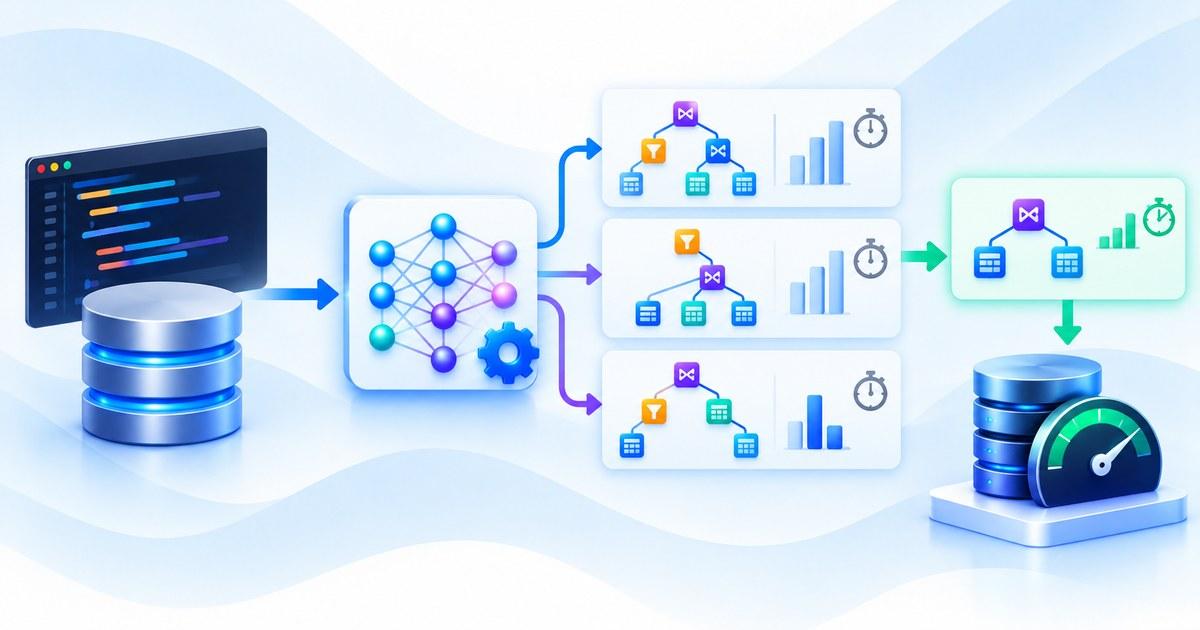
A critical engineering distinction is that a model predicting execution cost does not automatically discover the best possible execution plan, since its recommendations are constrained by the candidate plans supplied by the optimizer and the accuracy of its learned estimates. If plan exploration fails to include a strong alternative, even an accurate cost model cannot select that missing plan, while an unreliable prediction can cause the optimizer to rank candidates incorrectly. Effective designs therefore combine suitable model objectives with the optimizer's existing search mechanisms, evaluate prediction error across different query classes, and determine whether the learned estimates improve actual execution performance rather than treating lower estimation error as sufficient evidence of success.
Combining Learned Predictions With Traditional Optimizer Heuristics
A practical ML-guided database optimizer often combines learned estimates with established optimization mechanisms instead of replacing the conventional query planner with an entirely model-driven system. The traditional optimizer already provides important capabilities for parsing queries, applying relational transformations, enforcing semantic correctness, considering available access paths, and constructing valid execution plans, while machine learning can improve selected decisions where historical patterns provide additional predictive information. This hybrid approach allows database engineers to introduce learned cost estimates, cardinality predictions, or plan-ranking signals incrementally, evaluating their effects without discarding the reliability and extensive optimization logic already present in the database engine.
Integration can occur at several points in the optimization lifecycle, depending on the system's architecture and the weakness the ML component is intended to address. A learned cardinality estimator may replace or supplement a conventional estimate before join ordering, while an ML-based cost model may assign revised scores to candidate plans, and a ranking model may prioritize alternatives during plan exploration. Each integration point involves different trade-offs, because changing early estimates can affect many downstream planning decisions, whereas reranking complete candidate plans may require evaluating a larger set of alternatives and therefore increase planning time.
The computational cost of inference must also be considered when determining whether the learned component provides a net performance benefit. A sophisticated model may produce better plan predictions but require more time to evaluate than the database can reasonably spend planning a short query, meaning that additional inference overhead could exceed the execution time saved by choosing a better plan. The principles discussed in “The Economics of Machine Learning: Measuring the True Cost of a Model” are particularly relevant because the value of a learned optimizer depends on its overall operational economics, including inference latency, compute consumption, and the performance improvements realized across the actual query workload.
Hybrid designs should also account for prediction uncertainty and workload changes, since a model trained on historical executions may become less reliable when tables grow, query patterns shift, or the database configuration changes. Conservative deployment strategies can restrict learned predictions to supported query classes, compare model recommendations with conventional estimates, and fall back to established optimization mechanisms when the model produces uncertain or implausible results. By combining learned signals with valid plan generation, controlled exploration, and continuous performance measurement, engineering teams can improve selected optimization decisions while preserving the correctness and operational reliability expected from production database systems.
Key Takeaway
Machine learning can support database query optimization by learning from SQL structure, database statistics, execution history, and alternative plan outcomes to improve cardinality estimation, predict execution costs, and rank candidate plans. Its effectiveness depends on representative training data, reliable performance labels, appropriate model representations, and careful integration with the database engine's existing search and validation mechanisms. A hybrid optimizer that measures actual execution improvements, accounts for inference overhead, and retains conventional fallbacks offers a practical path toward faster query execution without assuming that learned predictions will always identify the optimal plan.
Section 3: Training and Evaluating ML Models for Query Optimization
Building Training Datasets From SQL Queries, Execution Plans, and Runtime Metrics
Building an effective machine learning model for database query optimization begins with collecting representative examples that connect query characteristics, execution plan structures, and observed performance. Unlike many conventional ML tasks, where training records contain relatively straightforward input features and target labels, query optimization requires information about both the logical requirements of a SQL statement and the physical operations used to execute it. Engineers must therefore collect SQL queries, normalized query representations, database schemas, table and column statistics, available indexes, candidate execution plans, and runtime measurements, ensuring that each training example preserves the context required to explain why a particular plan performed well or poorly.
Execution plans provide valuable structural information because they describe the operations selected by the database engine, including table scans, index lookups, joins, sorts, aggregations, and intermediate data processing. By extracting features from these plan trees, a training pipeline can represent estimated and actual row counts, operator types, join relationships, and the expected amount of work performed at different stages. Runtime telemetry adds another perspective through measurements such as elapsed execution time, CPU utilization, memory consumption, disk reads, rows processed, and temporary storage usage, allowing a model to learn how structural plan characteristics relate to the resources consumed during execution.
The dataset should also capture the conditions under which each query was executed, since runtime measurements can vary significantly even when the SQL statement and execution plan remain unchanged. Database version, hardware configuration, memory allocation, index availability, cache state, concurrent workload, parameter values, and database statistics can all influence observed performance, making it important to record relevant contextual information alongside the query and its execution results. Without this context, a model may attribute performance differences to plan structure when they actually result from resource contention or environmental changes, reducing its ability to generalize to production workloads.
Training-data collection should include a sufficiently diverse range of queries, from simple point lookups and selective filtering operations to complex analytical queries involving multiple joins, large aggregations, and substantial intermediate results. Engineers should also distinguish successful executions from timeouts, cancellations, and failed queries, because excluding difficult cases without understanding why they failed can produce a dataset that overrepresents easy workloads and understates the problems encountered in production. By combining query structure, execution-plan information, runtime measurements, and environmental metadata, teams can create a training dataset that supports more reliable performance prediction and plan selection.
Designing Reliable Labels for Plan Quality and Execution Performance
The choice of training labels determines what an ML-based query optimizer learns to predict, making label design an important decision that should reflect the actual objective of the optimization system. A model intended to estimate query execution latency needs reliable runtime measurements, while a cardinality estimator requires actual row counts produced by relevant query operators, and a plan-ranking model needs information that establishes which candidate plans perform better under comparable conditions. Although these objectives are related, they are not interchangeable, because accurate cardinality estimates do not automatically guarantee precise latency predictions, and a model that predicts runtime reasonably well may still rank two similarly performing plans incorrectly.
Execution time is a particularly challenging label because it can vary across repeated runs due to cache warming, background database activity, disk behavior, concurrency, and resource scheduling. A plan that completes in 200 milliseconds during an isolated benchmark might take substantially longer when executed alongside several resource-intensive queries, creating noise that makes it difficult for a model to distinguish inherent plan efficiency from temporary environmental conditions. Engineers can reduce this uncertainty by running controlled experiments, repeating measurements when appropriate, recording environmental conditions, and using suitable summary statistics rather than treating every individual execution time as an exact and universally representative label.
Another challenge is determining what constitutes a better plan when different performance objectives compete with one another. One plan may deliver lower average latency but consume more memory, while another may reduce CPU utilization but exhibit worse tail latency under high concurrency, making a single objective necessary for consistent plan comparisons. A training pipeline should therefore define whether optimization targets execution time, resource consumption, a weighted combination of costs, or a service-level objective such as a maximum acceptable latency, while preserving additional metrics that can reveal undesirable trade-offs.
For ranking models, training examples should compare alternative plans under sufficiently comparable conditions so that the relative performance labels reflect meaningful differences in execution strategy rather than unrelated environmental variation. Engineers may use repeated measurements, pairwise preferences, or normalized performance ratios to establish rankings, while accounting for cases where timing differences fall within measurement noise and cannot support a reliable preference. By explicitly defining the prediction target, documenting label-generation procedures, and validating the consistency of performance measurements, teams can prevent unreliable training labels from encouraging optimization decisions that look promising in offline experiments but fail to improve real database performance.
Preventing Workload Leakage, Overfitting, and Unreliable Optimization Decisions
Workload leakage occurs when training and evaluation datasets contain related information that makes the model appear more capable of generalizing than it actually is. For example, randomly splitting individual executions can place nearly identical queries with different parameter values into both training and testing datasets, allowing the model to recognize familiar patterns instead of learning optimization behavior that transfers to genuinely new workloads. Similar leakage can occur when repeated executions of the same query, nearly identical plan trees, or records generated from the same underlying workload are divided across the dataset splits without accounting for their relationships.
Engineers can reduce this risk by designing evaluation splits around meaningful differences in query templates, workload periods, parameter distributions, or database states, depending on the model's intended use. A temporal split can train the model on historical workloads and evaluate it on later executions, providing evidence about how well its predictions generalize as query behavior and database conditions evolve. Testing on previously unseen query patterns or substantially different data distributions can reveal additional weaknesses, although these evaluations should complement rather than replace representative testing of the workload the optimizer is expected to serve.
Overfitting presents another challenge because a model can learn associations that hold for a limited collection of SQL statements, schemas, or hardware configurations without capturing broader relationships between execution plans and performance. Feature selection, regularization, validation on independent workloads, and careful model-complexity management can reduce this risk, while repeated benchmarking and performance analysis help identify cases where apparent improvements depend on unusually favorable test conditions. Teams should also examine performance separately across query classes and difficult cases, since aggregate results can obscure substantial regressions in specific joins, access patterns, or data distributions.
The testing discipline discussed in “ML Testing for Software Engineers: How to Test Systems That Don't Always Produce the Same Output” is relevant because learned query optimizers must be evaluated through measurable behavioral boundaries and regression tests rather than assumptions that every prediction will remain identical across environments. Engineers should validate query correctness, enforce reasonable resource and latency limits, compare candidate plans against established baselines, and retain conventional optimizer fallbacks when model predictions are unreliable or unsupported by the available training data. By combining leakage-resistant evaluation, workload diversity, regression testing, and conservative deployment controls, teams can establish whether an ML-based optimizer delivers repeatable improvements without introducing unacceptable performance risks.
Key Takeaway
Training effective ML models for query optimization requires representative datasets that connect SQL structure, execution plans, database conditions, and reliable runtime measurements. Engineers must define meaningful labels, distinguish prediction accuracy from actual plan-selection quality, and evaluate learned optimizers against established baselines using realistic workloads and end-to-end performance metrics. By preventing workload leakage, testing generalization across different query patterns, and retaining safeguards against unreliable predictions, teams can determine whether machine learning genuinely improves query execution rather than merely performing well on historical benchmarks.
Conclusion: Building Faster Databases With Machine Learning
Database query optimization plays a central role in application performance because the execution strategy selected for a SQL statement can determine how much CPU time, memory, disk I/O, and processing latency are required to retrieve the requested data. Traditional cost-based optimizers use database statistics, predefined cost models, and search strategies to compare alternative execution plans, but inaccurate cardinality estimates, correlated data, skewed distributions, and changing workloads can cause them to select inefficient plans. These limitations create opportunities for machine learning to improve selected optimization decisions by learning relationships between query characteristics, execution-plan structures, and observed performance.
Machine learning can contribute to query optimization in several ways, including improving cardinality estimation, predicting execution costs, ranking candidate plans, and identifying patterns associated with efficient or inefficient query execution. Models can learn from SQL structures, table and column statistics, index availability, operator trees, and historical execution measurements to estimate which alternatives are likely to perform better under particular conditions. However, accurate prediction does not automatically guarantee faster execution, because the optimizer must still generate suitable candidate plans, account for execution constraints, and ensure that the selected strategy produces correct results.
Building effective ML-based optimizers also requires careful attention to training-data quality, label reliability, and evaluation methodology. Historical execution times can vary because of cache conditions, concurrent workloads, memory pressure, hardware differences, and other factors, making it important to collect relevant metadata and compare alternative plans under reasonably consistent conditions. Evaluation should measure not only prediction accuracy but also actual execution latency, throughput, tail latency, planning overhead, resource consumption, and the frequency of performance regressions, ensuring that improvements observed in offline experiments translate into meaningful production benefits.
Production deployment introduces additional responsibilities because learned predictions must operate within the database's query-planning lifecycle without becoming a new source of latency or operational instability. Hybrid architectures provide a practical approach by combining ML-based estimates or rankings with established optimizer mechanisms, while fallback strategies, prediction validation, model versioning, and controlled rollouts help contain the impact of unreliable recommendations. Continuous monitoring of execution outcomes, query patterns, feature distributions, and prediction errors allows engineering teams to detect workload drift and determine when changes to the model, database statistics, or optimization strategy are necessary.
Ultimately, machine learning should be introduced into database query optimization where it demonstrates measurable value rather than being treated as an automatic replacement for conventional optimization techniques. Some workloads may benefit substantially from learned cardinality estimates or plan rankings, particularly when traditional assumptions fail to capture complex data relationships, while simpler queries may continue to perform best with established cost-based methods. By combining carefully designed training datasets, realistic benchmarking, reliable integration, and production safeguards, engineering teams can use machine learning to improve query execution while maintaining the correctness, predictability, and operational reliability required by modern database systems.
Frequently Asked Questions
1. What Is Machine Learning for Database Query Optimization?
Machine learning for database query optimization uses models trained on query characteristics, database statistics, execution plans, and observed runtime performance to improve decisions about how SQL statements should execute. These models can help estimate cardinalities, predict execution costs, or rank alternative plans, allowing the database optimizer to incorporate patterns learned from historical workloads alongside its existing optimization techniques.
2. How Does a Traditional Database Query Optimizer Work?
A traditional query optimizer parses a SQL statement, considers alternative execution strategies, estimates their costs, and selects a plan expected to retrieve the required data efficiently. Its decisions commonly depend on table and column statistics, available indexes, estimated intermediate result sizes, join algorithms, and cost models, with inaccurate estimates sometimes causing the optimizer to select a plan that performs poorly during actual execution.
3. Why Do Traditional Query Optimizers Sometimes Select Slow Execution Plans?
Traditional optimizers can select inefficient plans when cardinality estimates are inaccurate, data distributions change, columns contain correlated values, or parameter values produce unexpectedly large result sets. These estimation errors can influence join ordering, index selection, memory allocation, and intermediate result sizes, causing a plan that appears inexpensive during optimization to consume substantial resources when executed.
4. What Is a Learned Query Optimizer?
A learned query optimizer uses machine learning to improve one or more decisions involved in generating, evaluating, or selecting database execution plans. Depending on its architecture, it may predict cardinalities, estimate execution costs, rank candidate plans, or guide plan exploration, while a hybrid design can retain conventional optimization mechanisms for query transformation, plan generation, and correctness safeguards.
5. How Can Machine Learning Improve Cardinality Estimation?
Machine learning can improve cardinality estimation by learning relationships between query predicates, column characteristics, data distributions, and observed row counts from historical execution data. This approach may help with complex correlations and skewed distributions that are difficult for conventional statistical summaries to represent accurately, although its effectiveness depends on representative training examples and the extent to which production data resembles the model's training conditions.
6. What Data Is Required to Train a Machine Learning Query Optimizer?
Training a query optimizer typically requires SQL queries, database schemas, table and column statistics, available indexes, execution-plan structures, and reliable measurements of actual performance. Additional metadata about parameter values, database configuration, hardware, cache conditions, and concurrent workloads can help explain execution variability, allowing the model to distinguish relationships associated with plan quality from differences caused by the environment.
7. What Is the Difference Between Predicting Query Cost and Selecting an Execution Plan?
Predicting query cost estimates how expensive a particular execution plan may be in terms of runtime or resource consumption, whereas plan selection uses cost estimates or other decision criteria to choose among available alternatives. An accurate cost predictor can support better decisions, but the optimizer must still generate suitable candidate plans, compare their predicted performance, and preserve the database engine's query-correctness requirements.
8. Can Machine Learning Automatically Find the Optimal SQL Execution Plan?
Machine learning can help identify promising execution plans, but it cannot guarantee that the globally optimal plan will always be found because candidate generation, search limits, training-data coverage, and prediction uncertainty constrain the decision process. A practical implementation uses learned predictions to guide optimization while retaining plan validation and established optimizer mechanisms, evaluating the selected plans against actual execution results rather than assuming that model recommendations are always optimal.
9. How Are Machine Learning Models Evaluated for Query Optimization?
ML-based optimizers should be evaluated against a suitable conventional optimizer using representative workloads, comparable database configurations, and reliable runtime measurements. Evaluation should include actual execution latency, throughput, tail latency, CPU and memory consumption, planning overhead, cardinality error, plan-ranking quality, and severe performance regressions, since a model with accurate numerical predictions may still make poor plan-selection decisions.
10. How Can Engineers Prevent Overfitting in Learned Query Optimizers?
Engineers can reduce overfitting by evaluating models on query templates, parameter distributions, workload periods, and database conditions that are meaningfully separate from the training data. Temporal validation and testing on unfamiliar query patterns can reveal whether the model generalizes beyond historical examples, while workload-specific performance analysis helps identify cases where apparent improvements depend on repeated or unusually favorable benchmark queries.
11. Does an ML-Based Query Optimizer Replace a Traditional Cost-Based Optimizer?
An ML-based optimizer does not necessarily replace a traditional cost-based optimizer, because machine learning can be integrated into selected components while established mechanisms continue to handle other planning responsibilities. A hybrid architecture may use learned cardinality estimates, cost predictions, or candidate-plan rankings while retaining conventional query transformations and validation, allowing teams to introduce ML incrementally and measure its value for specific workload classes.
12. How Much Latency Does Machine Learning Add to Query Planning?
The additional latency depends on model complexity, feature extraction requirements, inference hardware, data access patterns, and the number of candidate plans that must be evaluated. This overhead may be worthwhile for complex analytical queries when it helps avoid expensive execution plans, but it can outweigh the benefit for short queries, making it important to measure end-to-end performance and use lightweight models or conventional optimization when additional prediction work provides insufficient value.
13. How Should an ML Query Optimizer Handle Unreliable Predictions?
A production optimizer should validate model inputs and outputs, identify unsupported query patterns, and define conditions under which uncertain or implausible predictions are rejected. Depending on the architecture, the system can revert to conventional cost estimates, enforce query timeouts and resource limits, or restrict ML-guided decisions to validated query classes, while using controlled rollouts to identify harmful regressions before expanding deployment.
14. How Can Engineers Detect Workload Drift in an ML-Based Query Optimizer?
Workload drift can be detected by monitoring changes in query-template frequencies, database statistics, feature distributions, prediction errors, and the difference between estimated and observed execution performance. These measurements should be evaluated alongside latency, throughput, resource consumption, and plan-regression metrics, helping engineers determine whether a model's assumptions have become unreliable and whether statistics refreshes, model recalibration, retraining, or a rollback is appropriate.
15. When Should an Organization Use Machine Learning for Database Query Optimization?
Organizations should consider ML-guided query optimization when they have performance-critical workloads, measurable limitations in existing optimization decisions, and sufficient execution data to train and validate a model. A useful starting point is to identify query classes where inaccurate cardinality estimates or cost predictions cause repeated performance problems, then compare an ML-assisted approach against the conventional optimizer under representative workloads to determine whether the improvement justifies inference overhead, infrastructure costs, and ongoing operational complexity.