Section 1: Understanding Test-Time Compute and Why More Inference Can Improve Predictions
Training-Time Compute Versus Test-Time Compute: Understanding the Difference
Machine learning performance is traditionally improved by training larger models, increasing the amount of training data, refining model architectures, and investing additional computational resources in optimization. However, these approaches primarily change the capabilities encoded in the model's parameters, whereas test-time compute focuses on allocating additional computation when a model is asked to produce a particular prediction. Instead of relying exclusively on a single inference pass, a system can generate multiple candidate answers, evaluate alternative solutions, refine an initial response, or explore different possibilities before returning its final result. This approach is especially relevant to reasoning-intensive tasks, where reaching a reliable answer may require several dependent steps rather than a single straightforward transformation of input into output.
Training-time compute and test-time compute therefore serve different purposes within the machine learning lifecycle, even though both can contribute to better overall performance. Training computation is used to learn model parameters from data, including through optimization procedures that repeatedly adjust those parameters based on training objectives, while test-time computation is applied after the model has been trained to improve how a particular input is handled. For example, a model trained to solve mathematical problems may produce one answer immediately, or an inference system may generate several candidate solutions, check their intermediate results, and select the most convincing candidate using an appropriate evaluation mechanism. The second approach spends more computation on the individual problem without necessarily changing the underlying model parameters.
This distinction changes how engineers think about model quality because a model's useful capabilities depend not only on what it learned during training but also on how effectively those capabilities are applied during inference. A relatively strong model may benefit from additional search or verification when a problem is difficult, while an ordinary request may be answered accurately with a single execution. The challenge is determining when additional computation meaningfully improves the result, which requires measuring the relationship between inference budget, prediction quality, response latency, and operating cost rather than assuming that longer computation automatically produces better answers.
Why a Single Forward Pass May Be Insufficient for Difficult Prediction Tasks
A conventional inference request often follows a relatively direct path: the system receives an input, processes it through the trained model, and returns a prediction. This approach can work extremely well for routine classification, common retrieval tasks, and familiar patterns represented adequately in the model's training data, but it may be less reliable when a problem requires exploring several possibilities, coordinating dependent decisions, or checking whether intermediate results are consistent. Complex mathematical problems, multi-step programming tasks, planning decisions, and analytical questions can contain several interacting constraints, making it possible for an initially plausible answer to fail because of one incorrect assumption or an overlooked condition.
Additional test-time computation creates opportunities to examine these difficult cases more thoroughly by generating alternative solutions, decomposing a problem into smaller stages, or revisiting an initial result when a subsequent check identifies an inconsistency. A coding assistant, for example, may generate an initial implementation, examine whether it satisfies the requested requirements, test relevant edge cases, and revise the solution when the tests reveal a defect. Similarly, a mathematical reasoning system can compare alternative derivations or check whether a final result satisfies the original constraints, reducing dependence on the first candidate produced by the model. These mechanisms are useful because they allow the inference system to spend computation on evaluation and correction rather than treating the initial output as necessarily final.
However, additional attempts are valuable only when the system has a way to identify meaningful improvements, since generating multiple incorrect answers does not guarantee that the correct answer will be among them or that the selection mechanism will recognize it. Candidate generation may produce highly similar outputs because the model repeatedly follows the same learned patterns, and a verifier may favor a fluent but incorrect solution when its evaluation criteria do not adequately capture correctness. Engineers must therefore distinguish the number of computations performed from the quality of the evidence those computations provide, using task-specific validation, reliable scoring mechanisms, or external checks where appropriate to determine whether further inference improves the final decision.
The Main Approaches to Allocating More Computation During Inference
Several approaches can increase test-time compute, with each method allocating processing effort differently according to the problem being solved and the type of feedback available during inference. Best-of-N sampling generates multiple candidates and selects one using a scoring or verification mechanism, while self-consistency aggregates results from different reasoning attempts when agreement provides useful evidence about the answer. Iterative refinement allows a model to improve an initial output through successive revisions, whereas search-based approaches explore alternative states, decisions, or solution paths within a defined search space. These strategies can be combined, but their effectiveness depends on whether the additional computation provides new information or simply repeats the same reasoning pattern.
Verifier-guided inference adds an evaluation component that assesses candidate outputs against a learned reward model, a task-specific scoring rule, executable tests, or another source of evidence about correctness. In a programming task, for example, generated solutions may be evaluated using unit tests, while a structured optimization problem may allow candidate solutions to be checked against explicit constraints. These signals can help an inference system allocate more computation toward promising candidates and reject clearly invalid ones, although imperfect verifiers introduce their own risks by misranking solutions or encouraging the model to exploit weaknesses in the scoring mechanism. A reliable design therefore evaluates the quality of both candidate generation and candidate selection, since improvements in one component may not translate into better final predictions when the other remains weak.
The principles discussed in “Efficient ML: How to Build High-Performance Models With Less Compute” are relevant because test-time scaling requires engineers to justify additional resource consumption through measurable improvements in useful output quality. A production system should select an inference strategy according to the task's complexity, available latency budget, reliability requirements, and the expected benefit of additional evaluation, rather than applying maximum computation to every request. By comparing different inference budgets and candidate-selection strategies against a suitable baseline, teams can identify where extra computation improves predictions and where a simpler execution path provides better overall efficiency.
Key Takeaway
Test-time compute allows machine learning systems to devote additional processing to individual predictions through candidate generation, iterative refinement, search, and verification, rather than relying entirely on a single inference pass. Its effectiveness depends on the model's capabilities, the diversity of candidate solutions, the reliability of evaluation mechanisms, and the difficulty of the task, with diminishing returns emerging when further computation adds little useful information. By measuring the relationship between prediction quality, latency, and cost, engineering teams can allocate inference compute where it produces meaningful improvements instead of assuming that greater computational expenditure automatically guarantees better results.
Section 2: Techniques for Improving Predictions With Additional Inference Computation
Best-of-N Sampling and Candidate Selection
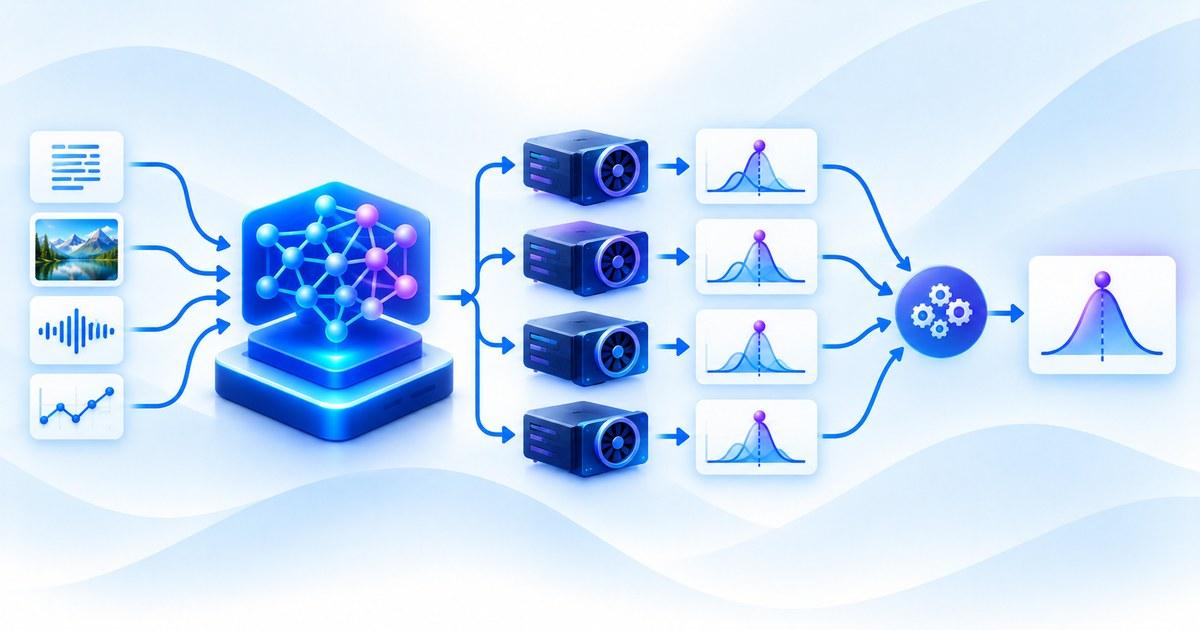
Best-of-N sampling is a test-time compute technique in which a model generates multiple candidate solutions for the same input and selects one using a scoring or evaluation mechanism. Instead of accepting the first response, the system allocates additional inference computation to explore different possible outputs, increasing the opportunity to identify a correct, complete, or otherwise higher-quality solution. This approach can be useful for mathematical reasoning, code generation, structured planning, and other tasks where several plausible responses may differ substantially in correctness, but its effectiveness depends on both the diversity of generated candidates and the ability of the selection mechanism to distinguish strong solutions from weak ones.
The process generally involves sampling several responses under a configured generation strategy, evaluating them using a suitable scoring mechanism, and returning the candidate that performs best according to the chosen objective. For example, a code-generation system might produce five implementations for a programming problem and evaluate each implementation against a set of unit tests, allowing the system to select a candidate that satisfies more of the required behaviors. In a reasoning-intensive application without executable tests, a learned reward model or task-specific verifier may instead assess consistency, constraint satisfaction, or other indicators of solution quality, although these evaluations provide useful evidence only to the extent that the scoring mechanism has been validated for the task.
Increasing the number of candidates can improve the probability of generating a strong solution when the model produces meaningfully different alternatives and the selection process can identify the best one. However, candidate generation is not equivalent to candidate quality, because repeated samples may share the same underlying error, and a weak evaluator may consistently select a fluent but incorrect response over a less polished correct answer. Best-of-N sampling also introduces additional latency, token consumption, memory use, and inference cost, making it important to determine whether the marginal improvement from each additional candidate justifies its resource requirements.
Self-Consistency and Aggregating Multiple Reasoning Paths
Self-consistency improves inference by generating multiple reasoning attempts for the same problem and aggregating their answers instead of depending entirely on a single generated response. The underlying idea is that a difficult question may permit several possible reasoning paths, and when independently generated attempts converge on the same answer, their agreement can provide a useful signal about the likely result. This method is particularly applicable to structured reasoning tasks where answers can be compared or normalized, such as arithmetic problems, logical questions, and selected planning tasks, although agreement should not be treated as definitive proof of correctness because multiple reasoning attempts can repeat the same underlying misconception.
A typical self-consistency pipeline samples multiple reasoning sequences, extracts their final answers, and combines the results through majority voting or another task-appropriate aggregation strategy. For example, a system solving a numerical word problem may independently generate several solutions, convert their final responses into normalized numerical values, and select the answer that appears most consistently across the attempts. This approach avoids requiring an evaluator to judge every intermediate reasoning step, since the system can aggregate final answers when those answers are easy to compare, while more complex outputs may require semantic comparison or a structured evaluation procedure before aggregation becomes reliable.
The benefits of self-consistency depend on the quality and independence of the sampled reasoning paths, because highly correlated responses can agree on the same incorrect answer and create unjustified confidence. Increasing sampling diversity may improve the opportunity to discover alternative solutions, but excessively similar candidates provide limited additional evidence, while ambiguous answers or inconsistent output formats can make aggregation difficult. Engineers should therefore evaluate self-consistency against a single-sample baseline and suitable alternative methods, measuring whether the additional computation improves task accuracy and calibration rather than assuming that greater agreement necessarily reflects greater correctness.
Self-consistency also introduces operational considerations because all sampled responses consume inference resources, and the aggregation stage must wait until enough results are available to make a decision. Parallel generation can reduce the additional wall-clock time when hardware capacity is available, but it may increase peak memory usage and reduce overall service throughput under high concurrency, whereas sequential sampling may be easier to control but can substantially increase response latency. The appropriate implementation therefore depends on the task's response-time requirements, the cost of an incorrect answer, and the extent to which additional reasoning attempts produce genuinely independent evidence about the final result.
Verifier-Guided Inference and Reward-Based Candidate Selection
Verifier-guided inference uses an evaluation mechanism to assess candidate solutions and direct additional computation toward outputs that appear to satisfy the task's requirements. A verifier may be a learned model trained to judge correctness or quality, a reward model that assigns preference scores, a rule-based validator that checks explicit constraints, or an executable test suite that determines whether a generated solution behaves as expected. By evaluating candidates during or after generation, the inference system can reject unsuitable outputs, select stronger alternatives, or use feedback to guide further refinement, making the verifier an important component of test-time compute strategies that depend on more than repeated sampling alone.
The effectiveness of verifier-guided inference depends on how closely the evaluation signal corresponds to the outcome the application actually needs. In code generation, executable tests can provide strong evidence that a candidate satisfies the covered behaviors, although incomplete tests may miss defects in untested conditions; in mathematical reasoning, a symbolic check or independent calculation may validate a result more reliably than a general-purpose language-model judgment. Learned verifiers can assess more complex outputs where explicit rules are difficult to construct, but their scores may reflect superficial patterns or biases in the training data rather than genuine correctness, requiring systematic evaluation before their outputs are used to select candidates in high-impact workflows.
Verifier-guided inference can also allocate computation adaptively by directing further sampling or refinement toward promising candidates that do not yet satisfy all required conditions. A system might reject candidates that violate explicit constraints, retain several strong alternatives for comparison, and spend additional inference resources on ambiguous cases where more exploration could meaningfully change the outcome. This approach may reduce wasted computation compared with generating a fixed large number of candidates for every request, but adaptive allocation requires reliable thresholds and a clear policy for situations where no candidate passes verification within the available budget.
The operational costs of verification must also be incorporated into the overall inference design because running a separate model, executing generated code, or repeatedly checking intermediate solutions adds latency and resource consumption. The engineering principles discussed in “Inference Optimization for ML Engineers: Reducing Latency Without Sacrificing Model Quality” are relevant because repeated generation and evaluation should be measured as part of the complete prediction pipeline rather than optimized as isolated stages. By benchmarking candidate generation, verification, selection, and any subsequent refinement together, engineering teams can establish whether verifier-guided computation improves the quality of final predictions enough to justify its additional cost and operational complexity.
Key Takeaway
Best-of-N sampling, self-consistency, iterative refinement, search, and verifier-guided inference provide different ways to allocate additional computation when a single prediction may be insufficient for a difficult task. Their effectiveness depends on candidate diversity, the reliability of evaluation mechanisms, the structure of the problem, and the ability to stop spending compute when further processing no longer provides meaningful improvement. By evaluating complete inference workflows against suitable baselines and measuring accuracy alongside latency and cost, engineers can choose strategies that improve prediction quality without allowing additional computation to become an uncontrolled serving expense.
Section 3: Designing Adaptive Test-Time Compute for Real-World Applications
Allocating Compute According to Task Difficulty and Prediction Uncertainty
Production machine learning systems rarely receive requests that all require the same amount of reasoning, verification, or computational effort, making a fixed inference budget inefficient for workloads that contain both straightforward and difficult tasks. A simple factual question may be answered reliably through a single model execution, whereas a complicated programming problem, mathematical derivation, or multi-constraint planning task may benefit from generating alternatives and checking intermediate results. Adaptive test-time compute addresses this variation by allocating additional inference resources according to the expected difficulty of a request, allowing a system to spend more computation where it is likely to improve the final result while keeping routine requests fast and inexpensive.
Estimating task difficulty can involve several signals, including the complexity of the input, the number of dependent reasoning steps, disagreement among candidate answers, uncertainty in intermediate results, or failures detected by a validation mechanism. For example, a code-generation service might use a lightweight initial attempt and a set of automated tests to determine whether further reasoning is necessary, while a mathematical reasoning system could generate additional candidates when independent attempts disagree on the result. These signals provide practical ways to guide compute allocation, although none should be treated as a universally reliable measure of difficulty because a model can be confidently wrong or produce similar answers across repeated attempts.
Prediction uncertainty and task difficulty should also be distinguished because they represent related but different reasons for allocating additional computation. A problem may be inherently complex but still fall within a model's well-understood capabilities, while a seemingly simple request can be ambiguous because the input lacks critical information or resembles unfamiliar training examples. An adaptive system should therefore consider both the expected benefit of additional reasoning and the possibility that more computation will not resolve the underlying uncertainty, particularly when the model lacks the knowledge, tools, or evidence required to answer correctly. By measuring the improvement associated with different inference budgets across representative task categories, engineering teams can establish allocation policies that reflect observed performance rather than relying exclusively on subjective difficulty scores.
Choosing Between Parallel Sampling and Sequential Reasoning
Parallel sampling allocates additional compute by generating multiple candidate responses independently, enabling the system to explore different possible answers without requiring each candidate to wait for the previous one to finish. This approach works well when candidate generation can be performed concurrently and the task offers a reliable way to compare the resulting outputs, as in code generation with executable tests or structured problem-solving tasks with verifiable answers. Parallel execution can reduce the wall-clock penalty associated with generating several candidates, but it increases aggregate computation, memory demand, and accelerator utilization, which may reduce overall service throughput when many requests compete for the same resources.
Sequential reasoning takes a different approach by allowing each stage to depend on the information produced by earlier stages, making it possible to refine an initial answer, test a hypothesis, or revise a solution after discovering a problem. A coding agent, for example, may generate a program, execute its tests, inspect a failure, and then update the implementation using the test results, with each subsequent step informed by evidence that was unavailable at the beginning. This process can be more efficient than generating multiple unrelated candidates when feedback meaningfully guides the next action, although its latency can increase because later stages must wait for earlier reasoning or evaluation to complete.
The choice between parallel and sequential computation depends on the task structure, available feedback, latency requirements, and the ability to execute multiple candidates economically. Parallel sampling is attractive when alternatives can be generated independently and evaluated together, whereas sequential reasoning is often useful when intermediate results determine which action should be taken next or which part of the solution deserves further investigation. Hybrid approaches can combine both strategies by producing several initial candidates in parallel, using a verifier to identify promising options, and spending further sequential reasoning on the strongest candidates, provided that the expected quality improvement justifies the additional coordination and compute costs.
Building Dynamic Inference Budgets, Early Stopping, and Escalation Policies
An adaptive inference architecture needs explicit budget controls that determine how much computation each request can consume, since unrestricted sampling or repeated reasoning can increase latency and cost without guaranteeing a better result. Practical limits may include maximum generated tokens, candidate counts, search depth, verification attempts, wall-clock time, or total model calls, with the appropriate combination depending on the serving environment and the task's acceptable failure risk. These budgets should be designed around measurable application requirements, ensuring that a high-priority reasoning task can receive additional processing while routine requests remain within predictable resource limits.
Early stopping helps prevent unnecessary computation by terminating the inference process when the system has sufficient evidence to return a useful result or when further processing is unlikely to improve the outcome. A system might stop when an executable solution passes its required tests, when candidate agreement reaches a validated threshold, or when a search procedure finds a solution that meets explicit constraints, although each stopping criterion must be tested for the relevant task. Agreement alone may be insufficient when multiple candidates share the same error, and a verifier can prematurely stop a search if its evaluation is unreliable, making it important to understand how stopping decisions affect both quality and cost across different input categories.
Escalation policies provide another mechanism for allocating computation by moving difficult requests from a lightweight inference path to a more intensive strategy when the initial attempt fails to meet defined requirements. For example, a service could begin with one generation, run a quick validation step, generate additional candidates if the validation fails, and then invoke a more expensive reasoning or search procedure only when simpler strategies remain unsuccessful. The principles discussed in “Model Complexity vs Business Value: Finding the Right Level of ML” are relevant because the most appropriate compute budget depends on whether the additional processing produces an outcome valuable enough to justify its cost. By evaluating escalation thresholds, stopping conditions, and budget limits against real workload distributions, teams can make adaptive compute more predictable while avoiding the assumption that every difficult request should receive the maximum available inference budget.
Key Takeaway
Adaptive test-time compute makes inference more efficient by allocating additional computation according to task requirements, prediction uncertainty, and the expected benefit of further reasoning. Parallel sampling, sequential refinement, dynamic budgets, early stopping, and escalation policies offer complementary ways to improve difficult predictions, but each introduces trade-offs involving latency, throughput, verification reliability, and infrastructure cost. By coordinating these strategies within a controlled production architecture and measuring their incremental contribution to prediction quality, engineering teams can spend more computation where it is justified while keeping routine requests efficient and service behavior predictable.
Conclusion: Making Additional Inference Computation Worth the Cost
Test-time compute introduces an important way to improve machine learning predictions by allocating additional computational resources during inference rather than relying exclusively on the model's first response. Traditional inference typically aims to produce an output efficiently from a single model execution, whereas test-time scaling allows a system to generate alternative candidates, examine different reasoning paths, refine an initial solution, or verify results before returning a final answer. These techniques are particularly relevant to reasoning-intensive applications such as mathematical problem solving, code generation, complex planning, and analytical decision support, where a plausible initial answer may require additional examination before it can be trusted.
Several techniques support this approach, each offering a different way to spend additional computation. Best-of-N sampling generates multiple candidates and selects one according to a scoring mechanism, self-consistency aggregates answers from multiple reasoning attempts, and iterative refinement improves an existing solution through successive revisions. Search-based reasoning explores alternative solution paths, while verifier-guided inference uses evaluators, executable tests, or task-specific constraints to identify promising candidates and reject unsuitable outputs. Although these techniques can improve results under appropriate conditions, their effectiveness depends on candidate diversity, the reliability of the evaluation mechanism, and whether the model has the underlying capabilities required to solve the problem.
Adaptive compute allocation helps make these techniques practical by directing additional inference resources toward requests where further processing is likely to provide meaningful benefits. A system might respond to a simple request with a single inference pass while allocating more candidates, verification steps, or search operations to a difficult programming task that fails initial validation. This approach can reduce unnecessary computation, but difficulty estimates and confidence signals must be validated because models can be confidently incorrect, repeated candidates can share the same error, and further reasoning may reinforce a flawed assumption. Explicit token budgets, stopping conditions, escalation rules, and fallback strategies therefore play an essential role in controlling inference behavior.
Production implementation requires evaluating more than the accuracy of the final answer because additional inference can increase response latency, token consumption, accelerator utilization, memory demand, and serving costs. Parallel candidate generation can reduce the wall-clock delay associated with exploring alternatives but may increase resource contention, while sequential reasoning allows later steps to incorporate feedback at the expense of additional dependent execution time. Engineers should measure how prediction quality changes across different inference budgets, examine marginal improvements, and identify the point at which further computation provides diminishing returns. These measurements should include both isolated request performance and system-level effects under realistic concurrency.
Ultimately, test-time compute is most effective when additional computation is treated as a limited engineering resource whose value must be demonstrated through measurable improvements. Organizations should compare candidate-generation and verification strategies against suitable baselines, define quality requirements and resource ceilings, and continuously monitor latency, throughput, cost, and task-level outcomes after deployment. By combining adaptive budgets, reliable evaluation mechanisms, controlled stopping conditions, and production observability, engineering teams can improve difficult predictions while keeping inference systems cost-effective, responsive, and dependable.
Frequently Asked Questions
1. What Is Test-Time Compute in Machine Learning?
Test-time compute is the computational effort a machine learning system spends during inference to improve the quality of a particular prediction or solution. Instead of accepting the first output immediately, the system may generate multiple candidates, explore alternative reasoning paths, refine an initial response, or verify intermediate results, with the objective of increasing the likelihood of obtaining a correct or useful answer.
2. What Is the Difference Between Training-Time Compute and Test-Time Compute?
Training-time compute is used to learn or update model parameters from training data, while test-time compute is allocated after training to improve how the model handles an individual input. For example, training may change a model's learned capabilities, whereas test-time computation may allow the same trained model to generate several possible answers, compare them, and select the strongest candidate without necessarily updating its parameters.
3. Why Can Additional Computation Improve Predictions?
Additional computation can improve predictions when it allows a model to explore useful alternatives, check intermediate results, correct mistakes, or identify inconsistencies that a single inference attempt might miss. The benefit depends on whether the model can generate meaningfully different candidates and whether the evaluation mechanism can distinguish strong solutions from weak ones, because repeated computation alone does not guarantee improved correctness.
4. What Is Test-Time Scaling?
Test-time scaling is the practice of increasing the computational budget available during inference and measuring how the additional computation affects task performance. A system may scale inference by generating more candidates, extending reasoning, conducting additional verification, or exploring a larger search space, while the resulting quality improvements must be compared against the associated latency and resource costs.
5. What Is Best-of-N Sampling?
Best-of-N sampling generates multiple candidate responses for the same input and selects one according to a scoring or evaluation mechanism. This approach can improve the chance of finding a strong solution when the candidates differ meaningfully, but its effectiveness depends on the quality of the selection process, since a weak evaluator may choose a plausible but incorrect response even when a better candidate exists.
6. How Does Self-Consistency Improve Model Reasoning?
Self-consistency generates multiple reasoning attempts and aggregates their final answers, often using majority voting or another suitable method when the outputs can be compared reliably. Agreement across different attempts can provide useful evidence that an answer is likely to be correct, although correlated reasoning errors can cause multiple candidates to converge on the same incorrect result, making validation important for difficult or high-impact tasks.
7. What Is the Difference Between Best-of-N Sampling and Self-Consistency?
Best-of-N sampling selects an individual candidate using a scoring or verification mechanism, whereas self-consistency typically aggregates answers across multiple reasoning attempts to identify a consistent result. The former depends heavily on the quality of the candidate evaluator, while the latter depends on the usefulness and diversity of the sampled answers, and both can be combined when an application benefits from generating alternatives before evaluating or aggregating them.
8. What Is Verifier-Guided Inference?
Verifier-guided inference uses an evaluation mechanism to assess candidate outputs and help determine which solutions should be selected, rejected, or refined further. The verifier may be a learned reward model, a rule-based validator, an executable test suite, or a task-specific constraint checker, with its effectiveness depending on how reliably it measures the properties that matter for the final result.
9. How Does Iterative Refinement Use Additional Test-Time Compute?
Iterative refinement allows a model to produce an initial answer, evaluate its limitations, and generate revised versions using feedback from previous attempts. This approach is useful when intermediate results reveal actionable weaknesses, such as missing requirements in generated code or inconsistencies in a reasoning sequence, although repeated refinement can waste resources or reinforce errors when the feedback mechanism fails to identify the underlying problem.
10. What Is Adaptive Test-Time Compute?
Adaptive test-time compute allocates different amounts of inference computation according to a request's difficulty, uncertainty, validation results, or expected benefit from further processing. A system might handle a straightforward request with one model execution while escalating a difficult problem to additional sampling, verification, or search, with the allocation policy designed to improve outcomes without imposing the maximum computational cost on every request.
11. How Can an ML System Decide When to Stop Reasoning?
A system can use explicit stopping criteria such as a maximum token budget, a fixed number of candidate attempts, successful task validation, a validated agreement threshold, or a wall-clock deadline. These conditions should reflect the application’s quality requirements because apparent confidence or agreement does not guarantee correctness, and further computation should stop when its expected improvement no longer justifies its cost or when the available budget has been exhausted.
12. Does More Test-Time Compute Always Produce Better Results?
More test-time compute does not always produce better results because additional attempts may repeat existing errors, generate weaker candidates, or increase dependence on an unreliable verifier. Performance gains can also diminish as the budget grows, so engineers should evaluate prediction quality across multiple compute levels and determine whether additional processing produces meaningful improvements instead of treating computation volume as a proxy for correctness.
13. How Does Test-Time Compute Affect Inference Latency and Cost?
Additional computation generally increases resource consumption because candidate generation, extended reasoning, search, and verification require more model execution or other processing. Parallel sampling may reduce the wall-clock delay for generating alternatives but increase peak resource utilization, while sequential refinement can increase response latency because later stages depend on earlier results, making it necessary to measure cost and performance across the complete inference workflow.
14. How Should Engineers Evaluate Test-Time Compute Strategies?
Engineers should compare each strategy against a suitable baseline using representative tasks and multiple inference budgets, measuring final-answer correctness, task-specific quality, response latency, throughput, token consumption, and infrastructure cost. They should also examine correlated errors, verifier reliability, performance across different difficulty levels, and the frequency of harmful revisions, ensuring that additional computation improves real outcomes rather than merely producing longer reasoning sequences or more candidate responses.
15. When Should an Organization Use Test-Time Compute in Production?
Organizations should consider test-time compute when difficult or consequential tasks can benefit from exploring alternatives, refining solutions, or verifying results before a decision is returned. The approach is most practical when experiments demonstrate measurable quality improvements that justify the added latency and cost, with production deployment supported by adaptive budgets, stopping policies, reliable validation, resource limits, and monitoring that reveals when additional computation is no longer providing sufficient value.