
Section 1: Understanding Why Model Cascades Matter in AI Systems
Modern AI applications increasingly rely on models with very different levels of capability. A single product may need to answer simple customer questions, classify documents, summarize text, write code, reason across multiple pieces of information, or perform specialized analysis. Yet many AI systems still use the same powerful model for every request. This creates an important inefficiency: the computational resources allocated to an AI task are often determined by the maximum capability required by the application rather than the actual difficulty of the individual request.
Model cascades provide a way to address this mismatch. Instead of sending every request to the most expensive model, a cascade uses multiple models arranged in stages and determines how much computation a particular request actually needs. A lightweight model may solve straightforward requests, while uncertain or complex requests are passed to progressively stronger models. The result is an AI system that can allocate computational resources according to workload difficulty rather than applying the same computational budget to every interaction.
Not Every AI Request Requires the Same Model
The fundamental reason model cascades work is that production AI workloads are heterogeneous. Not every user request requires advanced reasoning, a large context window, or the full capabilities of a frontier-scale model.
Consider an enterprise assistant handling four requests. A user may ask how to reset a password, request a summary of a company policy, ask why a distributed system failed, or request an analysis of a complex production incident. These requests may all enter the same application, but the amount of reasoning and computation required to answer them correctly can be very different.
The first request may be answered through straightforward retrieval and generation. The second may require slightly more contextual understanding but remain relatively routine. The third may require technical reasoning across several interacting components. The fourth may require extensive analysis, careful interpretation of evidence, and a high-capability model.
Routing every request through the strongest model assumes that all four problems deserve the same computational investment.
A cascade rejects that assumption.
The system can instead use an inexpensive model for the routine requests and reserve the more capable model for cases in which additional computation creates meaningful value. This allows the architecture to align model capability with task complexity.
The Basic Cascade Architecture
A basic model cascade contains at least two computational stages.
The first stage uses a model that is relatively inexpensive and fast. It processes the request and produces an answer, classification, prediction, or confidence signal. A routing mechanism then determines whether the result is sufficiently reliable.
If the result satisfies the required quality threshold, the system returns it.
If the result appears uncertain, invalid, or outside the model's reliable capability, the request is escalated to a stronger model.
Conceptually, the workflow can be expressed as:
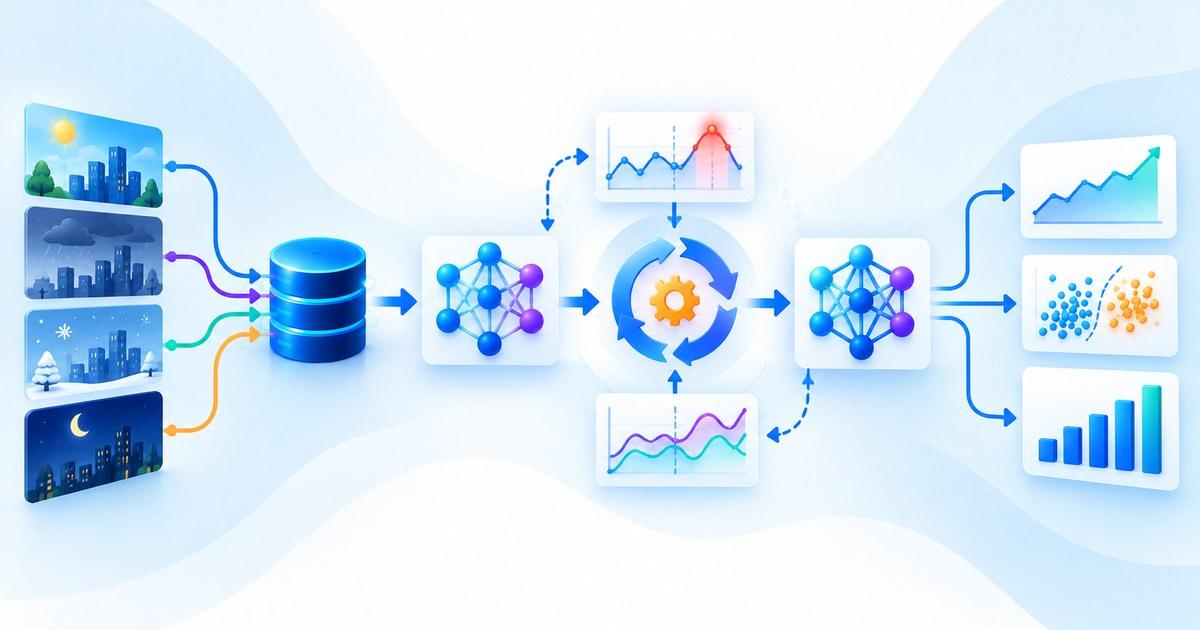
Request → Lower-Cost Model → Evaluation → Accept or Escalate → Stronger Model
This architecture is simple, but its implications are significant.
The smaller model becomes a form of computational filter. Instead of every request consuming the resources of the most powerful model, only the subset that needs additional capability reaches the next stage.
A cascade can therefore reduce the average computational cost per request, even though the application still has access to the strongest model when necessary.
Why Cascades Can Reduce Inference Costs
The economic argument becomes clearer when the workload is considered at scale.
Suppose an AI application receives one million requests. Sending all one million to a large model means paying for one million expensive inference operations.
Now assume a smaller model can successfully handle 80 percent of requests, with only 20 percent requiring escalation.
The cascade still processes all one million requests through the lower-cost stage, but only 200,000 continue to the expensive model.
The precise savings depend on model pricing, infrastructure costs, routing overhead, and the architecture of the deployment. Nevertheless, the basic principle remains powerful: expensive inference becomes selective rather than universal.
The larger the share of requests that can be safely handled by the lower-cost model, the greater the potential cost reduction.
However, cost savings cannot be considered independently of quality. A cascade that reduces expenses by allowing an inadequate model to answer difficult questions may create larger costs elsewhere through poor user experience, incorrect decisions, or operational failures.
The objective is therefore not to maximize the number of requests handled by the smallest model. The objective is to maximize the amount of reliable work performed at the lowest appropriate computational cost.
The Relationship Between Model Complexity and Business Value
Model cascades also reinforce an important production principle: more model capability is not automatically more business value.
A highly capable model can be valuable when its additional reasoning ability changes the outcome of a meaningful task. But using that model for a trivial operation may provide little incremental value.
For example, using a frontier-scale model to classify whether a support request belongs to “billing” or “password reset” may be unnecessary if a smaller classifier can perform the same task accurately. Conversely, using the same lightweight model for a complex technical investigation may create unacceptable quality degradation.
The correct model is therefore determined by the relationship between task requirements and business outcomes.
“Model Complexity vs Business Value: Finding the Right Level of ML” explores this broader idea of selecting model complexity according to actual application needs rather than assuming that more sophisticated modeling is always the better engineering decision.
Key Takeaway
Model cascades allow AI systems to match model capability and computational expenditure with the actual difficulty of each request. By using inexpensive models for routine workloads and escalating only uncertain or complex cases, organizations can reduce average inference cost and latency while preserving access to high-capability models when they are genuinely required. The key is not to use the smallest model possible, but to use the least expensive model that can reliably satisfy the task's requirements.
Section 2: How AI Systems Decide Which Model Should Handle a Request
The economic value of a model cascade depends heavily on one component: the router. Having multiple models available does not automatically reduce inference costs. The system needs to determine which requests can be handled by a lower-cost model and which ones require escalation to a more capable model. That decision sits at the center of the cascade architecture because an overly aggressive router can damage quality, while an overly conservative router can send too many requests to expensive models and eliminate the expected savings.
Routing is therefore not merely a piece of application logic. It is a decision system that determines the computational path of every request. Its effectiveness depends on the signals it uses, the quality of its thresholds, the characteristics of the workload, and the consequences of routing errors.
Confidence-Based Routing
One of the most intuitive routing strategies is confidence-based routing.
The first-stage model processes a request and produces a confidence estimate along with its result. When the confidence exceeds a defined threshold, the system accepts the result. When confidence falls below that threshold, the request is escalated to a stronger model.
This approach is particularly natural for classification problems. A lightweight classifier may predict the probability that an email is spam, that a transaction is fraudulent, or that a document belongs to a particular category. If the probability is sufficiently high, the inexpensive model can make the decision. When the prediction is uncertain, the system can send the case to a more sophisticated model.
Generative AI creates a more difficult situation because model confidence is not always equivalent to factual correctness. A language model can generate a highly fluent response with strong internal probability estimates while still producing an incorrect conclusion.
This means confidence-based routing for LLMs should be treated carefully. Engineers may need to combine model-generated signals with external validation, retrieval support, structured constraints, or dedicated evaluation models.
The important idea is that confidence should be calibrated against actual correctness, not assumed to be meaningful simply because the model produces a numerical signal.
Difficulty-Based Routing
Another approach is to predict the complexity of the request before selecting the generation model.
A lightweight routing model can classify requests according to anticipated difficulty. A routine question might be sent to a compact model, while a request involving multiple steps, complex reasoning, specialized technical content, or long-context analysis may be routed directly to a stronger model.
Difficulty prediction can be based on observable features of the request. The system might consider input length, number of entities, task type, required output structure, domain, historical error patterns, or the presence of specific reasoning indicators.
The advantage is that routing becomes independent of the first model's answer.
Instead of asking whether the initial answer appears trustworthy, the system asks whether the request itself falls within the known operating range of the smaller model.
This can make the cascade more predictable, particularly when historical evaluation data shows clear relationships between request characteristics and model performance.
However, a difficulty predictor introduces another component that needs to be trained, evaluated, monitored, and maintained. The routing system can therefore become a model in its own right.
Task-Based Model Routing
Not all requests differ because some are harder than others. Many differ because they require different kinds of expertise.
An AI application may contain models specialized for coding, summarization, information extraction, customer support, search, vision, or classification. In such an architecture, routing can be based primarily on the task rather than on a generic measure of complexity.
For example, a compact coding model may handle routine programming requests more efficiently than a larger general-purpose model. A specialized document model may extract structured fields from invoices more reliably than a general language model. A lightweight classifier may be sufficient for routing customer tickets.
This creates an important opportunity: a smaller specialized model can sometimes be a better choice than a larger general model.
The objective is not to identify the model with the greatest overall capability. It is to identify the model that provides sufficient capability for the particular task at the lowest acceptable cost.
Task-based routing can therefore be especially effective in enterprise environments where workloads naturally divide into well-defined categories.
Validation-Based Escalation
A cascade can also rely on deterministic or semi-deterministic validation.
The first-stage model produces an output, and a separate mechanism checks whether the result satisfies required conditions. If validation succeeds, the result is accepted. If validation fails, the request is escalated.
This approach is powerful because some model outputs can be evaluated without another expensive model call.
Consider a document extraction system. A lightweight model extracts invoice numbers, dates, totals, and vendor names. A validation layer can check whether required fields are present, whether dates match expected formats, whether numeric values are valid, and whether the extracted structure conforms to the expected schema.
A failed validation does not necessarily mean the smaller model is completely wrong. It means the system lacks sufficient confidence to accept the result safely.
The workflow becomes:
Generate cheaply → Validate → Accept or Escalate
This pattern can be particularly effective when the task has strong structural constraints.
Selective Escalation and Reusing Previous Work
An important optimization is ensuring that escalation does not require the entire request-processing pipeline to be repeated.
Suppose the smaller model has already performed preprocessing, identified the relevant documents, extracted key entities, or constructed useful context.
The stronger model can often consume those intermediate results rather than beginning from zero.
This creates a form of selective escalation.
The system retains useful work from the earlier stage and adds computational power only where required.
This is particularly important in retrieval-augmented generation systems. A smaller model or retrieval component might identify the most relevant documents, while the larger model performs the final reasoning and synthesis. Repeating retrieval during escalation would unnecessarily increase cost and latency.
The architecture can therefore combine model cascading with computational reuse.
This relationship becomes particularly important when paired with the caching strategies discussed in “Caching for AI Applications: The Overlooked Technique for Reducing Inference Costs,” because cached or previously computed intermediate results can remain useful even when a request ultimately requires escalation to a stronger model.
Key Takeaway
Model cascades depend on intelligent routing that determines which model is appropriate for each request. Confidence scores, difficulty prediction, task classification, validation, model disagreement, and multi-stage policies can all guide routing decisions. The central engineering challenge is balancing quality against escalation cost: the router must identify cases that a lower-cost model can handle reliably while directing genuinely difficult or high-risk requests to stronger models.
Section 3: Designing Model Cascades That Preserve Quality and Reliability
Reducing AI inference cost is valuable only when the resulting system continues to produce reliable outputs. This makes quality preservation the central engineering challenge in a model cascade. The purpose of cascading is not to replace a powerful model with a weaker one. It is to determine which requests genuinely require that level of capability and which can be handled reliably by a less expensive alternative.
That distinction requires much more than selecting two models and setting a confidence threshold. Engineers must understand the operating boundaries of each model, measure how routing decisions affect quality, identify situations in which escalation is mandatory, and continuously monitor the system as data and user behavior change. A cascade should therefore be designed as a quality-aware decision system, not merely as a cost-saving mechanism.
The Smaller Model Must Be Evaluated Empirically
The first step in building a reliable cascade is understanding what the lower-cost model can actually do.
A smaller model may perform extremely well on common requests while struggling with a narrow set of difficult cases. Aggregate benchmark performance can hide this distinction. A model might achieve strong overall accuracy while failing disproportionately on long inputs, rare categories, ambiguous questions, specialized terminology, or requests requiring multiple reasoning steps.
For example, a lightweight enterprise assistant may answer routine policy questions extremely well but struggle when several policies need to be interpreted together. A compact coding model may handle simple code completion but produce unreliable results for large architectural changes involving multiple files. A lightweight classification model may perform strongly on common classes but have difficulty identifying rare or previously unseen cases.
These differences define the model's reliable operating boundary.
The goal of evaluation is therefore not simply to determine the average quality of the smaller model. Engineers need to identify the specific conditions under which its predictions or responses become unreliable. Those conditions can then inform routing rules.
This approach is more useful than assuming that a model is “good enough” because its benchmark score is high.
Evaluating the Cascade as One System
It is also important to distinguish individual model quality from cascade quality.
Suppose a small model is less accurate than a large model. That does not automatically mean a cascade using the small model will produce worse overall results. If the routing system successfully identifies the cases where the small model is likely to fail, those requests can be escalated.
The final system can therefore achieve quality much closer to the larger model while using substantially less expensive inference.
Conversely, the individual small model might have excellent average performance while the cascade performs poorly because the router cannot identify its failure cases.
This creates a critical principle:
The object being optimized is the complete routing-and-inference system, not the individual models independently.
Evaluation should therefore compare different cascade configurations using end-to-end metrics. Engineers can measure final task quality, escalation frequency, average inference cost, latency, and failure rates rather than looking at model accuracy alone.
False Acceptance and False Escalation
Routing creates two fundamentally different errors.
A false acceptance occurs when a request is handled by a lower-capability model even though the request should have been escalated.
A false escalation occurs when the system sends a request to a more expensive model even though the cheaper model could have handled it successfully.
These errors have different consequences.
False escalation primarily increases cost and can increase latency. False acceptance can reduce quality and, in some applications, create much more serious consequences.
Consider an enterprise AI application that assists engineers with production incidents. Escalating an easy request to a large model may increase cost slightly. Allowing a complex incident analysis to be handled by an inadequate model could potentially result in an unsafe or incorrect recommendation.
For this reason, routing systems often need to be designed with an asymmetric objective. The goal is not necessarily to minimize the number of escalations. Instead, the objective is to minimize unnecessary expensive inference while keeping false acceptance below the application's acceptable risk threshold.
This distinction is central to reliable cascade design.
Handling Distribution Shift
Distribution shift is particularly important for cascades because both the models and the routing policy depend on assumptions about the incoming workload.
Suppose a customer-support model was evaluated primarily on questions about billing and account management. Several months later, the organization introduces a new product with substantially different support requirements. The incoming request distribution changes, but the routing policy may still assume the old workload.
The smaller model might receive a larger percentage of requests outside its reliable operating range.
This problem is closely related to “Machine Learning Under Distribution Shift: What Happens When the World Changes,” which explores how model behavior can change when real-world data differs from the distribution used during development.
A production cascade should therefore support periodic reevaluation and threshold recalibration. Monitoring request distributions and tracking errors by routing category can help identify when the existing cascade no longer represents the workload accurately.
Key Takeaway
A reliable model cascade is a quality-constrained cost optimization system. Engineers must empirically establish the smaller model's capabilities, evaluate the complete cascade, distinguish false acceptance from false escalation, test difficult and long-tail cases, monitor routing behavior in production, account for distribution shift, protect high-risk workloads, and verify that routing overhead does not erase the expected savings. The strongest cascades do not simply use cheaper models more often, they use each model only where its capability is sufficient for the required outcome.
Section 4: Why Model Cascades Are Becoming Important for Scalable AI
As AI applications move from prototypes to large-scale production systems, controlling inference cost is becoming a fundamental engineering requirement. Organizations are increasingly deploying AI assistants, coding copilots, customer-service agents, recommendation systems, document-processing platforms, and autonomous workflows across millions of interactions. These systems do not receive a uniform stream of requests. Some requests are simple and predictable, while others require extensive reasoning, specialized knowledge, or larger context. Yet a conventional architecture often processes every request using the same model.
Model cascades provide a mechanism for changing that architecture.
Instead of treating the most capable model as the default computational path, a cascade allows the system to distribute requests across several models according to their difficulty, requirements, and expected value. Lower-cost models can handle routine workloads, specialized models can handle specific categories, and high-capability models can be reserved for the difficult cases that genuinely require them.
This creates a broader principle for AI infrastructure: the average cost of intelligence does not need to equal the maximum cost of intelligence available to the application.
Lowering Average Inference Cost
The most compelling reason to deploy a model cascade is the potential reduction in average inference cost.
Consider an AI application processing one million requests. If every request is routed directly to a large model, the organization incurs the cost of one million large-model inferences. If a smaller model can reliably handle a significant percentage of those requests, the expensive model only needs to process the remaining cases.
Suppose 75 percent of requests are successfully handled by the smaller model and only 25 percent require escalation. The system still processes every request through an initial stage, but expensive inference is reserved for the minority of requests that require additional capability.
The exact economic benefit depends on the relative cost of the models and the infrastructure required to host them. However, the principle becomes increasingly attractive as the difference between model costs grows.
This is particularly relevant for large language models, where the difference in inference resources between compact and highly capable models can be substantial.
The organization is effectively paying for advanced intelligence only when advanced intelligence creates sufficient value.
Improving Latency for Routine Requests
Model cascades can also improve responsiveness.
Smaller models generally require fewer parameters and less computation than larger models. When routine requests are handled by these models, users may receive answers faster than they would through a large-model-only architecture.
This is particularly useful for interactive applications.
A user asking a straightforward knowledge-base question should not necessarily experience the latency associated with a complex reasoning workload. Routing that request to a lightweight model can shorten the computational path.
The difficult cases may still require more time because they are intentionally sent through a stronger model. However, the majority of routine interactions can remain fast.
There is another indirect latency benefit.
When fewer requests reach the expensive inference layer, queue pressure can decline. High-capacity models often become constrained not only by raw compute but also by concurrency, memory, batching behavior, and scheduling. Reducing unnecessary traffic can therefore improve the experience of requests that genuinely require the stronger model.
Cascades and Reliability
Although model cascades are primarily discussed as an efficiency technique, they can also contribute to reliability when designed correctly.
Different models can provide different failure characteristics.
A deterministic rules engine may be ideal for straightforward policy checks. A specialized classifier may handle a high-volume category with predictable behavior. A stronger model can address ambiguous cases.
This allows engineers to use the most appropriate mechanism for each part of the workload.
The cascade can also implement explicit fallback behavior. When an initial model fails validation, produces an invalid structure, or falls outside its confidence boundary, the system can escalate rather than returning an uncertain result.
This creates a form of graceful computational escalation.
The system does not need to assume that the first model must solve every request. Failure at one stage becomes a signal to allocate additional resources.
That is closely related to the broader production principle discussed in “Graceful Degradation in AI: Designing Systems That Still Work When Models Fail,” where robust AI systems are designed around controlled failure paths rather than assuming that every component will always behave perfectly.
Key Takeaway
Model cascades allow organizations to use computational power selectively rather than paying the maximum inference cost for every request. By combining lightweight, specialized, and high-capability models behind an intelligent routing layer, organizations can reduce average inference cost, improve latency for routine workloads, use hardware more efficiently, and preserve advanced reasoning capability for the requests that genuinely require it. As AI model portfolios become increasingly diverse, dynamic model selection is likely to become a core component of scalable AI infrastructure.
Conclusion
Model cascades offer a practical way to address one of the most important challenges in modern AI engineering: delivering increasingly capable intelligence without paying the highest computational cost for every request.
The fundamental idea is straightforward. Different requests require different levels of model capability, yet conventional AI applications often route every request through the same model. This can result in substantial over-computation, particularly when a large proportion of the workload consists of routine, predictable, or relatively simple tasks.
A model cascade changes that architecture by introducing multiple computational tiers. A lightweight model can process common requests, specialized models can handle domain-specific workloads, and a more powerful model can be reserved for difficult, ambiguous, or high-risk cases. The result is a system that can dynamically allocate computational resources according to the requirements of each request.
The greatest value of this approach comes from selective escalation.
Instead of treating the strongest model as the default, the system attempts to determine whether additional computational capability is actually necessary. When the less expensive model is sufficiently reliable, its response can be returned directly. When uncertainty or complexity exceeds a defined boundary, the request can be escalated.
This can substantially reduce average inference cost, particularly in workloads where the majority of requests are relatively simple and only a smaller fraction require advanced reasoning.
However, the effectiveness of a cascade depends heavily on the quality of its routing mechanism. Confidence scores, predicted task difficulty, task classification, validation checks, model disagreement, and explicit business rules can all help determine which model should receive a request. The router therefore becomes a critical production component rather than a simple implementation detail.
The most important routing trade-off is between false acceptance and false escalation. False escalation increases cost because the system uses a stronger model unnecessarily. False acceptance can reduce quality because a weaker model is trusted on a request outside its reliable operating range. In many production environments, especially higher-risk workloads, preventing false acceptance is more important than maximizing the percentage of traffic handled by the cheapest model.
This makes evaluation essential.
Frequently Asked Questions
1. What is a model cascade in AI?
A model cascade is an architecture in which multiple AI models with different capabilities, costs, or latency characteristics are arranged so that requests can be routed between them. Less expensive models handle suitable requests, while difficult or uncertain cases are escalated to stronger models.
2. How does a model cascade reduce AI inference costs?
A cascade reduces cost by avoiding unnecessary use of expensive models. Routine requests can be handled by smaller or specialized models, while only requests requiring additional capability are sent to more expensive models.
3. Is a model cascade the same as model routing?
They are closely related. Model routing refers broadly to selecting an appropriate model for a request, while a cascade usually involves sequential stages where an initial model can pass or escalate a request to another model.
4. What is a typical model cascade architecture?
A common architecture is a lightweight model followed by a more capable model. The first model processes the request, and a routing mechanism determines whether its result is acceptable or whether the request should be escalated. More complex systems can contain three or more stages.
5. Can model cascades use specialized models?
Yes. Cascades can combine general-purpose models with specialized models for coding, document extraction, classification, search, vision, summarization, or other domain-specific tasks. A specialized model can sometimes provide better results at lower cost than a larger general-purpose model.
6. How does a cascade decide when to escalate a request?
Escalation can be based on confidence scores, predicted task difficulty, task type, validation failures, model disagreement, business rules, or predefined quality and risk thresholds.
7. What is confidence-based routing?
Confidence-based routing uses a model's estimated confidence to decide whether its result is sufficiently reliable. High-confidence cases may remain with the lower-cost model, while low-confidence cases are escalated to a stronger model.
8. Can LLM confidence scores be used directly for routing?
Not necessarily. A language model can generate a fluent and apparently confident response that is still incorrect. Confidence signals should therefore be validated and calibrated against representative data and may need to be combined with other checks.
9. What is false acceptance in a model cascade?
False acceptance occurs when the system accepts a result from a lower-capability model even though the request should have been escalated. This can cause quality degradation and is particularly important for high-risk workloads.
10. What is false escalation?
False escalation occurs when a request is sent to a more expensive model even though the lower-cost model could have handled it adequately. False escalation primarily increases inference cost and potentially adds latency.
11. Do model cascades always improve latency?
No. Requests handled by smaller models may become faster, but escalated requests can incur the latency of multiple model stages. Routing itself also introduces some overhead. The complete system must therefore be benchmarked using realistic workloads.
12. How should engineers evaluate a model cascade?
Engineers should evaluate the complete system using final quality, escalation rate, false acceptance, false escalation, latency, throughput, infrastructure utilization, and total inference cost. The quality of individual models alone is not enough to determine whether the cascade is effective.
13. Can model cascades handle high-risk AI requests?
Yes, but high-risk requests should generally have stricter routing rules. An application can establish routing floors that bypass lightweight models and send sensitive or business-critical requests directly to stronger models or deterministic workflows.
14. How do model cascades relate to AI optimization techniques such as quantization and caching?
They optimize different parts of the system. A cascade determines which model should process a request. Quantization reduces the cost of the selected inference, while caching can eliminate repeated computation altogether. Combining these techniques can produce substantially greater efficiency.
15. Why are model cascades becoming important for the future of AI?
AI systems increasingly contain multiple models with different costs and capabilities, while production workloads contain requests with highly variable difficulty. Model cascades allow organizations to dynamically allocate computational resources, reduce average inference cost, improve latency for routine workloads, and reserve advanced models for requests that genuinely require them.