Section 1: Why Traditional Maintenance Strategies Miss Early Failure Signals
Industrial maintenance has traditionally relied on a combination of reactive and preventive strategies. Reactive maintenance waits until equipment fails before intervention, while preventive maintenance follows predefined schedules based on operating hours, production cycles, or calendar intervals. Both approaches can be effective in specific situations, but neither fully addresses a central challenge of modern industrial operations: equipment often provides subtle evidence of degradation long before a visible failure occurs.
Predictive Maintenance 2.0 focuses on detecting and interpreting those early signals. Modern machine learning systems can analyze large volumes of sensor data, recognize changes in equipment behavior, and estimate whether a machine is moving toward an abnormal operating state. The goal is not simply to predict failure, but to identify degradation early enough for maintenance teams to act.
Fixed Maintenance Schedules Cannot See Actual Equipment Condition
Preventive maintenance assumes that equipment condition is strongly related to elapsed time or usage.
A component may be replaced every 5,000 operating hours because historical experience suggests that failure becomes more likely around that point. The approach is simple and predictable, but it treats machines with similar usage histories as if they have experienced similar operating conditions.
In reality, two machines can age very differently.
One may operate under moderate loads in a controlled environment. Another may experience temperature fluctuations, repeated overloads, vibration, or irregular operating cycles. Although both have accumulated the same number of operating hours, their physical conditions may be very different.
Scheduled maintenance can therefore create two opposing problems.
Equipment may be serviced earlier than necessary, increasing maintenance cost and reducing asset availability. Alternatively, a component may deteriorate faster than expected and fail before its scheduled maintenance interval.
The limitation is not that preventive maintenance is inherently ineffective. It is that the schedule does not directly observe the evolving condition of the asset.
Machine learning creates an opportunity to move from calendar-based maintenance toward condition-based intelligence.
Instead of asking how long a machine has operated, the system can ask how the machine is behaving now compared with its expected behavior.
Equipment Often Produces Weak Signals Before Failure
Major equipment failures are frequently preceded by changes in measurable behavior.
A bearing may gradually exhibit different vibration characteristics. A motor may consume more energy than expected for a given workload. A pump may operate at unusual pressure levels. A turbine may show subtle temperature changes. A battery system may display changes in voltage or thermal behavior.
The difficulty is that these signals are rarely obvious in isolation.
A single vibration measurement may fall within a normal range. A single temperature reading may not indicate a problem. Energy consumption can vary naturally with workload.
The important information may exist in the relationship between multiple observations over time.
A machine learning system can potentially analyze these relationships rather than relying on individual thresholds.
This is particularly important because industrial equipment typically operates under changing conditions. The model needs to distinguish a legitimate change caused by increased load from a change that indicates degradation.
The challenge therefore becomes behavioral modeling.
What does normal operation look like for this specific machine under this specific operating condition?
And when does its behavior begin to diverge from that pattern?
Thresholds Struggle With Complex Operating Conditions
Traditional monitoring systems often rely on predefined thresholds.
If temperature exceeds a limit, trigger an alert.
If vibration exceeds a threshold, inspect the equipment.
If pressure falls below a defined value, initiate a response.
Thresholds remain useful because some physical conditions genuinely have known safety limits. However, they are often less effective for detecting gradual degradation that occurs within apparently normal ranges.
Suppose a motor normally operates between 60°C and 70°C under a particular workload. An increase from 64°C to 68°C may still be below a predefined alarm threshold, yet if similar motors operating under the same conditions remain stable at 62°C, the change may contain useful information.
A model can potentially identify that contextual deviation.
This is where predictive maintenance moves beyond simple threshold monitoring.
Rather than asking whether a measurement has crossed a fixed boundary, the system can estimate whether the pattern of behavior is becoming unusual.
This creates a direct connection with “Why Machine Learning Models Behave Differently in the Real World” Industrial equipment does not operate under perfectly controlled conditions, so reliable models must learn to distinguish meaningful changes from normal environmental and operational variation.
Key Takeaway
Traditional maintenance strategies can miss early equipment degradation because fixed schedules and isolated thresholds do not fully capture how asset condition changes under different operating environments. Modern predictive maintenance uses sensor histories and contextual behavior to identify deviations that may precede failure, with the ultimate objective of creating actionable lead time. The transition is therefore from asking when equipment is scheduled for maintenance to understanding how its actual condition is evolving.
Section 2: How Modern Machine Learning Detects Equipment Degradation Before Failure
Modern predictive maintenance systems are moving beyond simple threshold alerts by learning how equipment behaves across time, operating conditions, and multiple sensor channels. Instead of waiting for one measurement to cross a predefined limit, machine learning can analyze combinations of signals and identify patterns associated with changing equipment health.
The central idea is to establish a reliable representation of normal equipment behavior and then determine when observations begin to deviate from that expected state.
Learning Normal Equipment Behavior From Sensor Data
Industrial equipment can generate enormous quantities of telemetry, including temperature, pressure, vibration, current, voltage, rotational speed, acoustic measurements, and energy consumption. The challenge is that normal behavior is rarely represented by one fixed value.
A motor operating under heavy load should behave differently from the same motor operating at low load. A turbine's temperature profile may change with ambient conditions. A pump may exhibit different vibration characteristics at different operating speeds.
Machine learning can learn these relationships from historical observations.
Instead of establishing a single threshold for every sensor, models can learn expected behavior conditional on operating context. A prediction system might estimate the expected temperature given load, speed, and ambient conditions. Another model could estimate the expected vibration pattern based on operating state.
The difference between the observed measurement and the expected behavior can then become a useful health signal.
This creates an important distinction between absolute measurements and contextual deviations.
A value can be within a normal range while still being abnormal for the particular operating conditions.
Time-Series Models Can Track How Condition Evolves
Equipment degradation is rarely a single-point event. It often develops gradually.
A sensor may show a small change today, another change next week, and a more significant deviation later. Individually, none of these observations may be alarming. Together, they may reveal a trend indicating deteriorating equipment condition.
Time-series machine learning can model these trajectories.
Rather than examining measurements independently, the system can analyze sequences and determine whether equipment behavior is becoming progressively different from its historical operating pattern.
This enables concepts such as remaining useful life estimation, where a model attempts to estimate how long an asset can continue operating before reaching a defined failure or degradation condition.
Remaining useful life prediction is particularly valuable because maintenance decisions are strongly dependent on timing.
If an asset is likely to require intervention within several months, maintenance can potentially be coordinated with a scheduled production shutdown. If degradation is expected within days, immediate intervention may be required.
The prediction therefore becomes useful because it creates a window in which operations teams can act.
Combining Anomaly Detection With Failure Prediction
Modern predictive maintenance does not have to rely on a single modeling strategy.
Anomaly detection can identify unusual behavior even when there are very few historical failure examples. Supervised models can learn from known failure events when sufficient labeled data exists. Time-series models can estimate how equipment condition evolves. Domain-specific rules can provide safety constraints or known failure indicators.
Combining these approaches can provide a more robust architecture than relying exclusively on one model.
For example, an anomaly-detection model may identify an unusual vibration pattern. A second model can evaluate whether the pattern resembles a known degradation mode. A temporal model can estimate whether the deviation is becoming more severe. A rules layer can determine whether an immediate inspection is required.
This architecture allows each component to perform a specific role.
The machine learning system does not need to determine everything from one prediction.
Instead, it can build a layered understanding of equipment health.
The broader lesson is consistent with “Model Cascades: How AI Systems Combine Multiple Models to Reduce Cost” A maintenance system can use lightweight monitoring for routine conditions and apply more computationally expensive analysis when the evidence suggests that an asset requires closer attention.
The result is a system that can focus analytical resources where they matter most.
Key Takeaway
Modern predictive maintenance uses machine learning to understand equipment behavior across multiple sensors, operating conditions, and time horizons. Contextual anomaly detection can identify deviations that fixed thresholds miss, while time-series models can track gradual degradation and estimate remaining useful life. The strongest systems combine anomaly detection, supervised failure prediction, temporal modeling, and operational rules so that subtle signals can be transformed into earlier and more actionable maintenance warnings.
Section 3: Designing Predictive Maintenance Systems That Work in Real Industrial Environments
A machine learning model can identify patterns associated with equipment degradation, but deploying predictive maintenance successfully requires much more than training a model on historical sensor data. Industrial environments contain changing workloads, noisy sensors, incomplete failure records, maintenance interventions, and differences between individual assets. A model that performs well in a controlled dataset may therefore produce unreliable warnings when exposed to real operating conditions.
Predictive Maintenance 2.0 requires an end-to-end system that connects data collection, modeling, asset context, maintenance workflows, and continuous monitoring.
Build Asset-Specific Context Into the Model
Industrial equipment rarely operates under identical conditions. Two machines of the same model can experience different workloads, environments, operating cycles, and maintenance histories.
A predictive maintenance system should therefore understand the context surrounding each observation.
Sensor measurements can be combined with operating load, production state, ambient conditions, equipment age, maintenance history, component replacements, and other relevant information. This allows the model to distinguish normal variation from genuine degradation.
For example, increased vibration during high-speed operation may be expected, while the same vibration level under low-load conditions could indicate an emerging problem.
Asset history is equally important.
A component that was recently replaced may behave differently from one approaching the end of its expected operating life. A machine that has already undergone several interventions may have different failure characteristics from a newly installed asset.
Context transforms raw sensor measurements into information about equipment condition.
This is one reason the broader principles in “The Hidden Engineering Work Behind Every Successful Machine Learning Product” are highly relevant to predictive maintenance. The model is only one component; accurate asset metadata, reliable telemetry, maintenance records, and operational context are equally important to the system's success.
Design for Noisy Data and Changing Operating Conditions
Industrial sensor data is rarely perfect.
Sensors can drift, fail intermittently, produce outliers, or change behavior after calibration. Communication systems can introduce missing measurements, while production changes can alter normal operating patterns.
A predictive maintenance system must distinguish sensor problems from equipment problems.
If a temperature sensor suddenly reports an impossible value, the correct response is not necessarily to predict imminent machine failure. The system should be capable of identifying that the observation itself may be unreliable.
This can require data-quality checks, sensor-health monitoring, anomaly detection, and confidence estimation before predictions reach maintenance workflows.
Operating conditions can also change over time.
A factory may introduce a new production process. A machine may operate at a different load after an expansion. Seasonal environmental conditions may alter normal sensor behavior.
The model therefore needs to remain aligned with the current operating environment.
Monitoring distribution changes and periodically evaluating model performance can help identify when retraining, recalibration, or model redesign may be required.
Connect Predictions to Maintenance Decisions
A failure prediction is valuable only when it changes what maintenance teams can do.
The system should translate model outputs into actionable maintenance information.
A high-risk prediction may trigger an inspection. A gradual degradation pattern may lead to a planned maintenance window. A low-confidence anomaly may simply increase monitoring frequency.
This requires decision logic around the model.
The system may need to consider technician availability, spare-parts inventory, production schedules, safety requirements, and the estimated consequences of equipment downtime.
A prediction that is technically accurate but impossible to act on provides limited operational value.
Lead time also needs to be considered.
Maintenance teams need enough time to respond. An alert generated immediately before a failure may have little practical benefit, while an earlier warning can allow parts and personnel to be scheduled without disrupting production unnecessarily.
This creates a decision-oriented evaluation framework in which engineers consider not only prediction accuracy but also warning lead time, false-alert frequency, maintenance outcomes, and avoided downtime.
Key Takeaway
A production predictive-maintenance system must combine machine learning with asset context, sensor-quality controls, operating conditions, maintenance history, and actionable decision logic. The system should generate warnings with enough lead time to support real interventions and continuously learn from inspections, failures, maintenance actions, and false alarms. Predictive Maintenance 2.0 is therefore not just a failure-prediction model; it is a continuously monitored operational system that connects equipment data to maintenance decisions and outcomes.
Section 4: Why Predictive Maintenance 2.0 Could Transform Industrial Operations
Predictive maintenance has evolved from basic condition monitoring into a broader machine learning discipline capable of analyzing continuous streams of equipment data, identifying subtle changes in behavior, and supporting maintenance decisions before failures become disruptive. As industrial systems become more connected, the opportunity extends beyond predicting individual failures toward building continuously learning representations of asset health.
Predictive Maintenance 2.0 could therefore change not only how organizations maintain machines, but how they plan production, manage spare parts, allocate maintenance resources, and operate industrial infrastructure.
From Scheduled Maintenance to Continuous Asset Intelligence
Traditional preventive maintenance operates around predefined intervals. Predictive maintenance moves toward condition-based intervention, but modern machine learning can take the idea further by continuously updating its understanding of equipment condition.
Instead of asking whether a machine has reached a maintenance interval, the system can evaluate its current behavior relative to historical operating patterns and similar assets.
This creates a continuously updated view of asset health.
A turbine may show gradually changing vibration patterns. A motor may require increasing energy to produce the same output. A pump may begin behaving differently under operating conditions that previously produced stable performance.
Individually, these changes may appear insignificant.
Over time, however, their combination can provide evidence of degradation.
The machine learning system can continuously update health estimates and identify when an asset is moving away from its expected operating state.
This shift can make maintenance more dynamic.
Assets that remain healthy may require less unnecessary intervention, while deteriorating equipment can receive attention earlier.
The result is a transition from maintenance schedules toward continuous asset intelligence.
Predictive Maintenance Can Become Part of a Larger Digital Industrial System
The future of predictive maintenance is unlikely to depend on isolated sensor models. Industrial organizations can increasingly combine equipment telemetry with simulation, operational systems, digital twins, production schedules, and maintenance records.
A digital twin can provide a virtual representation of a physical asset or process. Machine learning can use historical and real-time observations to improve that representation and estimate how the asset may behave under different operating conditions.
This creates opportunities to test maintenance strategies before applying them to the physical system.
For example, engineers could examine how continued operation at a particular load might affect predicted equipment health, compare alternative maintenance windows, or estimate how a component replacement could affect future operating behavior.
This broader integration is closely related to “Machine Learning for Digital Twins: How AI Is Learning to Model the Physical World” Predictive maintenance becomes more powerful when equipment-health predictions are connected to representations of the physical system and the operational decisions surrounding it.
The result is a move from simply predicting failure toward understanding how maintenance actions interact with the complete industrial environment.
AI Can Optimize Maintenance Resources, Not Just Machines
A large industrial operation may contain thousands of assets, but maintenance resources are limited.
There may be a finite number of technicians, restricted spare-parts inventory, limited maintenance windows, and competing production priorities.
This creates another opportunity for machine learning.
Suppose a system identifies several machines showing signs of degradation. The organization may not be able to service all of them immediately.
The maintenance problem becomes an optimization problem.
Which assets should be inspected first?
Which failures are most likely to occur?
Which assets have the greatest operational consequences if they fail?
Which maintenance tasks can be combined?
Which parts and technicians are available?
A modern predictive-maintenance platform can combine model outputs with these operational constraints to prioritize interventions.
This creates a progression from failure prediction to maintenance decision intelligence.
The model does not simply identify risk.
It helps the organization decide how to allocate limited resources against that risk.
This can make predictive maintenance valuable even when individual failure predictions are imperfect, because better prioritization can still improve operational outcomes.
Predictive Maintenance Will Become More Adaptive
Industrial environments change continuously.
Equipment is replaced or upgraded. Production schedules change. New components are introduced. Operating loads vary. Sensor configurations evolve. Seasonal conditions affect equipment behavior.
A model trained under historical conditions may therefore become less reliable over time.
Predictive Maintenance 2.0 needs to account for this.
Models can be monitored for changes in sensor distributions, failure patterns, alert rates, and predictive performance. New maintenance outcomes can become training data. Asset-specific models can potentially adapt as sufficient operating history accumulates.
This creates an ongoing learning cycle rather than a static predictive system.
The challenge is to adapt without allowing temporary noise or unusual events to destabilize the model. Too little adaptation can make predictions stale, while too much adaptation can cause the system to learn short-lived anomalies as if they represented permanent changes.
The Future of Maintenance Is Likely to Be Closed-Loop
The long-term opportunity is to create a closed-loop industrial intelligence system.
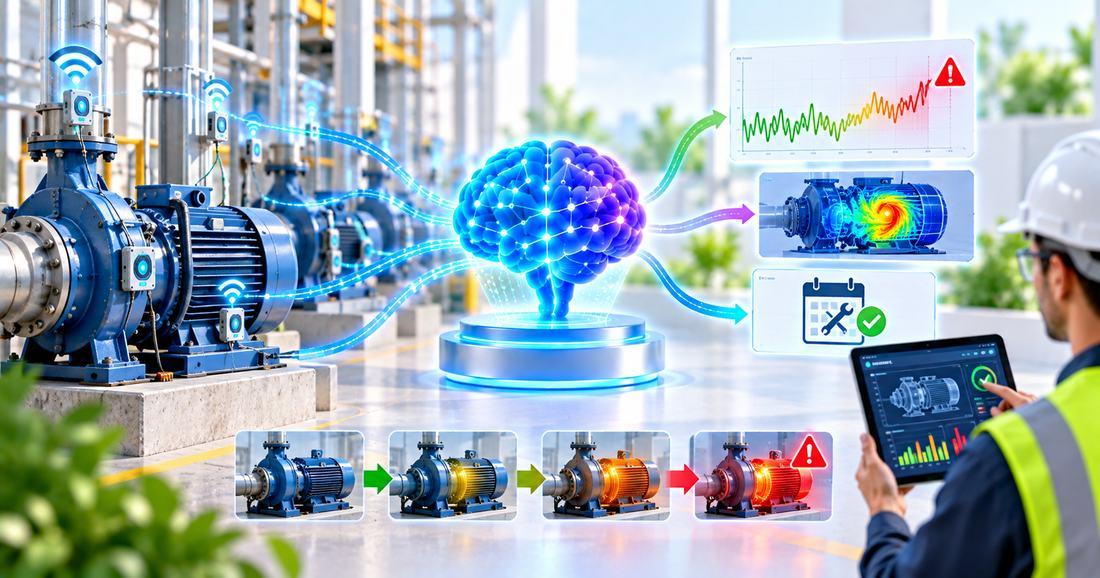
Sensors continuously observe equipment.
Machine learning models estimate asset health and identify emerging anomalies.
Decision systems prioritize maintenance actions.
Technicians perform inspections or repairs.
The outcomes of those interventions are recorded.
That information is then used to improve future predictions.
Such a system can gradually become more knowledgeable about how particular equipment behaves under specific operating conditions.
The value extends beyond avoiding failures.
Better maintenance intelligence can potentially improve equipment availability, coordinate interventions with production schedules, reduce unnecessary component replacement, improve spare-parts planning, and provide deeper visibility into the health of industrial assets.
The system becomes an operational learning layer connecting physical infrastructure with organizational decision-making.
Key Takeaway
Predictive Maintenance 2.0 could transform industrial operations by turning continuous equipment data into a reusable intelligence layer for asset health, maintenance prioritization, resource allocation, and operational planning. The future will likely combine machine learning with digital twins, optimization, adaptive learning, and maintenance workflows rather than relying on isolated failure-prediction models. The largest opportunity is a closed-loop system in which equipment observations, maintenance decisions, and real-world outcomes continuously improve one another.
Conclusion
Predictive maintenance is evolving from scheduled inspections and threshold-based monitoring into a broader machine learning discipline focused on understanding how equipment condition changes over time.
Traditional maintenance strategies remain important, but modern industrial systems generate far more information than fixed maintenance schedules can fully exploit. Sensors continuously capture vibration, temperature, pressure, current, energy consumption, acoustic behavior, and other operating signals. The challenge is turning those measurements into reliable information about asset health.
Predictive Maintenance 2.0 addresses this challenge by combining machine learning with time-series analysis, anomaly detection, failure prediction, remaining useful life estimation, asset context, and operational decision-making.
The most important shift is from asking “When is this machine scheduled for maintenance?” toward asking “How is this machine actually behaving, and is its condition changing in a way that requires attention?”
This distinction enables earlier intervention.
A machine may remain within conventional safety thresholds while its behavior gradually diverges from its historical operating pattern. Multivariate machine learning can identify relationships among sensors that would be difficult to capture through isolated thresholds. Time-series models can identify gradual degradation that becomes meaningful only when observed across multiple time periods.
However, early detection is useful only when it produces enough lead time for action.
A prediction generated immediately before failure may have high technical accuracy but limited operational value. A less precise prediction that provides several days or weeks of useful warning can enable maintenance teams to schedule technicians, obtain replacement parts, coordinate production schedules, and reduce unplanned downtime.
Frequently Asked Questions
1. What is Predictive Maintenance 2.0?
Predictive Maintenance 2.0 refers to a modern approach to equipment maintenance that uses machine learning, sensor data, time-series analysis, anomaly detection, failure prediction, and operational decision-making to identify degradation earlier and support more effective maintenance planning.
2. How is predictive maintenance different from preventive maintenance?
Preventive maintenance typically follows predefined schedules based on time, operating hours, or production cycles. Predictive maintenance uses actual equipment-condition data to estimate whether an asset is showing signs of degradation and determine when intervention may be necessary.
3. What data is used for predictive maintenance?
Common inputs include vibration, temperature, pressure, current, voltage, energy consumption, acoustic measurements, rotational speed, operating load, environmental conditions, equipment configuration, maintenance history, and production information.
4. Can machine learning detect equipment failure before it happens?
Machine learning can identify patterns associated with degradation or future failure when those patterns are represented sufficiently in the available data. The quality of early-warning performance depends on sensor coverage, historical examples, operating context, model design, and the time available between degradation and failure.
5. What is anomaly detection in predictive maintenance?
Anomaly detection identifies equipment behavior that differs from an established representation of normal operation. It can be especially useful when confirmed failure examples are scarce because abnormal behavior can sometimes be detected without requiring large numbers of labeled failures.
6. Why are multiple sensors important?
Equipment degradation may appear through relationships between multiple measurements rather than a single sensor. Combining vibration, temperature, energy, pressure, and other signals can provide a more complete representation of equipment condition.
7. What is remaining useful life estimation?
Remaining useful life estimation attempts to predict how much operating time an asset or component may have before reaching a defined failure or degradation condition. It can help maintenance teams plan interventions around operational requirements.
8. Why is lead time important in predictive maintenance?
A maintenance prediction is valuable only when there is enough time to act. Useful lead time allows teams to schedule technicians, procure spare parts, coordinate production, and reduce the disruption associated with unexpected equipment failure.
9. Can predictive maintenance work without many historical failures?
Yes. Approaches such as anomaly detection, unsupervised learning, and semi-supervised methods can be useful when confirmed failure events are rare. However, the appropriate approach depends on the equipment, available sensor data, and the specific maintenance objective.
10. How does machine learning distinguish equipment degradation from normal operating variation?
Models can incorporate operating context such as load, speed, ambient conditions, production state, and historical behavior. This allows the system to evaluate whether a measurement is unusual for the specific conditions rather than relying only on fixed thresholds.
11. Can sensor problems cause false maintenance alerts?
Yes. Sensor failures, calibration changes, missing measurements, communication problems, and timestamp errors can create observations that resemble equipment abnormalities. Production systems therefore need sensor-quality monitoring alongside equipment-health modeling.
12. Can predictive maintenance reduce maintenance costs?
It can potentially reduce unnecessary maintenance and unplanned downtime by helping organizations intervene based on observed equipment condition rather than fixed schedules alone. The actual economic impact depends on model performance, maintenance practices, asset criticality, and operating costs.
13. Can predictive maintenance be integrated with digital twins?
Yes. Machine learning can provide asset-health estimates and forecasts that feed into digital-twin environments. The digital representation can then be used to evaluate possible operating or maintenance scenarios alongside physical and operational constraints.
14. What are the biggest challenges in Predictive Maintenance 2.0?
Major challenges include noisy sensor data, limited failure examples, changing operating conditions, asset-to-asset differences, sensor drift, temporal leakage, false alarms, insufficient lead time, and connecting predictions to practical maintenance decisions.
15. What is the future of predictive maintenance?
The field is moving toward continuously learning asset-intelligence systems that combine real-time telemetry, machine learning, anomaly detection, remaining useful life estimation, digital twins, optimization, and maintenance workflows. The long-term objective is a closed-loop system in which equipment observations, maintenance decisions, and actual outcomes continuously improve one another.